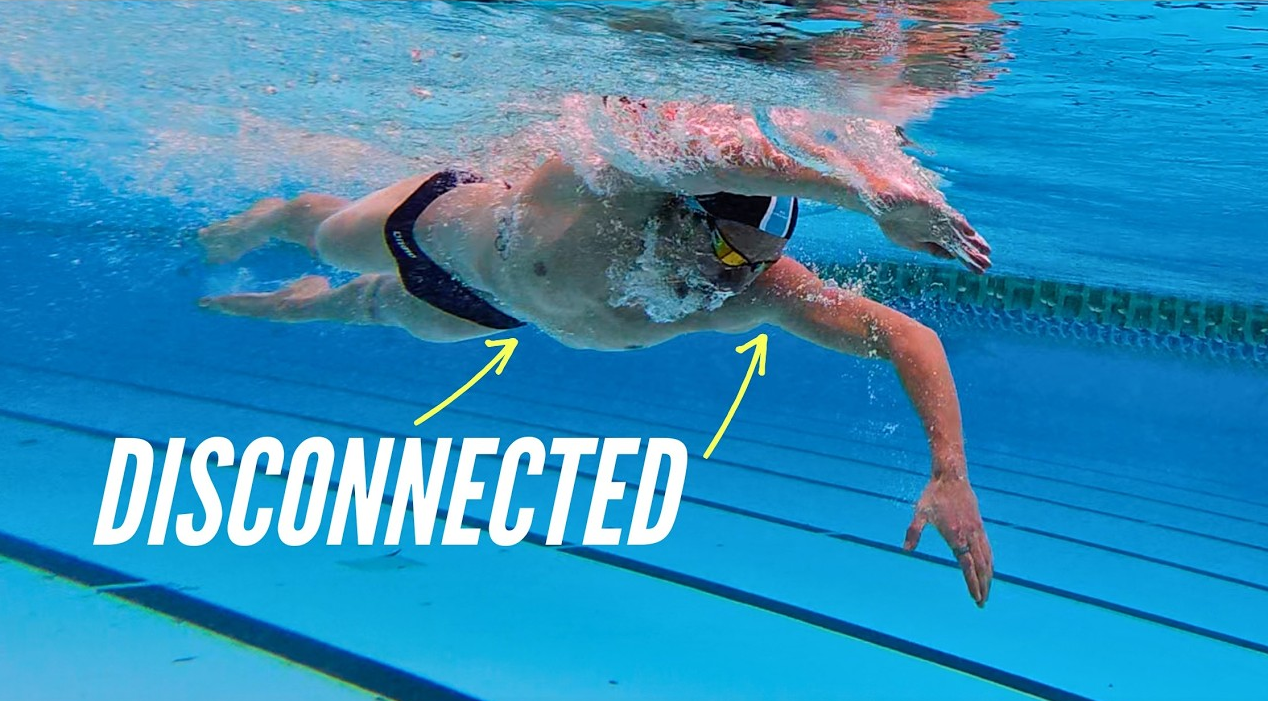









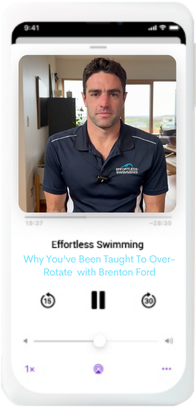
One of the most common things I see in newer swimmers… is how flat they are in the water.
Their hips are flat, their shoulders are flat — and what ends up happening is they just spin their wheels.
They’re putting in a lot of effort with the arms, kicking hard with the legs… but nothing is really connecting.
It feels like hard work — but it doesn’t translate into speed.
So in today’s episode, we’re going to break down why swimming flat is holding you back… and how to start linking everything together so your stroke actually works as one powerful, efficient system.
Transform your freestyle to be effortless and smooth with online video analysis:
https://effortlessswimming.com/courses-membership/
Try the new Nanoclear Anti-fog Goggles: https://bit.ly/nanocleargoggles
Transcript
Read the full transcript
Welcome to the Effortless Swimming Podcast to show that help swimmers and triathletes love the water, become a better swimmer and live a better life. Here’s your host, Brenton Ford.
One thing that’s really common among swimmers who are quite new is that they tend to start to flat when they’re swimming. So the hips and their shoulders are very flat and they end up spinning the wheels and a lot of effort has to go into their arms and their legs and nothing really works together. Then what happens next is we often see people get taught to rotate, but it’s really common to see people over rotate and over rotating is just as bad as staying too flat. And so in this video, I’m going to share with you how much you should rotate and how to know if you’re doing too much or too little. And when you make this change, you’ll likely find that other aspects of your stroke will improve a lot, especially your catch and pull. So recently I was working with a swimmer who had been taught that you should rotate your hips and your shoulders to 90 degrees because the longer you are, the more you are on your side, the longer your strokes will be and
the easier it will be. But the problem with that is, if you rotate all the way onto your side with your hips and shoulders, you’re likely going to lose balance and stability in the water. And what happens when you lose balance? The first thing that tends to go is your legs. They will splay out behind you like a big parachute opening up. And that’s going to cause you to slow down. The second thing that we often see happening there is that if you over rotate through the shoulders, it’s really difficult to keep the arm out in front, especially if you’re quite tight through the shoulders. And so what happens there is that the arm will just drop straight down, it will push down on the water and you’re unlikely to get much of a catch and a pull. And so you’re not going to get much propulsion from your stroke. And so those two things will slow you down and make it hard to get much faster. So with this summer, we
saw that her hips were going to about 60 or 70 degrees on the side. And she was really twisting through there. And we saw with her catch and pull that she wasn’t bending the elbow and pointing the fingers down to set up a nice catch position. She was going down very deep and very straight. And she said to me, I feel like I’ve got no power in my stroke. And it was really obvious why that was once we had a look at the footage. So what we had to initially do was make those hips be a bit more stable. Now you might see videos of coaches talking about keep the hips completely flat and let the shoulders rotate. That’s what you’ll find more with sprinters, 50 meter sprinters, some 100 meter sprinters, where the hips are quite stable, they’ll rock a bit, but not a whole lot. Most of the people that I work with are middle to long distance swimmers, especially triathletes and open water swimmers and general adult swimmers who are going longer than 50 meters fast. So what we
tend to want to do there is rotate the hips, but make them go 30 to 40 degrees on the side. To me, that’s like the engine room of the stroke. If you can have your hips just rocking gently side to side while keeping them in control, then you can start to rotate the right amount of pressure through your shoulders and get into a nice catch position. Now, if you feel, particularly when you breathe, that your hips start to fall apart, start to collapse, and particularly on this lower part of the body, like your lower back arches and your hips drop down, then you’ve probably over rotated. And it’s very common on that breathing stroke because we have to turn to breathe. And that’s where we see most people over rotate. So the important thing there is when you at least take a breath through this bottom part of your hip, almost like your hip flexor there and your lower core, we want to feel like that’s being held up near the
surface. So you’ll be on your side slightly, but from that lower part of the body, the hip flexor, the core, we want to feel like that’s being held up. And so we’re keeping that switched on or engaged. That way you’ll maintain your stability. And that’s what’s going to allow you to get a nice catch, especially on those breathing strokes. And so for her, when she made this change, from rolling side to side and tipping. And then she went to being more stable. One of the things she really started to feel was, oh, my, my lats and my, my back shoulders, they’re starting to work a little bit more. Whereas before it was all through the front of the shoulder. And that is not where you want to be when you’re going through your catching the pull. Because these are not the bigger, stronger muscles that we want to use. It’s more through the lats, around the back, through the shoulders, a bit through the chest as well, through the pec. It’s
more the lats that we want to be using through this part of the stroke. So she really started to feel that. And so what tends to happen there is people will make a change. They go, oh, that’s a little bit harder. That’s a little bit different. And then they go back to what they were doing before. But it’s going to take her three, four, five weeks to build up that strength in those different muscles to be able to hold that change in the stroke that will ultimately be faster. But it doesn’t necessarily feel like that straight away. Now, the other thing we had to do, because she was very deep and straight, she was just used to, she was in this habit of going down deep and straight with the arm. So the way it felt when she was doing it right was that she was very wide with the elbows. Because in our catch here, in order to get a high elbow catch, which is basically where we’ve got the fingers pointing down, hand and forearm facing
back, in order to get there, the only way you can do it is with this elbow out wide. You cannot get a high elbow catch if this elbow is narrow. You just can’t do it. It’s going to put you in a dropped elbow position. So she had to go, elbow would feel very wide in her catch. And the second thing, she just had to feel really shallow with the arms. It felt like she was here when in reality she was in the right depth. But it felt super shallow because it wasn’t what she was used to. And that’s one of the things I’ve learned after coaching thousands and thousands of different people, is that you often have to exaggerate any changes that you want to make in the stroke, to the point where it just feels like you are over doing it. And if you’re not sure if you are doing the right amount, get some footage taken, even with a camera on your phone, get someone to film you, and just get some idea of am I in the right position or not. And if you need help
with that, we work with people in our courses and coaching program to help them improve their swimming. And that’s where you see people improve 10, 15, sometimes 20 seconds per 100 over the course of a couple of months, as they start to refine the right aspects of their stroke. So you can find that in the description below. Thanks for listening to the Effortless Swimming podcast. If you’d like us to help you become a faster, more efficient swimmer, go to www.effortlesswimming.com.