








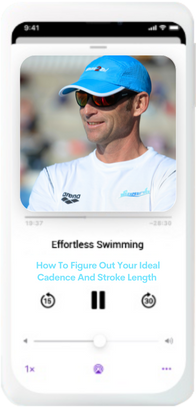
My guest today is Frank Huisman. He’s a swim coach based in the Netherlands. Tune in to this episode to learn more about becoming a faster and more efficient swimmer.
01:08 Working With Kristian Blummenfelt
01:52 Developed A Wetsuit For Kristian
03:27 What Is Impulse Time?
06:17 Speed Is Determined By Two Major Things
08:49 Get Your Swim Efficient
11:03 Keep Your Drag Low
12:10 Stroke Length
13:08 What Are The Things Impacting Body Position
15:52 The Swimmer’s Superman
18:31 Perform The Kick In The Right Way
22:11 3 Reasons Why You Have Kick
26:12 Simplify The Swim Technique
27:00 Swim Stroke Chart
31:32 To Bring Awareness
36:38 What If The Stroke Rate Is Too Low?
39:12 Get In Touch With Frank!
39:27 What’s Next?
Get in touch with Frank!:
https://www.tri-experience.com/
Form Googles:
http://formswim.com/effortless
Watch the video on YouTube:
Transcript
Read the full transcript
Welcome to the Effortless Swimming podcast to show that help swimmers and triathletes love the water, become a better swimmer and live a better life. Here’s your host, Brenton Ford. Welcome to the Effortless Swimming podcast. My guest today is Frank Huseman. He is a swim coach based in the Netherlands and you run TriExperience. You work with a lot of athletes similar to myself, that are adults, they’re triathletes and don’t necessarily come from a swimming background. And we originally got in contact with each other when I sent an email out about the EO swim better, which is the smart paddle device that measures the force and the direction of it. And you were asking some questions about it because you were using something similar. And when we did get on the call, we found out that you’ve done some work with Christian Blumenfeldt, who for those that are listening here, you got third in Kona on the weekend just gone.
And so I thought it’d be great to first of all jump in and see what were some of those insights that you got from working with Christian about his swimming. So first of all, welcome and then be great to get your insight into Christian Blumenfeldt’s stroke. Yeah. Thank you, Brent, for having me here on your podcast.
Yeah. Well, let me introduce myself a bit and the reason why I got to basically work with Christian for a bit. Basically, I am asked for the Boer wet suits on a regular basis as a swim coach to test and improve their wet suits because, you know, my background is swimming. I’m a swim coach and well, coincidentally, Alex the Boer, the founder of the Boer wet suits is a great friend of mine. What we did last year, we went to Bergen to meet up with Christian and Olive Alexander as coach to test Christian in his swimming and also to test his, how he is reacting on a different kind of support in wet suits. So we did all kinds of experiments on Christian, which was very fun with all kinds of neoprene accents in wet suits and test what the effect was of his swimming performance and his energy expenditure. Of course, we did this. The goal was to develop a wet suit for Christian, which was ideal to do and swim the sub seven project
in to get him into the fastest time for the swim, actually. So and basically what what I as a swim coach was surprised at Christian as a basically fairly good level, very good swim level for a triad lead. And if you’re speaking in terms of Olympic swimmers, of course, that is a different ballpark also in swim speed, of course, but also efficiency. The thing we found with Christian is that he was able to he is able to gain a basically a high power output or a high and a high cadence for a long time. And I think that’s also within the other disciplines cycling and and running is one of his sense as well. And that’s why he’s probably so good. Well, I can share some of the things we tested. We found that might give you some insights. So let me switch. That’d be good. And one of the things I remember you mentioning was he hasn’t and this was tested with a wetsuit on as well. So like the stroke can obviously change a bit there.
But one of the things that stood out was he hasn’t got a really he hasn’t got a long reach or glide time out the front. He was pretty quickly moving into the catch. Yeah. And one of the other things that I found interesting too is that you with these devices, you look at impulse time. And when I first heard that term, I would have all impulse here. I was like, what’s impulse time? But I guess the way that I would explain it and I’d like to get your take on it too is it’s essentially how long have you first of all got that contact with the water through your catch in your pool? And then what’s the overall? I guess if you look at the graph of when of the power, how much impulse have you got? How much and does that sort of fill up the space there? I’ve obviously butchered that description, but that’s how I would sort of see impulse time. Could you talk a bit about how you view impulse so that someone who may not come from a swimming background
and hasn’t spent the last 20, 20 years of their career coaching, how could you explain it in simple terms? Yeah, basically, scientifically, the impulse is the force that you apply, multiplied by the time that you apply the force. That’s the impulse you create. And to be able to swim fast, the only way it’s very simple basically swimming, it’s very simple because it’s all science. So you already move forward if you put pressure or force with your basically as your propulsion surfaces, which is the hand and the underarm in the backward direction, right? So any other movement, you can debate about that. What if you need to have a deep catch or a shallow catch or, you know, and well, we used to basically almost still school also in making an aspirin because we want to push water that was not moving and therefore create a bigger force. But, you know, any other movement that you make that is not in the backward direction is a loss.
So because that will, the only way that you’re moving forward is to press water in the backwards direction with us basically as much force and in the longer path. So that’s funny and I recently saw a documentary. There was also Dutch guy who, a Dutch Olympic athlete who was getting into the techniques of Usain Bolt while he is running that fast. And basically, this is also scientific. The speed is determined by two major things. Speed is the product of stroke rate and stroke length. And any other element is impacting those two. So, you know, if you’re having a poor body position, right, and so you have more drag in the water that has an immediate impact on your stroke length. So your travel distance per stroke is impacted negatively, right, because else. So if you put away that, if you don’t change anything about your swimming technique, but you put away that, you pull away that, you take away that drag or minimize that drag, for example,
by putting on a wetsuit or a buoyancy short or whatever, putting the body up higher, then suddenly you see that the travel distance per stroke is increased by 25, 30% of so. And then the stroke rate. The only thing with swimming is, and it’s that stroke rate and stroke length, they also impact each other until a certain extent. And it depends on what kind of level swimmer you are. You can increase your stroke rate quite a bit without decreasing in stroke length. If you have, if you’re a starter swimmer and you start to really increase stroke rate, then the stroke length, because there’s, well, the technique is maybe not that good. Body position is not that good. And the body is not trained that well. The stroke length will decrease immediately. It’s a really good way to keep things simple, isn’t it? If you just like, oh, how can I get faster? It’s like, well, you can reduce drag to increase your stroke length
or you can increase your propulsion so it’s better catch and pull and better connection with the body. And then the other factor is stroke rate. So there’s a number of things in there. There’s heaps of things in there that you can do to find ways to swim faster. And usually the first place that I would start would be reducing drag. That’s because you could have the best catch in the world. You could have the highest stroke rate. But if your hips and legs are dropping down, you’re not going to get, you’re not going to be going fast. So there’s so many things that you can do. And I think for a lot of people, it’s just understanding what those things are and then maybe which order should you go about them? Yeah. Yeah, well, basically the biggest trait is for a swimmer to when you start to get into the swim sport and starting to learn the freestyle, the main goal is, and you probably need a couple of years for this,
is to get your swim efficient. Because if you take a look at, for example, swimming is, we call it like a cycle sport, basically. You know, you do a movement and it’s completed. Basically it repeats all the time, all the time. And cycling is the same and running is the same. So if you want to become a efficient runner or cyclist, we know that you first have to work on cadence. And if you know you can move in a certain cadence, you have an efficient movement pattern, then you can start putting on an extra gear and then you go faster or make your step a little bit longer and then you go faster. Swimming is because we’re moving in water, which is 775 times the density of air. It’s incredible, 775 the density of air. So if you go on a time trial bike and you cycle 40K an hour, that speed is very important that you have like a good aerodynamic position, right? Because if you get up, it immediately impacts speed.
So we’re not swimming 40K an hour, but if you’re never a swimmer, you swim 4K an hour. So that’s 10 times slower. But you do that in a medium, which is water, which is 775 times more dense. So in swimming, the aqua dynamics is, if you’re either by 10 aqua dynamics is about 80, 75 to 80 times more important than aerodynamics in cycling. So if you want to be a good swimmer, the first thing you have to work on is keep your drag low, your body drag. So and also every movement that you make will amplify. If you do it in the incorrect way, it will amplify. It will immediately increase your body resistance. So if you’re swimming and you’re breathing and you’re losing your balance and one feet comes out and it comes out of your body alignment, then immediately that kick on the side is immediately causing a decrease of speed because it’s causing drag. So that’s why it’s so important. So if you want to become a good swimmer,
you first have to work on stroke length only. And if you were able to keep a good stroke length, a healthy stroke length for about, let’s say 1 or 2K continuously, then start to work on speed. That’s my basically fishing and experience. Yeah, I agree as well because you, but the one thing I’d note there for those that are listening is that we’re talking about stroke length. You know, you want to reduce your stroke count, but not to the point where you’re overreaching and over rotating and doing these really big long strokes where you’re just going too far with it. The way that I would often explain to someone is if you were to do a 50 meter swim and you were to try and have your lower stroke count without stopping and pausing, you were just swimming at a normal rhythm and tempo. That’s what we want to try to maintain as you go for those longer distances, not where you’re just trying to overreach and you have your,
let’s say your stroke count is normally 40, you don’t want to be going down to 34 where you’re actually going much lower because you’re over gliding. So that’s just one thing to note when you’re going for it. And with reducing drag, so the thing that I come across and I’d be interested to hear if you hear this too, head position is obviously important and you want to make sure you’ve got the right head position, but a lot of the beginners swimmers that I come across think it’s the only thing that’s impacting their body position. So in order to get their hips up and their legs up, they will bury their head in the water. They’ll go very deep and they’ll be swimming with it too far under the water at times. So it’s just one factor that impacts body position. What are some of those other things that you say is impacting body position? One thing if what I see most head position of course is one thing and it has to do with breathing
and what I, with the most of beginners swimmers, they want to, you know, get out of the water to breathe. So you want to get up. So if you pull your head up, your hips sink and your legs are attached to the hips. So they sink as well. So that causes immediately, it moves you out of the horizontal position and it causes drag. And you can also correct it. Of course, put your head in the water, put your complete head on the water, but the surface of the skull is quite big as well. So it also causes frontal drag. And also if you put your head down, there’s a strain on the back which enables or prevents you to move and to stretch out freely because if there’s too much tension there, it will hold you back. So that’s also a cause. But the muscle, I think the most common thing I see is a knot in hips. So a lift slightly bent hip. And if you have a slightly bent hip, then that will mean that the kick will be more from the knee.
If the kick is coming from the knee, then the effect of the kick is, well, I always say you need to have an active kick because if you don’t kick, the legs are too low basically and causing drag. But the kick is very difficult because there is like it’s working in a positive way or it’s working in a negative way. So you do it correctly and it benefits you. But if you do it incorrectly, it’s your causing drag.
And you can work with kick techniques and do all kinds of exercises. But the first thing people need, and especially if I have runners, if I have runners who want to learn to freestyle, they have a very hard time in keeping their hips straight.
What exercises would you have them do to start to train that and to get familiar with the movement and the way they need to hold their body, their core and their hips to be kicking effectively?
Well, good exercises. I’ll put them a land exercise. I do supermans. I call them the swimmer supermans because it’s not the original supermans. But if you I lie them on the back on a mat besides the pool and then lift your feet and your hands up five centimeters and then your whole body. Basically the hips are the lowest point. If the hips, if you’re lying in the water like this and the hips are the lowest points then your body position is very good. And that’s basically a good base. It doesn’t mean that you have to be that all the time. But there should be this tension. And there’s one trick I’ll learn. This is like also a little bit aqua dynamics. If the body position has this surface, there’s tension on this surface, then the body will float. If the tension is on the backward, then the body will sink. So you need to have the tension on the in the freestyle on the front side of the body. So the chest and the belt.
So in that way, the hips should be the lowest point or and you wouldn’t see that if you see experience swimmer. You wouldn’t catch that immediately because of course the body, you know, they’re so well trained and they’re moving quickly. You don’t see that but for beginner swimmer that I think one of the biggest tips is getting you don’t have to look like a banana in the water. But the tension should be on that side. Then you will float and from that body position start a kick with a straight leg and a loose ankle. Then your kick will come from the hips. It doesn’t feel like that. And you may have a slightly bent knee kicking downwards. Only you should have a straight leg in the upward movement. For those that are listening, you’re showing that position with your hand and the correct way there is thinking about like you talked about a banana almost like a dish or a plate that sort of will rise up on the edges there. Holding your body that way
will allow you to essentially float a bit better. And I remember when we had our Hawaii camp a couple of years ago, the coach I had with me at Gary Haring was getting the swimmers to practice floating and if you are trying to float so you face down the water and you’re trying to float with your hands below your body and your legs below your body it’s not going to happen for you. As soon as you try and lift your hands above your head and your legs above your hips and torso that’s when you’re actually able to float which is what you’re talking about there which is an interesting way of thinking about it. It’s quite good because obviously a lot of people do bend too much at their hips and their waist because they’re not used to holding their body that way. It’s not something that they would be doing in any other activity probably. So it’s an interesting concept. I like it. Yeah. I guess I have some nice picture. It’s a nice footage of a swimmer.
It’s doing in a slow-mo. It’s an Olympic swimmer. It’s Ferry Weisman. He’s Olympic gold medalist on the 10K Open 1 Swimming Rio. A very exceptional swimmer because he’s a long distance swimmer but he used to have a national record on the 400 short course as well. So he’s quite fast on the mid-distances and also in the marathon here. The 10K is very good as well. And his straight as a basically his strength is as a long distance swimmer that he has still a very active kick. So by far he doesn’t have a passive kick and it usually said or debated that a triad lead or a long distance swimmer should minimize the energy minimize the energy and the activity of the legs because that’s also, you know, it’s tiring. You have to run and you have to cycle afterwards. But if you perform the kick in the right way it doesn’t cost that much energy. Not at all. But it has a fair positive fusion to the complete stroke. So a good kick
and a good timed kick is basically supporting the glide phase in the supporting the body roll basically the surplus in the stroke but also if you’re really able to bring that into practice you can basically when I say the least the parts of the body which are on the least resistance you can use those to drive your tempo. Maybe you’ve heard of the running arms so a model runner that is, you know, getting into the last part of the race last 10K he really has to activate the arms to get, you know, the legs are tiring they want to slow down to get the legs driving. It was a nice thing when Elliot Kipchok did his first try to get on the sub two in Monza he was in the last two rounds and he was on the edge of barely making it or not and Schoeswatz was next to him cycling says, okay, use your arms, active you know, keep your arms active because your cadence is dropping so he activated arms and he could be able he was able to keep his cadence high
the same thing with swimming if you’re a competent swimmer you can basically steer your stroke rate or manage your stroke rate of yours and also the length of your stroke by increasing and decreasing the frequency of the kick so you can even switch you can even switch for a long distance swimmer I always teach them, okay you basically if you try to have a six beat kick but there’s also sprinters and they decouple the kick they can do 10 kicks or 12 in stroke cycle
so you can also do four but that means that there is basically somewhere a disturbance if you have a four, a two beat is also because you know, we are you know, we move in a way left arm, right foot right arm, left foot you know, that’s how we are programmed as humans so you run in that way and you swim in that way as well if you want to be efficient and controlled Can you talk a bit about the 10 and 12 beat kick you’re saying that some distance swimmers will use that to for part of the swim to let their arms rest a bit more or what are you referring to there? I don’t quite fully understand that side of it No, if you took it, if you for example, if you analyse a the 50 meter sprint the 50 freestyle of the last Olympics and you slow down the movements there see how many kicks those guys are making into one arm stroke an arm cycle, it’s more than six, right? Right So for a long distance swimmer I think that the kick should not be a
the kick should be there basically there’s three reasons why you have kick the first reason is get your body alignment right so if your feet are up if your feet are up then the complete resistance of the body is low right, so that’s the first thing second reason is coordination so if you want to move in a human way left, right, right, left you should be having a controlled kick rhythm, right so if you don’t have that it will disturb your stroke if you have that it will make the stroke easier and more controllable, so it’s more natural and the third one that is propulsion and I was working in I’ve been working in swim lab in 2013 in Eindhoven in Holland we weren’t able to test it but for Olympic sprinters we did some drag measurements and active drag measurements and we estimated that the contribution of the Olympic sprinter which by far has them the biggest effort in in the kick of all swimmers basically the contribution of the kick
in proportion basically the speed is maximum 15% so for those guys 85% is arms if you take a look at long distance swimmer with an active kick the contribution of the kick in speed it’s less than 4% so 96% is arms but if you don’t use the legs then your stroke doesn’t coordinate well and your legs will sink and it will cause drag so you have to use it this podcast is brought to you by form goggles form empowers swimmers at every level to reach their goals whether they want to get stronger faster swim further or be more efficient get lap by lap motivation with real time metrics and workout instructions right in your goggles and forms recently released form plans which included progressive series of workouts to help you achieve your fitness skills or triathlon goals you can follow along with the plan and your weekly swims will be automatically synced to your goggles so you’ll swim through your workouts with real time metrics
and workout instructions all in your goggles so it’s like having a coach right there with you and I’ve had a look through these training plans and I think they are excellent for people who want to train for certain triathlons or reach certain fitness goals it will build on each week and a really good way to progress progressively build up your fitness along with some plans to help you reach your specific swimming goals then check out form goggles at formswim.com forward slash effortless and this will give you $15 off your purchase of form goggles so formswim.com forward slash effortless to get your pair of form goggles someone could listen could hear that and think oh it’s only 4% so I don’t need to worry about my legs but as you’re mentioning there when you when it’s not effective when it’s not working for you then you’re going to be much slower overall and that’s why it’s an important thing to get right and I’ll often say to
people at clinics that we’re coaching is that like you don’t want to be kicking hard especially if you’re doing triathlon but you want to make sure that your kick is effective and that it’s not slowing you down because it just slows so many people down that it’s something that’s worth getting right and spending a couple weeks just tweaking some things to make sure that it’s not making your life harder over the time that you’ve coached what are some of the things that you as a coach you felt have maybe come up with your own ways of describing things or getting people to achieve certain parts of the stroke because I’m thinking back to when I first started coaching it was getting inputs from other coaches and swimmers and then I think that the more you coach you tend to come up with maybe not completely your own ideas they might not be 100% original but they are an accumulation of all this information and knowledge that you’ve taken
on board and then you come out with your own ways of perhaps teaching things. Are there a few that come to mind with you because I’d love to get your take on that because I’ve taken so many things from other coaches and learnt from so many coaches that I like to get their perspective on different parts of the stroke and how they like to teach one thing we already spoke about you know is simplify the swim technique in this concept of stroke length and stroke frequency that determines speed so also what helped me a great bit also is I’ve been using the chart the stroke rate and time chart that Swim Smooth uses maybe you’ve heard Swim Smooth also basically a colleague of ours I can share that sheet if you’re listening to this on the podcast we’ve also posted this episode on YouTube as well so you’ll be able to see this chart here that Frank’s about to pull up so this is a chart that I use when I have some swimmers that are able to swim
100 freestyle so they’re in basically one of my courses to swim the freestyle and they’re able to swim four lanes of 25 meters in one go I’ll have them perform this test they just swim 100 meters easy controlled and what we do is we time basically the swim time of that 100 meters and we count strokes based on the stroke count let’s say if I have a swimmer doing 25 strokes and then it’s swimming let’s say 140 it will show a dot here somewhere so 25 strokes so I have this table here and you can see 25 strokes and I said 140 which is pretty good time for a beginner that means there’s a stroke rate of 76 strokes per minute that’s quite fast, right? all those numbers extrapolated out so you can see based on their stroke count and their time what the stroke rate is and in this table if you plot out that 140 and that 67 stroke rate that means the grip time is pretty good but 25 stroke is way too much so the travel distance so it’s inefficient in a way
that it’s inefficient in a way that he is swimming with far too much effort probably too much drag high stroke rate with short strokes and this is a pace that he isn’t able to maintain for long and the other way, and that’s what we talked about what you said as well, stroke length is good you can have a certain balance between stroke length and stroke frequency and the other hand if you’re swimming the same pace but you have a stroke of let’s say 45 which means if I say the same pace, 45 let’s say 46 so if you swim 140 and 100 meters and you need 16 strokes per lane 16 strokes and then turn and you spend of course not too much time in the turn, but you quickly turn after 2-3 seconds before the next stroke and the next lane again then your stroke rate will be 40 let’s say 46 and that’s a little bit too low so this is the part where you’re over gliding and if you’re over gliding you need to basically it’s a stand still it’s like a stop motion
every stroke you need to pull yourself up again that’s a good tool to diagnose where someone’s falling short is their stroke rate too low or is their stroke rate too low or are they doing things where they’re inefficient in their technique in that way you can see what it is to work on so will you use that tool with someone who comes to you and you’ll see where they are on that chart and let’s say their stroke rate’s too high to work on slowing them down a bit and to work on the things in their stroke rate it was funny because I had this test for example for a group yesterday it was very funny and for the most of the people if you do not count your strokes you just swim and you try your best, you just swim and I had a lady it was a small lady and since he needed 30 strokes and her swim time was over 2 minutes so she was basically off this chart
so also had a guy who swam he swam 140 with 25 strokes this example, this example so then we started some exercises first with a pull boy then without a pull boy just you know stroke counting said okay let’s take the average amount of strokes we call that X you now swim 50 meters in X amount of strokes so if your average stroke count was 25 and of course during the test it’s not always 25, they started at 22 25, 26, 28 or something like that so you see so the first lane is controlled then the strokes shortings and the last lane is struggling but okay let’s swim 2 lanes with X exactly the average and then they start counting and then suddenly they swim with less they swim with 24 strokes so after 30 minutes of exercise I was able to and we did the cooldown swim for 100-200 meters and those guys are trying okay let’s do 100 and the guy that was doing 25 strokes in the test he did 100 meter very easily in 21 strokes the lady that needed
30 strokes seated a 100 meter in 24 strokes so a 6 stroke reduction just because they were counting they were aware of what they’re doing lengthen the stroke a bit and getting more control so only awareness yes improvement already that’s a great example of using that tool first of all but also bringing awareness to what those factors of your speed are because most people don’t know that when they’re new to the sport and a good set that I did with the squad I swim with a couple weeks ago that I got from a friend of mine actually is we did 10-100s the first 50 is strong so first 50 is strong and then on the way back you’re going fast but hold your stroke count for all 10-100s and there was about 30 seconds resting between what I found in that set is that I got faster as I went through because your body you figure out a way to be able to get more out of each stroke while holding that stroke count and if you do come up one or two
sometimes your times increase because you’re not moving as well like I’m probably holding the same stroke rate but there’s inefficiencies coming into the stroke so just having that awareness there of how many strokes you are taking helps you maintain your form and your technique it can be a very good thing to focus on that’s a great example also what I also use is I’ll just go over a pull-boy and grab a set of pedals and then have them swim and then immediately because of the the propulsion force the extra propulsion force you have and also the pedal in the glide stroke gives you a little bit of support in the glide so the arm if you’re a swimmer you have them see that the arm drop too fast in the glide it supports that a bit you can suddenly do three or four strokes less for pull length and then if you condition yourself in that way of swimming which is more on stroke length and power once you take off that pedals and you swim another lane
you suddenly you’re conditioned on the power so you suddenly start to reach better grab better get some more pressure on maybe but you immediately you want to feel the same pressure so what you will do is you will accelerate the hand a little bit more to feel the extra pressure and of course you won’t have that the stroke count of the set that you did with the pedal but it surely is one or maybe two strokes less than you did before it’s like wearing a parachute or like a sponge out behind you like a drag that gets created but it also enhances your awareness of those things so adding some drag to it or with the paddles adding that surface area it can be such a great tool for teaching those things that’s excellent is there any other things that have worked well for you coaching athletes on those kinds of things let’s say for someone who has their stroke rate is too low what approach would you often take there oh yeah that’s nice
I usually I first try to have them swim with a couple of strokes more on the lane to shorten the stroke a little bit if that doesn’t work you can grab the finished temperature training for example and put the temperature trainer under your swim cap and then increase a little bit by bit so if you’re let’s say the first swimmer and there’s no golden numbers but if you see in the chart the white zone it’s like a zone right and if you take a look at the chart again you see that the slower you are the white zone is getting more narrow the faster you are the white zone is getting bigger so basically and the white zone is where efficiency is pretty basically okay so if you’re a swimmer that does one minute a one minute 100 freestyle without a start you just push off the wall and then swim you can be in a white zone with a stroke rate of 70 that’s the down basically the bottom side of the zone but also with 100 right so and this
so the faster you are the more varieties you see and it’s also the nice thing in swimming and if you’re studying elite swimmers and as we as coaches we certainly I think each coach has a certain ideal way of swimming the freestyle in efficient or effective way but if you’re if the level goes up the variety in the technique and the styles the variety of styles they are much much greater and they are you know they are far more different it’s a good point is that I mean you look at an Olympic final in the 1500 freestyle and there is so many different styles of freestyle there isn’t there beginner swimmers you don’t want everyone swimming exactly the same there are certainly different styles there but you’re right there’s a narrower narrower band of acceptable not acceptable but ways that you would want someone one swimming there’s less ways of being creative with the stroke and still swimming fast there like is only a few different styles there so
yeah it’s a good observation with that you run a lot of you do a lot of coaching obviously where you are you also run camps similar to us so for those that are listening what’s the best way to get in touch with you like what’s the website for try experience and how can someone contact you directly yeah that’s www tryexperience.com and all the information it’s a Dutch website but with Google translate you can obviously translate everything and what have you got coming up in terms of coaching or squad stuff we’re starting up some new courses swim courses we’re developing basically what we do is with new insights and new tools we’re developing new courses for a broad variety of swim levels each year also because if you’re in the coaching for more than 10 years and you do the same thing all the time it’s not that it’s funny so you always look to new insights new methods to improve so for example I have we have developed a swim module that is called
tempo trainer and technique and the tempo trainer refers to the finished tempo trainer where we use not only the tempo trainer to control pace but we use the tempo trainer to increase focus on a certain element of the stroke so and this came through because my wife is a trainer of dogs as well and if you train dogs it’s a lot of signal learning like the path law theory and practice so actually we’re doing I’m not saying that we train the swim which has dogs but basically we took the path lift method into a swim training by using the tempo trainer so we set the tempo trainer into a controllable beep for everybody everybody has its own comfortable stroke frequency and from there you can say okay you can catch on the beep or focus push out give that accent in the push face on the beep or you can even
you can even place your kick rhythm in the beep if you really focus so that way your focus becomes that part of the stroke but also the the beep doesn’t stop so it’s continuous and it’s very exhausting not in intensity of the swim but for people it’s like a huge focus they have to yeah yeah so and that’s it’s a very fun way to be and to teach swimmers and triathletes away and to improve the stroke that’s really good I’ve never thought of it that way or heard of it done that way so I’ve got a tempo trainer I just need to replace the battery so it’s something that I’ll have to try that’s a great way of going about it Frank thanks so much for being on the podcast and no doubt we’ll be in touch in the future and yeah I appreciate you sharing the insights on the podcast and for anyone listening go check out Frank’s website which we’ll show you in a few of our own notes and especially if you are over in the Netherlands get in touch with Frank because great
resource and you’ve had a lot of experience working with a bunch of different swimmers and I’ve taken a lot from this podcast so thanks very much for being a part of it yep thank you Brent thanks for listening to the effortless swimming podcast if you’d like us to help you become a faster more efficient swimmer go to www.effortlesswimming.com