








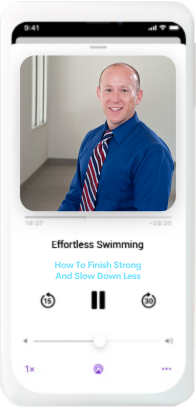
Welcome to the podcast with our special guest, RJ Boergers, the author of ‘Finish Strong: Resistance Training for Endurance Athletes.’ RJ is a certified athletic trainer with a doctorate degree in Movement Science. In this episode, we will discuss the positive impact of strength training on performance and well-being, misconceptions regarding strength training, and the importance of mobility. Tune in now, as this episode offers valuable insights and practical tips for athletes looking to enhance their swimming and triathlon performance.
Get the book here
Follow him on Instagram
Reach out to RJ via email [email protected]
Today’s podcast episode is also sponsored by Skillest. Exclusively for our Effortless Swimming podcast listeners, you can receive a free course, ‘The Art of Triathlon Swimming,’ and an online analysis through the Skillest app.
https://effortless-swimming.skillest.com/
In this episode
- 01:22 Passion for Resistance Training and its Benefits
- 05:41 Common Mistakes and Misconceptions in Strength Training
- 9:17 The Importance of Strength Training for Endurance Athletes: Maintaining Form and Improving Performance
- 20:18 Strength Training Success Stories: Injury Reduction
- 26:34 Effective Exercises to Strengthen Obliques
- 28:54 Must-Do Exercises for Swimmers: Targeting Core, Glutes, and Scapular Stabilizers
- 31:28 Why Mobility Training Is Crucial for Athletes
- 39:38 Key Takeaways for Effective Strength Training
- 44:16 Get in Contact with RJ
Links from this episode
- Change your technique and swim a smoother, easier freestyle in the Effortless Swimming membership
- Want to work with me personally to improve your technique? Join my swim technique coaching here
This podcast is brought to you by NanoClear — our own range of anti-fog swim goggles, designed by Effortless Swimming with the anti-fog treatment bonded into the lens itself (not sprayed on, so it doesn’t wear off after a few swims). Check out the NanoClear range here and use code PODCAST15 for 15% off.
Transcript
Read the full transcript
Welcome to the Effortless Swimming podcast to show that help swimmers and triathletes love the water, become a better swimmer and live a better life. Here’s your host, Brenton Ford.
Welcome to the Effortless Swimming podcast. My guest today is RJ Borges. He is the author of Finnish Strom, Resistance Training for Endurance Athletes. And on today’s episode, I really want to get stuck into some of the topics that you cover in the book, and some things that will really help the listener for this podcast, stay in the sport longer, not get injured and perform better. So firstly, RJ, welcome to the podcast. Brenton, thanks for having me. This is an exciting, it was an exciting invite to get. I’ve learned a lot from any of your swimming YouTube videos. And as you know, us age group triathletes, we’ve got plenty of work on our swimming to continue to do. But if I can help other triathletes out there by sharing a little bit of knowledge, that’s my main goal. And that was one of our main goals of producing the book. Well, we were talking before the podcast, and you are heavily involved in research, you are teaching this stuff at university,
you’re an age group triathlete yourself. So you are really in the thick of things, which I think is is great, that immersive experience that you’re having in triathlon and strength training, I think there’s going to be a lot of lot for us to cover. So to start with, where does all of this originate for you? Where does your passion and interest begin in this topic of resistance training? Yeah, so in terms of resistance training, we pretty much have to start back to being a university student. And so I was I was a major in athletic training and health science. And by profession, I’m a certified athletic trainer. I know that doesn’t really exist in all parts of the world, but pretty similar to a physio. And so we have a lot of same skill set as a physical therapist might have in the United States, or sports physio might have in other parts of the country. So we certainly get plenty of exposure to classes in therapeutic
exercise, and then also strength training for performance. So that was probably where I was first exposed to it, first got interested. And I really started to make it a part of my everyday life is going to the going to the gym, getting in a workout and and really loving the results that I’m getting. So getting a stronger, more healthy body, just overall overall health is pretty much, you know, my main interest at that point, I would say I got into my 20s, got really busy with work after I after I got some some of my first jobs. And then some of that fell by the wayside. And I got to the point where I didn’t like what I was seeing in the mirror. I didn’t like, you know, what I was what it was doing for any of my performance. So then my late 20s was when I really started to get back into strength training, and and really, you know, engage in it on a on a really consistent basis. So at least minimally five days a week. And then shortly
thereafter was once I got into my early 30s is when I started my endurance sports career. So I had this major foundation and had created this strong, healthy body. And it kind of made the some of the endurance training, specifically for triathlons, swim, bike and run, really not so bad. And and part of me was always questioning and thinking, gosh, I wonder what somebody that doesn’t that doesn’t do strength training, I wonder how their body feels after some of these workouts, because, you know, I think after you’re doing regular strength training, your body’s always going to be in some state of recovery. So there’s always going to be a minimal part of delayed onset muscle soreness. And so when you’re used to having some muscle soreness, I guess any of the soreness that you’re going to get from the endurance sport training, it really didn’t it really didn’t make a difference to me. So I liked how when I combined the two, yeah, I really liked
what I was seeing in terms of a my performance and be my overall health. And I think, well, I’ve seen so I’ve got two friends right who they’ve started running their late 30s, yeah, close to 40. And they’ve gone from not doing much running at all. And they’re training for a half marathon and then looking to do a marathon. And they based both of them. They’re a couple. They went too hard too soon. And they haven’t that don’t have don’t have to have surgery. But he was in a brace for a few weeks and basically just ran through the pain and he was doing no strength training whatsoever. And has injured himself and his wife as well has has done the same thing. So she’s just easing back into it now. And I have sort of had this a similar experience my early 20s, you can just you can kind of get through it without the need for as much strength training. But as we get older, it’s that strength training that will just stop
me from from getting injured. And, you know, it just helps your body adapt a lot. And in the last 18 to 24 months of being going fairly consistently three times a week to the gym. And I’ve noticed a massive difference just with not getting injured, feeling better and and holding up better towards the end of a training session or or a race. So I’m a big advocate for it. I wouldn’t say I’m a convert. I already knew the importance of it. But I absolutely love it. It’s quite addictive. Now I really look forward to going to the to the gym and working on this stuff. So what are what are some maybe common mistakes or misconceptions that you see about strength training that the typical triathlete or swimmer might have? Yeah, I mean, I think that sometimes people don’t understand that they’ve got to follow the same rules that they’re following for their endurance training. And so you want to have planned purposeful training
sessions. And so, you know, you you’re always going to be doing, you know, speed work. Sometimes you’re doing sometimes you’re going to be doing an endurance set as a swimmer. Sometimes it’s really more about the speed work. The same thing kind of goes at the gym. There should be a specific purpose of what you’re trying to accomplish. And I’ve heard from a number of folks where they say, I know I’m supposed to go to the gym. I just don’t know what I’m supposed to go and do. And and I said, Well, I said, then you need to just get get my book. We’ve got planned workouts for you. And then you actually can see what you should actually be doing. So, and I guess what I’m saying in terms of planned, you need to plan on hitting all of the correct muscle groups, right? And and so that would be the planned purposeful part behind some of the training, plus all of the order at which you’re going to train. Okay, so that’s all part of being
planned and purposeful. So you really want to always start out with any of your mobility work by starting out with any of the mobility exercises, you’re going to get your muscles set to the correct length tension relationship. And then that’s going to allow for a better workout. So you’ll be able to reach greater ranges of motion throughout some of the lifts. And that’s going to be an important part. So I think I think that’s a major misconception is like, well, all I got to do is go. You do have to go. That’s a definitely frequency is by far frequency and consistency of that frequency is the number one thing. The other thing that I hear sometimes is people think that you’ve got to be there for like these super long sessions. And so the big thing that I always hear is there’s just no time. I can’t do it. And I said, you definitely can do it. I said, you can definitely make time. And I think people don’t realize is we’re we become very good at wasting
time on social media and some other things. And I don’t want to, you know, get sidebar and make this about something else. But if you have a planned purposeful session of 30 to 45 minutes, you can accomplish a lot. You can get a full body workout in that time, and you’ll be fine. So, you know, a lot of people are just like, I don’t have an hour. I said, you don’t need an hour. And and you also don’t need to go every day. If you can give me three days a week, that’s going to be fantastic. For us, one of the things that we did in the book was we periodized around the training schedule. And so we, you know, we’re understanding that, you know, there is a time crunch once you’re in peak training time for your endurance sport. So as a triathlete that’s training for an Ironman event, you are going to be limited on time. I get that. And so at that point in time, maybe you’re only going to be able to get two quality sessions of 30
to 45 minutes in per week. But as long as they’re full body training sessions, it’s going to still have purpose. And so that would be pretty, you know, pretty useful for you. Let’s see, what are some of the other things. I get into it a lot with people about whether or not strength training is actually good for endurance sports athletes. And so maybe you’ve heard some of this, Brenton, but from the cellular level, are your muscles are going to make adaptations based on how you train. So if I’m training it to be aerobic, you know, by doing my endurance sports, then it’s going to take on those characteristics. Or if I’m training it anaerobically, like what I’m doing in the weight room, then now I’m going to stunt some of the some of what’s going on at the cellular level. What are your thoughts on that? Because I often will get into it with other with other professionals about this. Well, I, in terms of all the physiological
stuff, I’d say that is not my strong point. So yeah, for my own personal experience, though, when I have done, when I have done strength training, I’ve found it just my body doesn’t break down in a longer or harder session. It just it holds up. And so then my technique in my form maintains for the rest of the session. And then I’m able to maintain my my speed. So I just, yeah, I find it’s very helpful. And I haven’t seen any signs that it’s working against that aerobic development. Thank you. Thank you, because you and I agree on the set on the same principles. And and I this is, you know, I feel that it’s so important that we’re having that strength to maintain form and proper form is everything for a swimmer, for certain, and then certainly for a runner too. So if somebody’s an age group triathlete and they’re training for Iron Man, and I just did Iron Man Montremblant two months ago. And when you’re out on that run course, you start seeing a lot
of poor run form and people really start breaking down. And it’s because their muscles just aren’t holding them and into that correct posture into that optimal posture anymore. So to me, I will, I will take that any day. The other thing that I sometimes start to think with going back to the cellular level, if that was so true that, you know, I’m doing a disservice to my muscles by strength training, and I want them to only have the adaptations from the aerobic training. Why isn’t it that the person with the biggest VO2 max doesn’t win every race? So there’s something to be said for mechanics falling apart and things like that. So, um, especially in triathlon, where we’re going to be swimming, biking and running, it’s hugely important to be doing, to be doing the strength training. It took a while to, I would say for, for swimmers to kind of come around to get into the strength training, I would say probably, maybe it was
like, not in the like mid 90s or something, that finally it was starting to become a little bit more common for swimmers to start doing weight room training sessions. And then even to this day, there’s still some cross country coaches out there for runners that will just say, I don’t know, I’m really worried about that, that they’ll start to contaminate their muscle with the anaerobic training. And so we really just want them to focus on the aerobics. And I’m always just scratching my head because of the mechanical breakdown. As I mentioned, my by profession, I’m an athletic trainer, but my PhD is in biome mechanics. And so that’s always something that I’m super passionate about is what’s going on with our form and our overall mechanics. And how is that breaking down over over time? Fatigue plays a huge role in this. And the more that we do the strength training, the more we’re going to be able to reduce the effects of the
fatigue, we’ll be able to hold, hold on to hold on to that proper form. Proper form is everything and swimming. I mean, you’re clearly going to be faster that way. Yeah, that’s exactly right. Like it, it seems crazy to me that someone wouldn’t do the strength training because they think it’s going to impact their, their, their aerobic training because form is so important. You look at the end of any, any even 100 meter freestyle, you’ll see swimmers break down in the last five, 10, 15 meters. And it’s the swimmers who slow down the least at the end of a race that are the ones that are going to do the do the best. And it’s that ability to hold their, their technique and, and strength is a huge, huge part of it. And you know that from when you, you’re in your off season, maybe you haven’t swum for four weeks or six weeks and you go back in the pool and maybe for the first three or four hundred you’re feeling good, you feel
fresh, but that last 500 or a thousand meters can get pretty ugly and pretty slow because you just don’t have that, that strength there to be able to, to hold your form. So it’s just such an important piece of the, the puzzle. So it seems crazy that someone would say, no, it’s not, it’s not worth doing. This episode of the podcast is proudly brought to you by our sponsor, form smart swim goggles. They’re more than a pair of goggles. Meet the world’s most powerful swim platform. See yourself improve with form smart swim goggles, including a free one year membership when you purchase your goggles for only 249 US dollars. They have currently changed up their offer where you can now get the goggles and you have one year membership included for free. And if you’d like to continue with the membership going forwards, it’s only 15 US dollars a month where you get access to the workouts, training plans and custom workout builder, but
you’ll always have access to the real time data in the goggles. So you never lose access to that. My favorite thing about the form goggles is having the instant feedback of what times you’re doing, what stroke you’re doing and also the ability to see what your heart rate is because never before have we been able to have these immediate feedback heads up display where it’s actually telling you what your intervals are. So when I wear the goggles in training, I like that I know my split for the first 50 and the 100 and the 150. So every single lap, I’m getting that feedback on what my pace is. And I find it’s such an important tool for being able to not only have different gears where you can switch between the different speeds that you want to swim, but it helps you develop those gears and it helps you intuitively know how fast you need to go to before you’re going to blow up or before you’re going to go a little bit too hard. So it helps you just
get really good at judging your pace for when you do go to a race. And even if you’re not wearing the goggles in a race, it’s that intuition and that ability to develop your pacing that these goggles can really help with. To get your pair of form goggles and say 15% off, use our link formswim.com forward slash effortless or use the coupon effortless at checkout and that will get you 15% off your pair of goggles using our special link formswim.com forward slash effortless or the code effortless at checkout. This podcast is also brought to you by skillest, the ultimate digital coaching platform that’s making waves in the swimming world. Imagine having the opportunity to train with Olympic and world champions like Kyle Chalmers, Ryan Murphy and Brent Hayden. Well, with skillest, that dream is now a reality. Swimmers, you now have the chance to work with the absolute best in the sport, getting insights and guidance from these
elite athletes like never before. And skillest isn’t just your run of the mill coaching platform. It’s a game changer. Here is what sets it apart. You can discuss training programs, receive detailed stroke analysis and even develop race strategies with these incredible athletes and coaches. It’s like having a personal coaching session with an Olympic champion right in your pocket. And excitingly, coaches from around the world can also tap into the power of skillest. Coaches can use skillest amazing tools to train their students, analyze videos and incredibly connectives from across the world as well. So whether you are a swimmer or a coach, go to the app store, download the skillest app today. That’s SKI double L EST download the skillest app today and get started. And only for our effortless swimming podcast listeners, we’re giving away our art of triathlon course free, as well as a technique analysis online through the skillest app from me for
free as well. Go to effortless swimming dot com forward slash skillest offer or click the link in this podcast description and you will get the art of triathlon swimming course for free as well as a technique analysis from me through the skillest app. And now back to the podcast. Yeah, no, I’m glad that we’re in agreement on that because I get into some heated debates on that with with some people. And it’s something that I’m super passionate about because to me, form is is everything when it comes down to it. And as a guy who studies human biomechanics and understands how muscles will and joints will work optimally, I I know that the more strength that we have, we’re going to reduce our risk of injury. And then we’re also going to be, you know, be able to hold our peak, whatever that optimal form is. And then that should allow us to have a peak performance.
Yeah, I think I told this on a recent podcast. I can’t remember, but there’s this machine that I’ve been using. It’s like a back extension machine machine. So you start from like a killed position, and then you sort of press against it and then then go back. I had a lot of issues with my back about two years ago and just kept tweaking it and would sort of put me out for a day or two. And I originally started at 40 pounds on this machine. I’m up to 120 pounds now. And I haven’t had any issues with my with my lower back for the last 18 months or so. And I would often get it from if I was sitting down a lot. So just that fatigue from sitting in an airplane seat or in the car or at the desk for a long time, or just fatigue from if I’m if I was surfing for two, three or four hours, you just continuing to compress a little bit in the lower back and towards the end, it would just start to be very weak and I wouldn’t be able to hold
my myself together very well as I was popping up and just kept kept doing my back. And it was so frustrating. So that’s one of the reasons why I’m such an advocate for this strength training is I’ve seen the results of it. And yeah. And it’s just I just think it’s one of the best things that that people can do. And I mean, you’ve worked probably with a lot of athletes. You’ve probably seen a lot of different people. Do you have any examples or stories of people who you’ve seen having included this or having maybe had a good strength training program that’s helped them get better results or prevent injury? Yeah. So in terms of I would say the vast majority of what I what I could tell you in terms of stories would be injury reduction as a result of of their strength training. However, you know, I’m I’m the strength and mobility training coordinator for a for a triathlon team. And let’s see. So I took a couple of notes just to jot this down.
So in this past year and this is a team of twenty five twenty five athletes. We’ve had seventy nine top five performances. Forty one personal best. So and this is the first year that we’ve included the strength and mobility training in. So this was a triathlon coach that recognized the importance of of what we’re doing. He said, hey, you know, let’s team up, let’s work together. And, you know, it’s some combination of his training and then what I’m providing for our athletes to in terms of the strength and mobility work. So we have had success in terms of having a few less injuries. Again, this is, you know, small anecdotal evidence, but it’s evidence nonetheless. Another good performance story that I would have is a really close friend of mine. Unfortunately, she moved away, but I had I had worked with her while she was here. Really talented triathlete. She was a division one collegiate swimmer. So she’s always one of the first
one of the first females out of the water. And so she just had a top five performance at Ironman, Arizona, 70.3 this past weekend. She’s to always struggle with knee injuries. And her and so her her running was always just very poor because of trying to fight through through knee pain. And, you know, I had this chat with her. I said, look, we’ve got to work on your core and we’ve got and specifically we’ve got to work on on your glutes because you’ve got a glute dysfunction. So we did some we did some basic a movement assessment with her. We decided what what we needed to work on. And, you know, she was one of those people that was super receptive to it and said, I’m making this change because I know I can be really good in in this sport. She’s like, I need I need to do this. And and so, you know, we worked together. This is probably like 10 years ago. And this is the culmination over the years of her sticking with it. And, you know, now I’m
hearing a lot less from her of the knee pains back or things like so she’s just going going and she’s always having some really awesome performances. So hers is one of those ones where I think she was already talented to begin with. I do think that some of the strength training helped with her performance, but clearly being able to make it to the start line to be able to go and compete. I think the strength training is definitely helped with the reducing the injuries for her. Hmm, what’s another one? I can tell you here’s an interesting one. And this is actually one that I talk in my book. So I had an age group triathlete decent, probably like usually like top 10% finisher. But he was starting to have a lot of low back and specifically SI joint dysfunction. And so, you know, did the movement assessment with him also, you know, ask some questions about what he was doing for, you know, for swimming. He ended up being a unilateral breather.
So he really created a major side dominance issue and side dominance is a major problem. So aside from, you know, working with triathletes, I’ve got plenty of experience working with team sports athletes, so specifically like throwing athletes and the throwing athletes always going to have a side dominance. And so what what it does is it takes the the body’s natural kinetic chains and brings them out of balance. So specifically, the ones with this individual, if you’re constantly rotating and only taking a breath from one side, you’re going to have a very strong rotation or spiral spiral kinetic chain to the on one side, but then the other one becomes dysfunctional. So in our book, one of the things that we talk about is the importance of doing anti rotation exercises. And so we just really got him to do the correct core exercises. And then he really kind of turned around really quickly. I think I think within a couple of months, he was not having
the back pain anymore. And so this comes down to again, having a planned purposeful training session. And so here’s a guy that was going to the gym. He actually was doing all the strength training, but he was working only in the sagittal plane. So think about like crunches and lowering the legs and things like that. But you know what he was forgetting? The ever important obliques and one thing in in most of the athletes that I’ve worked with, I’ll find a spiral line dysfunction. And it really comes down to having a weakness in one or both of both sides of the obliques. So it’s a really underworked, underappreciated core muscle. And so usually one of my tricks for people that are having low back pain is to really start, you know, doing some work on on incorporating some of those exercises. What are one or two of those exercises to strengthen the obliques? Yeah, so a couple of my favorites are windshield wiper. So you can be performed
with a dumbbell or whatever, but you’ll lay on your back. You’ll hold a dumbbell up over your head. And that really is only going to be serving as a counterbalance. And then you’re going to be starting with your knees kind of bent up with your feet on the ground. And then you’re going to just be taking them from side to side in that 90 degree hips at hips and knees at the 90 90 position and then slowly bringing them back and forth. I do see people doing these at the gym and they’re going way too fast for it to for it to actually have that anti rotation benefit. So when people do those like a dumbbell win windshield wiper exercise like that, that’s that’s gold. Let’s see. What else do I like? I’m a big fan of the dead bug palloff press. So I think most people know what a dead bug exercise is. And so that usually is going to be, you know, working mostly in the in the sagittal plane, which is usually, you know, flexion and extension of
your your shoulders and your hips. Once you make a so people know what a dead bug is. People also know what a palloff press is, but usually they do a standing palloff press where they’ll have a resistance band while they’re standing in a bilateral stance and they’ll resist it from turning them. The minute that you go on to your back, you have very little stability and so you really don’t need much of a pull from that from that resistance band to be to be kind of fighting. So those are two that I absolutely love. They’re actually included in some of our top 10 exercises for swimmers in the book. I find those really challenging and then also really effective. So yeah, I think, you know, being able to target some of those forgotten or little used muscles, I think is always going to be important for people. Is there any other must do or go to exercises that you would normally prescribe for 90% of swimmers that you were to work with?
Yeah, so it’s all about just knowing what the target areas are, right? So that’s going to target my core. We also want to make sure that we’re going to be targeting our glutes, right? So unless you’re that triathlete that does absolutely no kick out there, which I can’t stand, but I always see somebody that’s out there and they’re just floating in their wetsuit and it’s just pull, pull, pull. Yeah, I mean, you need to have strong glutes if you’re going to be able to have, you know, a nice kick. And so for that, we really like a marching hip press. And so that can be done on a bench and you just place your shoulders on the on the back of a bench and kind of just place your arms across your chest and then make a nice bridge and then start doing a marching motion with with your legs. So because you’re going to basically be going into a single leg stance once you’re going into the march. So rather than just being, you know, working both glutes at one time,
you are, they are going to get that back and forth motion, which is truly what we’re going to be having to do during a kick anyway. So I like that. Other areas or regions that are going to be super important for, for a swimmer is going to be building a nice strong back and scapular stabilizers. So scapula is going to be that back of the shoulder region that really needs to be stable because that’s, that’s an anchor, essentially the way I look at it, that ends up being an anchor for our true shoulder joint. And when, when the scaps aren’t in the correct location, that’s when people start to have a lot of their shoulder pain. So when people start having shoulder impingements, usually the root cause of the problem was something going on with a scapular weakness. So for those, I, I love using cables, a cable column and then doing low to high row and also high to low row for, for cable column. So, you know, you can just kind of,
you know, start with the one where you’ll adjust it so that the handles are low or and then, you know, for the other one, you’ll just start with them adjusted high. I do think that both of those are going to be, you know, really critical for, for developing the strength there. So those are a couple of the, the strength exercises. The one thing that we always talk about is don’t neglect mobility and mobility is probably, sometimes some of the people that I’ve worked with, the problems, you know, after I start chatting with them and I start uncovering what they’ve been doing, they’ve been doing the correct thing by going to the gym and doing the strength training, but they’ve forgotten to do any mobility work. And so, you know, if you’re doing one without the other, you’re going to only create more of an imbalance. And so the key, the key mobility exercises for swimmers really need to make sure that we’re taking into consideration
the mobility of the back of the shoulder. So we like to do a cross body stretch for that. And then the front of the shoulder and I always love a good doorway stretch for that. So anytime people are doing static stretching, they should be held for 30 seconds. That’s the way that in the, in the research literature that’s been shown to be optimal. And then let me go back to that part where I said the scapula ends up being this anchor for the, for the shoulder. Well, the scapula is sitting on your thoracic spine on top of the ribs. And so, one of the things I’ll often see, and sometimes it’s been termed swimmer’s posture, a lot of it comes because people have overdeveloped lats. And so they’ll get that kyphotic middle back. And so it ends up being rounded. And we really want to try to fight that because once that gets rounded, that’s going to change the rib orientation. And then that change in rib orientation is subsequently going to affect
the orientation of the, of the scapula itself. So it’s really critical to do a lot of extension exercises. So I love doing an extension over a foam roller for my middle back. And then I also love exercises that promote rotation in the middle back. So a thread, the needle or a book opener, those end up being really, really good exercises to be doing. So again, I think we chatted already. I think I might have mentioned that always important to do the mobility exercises first prior to your, to your workout session to be planned and purposeful and then get into the, into the strength training sets.
Yeah, we do a bit of mobility testing and then some TheraBand exercises when we go away and run our camps were in Thailand two weeks ago. And we did some tests with the swimmers there and majority of them, I’d say 75% of them in the lower range of those mobility tests like we do a combined lateral raise do thoracic rotation test and you just say people are really, really stiff and this stuff takes, it takes time. It takes many months to be able to improve on it and just that consistency with the mobility work and the strength work but you’re going to be going through that time anyway. And if even five, 10 minutes of some mobility work before each session or before each strength session it makes a big difference, it does add up. And if you’ve got that patience and that willingness to just go, all right, I’m going to stick with this for six months, 12 months, you will see an improvement and you will absolutely feel a difference when you’re swimming.
It is night and day from seeing someone who’s very limited with their range of motion. You can see that I look at technique all the time I analyze from this and you can see when people are exceptionally tight through the upper or lower back, through their hips, you can notice it and it does limit their ability to get into the right position. So it’s a big factor and as much as I’d love to say like just do the technique work well, maybe you can’t do, maybe you can’t get into the right positions yet. So we need to be able to look at some of this other stuff as well. Yeah, and you said a couple of things. I love that you actually do testing on the athletes prior to and then you actually are assigning the corrective exercises to then go ahead and fix that. I think that’s huge. And you’re so right on the fact that you don’t fix this overnight. Strength training, you can’t improve strength in one training session, it doesn’t work like that.
And the same thing happens with mobility exercises because what you’re trying to do is create new lengths within your fascia and within the muscles. And one thing that we should probably talk about is the fact that as people age, so once you start to reach that age, that ever important age of 40, it’s a magic age where the body chemistry really changes. And once your body’s chemistry is gonna change like that, what happens is your tissues become stiffer. So the muscle becomes stiffer. The joint capsules become stiffer. So now you’ve got a lot more to fight through and it’s gonna take a little bit more time to actually get at. Unfortunately, people like in their 20s and 30s, they’re usually getting away with things. It doesn’t really matter. They’re like, I can just, you know, I don’t need the mobility exercise, that’ll be fine. Then all of a sudden it will catch up to people eventually. And so as in the older athlete,
really taking the time to do the mobility exercises is important. I had mentioned, you know, that I’m working with that coaching group. And we have a couple of younger triathletes on the team, but the vast majority of the individuals on the team are over 40. And so one thing that I did with our programming was make sure that it was a little bit heavier of an emphasis on the mobility training compared to the strength training. So I figured, I said, we’ll dial that back, just we’ll dial back the strength training just a bit, really try to get a focus on that so that people are gonna be able to get to the correct muscle lengths and then be able to have better form, better mechanics, certainly improve your swim as you had mentioned.
It takes a little bit of convincing or a little bit of selling, I think, to some athletes to convince them of the importance of it and that, all right, this is maybe 15 minutes or 20 minutes where you’re not training, you’re not getting that aerobic training, but this is actually going to help you just as much because right now you can’t have your arm overhead without having it 20 centimetres in front of your shoulder there. So it’s going to be worthwhile even though it maybe doesn’t feel like it early on. So I think, yeah, it just takes a little bit of explaining the benefit of it to a lot of athletes, especially, I’d say a lot of triathletes and swimmers as well, they just want to get to the pool, they want to get to the track and they just want to have their workout and go home. They just want to get that training done. And so sometimes this can feel like doing something that’s not necessarily working them towards their goal, even though it is.
Yeah, I mean, unfortunately, there’s so many people that have to learn things the hard way, right? So you might have already told them and we might have shared with them all these bits of knowledge. And then it’s just like, yeah, no, I’m not buying it. And then they don’t buy in. And then injuries catch up with them and things like that will typically happen. I find that that’s usually what happens then they have that injury. And then they’re like, oh, I guess it was important. Yeah, and sometimes it’s hard to learn from other people’s mistakes, we’ve just got to learn things the hard way. That’s just how it plays out. But whichever way it happens, we know that it is an important thing to be including. Before we sort of finish up here, anything else that you’d like to share with the listener on strength training, on things that you’ve seen work really well for people to leave them with a few words of wisdom and with all the work that you’re doing in this area,
are there a couple of sort of key things that you wish everyone would know? All right, let me think on this a little bit. I mean, it’s not that hard, right? And I think sometimes we’re overthinking it and sometimes we’re getting caught into the minutia of things. So just like in our endurance sports training, there’s different variables that we have to take charge of, right? So there’s the frequency at which you’re gonna train, you then have volume. And volume in the case of strength training is just gonna be manipulating your sets and repetitions. You then have your intensity and that’s really just gonna be your training load. And usually that’s typically talked about as being based off of a one repetition max. I think people will start to get caught in the weeds on rest intervals. And one thing I try to remind everyone is that, we’re not power lifters, we are endurance athletes.
So power lifters and anything that you’re hearing that they’re doing doesn’t really apply to us. And so a lot of times what they’ll do is they’ll have like really long rest intervals because their intensity is extremely at a high level. When it all comes down to all of this and manipulating these variables, the biggest thing that you’ve gotta do is you’ve just gotta overload your body, right? So overload creates, the body is going to create adaptations after it’s been overloaded. So if Brenton is giving you a swim workout and he’s got you swimming however many meters at whatever intensity, it’s going to create a training load. And so as you’re prepping your people for their next race, that’s always ramping up. And so we try to ramp up and create an overload within the strength training. I get crazy questions of, well, when am I supposed to do the really heavy lifting with, but just only a couple of repetitions?
And I tell everybody, I said, you’re in the weeds. I was like, that’s not really that important. I said, it’s all comes down to overload. And to prove this, I pulled out a systematic review the other day that I found. So high-level research on many, many strength training articles. And it really come, and in the end, the author just says, if your goal is to create strength
and hypertrophy, then as long as you’re training with an intensity which is greater than 30% of the one repetition max, obviously you might have to have longer, more repetitions in the set, people are getting and achieving strength and hypertrophy, which is the ultimate goal. So I just, I try to tell everyone, like don’t get caught in the weeds. There’s a lot of right ways to do this. And I think sometimes people are almost getting, I like to say they’re getting too cute with it and playing around with it. And it doesn’t have to be that hard. So consistency, consistency, consistency of training, as you know and I know for being a better endurance athlete is the key. Same thing with getting the benefits from your strength training, consistency is the key. So that really is my, that’s my take home message to everybody all the time is, if you wanna get some benefit out of it, you just gotta be consistent with it, you’ll be fine.
Yeah, when you look for clues of what the most successful athletes do, consistency, that’s always gonna be in there. It’s, there’s no one who’s trained for three months and become a champion. It’s just that consistency. So what a great way to end it. RJ, thank you so much for being on the podcast. People can grab your book from any good bookstore or online bookstore. We’ll put a link in our description as well. Is there anywhere else that you’d like to direct people to, to either get in contact or to follow what you’re doing? Sure, yeah. People can always reach out to me directly. So through my Seton Hall University email, and so that’s just my name, Richard.gorgers. Last name is spelled B-O-E-R-G-E-R-S at S-H-U dot E-D-U. We also do have a Instagram account for our book and that is at finish underscore strong underscore book.
Awesome. And we’ll put those in the show notes as well. Thanks again. And that’s been, this has been a great, great episode. And it’s, it’s something that I’ve really, really enjoyed over the last two years is doing more strength training. And I think sometimes people think that they’re gonna, they’re worried about getting big and bulky. You know, as a triathlete or a swimmer, but that’s really hard to do. You know, if you, if you’re, if you’re doing all this endurance training as well, it’s really just having strong foundations, not getting injured, as you said. And it just sets you up really well for, not only sport, but for, but for life. So I think it’s a really important message that you’ve shared. So RJ, thanks again. Thanks, Brenton. Appreciate you having me. Take care, everybody. Thanks for listening to the Effortless Swimming Podcast. If you’d like us to help you become a faster, more efficient swimmer, go to www.effortlesswimming.com.