







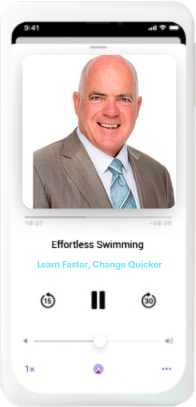
In this episode, professional speaker and author Glenn Capelli shares his expertise on learning better and making better decisions. He focuses specifically on how to improve swimming skills and mindset. Glenn discusses various topics he has studied throughout his life that can be applied to swimming, including getting into flow, maximizing the fun factor in training, using magic words to change approach, and developing small habits that lead to significant results. Tune in to this episode to gain valuable insights and tips for becoming a better swimmer.
Today’s podcast episode is also sponsored by Skillest. Exclusively for our Effortless Swimming podcast listeners, you can receive a free course, ‘The Art of Triathlon Swimming,’ and an online analysis through the Skillest app.
https://effortlessswimming.com/skillestoffer
In this episode
- 01:45 Swimming for Physical, Mental, and Spiritual Health
- 04:08 The Essence of Flow: Finding Mental and Metabolic Flexibility
- 07:14 Finding Flow in Swimming: When Time Becomes a Blur
- 09:51 Discovering Flow in Other Aspects of Life
- 12:54 Flow and the Power of Whole Brain, Whole Body Engagement
- 15:01 What is Autotelic?
- 20:13The Power of Shifting Language: Instead of ‘Have to’, Say ‘Get to'”
- 24:09 The Endless Journey of Learning: Upping the Challenge, Upping the Skills
- 27:50 Finding Beauty and Challenge in Swimming and Life
- 29:12 How Small Changes Can Lead to Success
- 31:09 Improvement of Life and Training: More, Less, Get Rid of, Throw In, Instead Of
- 34:45 Swimming is More Than Just a Sport, It’s a Path to Friendship and Social Circles
- 35:57 Connecting with Glenn!
Links from this episode
- LinkedIn.”>Get in touch with Glenn on Change your technique and swim a smoother, easier freestyle with the Effortless Swimming membership
- Want to work with me personally to improve your technique? Join my swim technique coaching here
This podcast is brought to you by NanoClear — our own range of anti-fog swim goggles, designed by Effortless Swimming with the anti-fog treatment bonded into the lens itself (not sprayed on, so it doesn’t wear off after a few swims). Check out the NanoClear range here and use code PODCAST15 for 15% off.
Transcript
Read the full transcript
So whether it’s swimming, you swimming, swimming, you coaching, when does time fly? When do you go, oh gee, look at that. It’s been, you know, it feels like it’s been five minutes and yet a half hour in a training session has passed. When does time fly for you? So I would ask every one of your athletes to yes, you’re using that constant feedback of times and data and what your garment or your Fitbit can tell you, but you’re also going, okay, what’s my theme for this swim? What’s my theme for this week? Oh, I can’t get in the water for six weeks. So what’s my theme for the six weeks? Welcome to the Effortless Swimming Podcast to show that help swimmers and triathletes love the water, become a better swimmer and live a better life. Here’s your host, Brenton Ford.
Welcome back to the Effortless Swimming Podcast. My guest today is professional speaker and author, Glenn Capali. He’s an expert on the topic of how to learn better and make better decisions. And on this episode, Glenn shares his knowledge on these topics and how you can use them to shorten the learning curve to becoming a better swimmer. On this episode, we discuss a range of different topics that he’s studied over the course of his lifetime that you can use to improve your swimming and change your attitude and mindset and your approach to your swimming in order to get better results. We talk about how to use and get into flow, that state where it feels like time stands still, and I’m sure you’ve felt this in your training and in your racing at times. How can we get into that quicker and use it to our advantage? We talk about how to maximize the fun factor with your training so that not only do you have more fun
and it becomes more enjoyable, but it also fast tracks your learning as well. And he talks about a couple of tweaks to your vocabulary and some magic words that can actually help you change your whole approach to swimming and change your whole approach to some of the things that you tackle in your life on a day-to-day basis. And we talk about how to develop small habits that compound over the course of several years so that you can end up in a spot that’s radically different than where you are right now. So let’s get into the episode with professional speaker and author Glenn Capali who is also an avid swimmer. He’s based down in Western Australia a couple of hours outside of Perth and he’s an avid open water swimmer. Let’s get into the episode. Here we are, Glenn, welcome to the podcast. Absolute pleasure to be here, mate. So Glenn, I know you’re an avid swimmer yourself. You’ve somewhat recently really gotten into it.
You’re down there on the coast of Western Australia and you love your open water swimming. How has getting into swimming yourself, has that impacted the way that you teach or has that opened up new things that you’ve discovered when you are speaking and presenting on stage? Listen, first of all, I can’t, all of my life, I couldn’t be near an ocean without going into it. So as soon as there’s a beach or moving water, I’ve got to get in there and be immersed. And I guess being immersed is everything that we’re about in what we teach in learning. So to really immerse yourself in what it is you need to learn. So it’s been wonderful applying all the stuff that I’ve been teaching for decades but applying it now to swimming and particularly ocean swimming, which I’m not able to get all the data from swimming laps because there are no swimming pools in Denmark, Western Australia, but there are some of the best beaches in the world.
So you’re swimming in context, it’s like running a marathon, the New York marathon one year is different than the New York marathon the next might be the same distance, but weather conditions and in swimming, current conditions and everything else. So how you get to flow with all of that is being magnificent. And what it does for me is I get down to that water and I am rejuvenated every single time. Sometimes you might think, oh, it’s cold or whatever you go in and you come out rejuvenated. And here in Denmark, you bump into people that are in their 80s and are swimming every day. You bump into Luke Longley more often than not and he’s swimming down at Greenspool. It’s just a magnificent environment and a magnificent thing to do for your physical, mental and let me say it, swimming is almost spiritual health, Brenton. I would have to agree. When through 2020, when I couldn’t get into the water and I couldn’t swim,
I felt like a piece of me was missing through that time. So to me, that really stood out because I’d never taken, I’d say longer than about a week out of the water since I was probably 12, 12 years of age. It was a long time there where I would be swimming at least once each week, but typically it would be three, four, five times. So I totally agree with you there. When we’re talking about the concept of flow, which is a big area that you focus on, for those that are listening, can you define that a little bit more or just explore what that is and how would we know whether or not we are in that state of flow and then why would we wanna get into it? What’s the benefit? Fantastic and certainly will. That whole thing about being out of the water for a while, I had to have an operation, I mean that for a couple of weeks I couldn’t get into the water. And one of the things about flow, and it’s not particularly mentioned,
but it really is one of the essences of it all. My mate used to be the president of the Dietitians Association of Australia and often he would talk about metabolic flexibility. So that in your eating, if you suddenly you’re an elite athlete and you’re eating all the healthy stuff, you’re drinking all the healthy stuff, you’re doing all of that and then you have a big Mac or something or a burger at Hungry Jacks and you feel as if you’re a mesh, you’ve fallen apart, then he says you haven’t got any metabolic flexibility and you need to have some metabolic flexibility. Now I think it’s beyond and what that means is instead of when you’re eating something that’s not your norm that you’re not so fragile that you fall into a heap, you’re not so precious and a lot of elite athletes and I worked with the ones who are gold medalists and whatever, a lot of the elite ones suddenly they get a minor injury, they’re not able to swim and they fall apart
or a marathon runner looks at themself in a mirror because they haven’t run for two days and got arm fat. And it’s almost like we need to have not only a metabolic flexibility but a mental flexibility as well. So those times when we aren’t able to get into the water we just see them, okay, this is a challenge for me to be more flexible as a human being. This is a challenge for me to broaden my scope and when I get back into the water, boy, isn’t it gonna be doubly magic? Isn’t it gonna be absolutely wonderful? And I guess the factor of flow and flow is not my invention as such, it’s the research of Mahaly Chikcent Machai and when I first met the man way back in 1980s, early 1990s, said, mate, how do you say your name? And Chikcent Machai, very guttural, Hungarian background, 40 years of research at the University of Chicago. And he says, when we are at our very best, we are in flow. And for swimmers, I mean, effortless swimming,
what you’re everything about is about flow and it’s peak performance, but it’s more than that. It’s happiness and health sustainably. So why we should embrace the concept of flow? Why we should embrace swimming or running or doing pottery or something that’s going to challenge us to keep on learning is because it gets us to own flow. Now, there’s some indicators, first of all, Brenton. So let me just ask you a question in your swimming and then also outside of your swimming. So whether it’s swimming, new swimming, swimming, new coaching, when does time fly? When do you go, oh gee, look at that. It’s been, it feels like it’s been five minutes and yet a half hour in a training session has passed. When does time fly for you? It is, I’d say it’s primarily in a main set that may go for somewhere between 30 to 60 minutes and it’s when I’m in the middle of a set and I’m starting to work hard or I’m really focused on the task at hand
when I’m looking at trying to maintain my speed, hit certain times, hit certain stroke counts and yeah, and I’m kind of churning through this main set. That to me is when time flies and I couldn’t tell you, I couldn’t really tell you how long it’s been because it all just seems to, it seems to be a bit of a blur looking back at it after that main set. So for me, it’s then or it’s if I’m in the open water, let’s say I’m at a Maldives camp two months ago and I’m just swimming around the island with the group and we’re looking at fish and we’re just sort of riding the waves and the chop. To me, that’s when it flies as well. So I’d say they’re probably the main ones when it comes to swimming. Okay, well just on that, we do a mile event here in Denmark each year at Easter time and about 150 people go in it and the first time I ever did it, that first 100 meters, 150 meters heading out to the first buoy and it was pretty wild conditions
and I’m gasping for breath and I think I’m never gonna be able to keep up this and it often is the way with flow, with running, swimming, probably even with cycling for triathletes. Initially, you’re not there in flow, you’re gasping and then you hit what Mahaley Csikszent Mahai calls that flow channel and suddenly your breathing’s fine. Suddenly your arms are going, suddenly your feet are going, suddenly everything is melding together. So and in my mind, when that was happening for me that gasping for breath in that first 150 meters and okay, it’s fine cap, you’re gonna get into that flow channel soon. Know that this is part of it and don’t let it spook you or panic you, you’re gonna hit that flow channel and bang sooner or later you do. Mahaley did say that it’s vital to have some stuff that is flow outside of your work, outside of what you do. So giving that swimming is so much a part of your life and so much a part of the people listening.
It’s great to have flow as swimming because it benefits you health wise in all capacities. But you gotta have something that is also flow outside of the water. So hopefully, I don’t know, when you’re with your kids playing, time should fly. So if you got something that you make sure you’re doing to remain a happy, healthy human being and particularly in that time when you couldn’t get into the water, were you doing other stuff that was flow aspects in your life and what are they because it’s vital. A lot of the driven people are only aiming at one thing and Mahaley says if it’s gotta be sustainable you gotta have more than one thing. You gotta have other stuff that brings your flow too. So outside of the water, Brendan, what have you got for people? I was just thinking then it’s primarily all sports exercise based, it’s surfing, running. I can very easily get into flow when I’m doing those things. And the then I was thinking as well,
even just mowing the lawn, just the act of trying to make this nice, clean, like short grass, make it look nice and following this pattern going around in a circle with it. Even that, I get a little, I feel like I get into flow with that or doing other things around the house and there’s a bit of a sense of achievement with those things but I think more than anything, why I get a kick out of it is because it’s like time seems to fly and I feel like I get into that state of flow but I’d never really thought of it that way necessarily because I’m just doing a job that needs to be done but hadn’t really considered it as having something outside of the pool to get into that state. Oh, you’re wonderful, mate because I lived on a kaboots in the north of Israel for well over a year and then again for a number of months and at a kaboots you’re painting a fence or you’re doing something and I say now because a lot of my life is flying
speaking at conferences, being in front of people you got to have some kaboots in your life. You got to have something that keeps you grounded, keeps your feet on the ground, painting the fence, mowing the lawn, doing the cleaning and I got to work with the high performance people who were in charge of the all blacks, the New Zealand rugby team and that’s why they, they’re elite athletes but that’s why they’re sweeping the floor at their place of training. That’s why they’re cleaning the benches. They’re doing some grounded kaboots like stuff but just to keep them not getting a big head not losing their ego but also it’s repetition of something where you can instantly see the reward. You can instantly see you’ve cleaned this and it’s better for you and it’s better for other people. So you’ve hit upon some of the aspects that are vital and again some of our elite athletes get so caught up in themselves and Mahaley Chikset Mahai says
you’re not in flow if you’ve got self-consciousness if it’s just all about you. In fact, when you’re in flow you’re forgetting about what you look like and yet your self-esteem grows. So you lose self-consciousness. You lose that I’m gonna take a photo of myself and put it on Instagram and you get into a self-esteem that grows. So time flies, you’re losing self-consciousness giving self-esteem and it is better he says no matter what you’re doing for the whole brain and the whole body to be involved. So for people who are sitting on screens for a lot of time to get up and move to use their physicality in some way and likewise, if you are swimming and it’s one of the ironies you’re in flow it’s happening for you but chances are you’re also counting your strokes or doing something that has got your brain involved. I mean often when I’m swimming I’m inventing my next presentation or designing it in my head. So have your whole brain, whole body involved.
And again, if you’ve got an injury that becomes difficult but make sure if you can’t move if you’ve got an injury in your legs and you can’t use your legs use your arms. Whatever you’ve got use it and that again leads us into flow whole brain, whole body involvement. And it is one of the things that Mahaley says it’s why people are attracted to sports because you know what you’re trying to do. As complex as swimming can be it can also be wonderfully simple. As complex as golf is you know what you’re trying to do and you know what you’re aiming at and getting that ball in the hole and you’re getting that constant feedback which is one of the agencies that can kick us into flow. So time flies, whole brain, whole body involvement lose self-consciousness. And now I’m gonna get you to be a dictionary mate. This is really putting you on the spot in front of the millions of people who listen to your podcast. I’m gonna give you a word
and you’re gonna tell me what you think it might mean. Okay? The word is spelled A-U-T-O auto and telek, T-E-L-I-C, auto telek. So if you’re a dictionary, yeah guessing’s a great and fun thing to do. So have a guess. What do you reckon it might mean? Before we dive into the rest of today’s podcast episode this episode is proudly brought to you by Form Smart Swim Goggles. They’ve been a long time sponsor of the podcast and they are my go-to goggles when it comes to tracking my training sessions and being able to see what’s happening in real time through the goggles. And we know swimming is a highly technical sport but without the guidance of a coach on deck identifying and addressing technique flaws can be a challenge. They’ve recently added a new feature to the goggles, Head Coach, and this addresses that problem head on. It gives swimmers improved access to their technique awareness, focus skill development and in-app education and analysis.
Head Coach provides real-time visual coaching via the Form Smart Swim Goggles augmented reality display. During and after a swim, Head Coach provides swimmers with technique feedback using two types of metrics, Form Score and Head Coach skills. Form Score is a measurement of overall swim efficiency ranging from zero to 100 defined by your pace and your stroke length. Head Coach skills encompasses five key areas that will help you identify where to focus on improving with your efficiency. Head roll, head pitch, set pacing, interval pacing and breathing time to neutral. And after completing a session, you can check back in on the form app to track your progress and Head Coach provides swimmers from beginner to expert with an unprecedented level of data-driven guidance and understanding, enabling you to boost your performance and your speed. Get your pair of Form Smart Swim Goggles today. Click the link in our podcast description
or use the code Effortless on Checkout to get 15% off your Form Smart Swim Goggles. This podcast is also brought to you by Skillist, the ultimate digital coaching platform that’s making waves in the swimming world. Imagine having the opportunity to train with Olympic and world champions like Kyle Chalmers, Ryan Murphy and Brent Hayden. Well, with Skillist, that dream is now a reality. Swimmers, you now have the chance to work with the absolute best in the sport, gaining insights and guidance from these elite athletes like never before. And Skillist isn’t just your run of the mill coaching platform, it’s a game changer. Here is what sets it apart. You can discuss training programs, receive detailed stroke analysis and even develop race strategies with these incredible athletes and coaches. It’s like having a personal coaching session with an Olympic champion right in your pocket. And excitingly, coaches from around the world
can also tap into the power of Skillist. Coaches can use Skillist’s amazing tools to train their students, analyze videos and incredibly connect with swimmers from across the world as well. So whether you are a swimmer or a coach, go to the app store, download the Skillist app today, that’s S-K-I-L-L-E-S-T, download the Skillist app today and get started. And only for our Effortless Swimming podcast listeners, we’re giving away our Art of Triathlon course free as well as a technique analysis online through the Skillist app from me for free as well. Go to effortlesswimming.com forward slash skillistoffer or click the link in this podcast description and you will get the Art of Triathlon swimming course for free as well as a technique analysis from me through the Skillist app. And now back to the podcast. I’m gonna think, I’m thinking down towards a telepathy sort of path like auto-telec would be something along the lines of being able to,
it’s almost like receiving messages or being aware of things without thinking about it. So subconsciously, how did I do? I think you can possibly hear everyone listening to your podcast, cheering and clapping and acknowledging, not because you are correct, but because it was a good guess. Auto-telec is one of the great words and again, it comes back to, to accept my high, auto-self and telec, the feeling of things. So auto-telec means it becomes enjoyable for its own sake. It becomes enjoyable for its own sake. So you’re doing something because you have to do it for work, but after a while, oh, I really enjoy this. I love doing it. I would do this even if I wasn’t paid to do it. Oh, you’ve got to do certain drills in training because it’s building up a certain movement in your arms. But after a while, it’s like, hey, this is good. So the thing with flow is that you might start off by doing it with a particular purpose,
but you then end up doing it because you just love it. You know, you might be swimming because you want to get healthier or fitter or whatever it might be, but you just then absolutely love it. And it’s one of the great motivators. It is the fun fact, you know, that as difficult and as complex and challenging as stuff is, when we really embrace it, oh, it becomes fun and to get a little bit better, it becomes fun. And I know you’re a fan of James Clear and the atomic habits. So one of the things I love in his work and that we teach in all of our programs is, it’s an instead of. So my roommate and my kibbutz was a Ukrainian and they would talk with a Ukrainian accent, more of Lysov. And instead of saying, I have to go to training today, I have to do these drills or I have to do this recovery stuff, it’s rubbing your hands together and saying, oh, I get to swim today. I get to do my drills today. I get to, and it’s a slight shift in language
that makes all the difference in the neuroscience of our brain. So, and the interesting thing too, with Mahaly’s work, then I did ask him about this because we used to teach a thing in our youth program, which went, the brain loves a challenge. The brain loves a challenge. So I like chanting. We worked on summer camps in America and they all begin to chanting. The brain loves a challenge. And Mahaly, and with Marion Diamond, one of the first women in neuroscience, she said, Glenn, it’s not necessarily correct. The brain needs a challenge. The brain needs a challenge. The brain, and after a while, when you need that challenge and you embrace that challenge, then I think you get to love that challenge. And that’s what we teach kids in terms of grit and determination. That’s what we teach CEOs, but love being challenged and fully embrace it. And then it’ll become enjoyable for its own sake. It’s auto-telec. It’s funny you mentioned that.
I had a podcast recently with another swim coach, Andrew Schaffin. He was talking about how to improve your stroke efficiency, improve your catch and pull, and he just threw out an example of, let’s say you’re taking 20 strokes for a lap and you want the swimmer to be able to improve on the catch and pull and hold the water a bit better, feel it a bit better. So you say, I don’t care how you get down there, but I just want you to take 10 strokes instead in this lap. Like just that alone, just that challenge of trying to go from 20 to 10 as an example, like that gives you some purpose, it gives you some meaning and it gives you something you can just start to attack and put your mind to. And even though that’s something very simple and in the grand scheme of things, probably doesn’t mean a whole lot, but it’s those little challenges like that that can really make the difference between feeling like you’ve got a reason
for doing something, it gives you that purpose and yeah, it doesn’t have to be a whole lot. Often it’s those small challenges like that that can be very rewarding and enjoyable to do. And something I’ve been doing a bit lately is I’ve started running again quite a bit more and just one of the things that I want to do most of the time is trying to do 10K each time I’m running and I want to try and find new places to explore and just that little challenge of 10K, find somewhere else to run, that just gets me at the door and I really enjoy it even if it’s like the run might not be that different but I just want to find some new streets and some new places to go and that’s enough to kind of get me doing it. So, and it makes me think of the times where I’m, if I feel a little bit lost or maybe a bit directionless, it’s when I haven’t got those challenges set out or I’m not clear on what they are and not clear on the thing that I’m working towards
even if it’s just a small thing. Magic and it’s athletes understand flow. They may not know what it is. They may have never heard of it before or defined it in this way but they’re flow based people. There’s an Alaskan wisdom. Now there’s two Alaskan wisdoms. The first one Frank Zappa wrote about which was don’t eat yellow snow which I don’t think you really should think about too much but the second Alaskan wisdom comes from a friend of mine, Rosella Wallace and she says variety is the magic key. The magic key is variety. And one of the things with flow is that you, yes you need to have a little bit of variety. Repetition is vital but as you’re saying when you change things a little bit when you take a different pathway or your friend coaching says listen let’s see what you can do in 10 strokes. It is what we call a wide zen. So how else? You try a how else? And we built, we discovered or invented the word wide zen
after the wonderful word kaizen the Japanese word which is kaizen is a little bit, a little bit, a little bit, a little bit of improvement every day. Tiny little improvements but as well as that how better kaizen we need the how else, the wide zen and that keeps it training interesting that keeps, it gets our body to be more flexible in different ways and try different things and situations or circumstances. So the, and what Chik-Sent Mahai says is that puts you into that challenge zone which is how better how else, how better how else constantly upping your challenge and upping your skills upping your challenge, upping your skills. So you never feel that you’ve actually you’re there. It’s like when you get there it just opens the door that there’s a whole stack more to learn. I mean, people think I was swimming I learned how to swim when I was a kid but when you start to unpack swimming boy it just opens another door
and another door and another door. There’s always more to learn. And the elite athletes that we’ve worked with and admittedly usually it’s on stage and they’re there talking about their successes but it’s those folk who they weren’t just about aiming for I’m gonna win this or I’m gonna get that world record time yes they had a name they had a target but they had a theme for what they were doing and you use the word purpose they had a purpose that was bigger than just a time or just bigger than one gold medal. The purpose was they were gonna maximize their talent or they’re gonna be the best that they can be as a swimmer and as a human being. So I would ask every one of your athletes to yes you’re using that constant feedback of times and data and what your garment or your Fitbit can tell you but you’re also going okay what’s my theme for this swim? What’s my theme for this week? Oh I can’t get in the water for six weeks
so what’s my theme for the six weeks? And my purpose is always to come out as a better, stronger, happier, healthier human being for myself, for my partner, for my family. So you got a bigger purpose than the achievement of a singular goal or aim or target and that bigger purpose will help you achieve the aims, the goals and the target. So upping the challenge, upping your skills why people get you involved go why we have coaches and constantly how better how else and that how else is a bit of a fun thing too. It’s like okay I’m gonna shift my training a little bit by doing this or I started to because I was doing so much timing on my swimming I’d read Roger Deakin’s wonderful book Waterlog and Deakin as you probably knows the guy who swam through a lot of rivers and things throughout England and he swam at what he called a frog’s eye view of the world which was breaststroke. You’re looking just above the water
and you’re seeing things. So I started to throw in some of my time swimming as frog’s eye view of the world. Here I am down at greens I’m looking at trying to get my pace up I’m working through that but then for a couple of hundred meters just breaststroking, noticing all of those rocks around me noticing all the wonderful things that are happening noticing as it happened one day the hail hitting the water as I’m swimming it is beautiful and ultimately one of the factors of flow is that it should be beautiful for you. So sometimes as fast as you are slow down sometimes as much as you’re doing this kind of training something else. So a little bit of that how else the challenge zone upping the challenge, upping the skills kaizen, wide zen little tweaking you can do and it’s not only in swimming it’s in life itself and it’s in business sometimes a few little tweaks can make all the difference.
Yeah those very small things it’s great to think big and set your sights on something big and work towards it but really comes down to those small improvements in different areas over time and chatting with Carl Chalmers who he had on the podcast a couple months ago he was talking about his turn and his start how that previously that’s been very weak for him it hasn’t been a strong suit so he’s just been working on improving his turn and his speed out of the turn and into those first couple of strokes and just over the course of 12 months 24 months just ratcheting it up and continuing to get a bit better get a bit better with it and I think it’s the same thing with like even with this podcast for example I sat down with my team last week and we said all right what can we do to make this better? How can we make it more engaging for the listeners? How can we get guests that are going to help the people that are listening more
and what can we do just to make it that a little bit better? And just by asking the question we’re able to come up with a couple of changes and improvements that hopefully people are starting to notice now and that challenge itself is like really invigorated me to wanna make the podcast better and it’s really got me kind of inspired to look for other areas of effortless swimming that can do the same thing and so I’ve started looking at our YouTube videos and how do we make those a little bit better and then the same thing with the clinics it’s where can we tweak things by 1% and hopefully improve them and give people a better result so I think that’s the essence of a really enjoyable life is having or wanting to just continue to develop and get better so it’s played a big part of effortless swimming for the last 15 years or so that we’ve been around. I know you speak about a number of topics to different groups.
Is there anything else that kind of stands out to you that you think would be beneficial for swimmers or triathletes listening to this podcast? Indeed and a couple of things just on what you said I mean, we’ve worked with Lisa Curry-Kennie on a number of conferences and Lisa of course a magnificent swimmer but when she was speaking she dedicated herself to being the best speaker she could be. So you take that approach, you know so for years not just about what you’re doing in terms of swimming but in terms of what you’re doing for your business you know, you’re looking at the flow that the second thing that attention the bigger picture I got to interview Sir Richard Branson on stage for 90 minutes because Richard doesn’t do speeches because of his dyslexia. He prefers an interview. My brother Gary wonderful business person good swimmer too is dyslexic and a lot of the dyslexic folk they struggle with reading and writing at times
but they’ve got an amazing ability with the bigger picture to do a really big picture with attention to detail within everything within that bigger picture. So I think we all need to become dyslexic in some way as we approach things bigger picture with attention to detail. And one of the things we do to help people with all of this is because of my Ukrainian roommate in the north of Israel and one of the world’s leading geophysicists his name is Zhenya Lander and he used to talk about all we need more of the air conditioning in this room so I would mimic him and go more of and now we teach people when you’re looking at your team sitting down you know, how can we make this better? What can we do more of that we’re already doing well but a little bit more of will help us and then the second Ukrainian his brother Lesov and Lesov might be equally even more important. What should we be doing Lesov with our diet with our movement, with our training, with our business
with our podcasts that can make it more enhancing? So I taught more of and less of and then to get less of sometimes you need to get rid of. There’s certain behaviors of mine certain behaviors of physicality certain behaviors that we need to stop doing we need to get rid of and the brain can be a very addictive thing so if you’ve got an addiction that’s very unhealthy then switch to swimming that’s far more healthy as an addiction more of, less of, rid of then because we were teaching innovation we came up with toss in what new things are you gonna toss into the brew? So for all of your swimmers or your athletes what new things are you gonna toss into the brew? They’re gonna help you be a happier, healthier more productive, more prosperous human being and then the other one that I mentioned earlier the instead ofs instead of I have to, I get to instead of the brain loves a challenge the brain needs a challenge and then it gets to love the challenge.
So I would say that every one of us can sit down with our youngsters and go through okay for us to be a happier family what do we more of, less of, rid of toss in and instead of for us to be better swimmers and as you learn the stuff that helps you be a better swimmer I think it can also help you be a better human being in life because flow really is the psychology of optimal happiness yes it’s the psychology of optimal performance but it is the psychology of optimal happiness.
And that’s why the introduction to this podcast is to help you become a better swimmer and live a better life I think the two things are certainly intertwined and that’s why I do what I do that’s why I teach swimming is because yes it’s great to get faster at it but I think just the ability to move through the water with ease and grace and to do it for long periods of time that in itself can lead to a lot of happiness and fulfillment and it can lead to making friends and joining social circles that you will be a part of for a long time and that’s just the start of it and I mean I’ve made a lot of great friends through the camps that I’ve run before and not only that but when I was training as a teenager I made a lot of good friends through that too and it’s much more than just a sport so that’s why I like to do what I do and a big reason why I started effortless swimming so Glenn I really appreciate you jumping on the podcast
to share some of these concepts with us and I really appreciate that you reached out and were able to share it so for those that are listening what’s the best way to either get in contact with you or find out more about what you do? Probably the best thing is just to go under LinkedIn and find Glenn with two Ns Mum said one N came from Glenn Miller one from Glenn Ford a musician and an actor Capelli C-A-P-E-W-L-L-I so yes, LinkedIn is great and sipped through a message to me and I’ll sipped through my email for everyone Glenn at GlennCapelli.com but you know, Brenton you mentioned the grace I think swimming and flow and what you’re doing is an amazing grace and it’s that amazing grace that we all need to discover in life no matter how many gold medals to be a grateful, gracious human being is that’s the sustainable factor Yeah, I love it Glenn thanks so much for your time I appreciate it and for anyone listening if you want to reach out to Glenn
we’ll include those links in the show notes and yeah, it’s been a good time thank you Glenn thank you mate thanks for listening to the effortless swimming podcast if you’d like us to help you become a faster more efficient swimmer go to www.effortlesswimming.com