







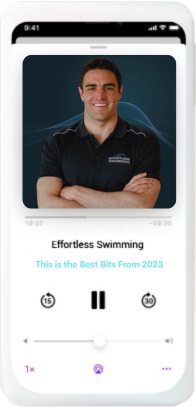
Have you ever wondered what makes certain podcast episodes stand out, becoming favorites among listeners? Join us as we explore the most impactful episodes from this year on the Effortless Swimming Podcast. From overcoming mental barriers to training secrets of Olympic athletes, each episode has left a lasting impression on our listeners. Reflecting on these conversations, we’ll uncover the wisdom and experiences shared by our guests and the valuable life lessons they offer. Gain insights into what made these episodes popular and discover the secrets that set them apart from the rest!
Today’s podcast episode is also sponsored by Skillest. Exclusively for our Effortless Swimming podcast listeners, you can receive a free course, ‘The Art of Triathlon Swimming,’ and an online analysis through the Skillest app.
https://effortlessswimming.com/skillestoffer
In this episode
- 00:32 EP #267: How To Adapt Your Stroke For Triathlons with 70.3 World Champion Tim Reed
- 05:55 EP #272: Swim Softer To Go Faster with Brant Best
- 10:37 EP #279: How Swimming Instills Lifelong Discipline with Pro Triathlete Joshua Lewis
- 17:14 EP #286: What It Takes To Win Olympic Gold And Break Worlds Records with Ryan Murph
- 25:19 EP #278: Using Stroke Rate, DPS and Consistency To Transform Your Swimming with Brian Johns
- 30:19 EP #263: A Simple Guide To Finding The Cause Of Your Technique Errors (Not Just The Symptom)
- 32:52 EP #275: Mental Hack for Marginal Mental Gains with Dr Jim Taylor
- 37:05 EP #288: How Olympians Use Underwater Filming And Analysis with Kyle Chalmers
- 41:35 EP #276: On A Mission To Complete The Oceans Seven in One Year with Andy Donaldson
- 44:48 EP #293: Swimming Secrets With 4x Olympian Brent Hayden
- 50:22 EP #298: Maintaining Your Competitive Edge For Life with 5x World Champion Craig Alexander
Links from this episode
- Change your technique and swim a smoother, easier freestyle with the Effortless Swimming membership
- Do you want to work with me personally to improve your technique? Join my swim technique coaching here
This podcast is brought to you by NanoClear — our own range of anti-fog swim goggles, designed by Effortless Swimming with the anti-fog treatment bonded into the lens itself (not sprayed on, so it doesn’t wear off after a few swims). Check out the NanoClear range here and use code PODCAST15 for 15% off.
Transcript
Read the full transcript
Welcome to the Effortless Swimming Podcast to show that help swimmers and triathletes love the water, become a better swimmer and live a better life. Here’s your host, Brenton Ford. Welcome to episode number 311 of the Effortless Swimming podcast. Today is a highlight reel of our last 12 months on the podcast based on our most popular episodes. So those that got the most downloads, as well as some of my personal favorites and some parts that I found insightful, inspiring, eye-opening, some of my favorite bits from the podcast throughout the year. So let’s get into it. The first highlight is from episode number 266 with former professional triathlete and triathlon coach Tim Reed discussing the changes that he had to make in his open water swimming so that he could make the front pack because he said he had the speed in the pool, but wasn’t able to match it in the open water until he changed this. Yeah, I wasn’t sure how much he touched on this before, but
it was something I thought, I should bring up. But when I first year or two I was racing pro, I was swimming faster in the pool than I ever did later in my career. And I could not make the front pack. And I was trying to swim like a swimmer. And I actually got so frustrated with it. I went to LA and started training, did a block of training with Jerry Rodriguez over there. And the first thing he did when he saw me swimming, he’s like, you got to stop trying to swim like Ian Thorpe. You’re not flexible enough. You don’t have the feel for the water. What you have is a high VO2 max. So you just need to get your stroke rate from 65 to 75. And I think you start making the pack. And that’s literally what we worked on. I just just rated up. It looked a lot more messy. But especially when you’re in the bubbles of the people’s feet in front of you, I didn’t I didn’t have that range of motion anyway, to get a really nice catch at the front. So by getting that
faster turnover, I was getting an extra 10 strokes per minute. And I wasn’t falling off the back of the pack anymore. And I left that six week block in LA and every race for the rest of the year, instead of getting out two minutes behind the pack, I was riding the race from the start. And I think yeah, it’s probably you might be able to speak more on this than me. But I feel like the open water swimming, especially on feet, the how pretty it needs to look is secondary to the just the basic physics of pushing water behind you. So yeah, so so true. And actually, I sort of went through a similar thing where my background was was competitive swimming in the pool. And then I started when did I start tries? I think I started tries in 2015. But I sort of started doing open water swimming from about 2008. And the evolution from say 2008, where I was at a pool from over the next eight years or so, just my stroke started to get
scrappier and scrappier. And but I was doing really well in the open water and I had some really good swims in the few triathlons that I did and open water races I was going well. But then I’d also do this one pool race every year, touring country champs. And I had a friend who’s a very good pool swimmer who was on the Olympic team and he coaches a lot of good swimmers. And he saw me swim the 400 freestyle and he goes, That looks hideous. That looks your stroke looks so bad. And I’m like, I’m thinking like, All right, that’s a kick in the guts, but you’re right. It looks like an open water stroke. And it just it wasn’t pretty in it. It wasn’t that quick either in the pool, but it was so good for open water. And I found it hard to sort of have those have those too, because I’ve just gotten so used to swimming for the open water. But yeah, it did not look good. It wasn’t that quick in the pool. People aren’t on feet. I’m interested, in your
opinion, why is it that that scrappier stroke seems to work pretty well? Like, is it because of the chop and the currents? Or is it the high buoyancy of salt water? Or well, I think all my races, I’d say we’re with a wetsuit on. So you’ve got that that buoyancy. And then obviously the salt water as well, where you’re just better off having that faster stroke rate, because you’re just sitting so high in the water that you can sort of get the stroke rate up and you need to get to come over quickly. You can’t do it with this Ian Thorpe like recovery, you just better swinging that hand over the top, getting it in. So I think that’s partly where that scrappiness comes on. You’re taking to just even in a wetsuit to have that neoprene around your elbow to then do that high elbow catch. I find it a lot of our athletes, we really go, you know, go for almost a straight on recovery or just to relax whatever feels natural recovery in your wetsuit. And
if you want to go high elbow and pretty in the pool, that’s fine without one, but it’s just too hard in a wetsuit. Yeah, yeah, that’s right. And I mean, yeah, pretty much with the wetsuit on as long as you’re not swinging really low and flat over the water where it’s causing this sort of side to side movement, it doesn’t matter too much how you’re coming over as long as, yeah, as long as you’re not too low, low and flat there. So it’s something I learned as a as a coach, originally coaching pool swimmers to then coaching triathletes and open water swimmers. And I think, and I see a lot of coaches going through the same thing that I went through coming from a pool background where there’s a lot more emphasis on looking good, being smooth, all that sort of stuff. But yeah, you’ve just got to have some other allowances there for the triathletes. And that’s such an interesting story about you going to see, see Jerry there and actually had Dan
Atkins on the podcast who coached a lot of the ITU guys, guys and girls in Australia and he had Michael Bol next to him, who’s probably the best Australian swim coach at the moment. And Boley said to him that with these athletes like they haven’t got the range of motion, the technique is okay, but they’re not going to be swimming like swimmers. So just get them as fit as you can to swim as they need to swim. Don’t, yeah, don’t worry about trying to perfect everything with their stroke. Just get them as fit in the pool as they can. And that’s what’s going to help them be really, really good ITU swimmers.
Next up, we had episode number 272 with Brant Best, who has coached swimmers at the highest level here in Australia. And in this episode, Brant discussed the concept of softness in swimming and how it relates to optimal tension and power. And it’s a way to think about conserving energy while maintaining maximum speed. Now you mentioned softness there. Do you want to talk about what you mean by softness? And I want to sort of preface this with how to send an email to me this morning. He’s sort of struggling to go beyond that 100 meters without feeling totally, totally gassed. And in his email, something he mentioned was the first 25, like I feel good, I feel lots of power in my, in my catch in my pool. And I’ve asked him another question, which I’m waiting for him to reply, how much effort are you putting into that, that catch in pool? Because if every stroke is like a maximum effort each one, that is not sustainable, no matter how, how good
you are. So when you talk about softness, what are you talking about there? We’re talking about myths and misconceptions. I think the myth is that the maximum amount of power you put on the water and also the maximum tension is going to produce the maximum speed. And that’s, we know that’s not the case. Look, it might be the case over 15 meters. We’re even finding that’s not the case, even over surely this is like that. But if you have maximum tension, I can’t stand here and hold my fist closed of maximum tension for 47, 48 seconds without getting very, very tired and running out of juice in my shoulders and in my hands. These guys have got their physiological range of responses happening. And they’re trying to do that from the start. So for me, the tension needs to be optimal rather than maximal. And then when we’re looking at extent, extending that across and you’ll see I might be going a minute or a minute 10 or even 50
I was like, observe it. He’s very, very good at going 50 seconds. You can’t hold maximum tension. You can’t probably even hold eight or nine out of 10 tension for that amount of time. So you’ve got to find the right amount of tension in your hands to extend across the race. So obviously we don’t want to have zero out of 10. Did something recently with a team where we dropped their attention to about six or seven. And they were only going to slower over 25 meters because they were setting better body position. They had a better length of stroke because they traveled better because they weren’t gripping and switching off their deeper controlling muscles. They are able to access better muscles in their core when they’ve got a little bit of control, their strength, their stroke length increases, their stroke rate holds on as well. So the basic technique are maintained and probably enhanced by defining that optimal
level of control through the first part of your race. It’s a long answer to a short question, but that’s what I mean by softness. It’s not complete softness, but it’s just finding and testing out what the optimal range is. So with that, when we’re doing this exercise, whether it be on a clinic with swimming Queensland or one of these camps with swimming Australia, we’re finding out what optimal is. For me, if the swimmer’s swimming at 12 seconds through the first 25 and they’re at maximum force and then they have a crack at one and they might be 7 out of 10 and they’re 0.2 slower, I’m happy with the 0.2 slower because we’re going to gain much more than that on the back end of the race. We might gain a second on the second 50 and I’m happy to give up 0.2 of a second to gain one second on the back of the race. So it’s just about finding where that sweet spot is to be able to come home at the speed that you want. And is this them judging
their own force, tension, like their perceived tension? Yeah, it’s hard to judge and it is a trial and error. I spent some time with one of our very good clubs in Brisbane yesterday, working this out, just going through 30m sprints yesterday, caught them sprints because we started going, they tried to go very hard at the beginning and we found that they went equally hard if not faster, a little bit lighter. So it is a trial and error thing. We’d like to be able to quantify it as closely as we can. We’re finding out with our swim better devices that we’re working out that peak forces aren’t exactly what we’re after if we’re going to get peak speeds as well. What we’re also finding is that the peak forces that we’re seeing when there’s maximum application. We get higher peaks but we don’t get the width of impulse. So we’re looking at our force versus time curve, which is my go-to, which I love looking at. We want to get maximum volume under
the curves we can. When I’m looking at the swimmers that are putting maximum force and we’re getting really high peaks, we’re also getting gaps in force through the middle of the stroke, which are easily identified and quantified and honestly so far when the athletes look at it, they can’t believe what’s going on. And it’s not a question as to whether they are or they aren’t losing force. They can see where it is and they can fix it a lot more quickly and they buy in a whole lot more quickly, which I think is super important when we’re trying to sell this concept to our athletes. So again, going a little bit deeper than the question asked, mate, but yeah, quantifying that is massively important.
Up next we’ve got professional triathlete, Joshua Lewis. On episode number 279, he and I were discussing the importance of putting yourself out there and pursuing something that maybe you’re not very good at in the beginning, but how taking that risk and making those scary decisions that feel scary at the time can lead to the personal growth and the enjoyment that at that time you may not have thought was possible. Yeah, it’s interesting. It makes me think back to when I first started coaching. So I was at university first year and I was living on campus at Melbourne University and they had a swim squad that was training twice a week and the coach there was finishing up and someone I think said, oh, look, they got a coaching role there. You knew how to swim like you’d be, you might be good at that. So I took on this coaching role and my dad was or is a swim coach. My granddad was a swim coach as well, but I never thought
I’m going to be a swim coach. It hadn’t entered my mind, but I did like teaching people. I did like working with people and I think my brain was very much oriented in that kind of direction in the teaching coaching. Anyway, that’s what I really enjoyed just based on school. I wouldn’t shoot a people, but I helped them with different subjects and stuff like that and I really enjoyed it. And then so I got this coaching role twice a week, enjoyed it. One of the swimmers there said, oh, we’ve got a masters club. Our coach there is leading. We’d love you to come and see if you want to do it and ended up coaching seven sessions a week there for about eight years. And at that time I started effortless swimming while I was at university and then just sort of started that while I was coaching for about 12, 13 hours there at this masters club. And yeah, like same thing. I just sort of fell into it, but realized that I loved it and
then just see what you really enjoyed doing and you just sort of follow that follow that path. So yeah, for me as well, it wasn’t just an active decision where I’m like, all right, what do I want to do with my life? You’re just especially at that age, you just got to figure out what it is that you good at what you like and how you like to think and what you’re doing at the moment is teaching architecture at university. And so you obviously sort of thinking that way as well. And you’re coaching triathletes as well. So you probably very similar sort of mindset to mine, I imagine. Yeah, I’d say definitely very similar. And the way that you describe well, I say falling into it. And I realized that I explained my transition into professional triathlon is falling into it as well. But it’s far more, we should give ourselves more credit, I think, because we’ve both put ourselves out there to do things which we thought we might be good at
or had an interest in and actually pursued it. So I think that I always forget that I’ve put myself in the position to do these things. And it was that is falling into place and things like that it’s actually far more you’ve given yourself the opportunities you put yourself out there, you’ve explored what you might be interested in. And I mean, I’d never have it any other way. I’ve definitely I’ve definitely never been shy to put myself in positions like try and help other people. I was always like putting myself out there to like be a year rep or tutor people before I started actually tutoring after university. It was there was an option to I think tutor younger years and I would always like put my name forward just because I enjoyed it. And then yeah, it was again almost a seamless transition. I went for an interview at university, not for tutoring necessarily, but I think it was for a graphic design role. And then they
were just like, oh, no, actually, we’d prefer you to tutor if that’s okay, your skills are more apt for that. So I was like, amazing, literally amazing. That was what I’d prefer to do anyway. So it was like again, falling into place, but you put yourself out there for the interview or whatever it was. And that’s where I really, really put my passion for teaching, which I very much find similar to coaching. I think we were saying before like, teaching and coaching is a very similar sort of thing. You’re just delivering information to people in a way that they’re able to understand it and then also execute it. So yeah, like for the coaching side of things and teaching, I absolutely love the puzzle of delivering information to different people in different ways, so that they can actually achieve their goals. So yeah, no, it definitely sounds a similar sort of kind of trajectory as to what you found with your teaching and coaching.
And I also have to remind myself that people who are starting out swimming and it’s the same thing with triathlon is that can be a very big step for them if they don’t have a background in any of the sports or even if they’ve got a background in running, but they’re new to swimming or to cycling. It can be quite nerve-wracking for them. It can be, people can be quite reserved and very conscious about how they look or in the water, what they’re doing, those sorts of things. So getting into a sport like swimming or triathlon can be a big life decision for people. So just I have to remind myself that like not everyone’s comfortable or confident walking into the pool and like you don’t know how it works in the beginning. You don’t know that you’ve got to go around in a circle and get in the right lane and all there’s all these little rules that we have to learn. And so even just some of those basic things can be life-changing for people
when they learn them. And in terms of putting yourself out there, I think it’s like those things that you hesitate to do that are a little bit scary are the ones where you look back and go, I’m so glad I did that. And some of those ones for me were when I started this podcast, which was about, I think it was about 10 years ago now, like this was before podcasting was cool. I started the podcast because my coach said, look, you should do a like start this podcast. And I was like, so I thought about it for six months. And then I’m just like, I’ll just whatever, I’ll do it. And I had a guest, Michael Clemont, who’s an Australian Olympian. And he was my first guest. And I was so nervous talking to him. I was just asked, I was there like an interview or just asking questions. And there was no, no back and forth because I’m just like, I’m just who wants to listen to me first of all. And then I can’t believe this Australian champions decide to come on my podcast.
But I’m so glad I did because had I not taken that step, we wouldn’t be talking. Most people probably wouldn’t know about effortless swimming. And I wouldn’t have developed and grown as a person and as a communicator. And I’ve learned so much from this podcast with guests I’ve had on and just improved my communication skills because of this. And we’re nearly 300 episodes in. And I’m just so glad I took that step. So it is those decisions that can be a little bit scary initially that you often look back at and go, God, I’m glad I did that. On episode number 286, we had Olympic gold medalist Ryan Murphy. On this episode, Ryan discussed how in the early days of his career, he was very much driven by wanting to compete and beat the top semis in the world. But in recent years, that motivation has shifted and it’s changed. Has your motivation changed in the last five to 10 years? So sort of in your earlier days of your career, do you feel like you were
driven by different things than you are now? Oh, totally. Totally. Yeah, I mean, I think in leading up to, you know, leading up to the 2016 Olympics, like it was, I was just like a young buck. Like, you know, I just wanted to get out there and race. Like, and then in the improvement curve was, was sort of see it that it, you know, every time we got into the water, it was like, all right, I’m going to best time here. That’s, that’s going to be, that’s going to be a good race. And so the motivation then was like, all right, I’m chasing. Like, I want to, I want to do some of the things that, you know, Ryan Lochte and Tyler Cleary were doing in the 200 back. I want to do the things that Matt Griebers and David Palmer are doing in the 100 backs, really like studying how they are doing things, trying to do, you know, trying to be like, create a player mode. Like growing up, I love playing Madden. And like, you could create a player however you want.
And I kind of view the way that, that those guys were doing things as a menu. Okay. What can I learn from Lochte? Like, what can he, what, what can, what does he do that I can do? And what are some things that I would maybe want to do a little bit differently? And you kind of, you look across enough good swimmers and you can make those, make those decisions in that way. And I would say coming off of, you’re not coming off of 2016, leading into 2021. I think my confidence got to the point where it’s like, all right, like, you know, it’s a little bit, it’s a little bit more on me and like, I’m trying to optimize me. So like, what am I doing that I think I could do a little bit better? And you do look at other swimmers to, to figure that out. But it, but it becomes like every, every person is want to lean into your relative traits instead of just copying what other people are doing. And then I would say now, like where I’m at is, is I’m really interested
in all of the things that correlate with a good performance. So, so looking at really like a lifestyle of success and all of the things that I could do to help myself have a great performance. Can you talk a bit more about the lifestyle of success that you mentioned there? So, are you talking more things outside of the pool? Just how you go about your daily life? Is it a bit more of a, like a, not a wholesale approach, but like a, a bit more of a, looking outside of just a swimming portion of, of your daily life? Sure, yeah. So, I mean, like when you’re, when you’re looking at swimming, I think there’s, there’s a tendency to, I mean, obviously first we’re going to look at like your, your physiology and your technique. So like, am I in great shape? Am I swimming the most efficient way possible? And that’s like, obviously, a great place to start. But I think that’s like, I think that’s kind of just like baseline, like at the Olympic level,
like everyone’s in incredible shape and the majority of people have also really good technique. And so like beyond that, like what are the things you can do to, to be even better? And so like, then you’re parsing apart, like, okay, what’s my nutrition look like? What’s the optimal, what’s the optimal, like eating plan for me? Like, at what times of the day, what, what types of, what types of meals I’m, am I eating, what are the macros in that meal? How has that changed throughout the season on the recovery side? Like, am I, am I doing the right things to recover practice to practice? And really looking at the different ways to do that. So, are you someone that responds to, to massage better or physical therapy or chiropractor? Like there’s, and then there’s so many products that are coming out to also help with, help with recovery. So it’s like, what do you, what do you hyperize come out with? Like, is that, is that a product that I should use
on the, you know, the mental fitness side, like you definitely want to walk behind the blocks with, with a clear mind understanding your strategy on the sleep side, just making sure that you’re staying on top of it and, and really like digging into that and making sure that you’re not,
that you’re not over treating in any kind of looking at, at things through that lens. So, I mean, those are just a couple of examples, but like everything you do in the day does impact performance. So most, I mean, throughout the day, like it’s honestly subconscious for me now, but like, a lot of decisions are made with performance in mind.
Before we dive into the rest of today’s podcast episode, this episode is proudly brought to you by Form Smart Swim Goggles. They’ve been a long time sponsor of the podcast and they are my go-to goggles when it comes to tracking my training sessions and being able to see what’s happening in real time through the goggles. And we know swimming’s a highly technical sport, but without the guidance of a coach on deck, identifying and addressing technique flaws can be a challenge. They’ve recently added a new feature to the goggles, Head Coach, and this addresses that problem head-on. It gives swimmers improved access to their technique awareness, focus skill development, and in-app education and analysis. Head Coach provides real-time visual coaching via the Form Smart Swim Goggles augmented reality display. During and after a swim, Head Coach provides swimmers with technique feedback using two types of metrics, Form Score and Head Coach skills.
Form Score is a measurement of overall swim efficiency ranging from 0 to 100, defined by your pace and your stroke length. Head Coach skills encompasses five key areas that will help you identify where to focus on improving with your efficiency. Head Roll, Head Pitch, Set Pacing, Interval Pacing, and Breathing Time to Neutral. And after completing a session, you can check back in on the Form App to track your progress. And Head Coach provides swimmers from beginner to expert with an unprecedented level of data-driven guidance and understanding, enabling you to boost your performance and your speed. Get your pair of Form Smart Swim Goggles today, click the link in our podcast description or use the code Effortless on Checkout to get 15% off your Form Smart Swim Goggles. This podcast is also brought to you by Skillist, the ultimate digital coaching platform that’s making waves in the swimming world. Imagine having the opportunity
to train with Olympic and World Champions like Kyle Chalmers, Ryan Murphy, and Brent Hayden. Well, with Skillist, that dream is now a reality. Swimmers, you now have the chance to work with the absolute best in the sport, gaining insights and guidance from these elite athletes like never before. And Skillist isn’t just your run-of-the-mill coaching platform, it’s a game changer. Here is what sets it apart. You can discuss training programs, receive detailed stroke analysis, and even develop race strategies with these incredible athletes and coaches. It’s like having a personal coaching session with an Olympic champion right in your pocket. And excitingly, coaches from around the world can also tap into the power of Skillist. Coaches can use Skillist’s amazing tools to train their students, analyze videos, and incredibly connect with swimmers from across the world as well. So whether you are a swimmer or a coach, go to the app store,
download the Skillist app today, that’s S-K-I-L-L-E-S-T, download the Skillist app today, and get started. And only for our effortless swimming podcast listeners, we’re giving away our Art of Triathlon course, free, as well as a technique analysis online through the Skillist app from me for free as well. Go to effortlesswimming.com forward slash skillistoffer or click the link in this podcast description. And you will get the Art of Triathlon swimming course for free as well as a technique analysis from me through the Skillist app. And now back to the podcast. On episode number 278, we had Brian Johns, former professional swimmer and head of technology at Form. In this episode, he was discussing how to find the sweet spot between your stroke rate and stroke length. Have you got any sort of advice for those listening about how they could find their sweet spot with stroke rate and stroke length?
Yeah, absolutely. And like to kind of build off that point and carry it through to this is that like with the goggles, we have real time stroke rate. And like when I was swimming, it was like touch the wall, wait for the coach to bark it out to me. And to be able to see that stroke rate in real time as you’re swimming, I think is a big way to understand that relationship between distance per stroke and stroke rate where, okay, you’re doing a 50 and maybe like you have a sense that it’s supposed to be like 60 strokes or like your stroke rate supposed to be about 60 but the start 70 in the end is 50. It’s like, well, you’re not really training in a way that’s reliable that’s going to affect your race. Or if anything, you’re actually like training in the opposite way that it might actually be hurtful for your racing. And if you want to be there, you actually have to learn how to be smoother at the start, hold on to it and just like roll on that stroke rate.
And so thinking about how to find that sweet spot for the stroke rate. I think it really comes down to understanding like for me, the distance per stroke piece has always come first where it’s like the distance per stroke is your technique. Then you apply the technique to your stroke rate and that comes with training. And it’s like in theory, you could tell somebody it’s like go in and do 90 stroke rate. It’s like, well, they can physically do it but not in a way that’s going to be helpful for their long term success. You have to be able to learn your technique. And then it’s like, okay, your technique right now and your stroke count right now has yet 45 stroke rate. Let’s try and keep the same technique, hold the same stroke count and bring it up to 50. And right there, you’re going to get some improvement. And then you might find that as you make some sort of other technical improvement, increase the stroke rate, your distance per stroke
may not increase like in the first length of the 200 but your seventh and eighth length do. And then that’s how you really get the technical reliability going from start to finish. So to find that like sweet spot of stroke rate, I think it comes really down to what are you training for? So if like you’re trying to train for like a 100 meter freestyle or a sprint triathlon or an Ironman, it’s a lot of different demands between that. So having the end goal in mind, know what you kind of need to go for that and then work backwards from there. Have your goal. My goal, shouldn’t it be X stroke rate? How am I going to train that here? And then you find that you’re accomplishing it a little bit earlier than expected, you can build it up and be actually better than you had anticipated. We do this set of 7100s, like almost like a ramp test where in our eight week faster freestyle course, which we’ve which we’ve just got added to. So if you’ve got form goggles,
you can basically just add those workouts or those sessions to your goggles now. One of the things we do there in week eight, I think it is, is the 7100s test and we’ll get them to bump up their stroke rate by four strokes for each hundred. And it doesn’t have to be four. You could do it less, it might be three because four is a relatively big jump. But what we see there, and if we start them on 56, I’ll go 56, 60, 64, 68, 72 and so on. And if you look at the time and the stroke time and the stroke rate and also getting to measure their perceived effort as well. And if you’re wearing a heart rate monitor, that could be the same thing, essentially. But we find there’s typically a sweet spot there where some people will get to say 64 strokes per minute and let’s say their time’s 130. And then they will go up to 68 strokes a minute, 72 strokes a minute. But their speed doesn’t actually change because their distance per stroke has shortened so much
and they’re really just spinning the wheels. But the perceived effort is increasing. So then they’re going backwards, that it’s not working for them. So it can help you find the sweet spot that way. And if you see that and you do a test like that, it gives you a bit of an idea of where you might be looking to sit, maybe a 1500 meter swim or a 1.9K swim. And if you see, when you’re doing this, that there is no change in speed with any difference in stroke rate, then we really just want to work on just some basic technique because the feedback that I get from a lot of people when they first start with me is I’ve only got one speed. I can’t go any faster. I can’t go any slower. I’ve just got this one speed. You can change that. That can be fixed. That can be changed. But I think it just comes down to knowing some basics of technique and making sure in training that you’re not just swimming at the one speed. Make sure that you’re
giving yourself the chance to actually vary your speed and adjust it.
In episode number 263, this was a solo episode where I was talking about how to find the root cause of the issues or the problems that you’re experiencing in your swimming. If we look and see we’ve got that crossover with the arms. Okay, maybe it is you’re just swinging your hand around too wide and then it comes across. Maybe that’s the case. But it also might be that you’re over rotating and that’s causing you to or you’re like you’re over rotating. That’s kind of throwing your timing off and causing the arm to swing around. So you can work it back from those couple of things to work out where should you focus. So to go through those one more time, the first thing we want to look at is body and it’s head, kick, rotation and arms. So I think that’s a great way to analyze the stroke and what’s the order of things I should be looking at them in. And if you are looking at a video of yourself, you’re recording yourself, you’re comparing it to
some of the videos on our YouTube, some of the analysis videos there. Then you can compare some of the aspects that we like to look at there and compare it to say perfect stroke like Dan Smith or Kim Elverton. But you can also go through that order and look at things in that way. And if your head is moving all around the place but your body position, your body line, your body position is fine, then you may just want to start with your head position. So I thought that was a really good way to approach them. And so we want to look at the cause and not the symptom. Another example of this is I was getting a really tight like mid-back, sort of thoracic and sometimes lower back. And I would only get it on the days where I was sitting down for three or four hours at a time. And so I would try and stretch, I’d go get a massage, get a fix, that’s great. But the cause was I had a really crappy office chair and it’s taken me way too long
to make a change to this. But finally, I saw a friend post about a chair that he had had good success with. So I bought this chair and since switching over to this chair had no back issues, so much better. But it just took me a long time to realize that. And I think speaking personally, for myself, I know that when we do look at these, when we do have things that come up, too often to try and fix the symptom, the thing that’s come out of it. But we don’t often look at and treat or change the cause of it. So this is my way of wanting to show you that there is maybe a better way for you to approach the things that you’re doing in your life. Because I know that when I have actually tapped into the cause and made a change there, life’s been a whole lot better. And you can do that with your stream of stroke, you can do that with other aspects of your life. On episode number 275, we saw Dr. Jim Taylor discussing a very simple mind hack
that has a significant impact on your physiology and your emotions. Another mind hack has to be smiling in two ways. Now, I think I did talk about this a while ago in one of our earlier ones, but I’m going to add a little twist to it. So smiling is a very strange thing. It has a tremendous impact on our physiologies and our emotions. So a lot of people think, well, you’re smiling when you’re happy. But it also goes both the other way, where if you smile, it makes you happier. And there’s been a lot of research that’s found that if you simply force yourself to smile, your mood lifts and you feel less pain for a couple of reasons. First of all, as we grow up, what do we learn
how we’re feeling when we’re smiling? Well, life’s good, I’m happy, on so on. Also, smiling releases neurochemicals and dorphins, serotonin, dopamine that actually make us happier and our natural bodies, natural painkillers. So this is a little hard to do in swimming, but I do it every day when I’m in the pool is I’ll actually smile during a workout. And obviously, after, let’s say, I’m doing sets of 100 or 200 or whatever, I’m hanging at the wall and I’m breathing hard, I’ll smile. And I don’t mean to be having a great time because when you suck and wind, and I train part of the time up in the mountains of Northern California at 7,000 feet, that’s really impressive. I can assure you, there’s no joy there either. But simply going like this, smiling is a motor skill, simply raising the sides of your mouth produces those same feelings. Now it’s not the same as actually genuinely feeling those emotions, smiling for genuine reasons,
but even when you’re hurting, you can often find reasons to smile. Like I’m pushing my limits, I’m challenging myself, I’m getting stronger, I’m pursuing my goals, whatever it might be. So when things get hard, simply forcing yourself to smile. And this is a great just life thing. You know, you’re driving the road and you’re stressed out because of the traffic, just forcing yourself to smile. It’s just hard for our bodies to think, and our minds to think and feel in ways that are inconsistent with what the messages our bodies send us. So if I’m going like this, it’s hard to be really angry because the message my mind is getting from my face is, oh, wait a minute, but you’re happy. And so it goes okay, and then it makes the physiological changes. So simply smiling is a great tool to use in the water, on the bike, on the run, when things get hard, force yourself to smile. And all of a sudden it’s like, whoa, you know, you actually feel better.
So that’s part one of the smiling. Part two is this, there’s been some fascinating research done in the Human Performance Lab where they have a cyclist on an indoor trainer with a TV screen. And it might be something like Zwift or something like that. And they would flash smiley faces below the level of consciousness. So the people riding and looking at the screen can’t see the smiley face consciously. But the mind picks it up. It’s called subliminal messaging. And what they found was that when people are exposed to subliminal messaging,
that is of a smiley face, they actually go faster and have lower perceived effort and can push harder than if they see a frowny face or no face at all. Now, here’s the problem with swimming. You can’t put a smiley face maybe in your goggles or something. But you can picture the smiley face because that’s just like putting it on that screen in your mind’s eye. And when I do my effort, my training cave, I don’t like to call it pain cave as sort of negative connotations, but I call it in my training cave. I print it out a smiley face and put it up above my TV when I’m doing indoor workouts. And so when I swim, I’ll also, in addition to smiling periodically when it’s getting hard, I just pop that image of the smiley face in my mind. Now, realistically, is this scientifically proven to be able to just put a picture in your mind? No. But I think it works. And if anything else, it’s a placebo. And so I’m going to stick with it. So smiling is this really powerful tool
that we can use. And if we use it on a regular basis and we train ourselves to use it during those hard times, we’re able to get more out of our…
…and his skills. Can you talk a bit about how much of that you’ve done over your career and how you like to use it and that have improved with that kind of feedback on a consistent basis? Yeah, feedback for me has been probably the biggest aspect of my swimming career, I think. I think I’m naturally pretty strong and fast through the water and powerful, but being able to actually use that to my advantage by putting,
what the feedback that they’re giving me into place to swim faster and be more efficient is both what’s been the driving force to me actually improving over the years. So I think I started working with skill acquisition probably early as 2015 with underwater cameras and GoPros. And as we’ve kind of progressed and I’ve had a bit of success, I think the funding into swimming in South Australia has probably gone a little bit more. So we’ve been able to acquire probably better equipment and gain that little bit more knowledge from me racing against other guys around the world or things that I’ve done to be able to improve myself. But just that constant feedback of when I’m in the water just videoing every single turn we have the big screen in the pool is kind of a live stream of that turns. It’s on a 50 second delay so we’re able to look straight up on the screen and see the turn that we just did or occasionally we’ll swap it to the other end
to see the finishes that we’re doing. And then I have a skills coach there that’s able to give me feedback straight away with how my feet are hitting the wall, how I’m pushing off the wall, my fly kicks, my break out, whatever it might be that I’m working on in that period of time which I find super beneficial when I’m a visual learner so I have to actually be able to see what they’re talking about and then try to put that into practice. So I know that if it’s something on my turn I kind of have to do it. They have to show me what I’m doing wrong and then I have to get straight back in the pool and do it to be able to learn that skill and acquire it. But I know that I definitely wouldn’t be where I am today without my skills. You know I used to think back in 2016 or early days I probably used to win races by being one of the fitter swimmers in terms of my back end and but if you watch my skills from probably Rio it’s probably some of the worst
skills you’d kind of see you know like my turns probably two to three fly kicks and then it’s my head comes straight out of the water on my break out and my finish was terrible. I remember in that race thinking I’d lost the race just on my finish so
over the years I’ve got better and better at my skills and I have to do that if I’m going to match the likes of Caleb Dressel. In the 100 freestyle his skills are amazing his dive is incredible and I’ve learned to watch a lot from watching his dive or his turns and his underwater fly kicks and breakouts and then trying to put that into practice on myself and I think that’s what’s allowed me to get to get better and have you found that what you’ve learnt from those skill acquisition coaches with how they how they analyze it how they go about teaching you have you done much work with younger kids in sort of clinics or just in in squads where you’ve been able to take that stuff on board and then pass it on to those younger kids who are up and coming yeah definitely like an example of that this year’s probably being on the national event camp on the Gold Coast we split up into our strokes so I was with 100 freestyle guys and we’ve got a couple
of young guys coming up through there like flints out them and Dylan Dylan Andreia that are both really keen to learn and both looking to me for advice and I think you know we did a morning where it was just kind of based around turns and I’m kind of almost giving more advice to them than what the actual skill act that we had there was giving to them because I think I’ve been learning you know freestyle turns for such a long period of time I do the however many hundreds of times a day probably that I’m able to kind of look at their turns see exactly what they’re doing wrong and then give them the advice which I found really cool and they’ll both super eager to learn and both super keen to be able to then put that in the place so quickly and they’re going to be important parts of of my relay next year so the faster that they can turn and the faster they can swim the better but but yeah definitely the kind of skills that I’ve learned from being coached
by skill acts for such a long period of time has allowed me to probably retain that information to then coach the next generation and I’ve been able to do that and but it’s something an area that I definitely love doing is helping the younger kids that are coming through because my time in swimming is probably coming to an end a little bit you know like I’m at the pointy end of my career whereas these guys are start just starting up and if I can help them kind of take over from where I’m at you know it’s just going to be more beneficial for Australia really moving forward On episode number 276 we had Annie Donson who completed the Ocean 7 within 12 months and broke the record for it he was discussing how he rediscovered his passion for swimming and what that meant when it come to changing his old goals where he didn’t quite reach the heights that he wanted to in the professional swimming world but he was able to shift and then go on to actually break a world record
and do something that very few people have actually done I dedicated so much of my life to swimming and I think I was neglecting other areas like my career so I’m an accountant and so I’ve wanted to spend a bit more time pursuing that and growing and building a career and thinking about life after swimming and it was a bit of a shame I probably left the sport not having really achieved the things that I wanted to or feeling a bit unfulfilled and perhaps in my own view as a bit of a failure so I was I was a bit burnt out from it all so you know I didn’t actually have any intentions to come back to the sport but not in a competitive capacity at all but you know it’s funny what happens in life and during the coronavirus that I found myself coming back to swimming as a way of managing my mental well-being one of my friends during lockdown invited me to come swim along the coast and through those swims from Trig Beach in NWA to Sorrento yeah I just rediscovered
this passion for the sport and swimming and that’s just how much I missed it as an incredible finest part of my life so yeah was very fortunate in that regard and you know blessed that happened to me during you know a worldwide pandemic what is it about the sport that you think drag me back I think there’s a number of things I mean obviously there’s the physical benefits of swimming it’s a full body workout but I think from a mental aspect you know you’re in the water but you’re with nature you’re out in the element and there’s time for you to be alone with your own thoughts I don’t think there’s many things out there in today’s world in society where that happens you know you’re always connected you’re always you know if you go on the train everyone’s looking at the phone or listening to music but when you’re in the water it’s just you and and you know in nature and I think there’s something very freeing and liberating about you know your swimming
and it is peaceful there’s a breathwork element to it which is I think has you know a very calming effect and then once you’ve done your swim you know this there’s the community aspect of it and all these people around you in for the same reasons and you know with many of them working towards particular goals so through the process of these swims I got started to get quite fit again and you know with a bit of encouragement from that friend that invited first invite me down a guy called Martin’s Movie he suggested maybe maybe you should revisit some of your old goals and and and see what happens and so from there this would have been in mid 2020 I decided to get back into swimming and have a crack at trying to win the Rodney’s Channel Swim which is the big open water swim here in Perth West in Australia In episode number 293 we saw Olympic medalist Brent Hayden and here he was discussing in the lead up to the Olympics the importance of teamwork
and some of the challenges that he and the other relay swimmers faced in the lead up to the Olympics and what they’re able to do to turn that around and actually use it to drive them forward talk me through that relay so you’re on the Canadian team obviously you let out well you guys made the final first of all you let out the team and you’re the ended up going 47.99 so were you 37 at the time 37 years of age yeah 37 yeah so oldest oldest person to swim under 48 by like five years which is unbelievable yeah Jason Lezak I remember when he he did that and that was at Beijing but I’ll still remember that that anchor swim he did right we were over there and like lane one or lane two or something like that when he when he did that and so to be able to to like have his name there and now like see seeing my name above his there it’s you know like
we still like I just want to say that we kind of like you know we we all stand on the shoulders of giants right so the fact that Lezak did that showed us that we can keep being competitive as we get over and now that I’ve done it I think we’re going to be seeing like I don’t expect my name to be at the top of that list for for much longer I think we’re going to have swimmers that are now opening up their eyes to the longevity of what’s possible and you know
probably like maybe even after World Champs we might already have another older so older swimmer ever under 40 seconds or after Paris right so but it’s it’s cool to be able to see my name at the top of that for the time being what was it like hitting the wall and looking at a time and going wow that was so unexpected yeah that was that I mean I think everything kind of leading up to that moment it wasn’t necessarily just just the 47 9 9 like at our Olympic trials we we were at risk of not even having a team to qualify for the Olympic games because we were ranked 15th and you know only top 16 actually get to go so we came together to do a time trial to hopefully just get us a better out of time to or sorry just to get a better time so we can you know feel a little bit safer in case other teams behind us in the trial and knock this out and I think we moved up to 12th I think with that time trial and one thing that I was telling this the guys was the story of
watching the South Africans at the 2004 Olympics right was that I think Darian Townsend Lyndon Ferns Wike Nethling and Roland Schumann nobody expected them to to win a medal and they came out they believed in themselves when no one else would and they they won the gold medal so I wanted to kind of share share that experience with them so I use that as a as an example and just like we went out there you know I also told like there’s still a chance that this this could be it so swim this race like it’s a final in the heats and so we did every guy stepped up you know we had Ruslan Gaziov who was who swam as our alternate in the in the heats and he really stepped up big time as well so they got us that lane so that gave us the opportunity and still people still didn’t believe in us or like you know like guys like we have a chance to medal right and I guess leading off that that relay I knew it was going to hurt coming back and like because I didn’t train
necessarily focusing on the hundred I was training for the 50 because I felt that was probably the most realistic place or realistic event for me to be doing a come back at my age in such a short amount of time right but I guess my coach I guess was secretly training me for 100 without telling me right I just show up and just do what my coach tells me to do
so I just I just wanted to not put any limits on how on what my body was capable of on the second length that wasn’t going to save anything for for the swim back that’s why I was just thinking about that movie Gadica there’s a there’s a scene in that movie where the guys are swimming out and the one guy he just wanted to turn around swim back but he doesn’t want to get beaten and finally he asked the guy you know how are you doing this and he says I didn’t ever save anything for the swim back so I’ve always thought of that that line and so in that moment that’s kind of the way I decided to approach that race is don’t save anything for the swim back because I don’t know what my body is capable in in this moment all right what it’s capable of so I just went out as fast as I could and I came back and you know when that pain’s taken over your body there’s something about being on a relay when you’ve got three other guys they’re swimming with that kind of helps
elevate you and push through that pain just a little bit more sometimes and I touched that wall and it turned around and you know I see Josh’s feet enter that water and in that moment it was the first thing that went through my mind was that I feel like this was kind of like a passing of a torch this moment because here I am at 30 37 years old Josh was born after I made my first national team right at the 2002 Commonwealth Games in Manchester so I kind of feel like that moment is kind of like a passing of the torch and then I noticed that time and seeing that 47, 9, 9, 9 and you know the last time I saw a 47 up there was the 2012 Olympics 10 years earlier I’m sorry nine years earlier I felt really proud of what I did and I knew that I did what I needed to do to give ourselves a chance and we almost won a medal we were so close
On episode number 298 we saw former Iron Man World champion Craig Alexander and here he was discussing the most important piece of advice that he received early on in his career did you have a particular mantra or piece of advice that you’d gotten from a coach or you’d come across that you kept close to your heart during your career is there something that’s been this thread throughout your career that you’ve used as your philosophy or your way of approaching things as you’ve gone through this triathlon journey yeah there’s there’s been a few things so one piece of advice I got and I got early in my Iron Man career actually I just stepped up in distance to the Iron Man for the first time and it was just a casual conversation I was having with the lady called Pauline Ubi Fraser who won Hawaii eight times what was one of the all-time great triathletes and was still working in and around triathlon in media and doing other things and she just said to me
you know something she used to ask herself in training every day and also multiple times throughout all her races is what can I do right now
what can I do right now to improve my situation I think that’s a good that’s a good mantra because sometimes we get overwhelmed with the gravity of the task at hand or the length of the race we’re about to undertake off where you know we arrived at the pool and we got a set of 2400s to do the enormity of it can be overwhelming so it’s good to break it down and and you know it’s a little bite-sized pieces I always found that you know asking that question what can I do right now what’s what’s my immediate focus in the next 30 seconds the next 60 seconds the next five minutes one of the things I really need to be focusing on so that’s something that helped me a lot and I had a couple of really old school swim coaches both Olympians had a huge impact on on my career in my life and you know one used to say there’s no time like the present you know if you’re thinking about changing your swimstroke or changing your training or you know there’s there’s no time
like the present what put off doing things that we can we can start working on right now and another one used to say don’t quit before the magic happens you know it’s it’s a long journey nobody becomes a world champion overnight and there’s going to be I mean I guess it’s an analogy I like you know an endurance sporting career it’s like investing in the stock market you know there’s going to be peaks and troughs you’ve got to be you’ve got to be good enough and lucky enough to be able to ride the waves when they come along and but you’ve also got to be robust enough and durable not to ride out the storms when they come along so so you’re still around when the next wave comes so you know you just have to hang in there you know this this coach used to always say to me you know when when things get really really difficult that’s usually when you’re on the cusp of something really special either a little leveling up in performance or a performance breakthrough
so yeah you can’t quit before the magic happens you’ve got to you’ve got to hang in there so I think they’re good men just to have I just think a lot of the things we do in life whether it’s education academics sport business whatever they’re long journeys you don’t send to the great heights overnight I mean the great proponents in all those arenas will you know will tell us that so I think by virtue of the fact it’s a long journey you just understand there’s going to be a lot of low points so you’ve got to you’ve got to be able to ride them out one great lesson I also learned is to surround yourself with good people have the best people around you and that starts at home it starts at home with your family and your partner’s husband’s wives parents you know you’ve got to have great people around you and that extends in sport to your training partners your coaches so you know having people around you to share the journey when it’s great but also to to you know
help you take some of the lumps when it’s not so great I think is a good lesson yeah one of the things you mentioned there was just about what can I do in this this moment and one thing I got sort of came across a couple years ago it’s about being in the moment where nothing in your past exists nothing in the future exists it’s just this moment right now that we’ve actually got and if you can make the most of that whether that’s through
having that presence there where you’re not distracted by your phone you’re not thinking about the future where you’re just really in the present moment that’s where you actually have the power because nothing outside of that exists now I think there’s a certain truth to that obviously we want to be planning for the future and making good decisions for our future but the only thing you can do right now is here’s what’s in the moment and I think that applies particularly in training or if you’ve got to make a split decision in a race as well it’s like well don’t worry what’s going to happen 10k down the road on the run it’s like well what can you do that’s it for this episode I want to thank you so much for listening to the podcast this year if you haven’t left a review on Spotify or iTunes I would love it if you could that helps us reach more people and show that this is hopefully a podcast worth listening to I remember starting this podcast more than 10 years ago
it was and I was quite nervous about starting it I thought who wants to listen to me talk about swimming and I thought look I’m just going to try it see how it goes and I’m really glad that I stuck with it and the amount of people that I see clinics and camps or run into them at the pool who say they listen to the podcast it’s quite amazing to me that so many of you do so thank you so much it really means a lot and this is something that I really enjoy doing I’m going to continue to release an episode every single week through the holidays so I’ll keep that content coming we’ve got lots of new and exciting guests coming up over the next couple of months as well and my aim is to continue to make this podcast better more valuable more helpful and to keep bringing you new things that you can do to help improve your swimming or just learn about different things that people are doing so thanks very much for listening hope you have a great holiday
we’re going to continue to bring out these episodes thanks for listening to the Effortless Swimming Podcast if you’d like us to help you become a faster more efficient swimmer go to www.effortlesswimming.com