








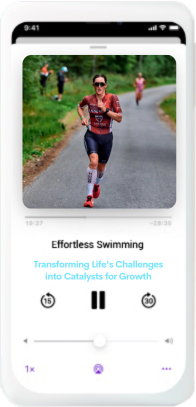
Join us in this inspiring episode as we talk to professional triathlete Kat Matthews. Despite a major setback in 2022 when she was hit by a car before the Kona Ironman World Championships, Kat found inspiration and made a triumphant comeback the following year. We discuss her journey of overcoming adversity and her impressive second-place finish at the Ironman World Championships. Whether you’re a seasoned swimmer or just starting out, this episode offers valuable insights. Tune in now!
Today’s podcast episode is also sponsored by Skillest. Exclusively for our Effortless Swimming podcast listeners, you can receive a free course, ‘The Art of Triathlon Swimming,’ and an online analysis through the Skillest app.
https://effortlessswimming.com/skillestoffer
In this episode
- 01:59 Swimming Background
- 05:12 The Battle of Overthinking
- 08:20 Recognizing the Difference Between a Good and Bad Swim
- 11:48 How Head Position Can Impact Swimming
- 14:53 The Connection Between Kick and Body Position
- 18:16 Choosing the Right Fins: DMC Elite vs. Arena Powerfins
- 21:06 Ballerina in a Bucket Cue
- 22:39 Navigating Loss and Grief: Kat’s Journey After the Accident
- 29:27 The Clues Trauma Leaves: Understanding the Psychological and Physical Effects
- 31:38 The Double-Edged Sword: Putting Emphasis on Race Results
- 34:43 Setting Achievable Goals and How Breaking Down Objectives Can Boost Motivation
- 39:12 The Importance of Translating Training Performance to Race Results
- 41:42 The Trap of Overdoing Training for Numbers
- 45:34 The Rewards of Following a Structured Training Routine
- 51:45 Swimming Advice for Beginners
Links from this episode
- Instagram”>Follow Kat on Change your technique and swim a smoother, easier freestyle with the Effortless Swimming membership
- Want to work with me personally to improve your technique? Join my swim technique coaching here
This podcast is brought to you by NanoClear — our own range of anti-fog swim goggles, designed by Effortless Swimming with the anti-fog treatment bonded into the lens itself (not sprayed on, so it doesn’t wear off after a few swims). Check out the NanoClear range here and use code PODCAST15 for 15% off.
Transcript
Read the full transcript
It was like suddenly my life was on a hospital bed and it was more that like loss of personal freedom. Like I couldn’t do anything. I couldn’t make decisions. I couldn’t choose anything. I had a listener send in a question about trying the mental aspect and the mindset aspect. And there’s two things that you mentioned just before that stood out to me there. Welcome to the Effortless Swimming Podcast to show that help swimmers and triathletes love the water, become a better swimmer and live a better life. Here’s your host, Brenton Ford.
Hello and welcome to today’s podcast episode. This is episode number 309, my name is Brenton Ford. And on today’s podcast, we have professional triathlete, Kat Matthews. In 2022, Kat faced a defining moment in her career when she was struck by a car just two weeks before the Kona Iron Man World Championships. And the accident left her with serious injuries and cast doubt on her future in the sport. And instead of giving up, she actually attended Kona as a spectator, finding inspiration among her peers. And in the following year, Kat made a triumphant return to racing, securing a remarkable second place finish at the Iron Man World Championships in the 70.3 distance. And in today’s episode, we talk about that amazing comeback and how she was able to overcome the injuries and get herself back on track. And we also talk about the silver lining that actually came from that accident where there was two things that she was doing in a swimming
that she wouldn’t have been able to change or improve had it not been for that accident. So she was able to find a silver lining there. And we also talk about some of the training and concepts that she’s been able to apply to her swimming to make big improvements and big changes over the last couple of years. She had a little bit of a swimming background as a kid, but not a huge amount. And there’s been some things that really stood out to me as I was asking her these questions that I think you’ll enjoy. And I think you’ll be able to take away and perhaps implement some of these things in your own swimming. So without further ado, let’s get stuck into the podcast with Kat Matthews. All right, Kat Matthews, welcome to the podcast. Hi, Brent, thanks so much for having me. I feel like it’s a real honour. And I had to have a little word for myself this morning. I was like, hello, I’m Kat Matthews and I’m going on a swimming podcast for swimming 10 years ago.
Do you think you would ever be saying that sentence? No, 10 years ago. Goodness, I wasn’t swimming. Like I hadn’t swam in like six years, 10 years ago. What is your swimming background? So I asked this for questions, which I’m going to ask later on. But a lot of them are asking swimming related questions like how have you got to the point where you are, which we’ll get into. But what was your swimming background pre triathlon? Yeah, I did swim as a kid. And I think that’s pretty fundamental. I did sort of swimming lessons as they do. Everyone does what I thought everyone did in the UK. And then I did at whatever age it was, 9, 10, transition into the local swimming club, where we then properly trained swimming. And I then did throughout my whole sort of 10 to 15, like age, did two to three training sessions a week. So that was maybe four hours a week by the time I was 14, 15, you know, seven p.m. finishing at nine, cycling home.
I think that was pretty massive in terms of technique. And I did it really for the social scene. Like I enjoyed it. But I didn’t ever think of swimming as a like a faff when I was there. It was just getting there in the rain. But I think I think that was pretty important. I joke now that I was a better swimmer then. Like, I’m pretty sure I did a 100 meter freestyle in a 104. And my husband, Mark, he’s like, there’s absolutely no where you did that. Because now I obviously can’t swim that quick. So, yeah, like child swimming was, you know, pretty fundamental. But then I got a bit bored of it and realised there’s other things I wanted to do on a Friday night just generally. And so I didn’t swim from maybe sort of age 17 through until 24, which I think by that point was quite a critical, you know, period of time. And swimming strokes just completely changed by the time I got back into it. And was that 2015, 16?
And by swimming strokes, changing, you mean the way it was taught or your own stroke had changed a lot in that time? I meant the way it was taught. So when I was taught, it was this sort of keyhole come in and then push out. And then by the time I started, you know, YouTubing, how to learn to swim again, it was very much like, no, absolutely don’t do that, S. You should just do a straight arm stroke. So I sort of, I guess, like retort myself to swim. It sounds a bit dramatic, retort, but got back into swimming and tried to relearn those technique points. But with this swim style, the Army triathlon sort of group hub were coaching the swim smooth, which I know it’s probably a bit of a competitor. But they I didn’t I never really have really got on board it. It just didn’t feel quite right to me. But obviously you pick up little bits of technique from that. And I think as your question, like I as a 15 year old to then a 24 year old
or whatever the gap was, you obviously your body changes a lot. And my ability to propel my now adult body through the water was completely different. So I think I had to just like relearn that as well. Do you think that when you were younger, when you’re a teenager that there was a lot less thought about the technique and it was just you get in and you do it. And then when you get a bit older, you start to think about things more and you’re more aware of technique. Is it do you feel like that was there was a difference there in I guess the thinking involved with it? Yeah, I think somewhat. I do remember as a teenager really being like really focused on my technique. I remember having the training sessions where a lot of technique, a lot of kick, which I hated a lot of different strokes. And I remember at one point like really progressing in one season in as a kid, because I had focused on the end of my stroke.
I was really finishing it and I was a couple of seconds quicker, 100 straight away. So I remember having these like significant sort of key teaching points. But yeah, I’ve definitely learned now as an adult that I’m a visual learner and kinesthetic like the act of movement. I think I’m really good at my body proprioception. And I think that’s also come from study of physiotherapy. So I’m now probably too in tune, which can be a negative with what’s going on. So yeah, it comes as a battle not to overanalyze the stroke. Yeah, I think for everyone, every adult who wants to get better, I think they battle with that. It’s like, hey, how I really want to think about things. I’m really aware of what’s going on. And in many cases, you sometimes just need to get out of your head and you need to just be in tune with how you’re feeling and then just kind of get into the groove and get into the rhythm of things. But it’s that constant battle.
And I find myself doing the same thing, trying not to overthink the stroke. And for me, and I’d be curious to hear if it’s for you, the sessions where I swim the best, the races where I do the best are usually the ones where I’m not overthinking the stroke. I’m just trying to be really aware of the race conditions and just getting into into a groove that I feel like I can sustain for the race. And when I look back at it, there’s a little bit of a blur when I look back at the swim. I can remember moments in time, but I feel like I’m really in flow. I guess it’s probably the way to put it. What is it the same for you? Do you sort of find that or something different? I’d be curious to hear your perspective there. No, I think I think so. I’m not sure I’ve got enough of a bank of good swims to really build this, you know, the norm now. And this is how I feel when it goes well. I think the biggest thing for me is like you said,
yeah, just like maybe the stopping, thinking about technique. But I definitely get a lot from thinking about my body position more than the stroke technique. So I feel like, especially at the start of every training session or mid-race, it becomes less about, oh, my goodness, that stroke wasn’t quite good enough because of the, you know, the ocean swell or something. It’s more about head and lower back, bum sort of position that makes me feel ground, like grounded. I don’t know if that’s the right word, but I think that that bit rather than the technique of the swim stroke, I think I’ll sort of go back to. Yeah, it’s because the first thing you need to do is you need good body position. You need to minimize drag first and foremost, because if your hips and legs are dropping, you’re going to be slow. And no matter how fit you are, you’re just going to slow yourself down. So I think it’s a great first principle to always come back to
is body position and how you’re sitting. So is that something that if you’re not having a great swim training session, do you feel like you sit lower in the water or are there other things that you feel like that aren’t quite working for you, whether it’s the timing or like your heart rates a little bit higher? What are those kinds of things where you can differentiate between a good swim and a not so good swim? Yeah, totally. I think it’s immediate, it’s sort of immediately. And it often comes after a hard bike or a run during training. Is the body position. So I I immediately feel that I’m lower through my hips and then I’m therefore not sort of able to get on top of the front of my stroke. So it just doesn’t feel like I’m moving at all, whereas I don’t think I ever had that good feeling before. So I think now I know what that feels like because I’m able to change my body position. Now I know what bad feels like.
I think that’s the big change this year, actually.
It’s like someone who’s constantly hung over if they’re drinking every day. It’s like they don’t know how bad they feel until they stop drinking. And then they’ve got this new this new level of this feels this feels amazing. It’s obviously it’s a lot better if you’re you’re just feeling bad in the water and not hung over constantly. But that’s that’s really interesting to hear hear you say that that now you get that sense of swimming well. How did it take you to get to that point where you feel that feel yourself feel good and move well through the water? I am actually maybe slightly unique there. I’m seeing this as a bit of a silver lining of a big accident I had last year. I broke my skull, didn’t break my neck, broke my back in a couple of places, sternum, hip. And I couldn’t lift my neck up for a while because it had been in the brace for six weeks or so. And then lifting it up generally was hard and stressful.
So I spent a lot of time in that build up at the end of last year with a snorkel, which I’d never really used before. And my husband, Keene Swimmer, I’ll mention him a lot because he sort of feeds back in a little bit. But he was he’s always been saying your head’s too high. And I was like, no, it’s just my swimming bun like the bun under your swimming hat. Like, I think it’s just affecting your perspective. And was adamant that I couldn’t get my head any lower. But then this accident and snorkel work suddenly I got my head down because it was way comforted to have my head down and that was massive for just bringing my body position back up and knowing what that should feel like. So then I started swimming training at the start of this year, twenty three, with my head in a better position. And then so sort of suddenly I was able to be like, oh, you know, even though way weaker, that’s what I should be feeling like in the water.
So it’s maybe not the norm, but I think the snorkel really helped, regardless of the accident, just allow myself that time to use the snorkel and feel a different body position. That’s great to hear about the improvement that you’ve been able to get from a negative that that happened last last year. And I want to go into that a little bit more as well in a moment in terms of your head position. So was he saying that you’re holding your head too high or that you’re looking too far forwards? I never felt like I was looking too far forwards. You know, I watched your videos and be like, there’s the forty five degree angle. Like I always felt like, yeah, I’m not looking for the end of the pool, but I’m looking somewhere in the middle. If not, I was sort of even just like looking at the floor sometime to try and bring my head down. But I think it was physically my head was out of the water. And the other caveat is that swimming in a public lane in England,
normally you are in a twenty five meter pool and there’s other people in the lane doing lots of odd to you things. And so you’re constantly looking for the end of the pool and you’re constantly looking to see if you’re going to swim into someone suddenly who’s swimming three minutes per hundred meter pace. So I think that there was that element as well. Like I never had a natural sort of the freedom to get my head down and eyes down and sort of practice that in a pool. Whereas another change that happened at exactly the same time is that I’ve now started swimming deliberately in like a 50 meter local pool where the fast lane is actually full of people who are swimming off a 90 base. Yeah. So I want to send me some footage that I do coaching with. And they were swimming trying to think where they were. I’ve got enough to top of my head. But I know I’ve been to Germany once and we went to a pool. No lane rips at all.
It’s just a free for all in there. And how to how can you not swim with your eyes looking directly forward? How can you not have your head really high when that’s the case? And that’s like the worst case scenario. But then if you’re in a in lanes where there’s just people doing all sorts of things in there, it’s it’s very hard to have that good good head position. So it just becomes becomes a norm. So I think there’s a big benefit to changing your environment. And that environment is going to that 50 meter pool with good swimmers in that lane where you can actually get your head down. It can make such a difference. And I work a lot with the age group triathlete, sort of some of the people who are new to swimming or pretty new to it and maybe didn’t learn as a kid or had a little bit of experience as a kid. But mostly they’ve been doing it for a couple of years as an adult and I’d say I’d say two thirds of the people that I work
with their heads are either holding up too high in the water or they’re looking too far forwards, but they think they’re looking in the right spot. And it’s not until we show them on the video where we go, this is where it is, you can see it and they go, OK, like, yeah, I didn’t think I was I was doing that. So there’s just such a disconnect from what people think they’re doing to what they’re actually doing. And it sounds like it was the same for you. And there’s just so much stuff in swimming like that. Especially in in the water where you haven’t got you’re not grounded and you can’t really see what’s going on is just such a disconnect there. So that’s why I think that coaching can be helpful. That kind of feedback like self feedback when you’re using a snorkel or just video analysis that can make such a such a difference. So the fact that that came out of the accident is quite quite remarkable. I think that that has been able to make such a such a difference.
Was there anything after making that change where so you said you felt like you could kind of get on top of your catch a bit more when you had that better head position? Yeah. And another key part was that I was actually doing kick because I couldn’t because my back I couldn’t do a lot of like swimming and pull. And so I was doing a lot more kick and I think therefore I got more confident with my kick again with fins because I wouldn’t have been moving forwards otherwise. I then was able to use that kick in my swimming. And I think that’s another massive change this year is that my kick is actually functional, which is obviously two factors important because one, it enables me to maintain that higher body position, which I don’t think I had before. It also helps. I think the kicking as a separate entity training would help with my core generally, which again helps the body position. But then also the speed in terms of get out speed for racing,
I think that that’s now something I’m actually really confident in. So I think the kicking as well as the head position were sort of tied together. Oh, that’s that’s great to hear that. Yeah, the kick is so many people age group triathletes. They go, I don’t kick at all. And it’s not that you really have to kick much, especially is just like an average age group are necessarily because you may not need that get out speed like like you do in a race. But the main thing with a kick is I love the word functional that you use. It’s like if you can kick the right way, then it gives you it kind of gives you a little bit of that that grounding and that ability to anchor like someone who’s throwing a baseball where they’ve got their feet planted on the ground. We don’t have that in the water. So an effective kick or a functional kick will actually give you something to be able to anchor against when you’re when you’re pulling.
And as you said, it sort of connects up with your hips and your core. And that’s where you feel like you’ve got something to pull against. And then the combination of having a functional kick when you need it, you know, you can bring in a six-speed kick if you have to, to try and make that front pack. Or if you’ve got to find feet, you know, you’ve got to catch up to someone. You can bring it in when you need to. And then you can drop back to a two-beat or a four-beat if you have to. So that’s yeah, it’s such a great thing to develop. And were you were you aware of that prior to improving that? Like were you aware that your your kick wasn’t necessarily functional? Or was it just something that you started to realise as you started to do more kick? I think I was definitely in the camp of, oh, I don’t need to kick. Like I barely kick, so therefore I don’t need to really train it. I had worked on kick timing quite a lot from, you know, the last couple of years.
So I was pretty happy, you know, last year of, you know, that my one kick per one reach sort of thing worked really well. And it was like one decent kick. It felt good enough. But I think I always thought it could be better if I was to ever kick against someone, my husband, he had just destroyed like I’d be useless. So I started thinking, right, why not again with the accident? Like why not do more kick because I can physically do it? So I might as well practice it while I can. And again, fins in a 50 meter is way easier than fins in a 25 because you’re at the end by 12 seconds or something. So I think again, another sort of opportunity area there. And can you tell me about what sort of kick sets you were doing? Like did you have the snorkel on? You have the fins on? We’re going hard for 50. Were you doing kick sets of 400? What did those kick sets look like? My kick sets have very little structure and it’s more like,
how can you possibly get through 400 meters? Do it as best you can. I did one yesterday as in I’m going to do 500 meters of kick. And I did like I was just I just braked what I needed to do or someone was in I was in someone else’s way. You know, 100 meters with fins, 50 meters harder with fins. Come on, try and make 45 seconds. Try and go off 50 seconds, not a minute. I remember it used to take me a minute in a 25 meter pool without fins, I think. And so by the end, I was absolutely, you know, this is with a float as well. I would way, obviously way prefer to do it with a float, but lots of the times I would do maybe 100 meters with a float, 100 meters without. And then I might do 100 meters, six, three, six to try and incorporate it back into a bit of the stroke. But I have been trying to do some without fins. It’s not it’s not very fun at all, as you know, to do fins and then take them off and do it without.
I didn’t think I was moving and I was really struggling in a 50 meter yesterday. Yeah, yeah. Well, it’s just nice to hear that that has helped overall. And again, the athletes I would normally work with the age group is when we put fins on and we do drills, a lot of them are very like they’re just they’re too laid back with their kick. So I encourage them to get your feet moving. You’ve got the fins on for a reason. And if you just start to work, you kick more in those moments, in those sets that you’ve got your fins on or when you’re doing kick sets, like just be more active with it, work it in the down and the up kick, try and feel that undulation with it and just train it while you’ve got the fins on. It can help develop it, develop it a lot. And, you know, if you get yourself a pair of good fins and some things are not great, like there’s some things are really stiff and hard and uncomfortable. But if you get yourself a good pair of fins, like I like the DMC fins,
DMC elite ones, or I think the arena power fins, pretty similar, which is quite good. Like a good pair of fins makes a world of difference. So if you hate fins and you listen to this, get yourself a good pair. First of all, they’re much more comfortable. You get more propulsion from them and don’t get the long fins that they’re fine. But they’re not as not as good for you as a good pair of kind of shorter fins like the ones that I’ve mentioned. What fins are you using? Oh, and honestly, not sure I’ve had them since, you know, three or four years. Like I have no sort of they are these ones. Yeah, they’re orange. OK, orange fins. So get yourself a pair of orange fins, yeah. Yeah, on your note about the intensity thing. I used to when I was getting back into swimming, I used to definitely be guilty of that, especially when I was swimming on my own a lot, I would just do kick for the sake of doing kick, you know, 50 meters cool, 50 meters cool.
But now every kick, I sort of dread it in a way because it’s harder than swimming. Well, that’s the intensity I feel like it should be at, is that I should be sort of basically racing someone every time I do it. So I remember that as a kid, like I remember, you know, cheating on the lane rope, like, can I, I can’t keep up, you know, I’ve got to try and like do one stroke, the coach won’t sort of see. Like, I remember it being a real stress, the kick set. So I think the intensity of that, yeah, that’s definitely something. The other element of not just intensity, but in terms of technique is I think you or someone else might have driven this sort of box around your kick, so like keeping the kick within that box rather than just like my old kick technique would be that sort of one bigger kick on one side. So I think that was pretty, pretty important in terms of reminding myself that it should be super efficient and therefore hopefully translates
to swimming without the fins as well. Nice. Yeah, I’ll take all the credit for that. That’s that’s fine. Kicking the bucket is the way the way I’d normally describe it and not a tiny bucket, but like a larger bucket out behind you, slightly wider than your body line. So it’s a good way to visualise it. And I like the the queue of ballerina in a bucket because the ballerina is up on their tippy toes and then just imagine kicking in that bucket. So I’ll take all the credit for that. Thanks, Kat. So going back to your accident last year, so take me back to that moment. What was the first thing running through your head? Was it am I going to be able to race again? Is it am I going to be able to walk again? What was going through your mind when that first happened? I haven’t really dwelled on like trying to remember that. So I find it quite hard to be like this was the first thing. Maybe when I write a book about it, I’ll have dealt with it better.
But I think the first bit of it and the overarching sensation was just like loss and grief. And it wasn’t about triathlon. It was like suddenly my life was on a hospital bed and it was more that like loss of personal freedom. Like I couldn’t do anything. I couldn’t make decisions. I couldn’t choose anything. So, yeah, it wasn’t necessarily about, oh, no, I can’t do a triathlon. It was not allowed to walk at the moment and I can’t turn my head. So the doctors were very good and out in the woodlands in Texas. They scanned everything and gave me the appropriate amount of information. And my, you know, everyone else, all my friends, my coach was there. Husband got out there as soon as he could. So they gave them all the information they really needed. And me again, just just enough as a physio. I was really prodding at like what’s wrong. And I think there was a few uncertainties quite early on about just the integrity of my neck.
Blood like the main artery in my neck. And of course, just like double checking that they weren’t missing anything. I think the injuries didn’t quite make sense due to the trauma. So I think they were even though the scan, you know, I think they wanted to double check triple check triple check again just to make sure that that wasn’t something that was they’d really missed. So yeah, a lot of sadness, I think was the big one. Did you do you think it was at that time better to have your physio background or to not have it and maybe not know so much what was going on? Do you think it was helpful or not so much? I think it’s always helpful. I think education knowledge is it was always helpful because in theory, you should be there for have the rationale to apply it appropriately. So I think knowing that they had checked my spinal cord. Cool. You can you can walk. OK, cool. So then I was like, they must have done this, this and this to be happy.
It wasn’t me going, oh, are you sure I can walk? You know, like, are you sure? Well, they I had some like, obviously some issues with my lungs and I was being told to blow into these devices again. I would have freaked out probably a little bit about what this sort of, you know, how big a volume my lungs can blow it up. And to me, it was like, I’d given that little device to about 100 people and it was like, cool, yeah, just practice that. So I knew exactly what I had to do for the next two weeks in terms of blowing into a device and how my lungs, how important standing up, taking deep breaths, even though it hurt, you know, bracing during sneezing, like all of those things associated to the lungs. That is actually part of my, you know, experience as a physiotherapist, even though most people see physio as just soar knees or shoulder. I don’t know what it’s like in other countries, but we’re very grounded in our whole medical physiotherapy.
And part of that is respiratory. So those were the biggies as well as the, you know, walking side of life. Before we dive into the rest of today’s podcast episode, this episode is proudly brought to you by Form Smart Swim Goggles. They’ve been a long time sponsor of the podcast and they are my go-to goggles when it comes to tracking my training sessions and being able to see what’s happening in real time through the goggles. And we know swimming is a highly technical sport, but without the guidance of a coach on deck, identifying and addressing technique flaws can be a challenge. They’ve recently added a new feature to the goggles, Head Coach. And this addresses that problem head on. It gives them as improved access to their technique, awareness, focused skill development and in-app education and analysis. Head Coach provides real-time visual coaching via the Form Smart Swim Goggles augmented reality display.
During and after a swim, Head Coach provides them as with technique feedback using two types of metrics, form score and head coach skills. Form score is a measurement of overall swim efficiency ranging from zero to 100 defined by your pace and your stroke length. Head Coach skills encompasses five key areas that will help you identify where to focus on improving with your efficiency. Head roll, head pitch, set pacing, interval pacing and breathing time to neutral. And after completing a session, you can check back in on the form app to track your progress. And Head Coach provides swimmers from beginner to expert with an unprecedented level of data driven guidance and understanding, enabling you to boost your performance and your speed. Get your pair of Form Smart Swim Goggles today. Click the link in our podcast description or use the code Effortless on Checkout to get 15% off your Form Smart Swim Goggles.
This podcast is also brought to you by Skillist, the ultimate digital coaching platform that’s making waves in the swimming world. Imagine having the opportunity to train with Olympic and world champions like Kyle Chalmers, Ryan Murphy and Brent Hayden. Well, with Skillist, that dream is now a reality. Swimmers, you now have the chance to work with the absolute best in the sport, getting insights and guidance from these elite athletes like never before. And Skillist isn’t just your run of the mill coaching platform. It’s a game changer. Here is what sets it apart. You can discuss training programs, receive detailed stroke analysis and even develop race strategies with these incredible athletes and coaches. It’s like having a personal coaching session with an Olympic champion right in your pocket. And excitingly, coaches from around the world can also tap into the power of Skillist. Coaches can use Skillist’s amazing tools to train their students,
analyze videos and incredibly connect with swimmers from across the world as well. So whether you are a swimmer or a coach, go to the app store. Download the Skillist app today. That’s S-K-I-L-L-E-S-T. Download the Skillist app today and get started. And only for our Effortless Swimming Podcast listeners. We’re giving away our Art of Triathlon course free, as well as a technique analysis online through the Skillist app from me for free as well. Go to effortlesswimming.com forward slash Skillist offer or click the link in this podcast description and you will get the Art of Triathlon swimming course for free as well as a technique analysis from me through the Skillist app. And now back to the podcast. Is there anything that you do or can’t do quite as well at the moment as a result of it or you feel like pretty much back to normal? I saw the spinal consultant at like the one year point just a few weeks ago
and he came, he said a phrase that I now I really like. He says trauma leaves clues and I found it really hard for the first six months, especially then I got back racing and everything was fine for people to be like, oh, cool, you’re healed now. And I was like, I think that’s the trouble with this sort of injury. It can be a trouble is that the psychological trauma is an entity and then the physical trauma is an entity and anything to do with the spine. It doesn’t necessarily just fix like a 10 year old’s wrist would just fix or a tendon would just heal after loading it. So I think there are things that will always be a little bit different with my movement and just general sort of the integrity of those bits that were broken, but physically I’m now acting without any, you know, reservation. I think I realized over the summer and, you know, that sort of eight month point, I wasn’t worried about it anymore.
I wasn’t thinking, oh, you know, every so often it was just I’m able to move, I’m able to breathe, I’m able to sneeze. I’m able to, you know, attack a hill climb on the bike. I’m able to sprint on the run. There was nothing that was like, oh, not sure about that. Or even just a consideration of the overload. So my body is a bit different, but at the moment it’s not. There’s no problems with that. Yeah, it sounds like that’s a bit of a turning point where you’re not it’s not like there all the time, like, oh, OK, I felt felt that way. You get to that point where you can just operate. As normal, you can train as normal and maybe maybe you might pull up a bit sore here and there, but it’s not not restrictive where we kind of limited in your sessions there. So that’s it’s great to hear you’re at that point. And coming to this year to get podium at the 17.3 World Champs. Take me to that moment when you cross the finish line
or you’re on the podium. What was that like for you? Because I can’t imagine how much rehab, how much work you would have had to go through in a couple of months time to to get to that point and to to make it back when maybe that could have been the end of your racing career. Yeah, I think it looks like a bigger deal than it maybe felt because I never allowed that consideration of it could be it. And I say, I like my husband was from day one. Cool, you’re going to be back. You’ll be fine. You’ll be better than ever. And I just drove off that. Like it wasn’t a consideration or it it might have flickered across my mind, but it wasn’t I had never allowed myself to dwell on it. So the rehab was just the same as doing my job, you know, training. Yes, sure, there was moments where it was really hard. But by the time I got to the summer, it was I was working just as hard as everyone else or, you know, the same. I ish. And so it wasn’t necessarily
anything in my mind that was like super spectacular on reflection. Obviously there was a much lower starting point at the start of the year. But again, everybody has these, you know, big, big ish injuries that sometimes set them back in life. So I think it was it was pretty valuable to me in terms of my physiology, like the confidence in my physiology that I’m still improving. That was big. So my performance was pretty good. And my running consistency over the summer leading up into Lati was better than ever. So I think those things were just to then put it into a race was really nice. It’s so hard as, you know, as doing the sport to have this constant battle of I know I can do this physically in training, but so what if I can’t do it in a race? So I think that was the biggest thing was this sort of relief of my training is real. This is how fit I am because I can show it in a race. I think side note, I think we often get sort of sidetracked by how we think
we’re better than we are just because we can do it in training. Whereas actually I see performance level as the race. And I think that’s maybe why when it goes wrong, it hits you so bad because you haven’t got this, you haven’t got this, it’s OK. I can do it in training. It’s like, no, that race was all that mattered. And your training is completely relevant, useless, you know, pointless because you haven’t been able to show it in the race. Sounds like a bit of a double edged sword in a way where we should put the put the importance on on your race results. That means you can can do it like that is that’s the real that’s the real test and that and for you, you know, where you have to prove yourself in the race. I think that it can be a great thing. And then obviously when it doesn’t go right, that’s when it can can hit you and that and the mental side of it can be can be quite difficult. I had a listener send in a question about training the mental aspect
and the and the mindset aspect. And there’s two things that you mentioned just before that that stood out to me there. One is after the injury and your husband was saying, all right, you’ll be back. All right, this is this is just what we’ll do. We’ll get we’ll get back to it where it’s not not a big deal. It’s like, we’ll just get on with it and we’ll do what we need to do. That sounded like an interesting approach that seemed to to make a big difference for you where you don’t make it. You build it up as a huge thing in your head. It’s just that’s no big deal. Let’s get on with it. And then the second thing there that you mentioned as as well is putting that importance on proving yourself in in a race, because I know a lot of I know a lot of triathletes, a lot of swimmers who are great trainers and they will do some I’ve seen some amazing sessions by them, but they can’t put together in a race and from the outside, it seems like they put too much effort
into some of their training sessions where maybe they push harder than they need to because they’re trying to prove themselves in training and not in a race. What are your thoughts around those those two things? Does that sound about right? Because it just sounded quite interesting to me. Listen to you explain those couple of things. No, totally. I love I’d love to talk about them way too long for the podcast. But the first one because it’s easier. Yeah. My husband’s attitude was, I think, fundamental to my sort of mental health in those first few months. So it was it wasn’t just this. He was in the he was in the army had been for years now left. He’s sort of like, cool, you know, let’s crack on. It was more I think he needed to feel super confident that I’d be totally fine. And so it was both of us. It was the easiest way of being like, cool, it’ll be fine. You know, we were as a as an entity, he’d left the army.
We were going to go both, you know, go forward this year with my professional sport. There wasn’t also really a choice. It was just cool, you know, let’s just sort of it will all be fine. He doesn’t stress as in he’s one of those people who doesn’t worry. I’m a warrior. So it was like normal for us for him to not worry. And then if I started worrying, he’d do the head pat. It’s OK. I’d cry a little bit and it would be like, it’s OK. And then, you know, next day, cool, let’s do it. And it wasn’t it wasn’t ever a sort of super over the top positivity. It was just the perfect level of confidence and supporting, accepting that it was a really bad situation, because I think that would be easy not to allow those emotions and not to allow that sadness. But he and my family and friends got the perfect balance of letting me be super sad, but equally giving me the space to breathe before then deciding myself, which is how it normally works for me like in an off season,
like deciding myself that I’m ready to try and do a bit more on that as well. My physio was really important. I had moved to Loughborough, new environment, new house, new swimming pool, new physio the day we got back from Kona. And I went to see her for the first time and I was like, yes. So had all these had all these injuries and we looked at my thoracic rotation and my neck rotation. She’s like, so when are you racing? And this is like week seven. And so that was a big like, oh, steady on, you know, I don’t really know you. That’s not how I work. Like I need to feel confident in myself before I, you know, even think about racing. And it was just sort of honestly, later in that day, I was like, hmm, actually, she was right. When am I racing? Like I need to, she suggested, say, like from a physio perspective, what do you need to be able to do 12 weeks away from a race? You know, and therefore what do you need to be able to do 16 weeks away
from a race sort of thing? And so I then go out my Excel spreadsheet and started making these little like, OK, well, if I was to race in April by March, I need to have done. I think my confidence would be like two 20 hour training weeks or something back to back is it sort of as a fitness entity, like tolerate the load. I need to be able to swim at least 20 K a week sort of thing for a month. Those little markers, because of what she said, became my tangible, like just reachable goals for the next six weeks. So that’s pretty important mindset, like mentality wise. And then to the other part of training versus racing, I think it’s something that we like really people are quite divided on it. I think lots of people will always be like, oh, wow, she’s so good at training. She’ll be excellent. She is excellent. And I’ve always been the opposite. So it’s easy for me to say I need to show it in a race for it to be factual
because I’m not a great trainer. I don’t think like I don’t I don’t beat my I wouldn’t beat my competitors in training, even if I that same day or later that day, I’d then race and we’d I’d actually beat them. So I’ve never I’ve never really trained in an environment where it is competitive like that to try and beat my sort of friends. So I’ve never had that comparison. My power in training is in my like intervals, for example, swimming, cycling and running is always way better than I’m able to do in a race. But I think that’s normal. I think that was that sort of obvious. Like, obviously, it’s better in training when it’s a shorter rep. So I think some people perhaps just get confused that if they can do it in a in a training session, therefore they can do it in a race. Whereas the race is obviously way longer and has way more other factors involved. So I might be swimming like 75 long course threshold.
But I don’t think I can do that actual threshold for an hour. Like I don’t think I can. So if I then do 80 seconds per hundred in a race, then I’m pretty happy of that normally. So I think some people have this like mismatch, maybe of what those training values really mean. And for me, it’s always just been about the performance because that is what you’re training to do. But I don’t know if that’s just like my my mindset of that sort of ethos. But I do think that that’s where you show mental strength or resilience or just aptitude to employing strategic or resilient techniques. Whether that’s conscious or subconscious in the race is where it shows. So you can be excellent for a 10 minute rep in training because you’re just going to jump off and have a shower and go to work. But if you’re not like if you’re not able to just be focused and mentally strong, whatever that means in a race where you’ve still got half marathon to run, then so what?
If you can do a 10 minute rep. Yeah, when you say you’re not a great trainer, can you clarify that a little bit? Do you feel like you don’t train as hard as you could? Or do you feel like like the numbers that you put out could be like they’re just not as much as some of your competitors, but you are better in racing? Can you clarify that a little bit? Because I think when someone when someone hears that, yeah, maybe they might interpret it as, you know, you don’t like maybe faff about a bit here and there. And I’m guessing I’m guessing you don’t, right? Like I’m just just curious to get your thoughts on that. Yeah, thank you. I’m absolutely not saying that I’m not. I’m again, I don’t I train with some people sometimes and this year loads more than previously. And I have a I like as an example, I have like a semi different personality when I’ve actually got a session as opposed to just an aerobic session.
Like I become really I become a less nice person because I’m so focused. Like I’m not able to tolerate chat in the rep. Like it’s just about the rep, like everything is perfection. The rest is purely rest, rest or eating or drinking. Go like go again. Let’s chat at the end of the session when we’ve got an hour and a half easy riding or, you know, in the showers after swimming sort of training. And so I think my when I say I’m not a good trainer, I mean more every session that has to be ten out of ten effort is ten out of ten effort. Nine and a half some bad days or it’s ten out of ten effort and just not very good. But a lot of my sessions are seven out of ten sessions, you know, or they have a little bit of eight out of ten in there. And it’s only seven out of ten or eight out of ten RPE that I’m doing. I’m not putting I’m not doing my threshold reps at one hundred percent and then thinking, oh, my goodness, my my threshold is seventy seconds,
not seventy five seconds, for example, obviously, it’s not the same thing as it is on the on the bike. But so I think that’s sort of important. Like it’s the discipline of training control. And I have noticed mainly in cycling and run volume that my competitors do a lot more than me. And some age groupers, I hate that word, some amateur triathletes will do four hour rides at like averaging over three watts a kilo, you know, three point five watts a kilo. And they’re two kilometers an hour faster than me over the same route or something Strava is dangerous. And then I beat them by like half an hour in a race. So over four hours or over two hours even. So I think I know that I’m I have that sort of intensity, control and discipline in training, not that I am. I mean, I’m not a good performer in training. Yeah, it sounds like you’re smart about your training, not trying to overdo it when there’s no there’s no need to to push it
more just for the for the Strava numbers or to prove to yourself that you can do can do those numbers. And I think that’s a trap that a lot of people fall into, whether it’s because of Strava or they just like to compete. They like to challenge themselves. I know I’m guilty of it on occasion, just going harder than I need to in an aerobic based session because I want to get a good workout. I want to see what times I can hit. It is hard to restrain yourself sometimes, but I think that’s a good ethos that you’ve got of your performance. It’s it doesn’t matter in training. It’s about the race. So that’s it. And you want to go with what works well for you. And it sounds like you’ve thought a lot about the things that work well, the things that don’t and you’ve evolved over the last couple of years of training and racing and probably figured some of those things out. When it comes to thinking and or looking back at past performances
and the way that you do things, do you have a sort of structure that you that you follow? Do you review it annually? Do you sit down with your coach and go through it every six months? What’s that look like for you? Do you mean like a sort of as in like January to March race season? Yeah, just in terms of adjusting training and the way you go about things. Do you have a structure to to analysing that? Or is it usually after after a race, you do it each time and and then tweak things? Or have you have you got a general structure that you’d follow for that? I’m not really sure. I think I rely and I’m happy to like sit back sometimes, sometimes and rely on my coaches, expertise, Björn Giesmann, German triathlon coach. And I think I give him the overarching control over those things. And I trust that he’s looking back and seeing what works well and what doesn’t. Me and my husband, Mark, we will discuss things often and often disagree.
And I then choose to take some of those things to Björn and some of them I don’t. And sometimes we have a group, little chat about normally issues. Obviously, it’s easier to pick up on issues. But I I sort of pride myself that I’m good at also seeing the positives like going into Kona, like I felt great. You know, first week, awful, new conditions, environment. But coming into race week, I I honestly thought at one point I was like, wow, I could hug Björn. I feel so good right now. Like this this was perfect. So I think, yeah, that sort of structure, if that’s if that’s more what you mean, like that sort of that build into a race or even just training structure generally is totally on him because I’m full time. I can go away and do training camps. So when I’m at home, my training volume is way less. And it’s really nice, you know, 90 minute turbos, maybe two hours, two, often sometimes three sessions a day.
Whereas a training camp, you know, we’re pushing out to sort of 30 plus hours in the week with three and, you know, 90 minute swims, well, 75 minute swims and then three to four hours on the bike and then another hour running in the evening or a gym session. So it really fluctuates. And I think that’s something that I’m really grateful for that. I don’t have to do all of these, you know, horrible sessions or use up loads of mental energy when I don’t have to. I can sort of prioritize that into a training camp when volume is way easier. So, yeah, I think like a bit more volume over sort of the early part of the year. And then it becomes a little bit more sort of focused, perhaps, in terms of intensity control, less just bulk mileage for the sake of it around races. What you mentioned there about giving control to to beyond or giving just trusting that they know what they’re they’re doing. I had a professional swimmer here on the podcast recently,
a big guy flinted southern and he said the same thing. It’s like I when I go to the gym, when I go to the pool, I I just I trust my coaches know what they’re doing. So I just get in there and I do what they ask. And I’m thinking about my stroke. I’m working on those things. But that way he just takes that mental load off and that that your mental capacity working hard, you’re training a lot. 30 hours is a huge is a huge training week. And if you’ve got to think about the types of sessions you’re doing, all that sort of stuff, it’s it’s often too much. And so being able to just see that to someone else and someone that you trust, it can make a huge difference. And it sounds like that kind of takes the the a huge load off your off your shoulders, which is which is what you want as a professional triathlete. You’ve got a lot to think about. There’s the training. There’s stuff to do with sponsors. There’s flights and travel and all the sorts of stuff that you’ve got
to factor in that you don’t need any more in your plate. And I think the I think the satisfaction of the simple. Yeah, done that, Tick. If you’re not setting the goal, it’s very easy to feel that satisfaction of achieving the goal because it should be achievable. Whereas if I’m setting the goal, I will often either doubt myself that that’s not too hard to swimming here or I or it’s sort of too easy. And it’s like, have I done enough? So I think that’s a massive thing for me this last 12 months as I started swimming with somebody else. Because, yeah, like I said, moved to Loughborough and new environment at the same time, sort of somebody we knew, but we weren’t friends over the time, also moved here, Sam Proctor, another British pro athlete. And so me and him started swimming together and he also does some coaching. And for the last couple of years, I’ve just been setting my own swimming sessions, whereas now I turn up to the pool and Sam has taken complete control
of that sort of Monday aerobic Tuesday, we’re going to do, you know, V02 and then CSS or threshold on a Friday, like having this structure and having sessions that I I try not to look at the session because I’m so fearful and nearly every session I’m thinking I can’t do this. So I’m I’m two reps into 10 or whatever it is. And I’m I need to drop out. I need to drop out. I need to drop out. How do I explain? How do I like come up with some sort of I’ll do the next one is paddles or maybe I’ll just take one easy while you carry on and and I fight that so hard nearly every session to just finish. And that’s been the most rewarding thing this whole years. I’ve probably only dipped out of sort of one or two percent of those sessions because something’s wrong, like I actually do have a bit of a slightly sore shoulder, not just all my shoulder feels sore. It’s like, actually, it was sore the other day. I need to be steady on this swim, for example, I won’t use paddles.
I just use finger paddles sort of thing. So, yeah, that’s been massive, like having somebody else dictate that training sort of session intensity and routine through the week. It’s so funny what your mind goes through. Just I’ve done the exact same thing. It’s like, what excuse that sounds legitimate? Can I come up with to make it sound like I’m not being soft here and wanting to get out? But nine times out of ten, it’s like you’re being soft. All right, just push through it, you know, to be over soon and just embrace the suck, as Mac would say. So, yeah, totally, totally get it. Now, I know you’ve got to go, so we’ll wrap up here. Those that are, for those that are listening in terms of swim advice. So you’ve improved your swimming a lot over the last couple of years. We talked about some of those things. Do you have any other advice for people working on their swimming if they’re maybe newer to swimming and struggling with it?
What are a couple of key things that you’d or key bits of advice you give to them? Well, they’re listening to this. Obviously, they should be following your platform to like key advice. I but on that note, I found more interest in listening and watching like swimming technique rather than it being a doesn’t feel like a chore. It’s like, oh, this is interesting. And then like thinking about that as an idea. But that’s pretty like some people will find that really boring. So I think physically, I think the things we said are the things that I would think for most people. So body position rather than just thrashing yourself, but thrashing yourself is equally as important once and maybe not just once. But like all year round, I think I was guilty of not believing that I could do sessions. So I think knowing that it’s really hard and you’re really out of breath and you feel totally out of control is normal. Like I don’t have that with the other sports.
Like I’ve never I’ve never had that really, whereas swimming is horrendous. And I think being OK to go a bit slower as well is also fine. But I think it just changes. I think you just have to adapt. And that’s why it’s really hard and swimming is really hard. And knowing that I saw a really nice graph that made me feel better about myself. And it was like one of the best swimmers in the world. I think it was pre world champs and she took three years where she plateaued, not even a second quicker in three years. And then suddenly she dropped a second and then another two seconds the next year and bam, world champion, world record. So I think it’s a persistence thing. And the biggest thing not just this year, but for me overall with swimming has been the sort of change in mindset of target setting. So the effort used to be getting to the pool and swimming. I’ve got to swim. Now it was like, cool, I’ve made a decision that I want to swim at least
like insert an achievable kilometer goal here. For me, it was 20 K. That’s changed. It’s now 18, but it could be 10, it could be 12, 15. Like I want to swim at least 18 kilometers a week, regardless of how that looks. So I then stopped worrying about every session I was going to. It was like, cool, well, I only have to I just have to do three K today. It doesn’t matter what it looks like. So I stopped worrying that it was going to be a bad swim or it was going to be too hard. It was just so I’ve just got to get through three K. And that was really big for me in 20, 20, 21. So yeah, that would be my like set a totally achievable goal as your baseline. And then there’s so many other things that you can progress into. Like we’ve chatted to today, technique, structure, effort, confidence. Kat, that is a great, great way to end the podcast. I appreciate you sticking around. I know we’ve gone a little bit over time
and you’ll have to head off here. But that was terrific to hear very thoughtful about the way that you about your approach to swimming and triathlon. And I think for the listeners of the podcast, they’ll get a lot out of it listening to the changes that you’ve made to your swimming and how you’ve how you’ve thought about it. So I appreciate you sharing that on the podcast. And it’s been great to watch your watch your journey over the last couple of years. And I appreciate you being on here. So thank you. And I can’t wait to get you back on here. Thanks so much. And though all of the thank you goes to you and your platform, because I didn’t get the opportunity to say that I think most of my swimming technique comes from your Instagram. So I just that should be known. So thank you. Yeah, as I said before the podcast, I get a huge kick out of that. That someone at your level in triathlon is able to benefit from some of the videos that I do, because put a lot of effort into it.
I love helping people. I love working with people and the fact that that it’s been able to help you. I really get a kick out of it. So I appreciate that. And yeah, looking forward to your journey of the next couple of years. So thanks again, Kat. Thank you. Thanks for having me. Thanks for listening to the Effortless Swimming Podcast. If you’d like us to help you become a faster, more efficient swimmer, go to www.effortlesswimming.com.