







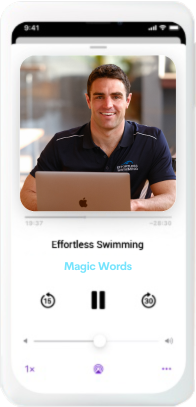
In this episode, we talk about magic words and how you can use the power of language to become a faster swimmer.
Change your technique and swim smoother, easier freestyle in the Effortless Swimming membership:
https://effortlessswimming.com/training-and-membership-plans/?el=blog
In this episode
- 00:23 Swim Camp
- 01:41 Identify Yourself As A Swimmer
- 04:50 Cues
- 06:41 Replace Can’t With Don’t
- 08:10 Replace Should With Could
Links from this episode
This podcast is brought to you by NanoClear — our own range of anti-fog swim goggles, designed by Effortless Swimming with the anti-fog treatment bonded into the lens itself (not sprayed on, so it doesn’t wear off after a few swims). Check out the NanoClear range here and use code PODCAST15 for 15% off.
Transcript
Read the full transcript
Welcome to the Effortless Swimming Podcast to show that help swimmers and triathletes love the water, become a better swimmer and live a better life. Here’s your host, Brenton Ford. Welcome to episode number 277 of the Effortless Swimming Podcast. This episode is about magic words. How can you use the power of language to become a faster swimmer? Before I get into this episode, I want to let you know about a swim camp that we have just released, which will be held up in the Whitsundays, which is in tropical North Queensland. It’s going to be myself and eight swimmers on that camp. It’ll be run from June 4th to June 9th. And if you want to improve your swimming and get coached by me and improve your stroke every day with coaching, feedback, videoing, and all the things you hear about on this podcast, then I’d love for you to join me up in North Queensland in early June. Now, at the time of recording, there’s only two spots available, so they may be gone by the time you’re listening to this.
But you can check out effortlesswimming.com forward slash Whitsundays to get more information about the camp or click the link in the podcast description. And each and every day, we’re going to go out to some different islands, some different locations. We’re going to swim there. I’m going to be giving you feedback on your stroke. I’m going to be coaching you there so that not only do you leave feeling good, having swum each and every day, at least twice and having improved your stroke, but you get to enjoy it like it’s a holiday, which it certainly will be. And you get to enjoy the good food up there as well and the sunshine up at the Whitsundays. So effortlesswimming.com forward slash Whitsundays if you’d like to grab one of those last two remaining spots. Now, I’ve been reading this book called Magic Words by the author Jonah Berger. And one of the things he mentions in this book is that in the early 70s, they started running these studies with young kids.
And they found that the way that the words that they use with young kids, and I think it’s the same with adults, can have a very different impact or result depending on what words you use. So for example, what they did with the kids is they had these toys on the ground and they found that by changing one word, they got a 30% better result in the desired outcome. So there was these toys on the ground and they either asked the kids to help them pick up the toys or to be a helper and pick up the toys. And when they asked the kids to be a helper, they got roughly 30% more of them picking up the toys and helping them. And they think that the reason for this is that kids want to identify with a positive identity, a positive behaviour, a way of being. And identifying as a helper is a positive thing. And they think that the kids want to lean towards that, they want to move towards that positive identity. Whereas just helping, it doesn’t elicit that same sort of response or movement towards that kind of identity.
And I think it’s very similar with people who identify as a swimmer. Quite often I’ll be running clinics and when we do the introduction there’s people who say I’m not a swimmer. But if you can change that in your mind and tell yourself that you are a swimmer, that I am a swimmer, I think that gives you much more confidence and I think that actually helps speed up your progression and your improvement. Because if you keep telling yourself I’m not a swimmer, you’re probably not going to do the things that are required of a person who’s going to get better. And I know you may not feel like a swimmer, especially if you’re quite new to the sport and maybe it’s 10 to 20% of the time that you really feel like you’re getting into a good rhythm and a good groove with your swim. But if you tell yourself that I’m a swimmer and identify that way, you’re going to do things that will actually help you become a better swimmer.
And quite often I can see it when people turn up to the pool, those that do identify as a swimmer carry themselves differently. And there’s nothing stopping you from identifying as a swimmer. There’s no one saying you are or you aren’t a swimmer. It’s just yourself. So I think that can be very powerful. And I’ve been using this since I’ve read the book. I’ve been using this when I’m going about the different things that I do. I already identify as a swimmer. I’ve done that since I was a kid. I’ve started identifying as a surfer over the last couple of years that I have been doing it quite regularly and I think that’s helped. But also with this podcast and with the YouTube videos, what I’m telling myself when I go into that activity is I’m a podcaster or I’m a YouTuber or I’m a business owner. These different roles, I tell myself that that is me. I’m that identity. And that actually helps me do the thing that’s required at the time.
So I think it’s one example of how words can be really powerful. And if you’ve heard a couple of these podcast episodes before, you will have heard some of the cues that I like to use with athletes. And that’s just another example of how words can have power. One phrase, one word can really change how we view something. So I think it’s a very powerful thing that is quite often forgotten. This episode of the podcast is proudly brought to you by our sponsor, FormGoggles. They’re more than a pair of goggles. Meet the world’s most powerful swim platform. See yourself improve with form smart swim goggles, including a free one year membership when you purchase your goggles for only 228 US dollars. Now they’ve currently changed up the offer where you can now get the goggles and you have that one year membership included for free. And then if you’d like to continue with membership going forward, it’s only 15 US dollars a month where you get access to their workouts, training plans and their custom workout builder.
But you’ll always have access to the real time data of the goggles, so you’ll never lose access to that. So if you’d like to swim without stopping to look at a pace clock or your watch and get live metrics right inside your goggles, including your time, distance, pace, they are right there in your goggles with form goggles. I’ve used these for over 12 months now. And I’m a huge fan of these goggles and use them for a majority of my sessions and find them very helpful, especially for gauging my time, my effort and my pace. And I think it’s a very helpful tool for the majority of swimmers that I would normally work with. To get your pair of form goggles and save 15% off, use our link formswim.com forward slash effortless or use the coupon effortless at checkout. And that will get you 15% off your pair of form goggles using our special link formswim.com forward slash effortless or use the coupon code effortless at checkout.
The other thing that I quite liked in this book, another example of how words can have some magic to them is if you replace can’t with don’t. And the example he uses here is that if you were to have two people together and they’re going for the same thing and the example I’ll use here is someone who’s training for an Ironman. And they said, oh, I can’t do anything less than two sessions a week or I’m not going to swim 110. I’m not going to swim 110 for my Ironman swim. And then you had another person who said, I don’t swim anything less than two times a week because I’m going to do a 110 Ironman swim. You’re much more likely to put your money on the person, on the second person because they are much more definitive. And their identity is someone who doesn’t do anything less than two sessions a week. Whereas someone who says, I can’t, it leaves it, it leaves it open. It makes it sound like they’re forced to do this thing that they don’t want to do when they use the word can’t.
And the same thing goes if you’re on a weight loss journey or you’re looking to get healthier or fitter. It’s those people who have this definitive statement of I don’t eat sweets or if they’re doing ketotes, I don’t eat carbs. These definitive statements, they’re the people who I think have much more success. So you can replace can’t with don’t and that way it changes how you identify with something. And the third and final one here that I found was quite helpful too is rather than saying or asking, what should I do to swim faster? Replace should with could. What could I do to swim faster? Because if you say, what should I do? It narrows it down to thinking that there’s one definitive solution, that there’s only one option here to choose from. What should I do? Whereas in reality, there are a thousand things you could do to become a better swimmer, to swim faster, to make it easier. And if you pose the question of what could I do to swim faster?
It allows you to be creative, allows you to come up with different solutions and allows you to think about more than just one solution that is already predetermined. So I think it just allows the possibility of more creativity and more options. So replacing should with could. And quite often people will ask, what should I do in my workouts to swim faster? Or what should I do to improve my technique? If you phrase it as, what could I do? Then we can brainstorm, then we can come up with some different things, rather than thinking it’s just this one pigeon hold solution that’s going to give you that answer. So they’re just a couple of examples that I got from this book, Magic Words by Jonah Berger. I highly recommend it. I think it’s excellent, not only just for how you approach your swimming, but if you are in any sort of professional capacity or with your family or friends, I think that words can really have a lot of power and using them the right way and having these tools to be able to draw upon in conversation can really help.
Thanks for listening to the Effortless Swimming Podcast. If you’d like us to help you become a faster, more efficient swimmer, go to www.effortlesswimming.com.