







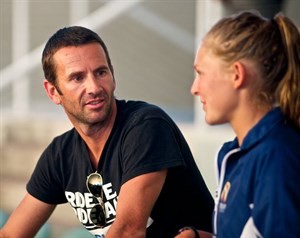
 In this episode of The Effortless Swimming Podcast, we have Pete Robinson aka “Robbo”. He is a 3-time world champion in Triathlon, qualified for the 2000 and 2004 Olympic Games, and a bronze medalist in the Commonwealth Games.
Pete has transition to a coach through his business – Elite Performing Minds.In this podcast, we’ll talk about how Pete:
- has had a great success in the last 2 decades of competition
- used mental strategies to have the upper edge over his competitors
- teaches all these as a mentor
01:22 – Retired…and back
02:05 – Enjoying The Mental Side
05:43 – Passing on the knowledge…
10:53 – How Visualization Plays A Role in Coaching
17:53 – “I’m the healthiest guy in the start line…”
21:43 – Having The Clarity of What Was Going to Happen in The Race
25:42 – The Why, Where, How and When
27:11 – Switch Pff, Relax and Reset
28:05 – Earning Respect as a Mentor
35:48 – What’s even more powerful than me having the answer…
To learn more about Pete’s work, visit ElitePerformingMinds.com
Transcript
Read the full transcript
Welcome to Effortless Swimming, the podcast for swimmers, triathletes and coaches. Join Australian swim coach Brenton Ford as he reveals the latest techniques and information to improve your swimming. Let’s dive right in. Brenton Ford here. Welcome to the Effortless Swimming podcast. My guest today is Pete Robertson. You might know him as Rubbo. He is a three times world champion in triathlon. He’s qualified for two Olympic games, Sydney in 2000, Athens in 2004. He’s also a bronze medalist in the Commonwealth Games. And Pete is transitioning to more of a mentoring and coaching role through his business elite performing minds, but he still competes in triathlon. And what we talk about on today’s podcast is how he’s had such great success over the last two decades of competition and how he’s used some mental strategies and mindset strategies to have the upper edge over his competitors and how he now teaches that to other athletes through his business elite performing minds.
I was at the airport when I recorded this call, so there’s a little bit of background noise. So hopefully you can still hear the audio very clearly. But just to give you a heads up, there’s a little bit of background noise and a few announcements over the loudspeaker as well. So here we go. Here’s Pete talking about how he’s now making that transition into more of a mentoring role. Yeah, well, I initially retired actually from racing back in 2010. And then I had a bit of time away from the sport. And then after about 12 months, I got involved again, and that was through actually a coaching role through Triathlon Australia. And I was really fortunate to be able to work with some of the top elite juniors and sort of the future of triathlon in Australia. And I really enjoyed the role, but I guess like anything, until you get into it, you don’t really find out what you really like about it. And I really enjoyed more the mental side of the coaching game.
And to be honest, the physical side was the technical aspects of coaching. It didn’t really interest me that much. And that’s why I really, since then, have sort of gone more down the side of, yeah, focusing totally on the mind that helps the sport. And so, yeah, since I finished up in that role, and then around the same time, I started back into racing again. So I came out of retirement, went back, not just being 100% focused on being an athlete anymore. I went back and studied elite athlete mentoring. And so, yeah, during that, while I was studying, I was actively doing more mentoring with athletes I was training with. And I had some access to athletes in the squad I was training with. So I was training with Aeromax for a while there, and the coach there, Grant Charles, gave me access. I just let me enter some of the squad members, which was really, you know, I think it was a win-win for hopefully everyone involved.
And yeah, from there, it’s developed. And then, yeah, early this year, I launched, you know, officially launched elite performing minds and sort of, I guess, took it a bit more public. And yeah, so it’s been a progression. And yeah, and for me, I think something, you know, mentoring is something, it’s not something you can force on anyone. So I’ve grown it, I guess, more organically. And yeah, just trying to combine both still the racing with the mentoring. Do you find that still competing actually helps you with your coaching? Because I mean, I find that when I’m coaching best, when I’ve got the most motivation, when I’m really, you know, when I’m thinking hard about what sort of programs I want to give my swimmers is when I’m training at a higher level. So have you found a similar thing? Oh, to be honest, I’ve been very surprised actually how much I get out of mentoring. It’s nothing, I’ve never set out to actually that to be the case.
But it’s quite, you know, I was blown away, you know, how hard to explain sometimes. But yeah, you get so much out of the sessions personally yourself, you know, especially when you’re getting good outcomes or, you know, overcome some sort of, a lot of times it’s not me telling people what to do, they’re often telling me what they’re going to do. Something that I’ve learnt through the study is to try and, yeah, coax that out of athletes is to get them to tell me what they’re going to do. And it’s a much more powerful way of mentoring where, you know, I got into mentoring because I had what I thought was a great mentor. And that was something that I wanted to pass on a lot of the knowledge that I’ve learned over the years that he taught me over the years. But I always knew that there’s probably a more effective way of getting that message across and that, and through the study, I was quite surprised at what I did learn out of the study.
And, yeah, one of the keys to what I learnt through mentoring or through the course was that it’s not, I’m not here to tell people what to do. I’m here, people will tell me what to do and then sort of together, you know, we come up with some ways of getting the best outcomes. But it’s definitely not… Oh, you there? How are you there? Yeah, I think this dropped out right in there. It dropped out at, what was it?
You were talking about, yeah, the thing you found through the study was that it’s not yet that you can’t coax it out of people. I think, sorry, I should be able to cut it. So it works, that’s all good. And so with that, does that mean asking different or better questions or what kind of changes had you made as you started to learn more? Yeah, that’s exactly right. Rather than me telling people what to do, I have to ask the right questions. And so that’s been, I guess, a real challenge for me in through mentoring is that it’s easy to tell people what to do and anyone can do that. And that’s why I guess there are a lot of mentors out there. But what I’m trying to achieve through Elite Performing Mines is being an effective mentor. My mentor, who I talk about a lot, I have a lot of respect for him, he worked really well for me because I knew that he had his best interests at heart. But the fact that I benefited so much out of his mentoring
didn’t mean that translated to every other athlete that he touched and worked with. So what I’m trying to create is a more effective way of mentoring and through asking the right questions, that is what’s been shown to be a more effective way of mentoring. So it’s a real challenge for me because, yeah, to make my life easy would be easy just to tell people what to do. And we see that happen a lot, you know, it’s very easy to tell people what to do. But focusing the right questions out of people and getting them to tell you what they’re going to do is actually a more effective way. Yeah, I think you just sort of need to… It’s actually more difficult to create that sort of bond and relationship where you can have them talk about that. It is actually more difficult because you’ve got to think of the best way to approach it as opposed to just throwing everything at them and telling them what you think they should do.
But, you know, change only really comes when that person is ready to change. So I sort of found that when I run a training camp over in Tanyapura a few months ago and, you know, with that we have a goal setting session where the athletes ride down there. Their goals, you know, an event that they’re training for, what they need to do to achieve it and, you know, what are some of the habits and things like that that they’re going to create in order to achieve what they’ve set out to do. And then I got them to share it with the group and with other athletes there. And that way they’re really building their own vision, their own dream as opposed to you telling them, you know, what they should be doing to hit those goals. And I found that just that kind of discovery process really beneficial and especially with adults, you know, they just don’t get asked that very often and they don’t get the time or the chance to really sit down and write down their goals clearly
and define what they are exactly. Yeah, absolutely. Do you use any sort of visualisation with your athletes? Is that part of the program that you haven’t gone through? Yeah, definitely when we’re talking more about, you know, racing and, you know, one of the things I like to focus on is that training is you train to race. I find a lot of athletes, not through my mentoring that I’ve done, but just over the years, you know, a lot of athletes just too focused on training where, you know, they leave a lot of their best performances in training sessions. You know, just that small shift in focus of training to race is something that I use and I guess that’s where, you know, the visualisation can start. It’s a good starting point, you know, where you rather than trying to nail have the best actual session, you’re not so focused on that particular set to focus, start to focus on racing. And through that process, you’re automatically going to have a great session, right?
But you’re not focused on so much on the set. You’ve started that process of visualising your racing. And then, you know, closer to the race, I mean, there’s lots of different techniques and I probably don’t know all of them. But as you get closer to racing, then you will become a lot more specific visualising the races and so on as well. I think it’s important about the training to race because a friend of mine who’s a pro-trained athlete, he trained over in France the last couple of years and trained with a good squad over there. And he said that most of the time, sometimes it’s the athletes that weren’t necessarily training the hardest every session that were racing really well. And I think the reason behind that is that they were possibly doing what they needed to do in the session in order to race well, as opposed to giving 100% every single session and maybe pushing harder than what was required in the training session.
And as much as you’d like the hardest working athletes to succeed sometimes, you’ve got to train smart with the end goal in mind of wanting to race well. And sometimes it might mean holding back a little bit in some sessions if that’s what the session requires. Did you sort of find that when you were training for the Olympics and Tom games and everything, did you sort of come across that with athletes as well? Yeah, all the time. I constantly came in contact with athletes who in training scared the hell out of me. I was blown away with what some athletes could do in training. And then on the flip side, it confused the hell out of me how come they would never beat me in the races. And I think one of probably the greatest examples of this who fortunately was able to turn it around and has gone on to become one of the greatest triathletes of all time is Craig Alexander. I trained with Crowey back in 2000. And back then his nickname was the world champion trainer.
He trained so hard. And everyone who came in contact with Crowey back then just knew that once he got things sorted in the races, that once something clicked, that he was going to just stop. And it still took a few years after that for that to happen. But around 2005, I think, yeah, he’s actually breakthrough. And then on, he’s just something clicked. I’d actually love to sit down with him and ask him one day to change. Clearly there was nothing physical to change between 2000 to 2004 to 2005 to 2007. He’s dominated triathlon. It’s clearly just a mental thing. Yeah, but I guess he was a classic example of someone who was so amazing in training. I was the best triathlete in the world around that time yet. He was my training and he would whip me in training. I could not compete with him in training, swimming, running. He would smash me up. The bike would probably be even. But the other two disciplines, he had a lot more speed than I did.
I was the fastest triathlete in the world around that time. Fortunately for him, he went on to be one of the greatest triathletes of all time. But there’s a lot of triathletes who haven’t overcome that and have left a lot of their best performances in training and never really converted that to being the athlete that they could be. Is that something you feel gave you an advantage when racing was some kind of mental quality or mindset that gave you an advantage over a lot of your competitors? Yeah, absolutely. I never stood on the start line thinking that I was physically better than my competitors. But there were many times I stood on the start line thinking that I could beat everyone. It was just through different things, through preparing differently. There were some things which were measurable, which training is often measurable. We often measure ourselves from training sessions, but there were certain things,
so I always paid a lot of attention to my diet and nutrition. That isn’t measurable, apart from getting some blood tests or things like that. I always stood on the start line thinking I’m the healthiest guy on the start line. No one’s body is going to be more efficient than mine today because I’m healthier than everyone else and I’ll be able to push myself to a further limit because my body functions at a higher level. I couldn’t prove that. I didn’t have no real means to know. But I just believed it and that was something I believed. Sure, no, it didn’t matter. I believed it. That was one of the tricks that I used through my career. Obviously, there has to be a combination of different training, but looking back over the years, the years that I won the World Championship and compared to the years that I finished running up, I reckon I was physically in better shape than the years that I finished running up than the years that I won.
The years that I won and I was going to win. There’s powerful lessons to come through having that belief in yourself. Yeah, definitely. I don’t know if you’ve seen much of the UFC, but the recent fight with Conor McGregor, the Irish guy versus Joe Gale, did you see the fight? 18 seconds, yeah. Just going into the ring, Conor McGregor looked so loose and relaxed and it could have been any other day for him and Joe Gale looked scared. He wouldn’t look him in the eye and it just looked from the very beginning that you could almost tell what was going to happen and it did within 14, 15 seconds. So it’s just that mindset going into it and fighting is probably the most evident with that, but then you can see it on the start line in triathlon as well is how people are feeling. If they’ve got those raceners, they’ve got the anxiety at the start, then nine times out of ten, you know how they’re going to race. Yeah, I totally agree, yeah.
No, I’m a fan of the UFC as well. And I saw a follow-up video, not video, but interview of Conor and the reporters said, you described exactly what was going to happen in your fight, word for word, moment for moment, you described it and this was after the event. But an interview that he’d done before, he had talked about it afterwards and it was really not mind-blowing, but it’s great to see that kind of stuff and it’s sometimes hard to, it’s easier to explain before it’s happened than after because you are in a different state of mind and it is a state of mind that you have to work yourself into and it doesn’t just happen overnight. There’s a lot of things you can change very quickly in the mind but there’s also things that need work over weeks or usually weeks I would say and sometimes months, but it was really interesting just the way, he was so clear on what he was going to do in the fight. He picked his patterns
and that was definitely something that I used during my career just having that clarity of what was going to happen in the race and it’s amazing, one, it’s amazing being in that state of mind it’s almost a knowingness that you’re going to, when I won my first world title I said I was going to be in I came out and said I knew exactly how I was going to do that through the race plan and so on and it unfolds about, actually I’m pretty sure that race unfolded exactly how I had anticipated and it’s such a powerful way to race but I find there’s two ways to compete one being proactive and one being reactive and when you have a clear race plan and you’re being proactive, you’re dictating what you want or how you want to race rather than waiting to see what everyone else does and I know Triathlon very well but I’ve spoken to some swimmers as well who have also used being proactive knowing exactly what they’re going to do
take the race out real hard or whatever your sport needs then you’ve got to be prepared for that physically and definitely yeah and that’s what I love about sport is it’s just being able to set those goals and work towards them and then just having the confidence to go out there and race it to how you plan and then have that come off, have that happen I think it gives you such confidence for everything else that you do in your life you really get to test yourself and see what you’re capable of whereas I guess in day to day life it’s very hard to have that show so clearly so probably my best race when I visualised this 400 IM when I was 15 it was my from 12 months out I was visualising this race and I knew what time I wanted to go and how it would play out and then I got within about I think it was within about half a second of what I’d planned and it was as well beyond what I’d done in the past but I just pictured myself swimming in this race
for 12 months and lead up to it and it came off and I just never had such a good feeling after a race like that one when you’re seeing this thing happen for so long out but then you actually go ahead and do it it’s very hard to beat that feeling yeah it’s awesome what are your strategies or what do you do when you sit down and think about your goals for the next 6-12 months what’s your plans for doing that yeah well I like to write them down and yeah it goes with any sort of goals whether they’re triathlon or racing goals or sporting goals or life goals or different aspects of life yeah and I sort of run through yeah the what, why, where, how, when you know all those different aspects of the goal and I find once I go through all those steps it sort of answers all the questions of what the goal is and yeah so you keep it simple is there any specific timeline you have when setting goals like you only think about the next 6 months
or do you set real long term ones like 5 years, 10 years out to be honest like throughout my career it’s fluctuated it’s not something that I’ve done consistently yeah I would say so yeah sometimes I’ve set those longer term 5 or 10 mid-term goals and then other times I’ve just been focused a bit more on the short to mid-term goals yeah I look it’s one of those things how I wish I probably had written more long term goals out but yeah I guess we can all constantly work out yeah definitely I think it kind of goes in it goes in stages it’s like when you compete in you might be training for an event which is 12 months away so you’re working towards it and then afterwards you’re going to take a break and have a rest and the same thing goes when you’re setting your goals sometimes it’s good not to have anything there for a while just so you can switch off, relax and be ready to reset the next time you’re ready to work towards
something big so yeah I think it’s like it’s like anything in life it’s a bit of a roller coaster yeah and you know yeah I guess it’s the case of one of the reasons my mentor was so powerful for me I always everything I guess told me to do or asked me to do I knew that he was always prepared to do it as well and so there was a lot of respect there and that’s I guess it’s something I try and create as well that if I’m advising someone to do this or that that I’m willing or prepared to do it as well
on the flip side you know I’m not 100% perfect either and so you can’t always
set your life around what someone has or hasn’t done so yeah you really got to take control of your own life and what’s yeah what’s important to you yeah definitely and with the people that you advise that you sort of consult to what stage are they at not I wouldn’t say mentally but so someone when you get approached by someone what are they generally wanting to achieve or wanting to do so why does someone yeah what sort of makes someone think I really need to work on my mental game well yeah it really varies yeah I’ve had few years I’ve had age groupers I’ve had pros probably the one thing that I have have noticed is I get more women to be my mentees that’s something that yeah it’s fine with me like I yeah but it’s just something that I’ve noticed that a lot more women are open to being mentored and yeah which is again I still enjoy working with all types of athletes whether they’re elites, age groupers, juniors or so on when I first set out to do it
I was probably more thinking towards juniors because I think that’s a really influential time in their ground now it was for me I had a lot of questions when I was at that age but everyone still has questions just one of the things that I do enjoy about mentoring is that I often finish a session and I ask myself if they hadn’t asked me that question I wonder if they would have asked anyone and sometimes it might just be a little question, might be a big one it’s just nice to know that people trust me and they’re comfortable talking to me about basically anything and everything but it is one of the things that it is important and what I want to do is that every session that I have is 100% confidential with the athlete and so yeah I think that’s comforting for the athlete to know that I don’t discuss anything that I talk about with athletes it’s sometimes hard for me to when I do get to interview like this to talk to talk too much about
what I talk about with athletes I’m asking a specific question and I’m asked about what I talk about with athletes or what happens with athletes I could potentially end up talking about personal situations but I guess generalising there’s all different things that are happening and sometimes I guess it’s similar to what we were talking about earlier is that often what I’ve found is just the athlete talking out loud about what they’re trying to overcome or having challenges at the time just them hearing it out loud often they’ll come up with their own solutions and what I realise is that them playing that over and over in their head it’s not quite as big as they made it out to be and that’s not undermined or glossed over problems because it’s something that they need to deal with but when they just speaking it out loud and often trigger enough to go hang on I’ve blown this all out of proportion that’s not actually that big
we can do this mess and then move on but yeah just sometimes something as simple as that I’m not really doing anything there except listening and the athlete will come up with their own solutions often I might together we’ll have a solution as well and hearing it out loud can often trigger the right responses and ways going forward having them being comfortable enough to talk to you about that stuff and being a bit of a sounding board can be a huge difference because I know with one of my mentors we have a weekly call and there’s three things we cover one is a win I’ve had for the week one is a challenge you had for the week and then one thing that you’re going to do by the next call next week and half the time when I bring up the challenges that I’m having I’ll sort of talk them out and then by the time I finish talking I know pretty much what the solution is a lot of the time and the times that I don’t he’ll talk about
some options I might have or things he might have done in the past it’s a huge difference just as you said sounding them out and talking them through it’s almost like you’re the partner of another person like if you’ve got a wife or husband that you can talk stuff out with it’s the same thing with the mentor it’s just being able to be open about some stuff that you may not talk to most people about yeah and the important thing is I don’t have all the answers and so I can’t sit on the other end of the call expecting to be able to answer everyone’s questions or deal with every situation that comes up I’ve had a lot of experience I have my own knowledge but that might not be the answer to everyone’s issues or challenges but if they have the answer then that’s even more powerful than me having the answer so yeah it’s about dealing with these things talking about them brings it to the point where it shows that there is something to work through
and often the biggest step is actually acknowledging that we can’t solve it well I think when you say you haven’t got all the answers you’ve got such a huge base of experience and knowledge behind you that you’ve probably dealt with a lot of the things that they’ve been thinking about or questioning themselves about and when you were probably going through it it was more about having the space for you to be able to understand it and figure it out for yourself what the changes you’d need to make are so it kind of goes back to not telling what they need to do but more just asking the right questions for them to discover it themselves when it comes to getting anxiety at the start of a race do you find that this is really common among many age groupers or who do you find deals with nerves the most? it’s totally random it’s not one group of half or less but yeah I just try and bring it back to people focusing on what they can
it often sounds a lot cliche but bringing it back to what people can control it’s usually the things that make us anxious so often the things that control whether it’s a crazy swim we just are, you know, scared of all the other people around us it’s what makes a lot of people most anxious just having those fears around open water, being around a lot of people things that are a bit out of their control but it’s often when you bring it back to the things that they can do and think they do actually know to be true then that helps with overcoming some of these anxious issues and just to finish off work and people will find out about what you do and if they’d like to work on their own mental game for triathlon what’s the best place for them to visit yeah absolutely, so I guess the first point of call would be the website and yeah everything is Elite Performing Mines and the website is eliteperformingmines.com social media
there’s the Facebook page Elite Performing Mines Instagram and yeah I guess the first point of call is just to drop an email or give me a call and I’ll put all my details around awesome and I think it’s like you were sort of saying at the start you preferred to work on the mental side of things with athletes as opposed to you know more of the physical training and I don’t think that many coaches really cover the mental aspect of racing and sport but when it all comes down to it that if you haven’t got that right a lot of times the work that you do before it is not for nothing but it’s very hard to perform it your very best without having the right mindset going into it so I think it’s great that you’ve moved into that area because especially triathlon coaches who will help coach the physical aspect of triathlon but yeah not many doing the mental game so that’s excellent and I think it’s a really valuable service
that you can offer people
oops you there I don’t know when it cut out you were saying that you were glad that I got into it I guess yeah one of the reasons I just constantly heard and it was more elite athletes you know they’re the ones getting more interviews that they were often referring back to the mental side of the sport how important it was to perform well you know obviously the winners always get interviewed or something it was such a mental game today for me the physical they barely mentioned the physical side of sport they always mentioned how they had to overcome something mentally whether it was leading up to the race or during the race and it was a really important time for them and you know through my own personal experience it’s the same thing and often it was the mental side which definitely got me my great performances and probably held me back with some of my performances which didn’t go to plan so that’s why I chose to focus on it
and also I enjoy this side of the sport I tend to think that it was one of my strengths through my career that you know I was good at the mental side of the sport and so yeah it took me a while to realise that some of the techniques that I were different from other athletes for a long time I just thought that everyone did the same thing and everyone thought the same way but it’s not the case but a lot of those things can be learned so you know I’m also at an age now where I’m willing to talk openly about probably 15 years ago I spoke it so openly about the mental side of what I hear and why do you think that is? Just a maturity thing trying to beat the whole world up it’s just a maturity thing as you age your motivations change racing for different reasons I guess as you’re older you got less to prove I guess in my mid 20’s I was trying to prove everything to the world now it’s like well that’s not the case anymore
now I want to share what I’ve learnt with the world so this is a good big deal thanks for being on the podcast I’ll put all the links to your website and social media in the post and it’s been a pleasure having you on chat and I can talk about it thanks for joining us on the effortless swimming podcast to get transcriptions, bonus videos and to be the first to hear about new episodes go to swimmingpodcast.com