








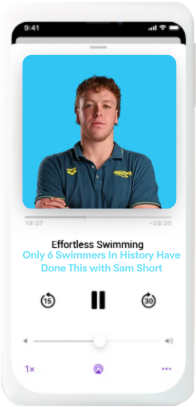
So what does he do that 99.999% of swimmers don’t? How is he able to swim this fast?
I’ve spent my career analyzing the best swimmers in the world, but watching Sam swim up close is a completely different experience. I’ve never seen anyone hold as much water as he does, even at world-record pace.
What stands out the most isn’t just the speed. It’s the relaxation. His recovery looks effortless, and the way he reaches forward into the catch is incredibly fluid—almost calm—despite the intensity of the pace he’s holding.
When Sam shared some of his training with me, one thing surprised me. He’s consistently swimming up to 80 kilometers a week. Massive volume. Huge power in the stroke. But when you ask him what really matters, he often comes back to the basics—simple things like rock-solid head position and clean fundamentals.
If you’re a triathlete or an open water swimmer, Sam’s power stroke isn’t just impressive to watch. It’s actually a blueprint for efficiency.
So today, we’re breaking it all down—the sets, the technique, and the mindset around recovery that helped take him to the very top of the sport.
01:27 Sam Short Intro
01:30 How Do You Describe Your Stroke When You Race?
01:47 Developed Overtime?
2:00 Mobility And Flexibility
02:20 What Does Swimming Fell Like When You Are Swimming Well?
02:39 Any Particular Part Of Your Stroke That You Are Working On?
02:53 400 Free vs.. 10k Openwater Swim
03:12 Kicking Sets
03:28 Cues And Phrases
03:45 Stroke Rates
04:03 Head And Body Position
04:43 When Body Position Is Not Where It Should Be
05:06 Good Feel For The Water
05:28 Breathing Pattern
05:54 Rotation
06:19 Openwater
06:47 Favorite Sets
07:26 Hardest Set
07:50 Distance per Week
08:10 Taper
08:28 Sessions Per Week And Gym
08:48 Being A Smarter Athlete
Transform your freestyle to be effortless and smooth with online video analysis:
https://effortlessswimming.com/courses-membership/
Try the new Nanoclear Anti-fog Goggles: https://bit.ly/nanocleargoggles
Transcript
Read the full transcript
Welcome to the Effortless Swimming Podcast to show that help swimmers and triathletes love the water, become a better swimmer and live a better life. Here’s your host, Brenton Ford.
What does it take to swim 55 seconds per 100 meters? Not just once, but four times in a row without stopping. Sam Short is one of only six swimmers in history to ever break three minutes 41 seconds for the 400 freestyle in a long course pool. And to the average swimmer, that speed feels impossible. So what does he do that 99.99% of others don’t? How is he this fast? I’ve spent my career analyzing the best in the world. But watching Sam swim up close is a different experience. I’ve never seen anyone hold as much water as he does. Even at world record pace, there’s this level of relaxation in his recovery and fluid reach into the catch that defies the intensity of his speed. And Sam told me he’s consistently hitting up to 80 kilometers a week. But despite massive volume and raw power in his stroke, his focus often comes down to the basics like rock solid head position. If you’re a triathlete or open water swimmer, Sam’s power stroke
isn’t just impressive to watch. It’s a blueprint for efficiency. And today we’re breaking down the sets, the technique and the mindset changes regarding recovery that took him to the top of the world. My name is Samuel Shaw, train and swim in Brisbane, Commonwealth champion, world champion, multiple time world championship medalist and an Olympian. How do you describe your stroke when you race? I’d say powerful stroke. I do have a tendency to like lope and I’ve kind of morphed that into like my optimal stroke for me, not as tall as I’m like competitors. So I kind of try and use my long arms for my my heart to my advantage and you know, kind of creates a lope. So and is that something that you’ve always swum that way or you it’s developed over time? Yeah, I’ve grown up swimming in the surf all since I was a baby up till now. And I think I was kind of influenced that a little bit and swum into it and then just developed into me right now and some of my
fastest times on it. In terms of mobility and flexibility, how do you rate yourself in terms of that? I say shoulder mobility and health is relatively really good right now. My very good shoulder range. If you’re talking hips and all that sort of stuff, I can definitely have some help on that. I always get tight hips and all that sort of stuff. But for a swimmer and a distance from that, I’d say my range is pretty good for shoulders. What does swimming feel like for you when you’re swimming well? What do you notice between when you’re swimming well and when you’re not? When you’re swimming well for me, I feel really light, just weightless almost and you can feel yourself propelling through the water. You feel strong and you can feel like you can just keep building through those races. And if someone takes off or you need to chase them, you have the capability to do that. What about any particular parts of your
stroke you’re working on at the moment? Consistent kick. Sometimes if I’m lazy, I have a tendency to like kind of miss it, miss a kick here and there. And that’s just gonna waste its space and not as optimal. So consistent six bit kick for me. And how does it change between a 400 free and a 10 K open water swim? Honestly, probably the legs and obviously the stroke rate as well, but you’re not going to be belting your legs as hard in a 1500 as you would be in a 400. Your legs don’t need to be really fit regardless. But I think your legs, definitely if you’re for 1500 will fatigue very quickly if you’re just belting them. Are you doing a lot of kicking sets to develop it? Yeah, I’ve improved my kick a lot over the last couple of years. I used to be horrible. Actually, when I won the Commonwealth Games when I was 18, I could barely kick sub two minutes. And now I’m like, I can kick some 130 like on repeat probably. So it’s a
lot better. And I definitely far from the best. Is there any cues or phrases that you think of when you’re swimming or you’re racing that you tend to go to? I’m a stroke rate based kind of swimmer. So I know all my stroke rates for my races. And so pretty much just tempo. I just keep trying to repeat the word tempo on my head. Sometimes I have a song with the tempo I like that I just like to try and hit those stroke rates with. What are your stroke rates for the different events? Like 400. When I swim my best, I’m like 42 43. So pretty high for 400 800 free. When I saw my best like 39 40. And then 1500. When I saw my best, the first thousand was like 38. And then towards the end, I was like 36. But you know, probably 36 or 38 range. And what about in terms of head and body position? Are you thinking about that on a constant basis? Or what do you like to think of there? If I’m really tired, I do tend to move my head a lot. And you know, that
creates drag. So keep my head low is a good cue I like to use. So sometimes the break out in the turns I do tend to be lazy and lift my head and that creates drag and it’s slower. So definitely keep my head low. Is that something you’ve seen in in races before from field like analysis footage? So like if you look at my 20 25 400 freestyle, I came second by point oh two and like the last turn I come up and just take a massive breath. And there’s you know, that’s just you could you think what what could have been. So you know, definitely try and keep that head low. What do you still when you have your body position is not where it should be? Well, I feel like you almost something like that like your legs could feel like they’re dragging along along the bottom of the floor. If your head’s too high like that’ll affect your hips and your legs. So it’s all that hip set for me to be honest. If I’m in a good body position and I feel nice and high in
the water and my legs are kind of just like on the surface kicking well. The feeling of heavy legs pretty much. So are they some of the things that you feel like you’re not sitting high in the water? What things would you play around with to try and improve it for the session? A lot of drill work I’d say like I always do drill work it’s out of my sessions to warm up like I love the long dog drill six kick switch. Start to kind of keep my legs active and also a lot of scale I love getting the feel for the water with the scaling that sort of stuff I do kind of helps me have the good feel for the water and that kind of creates good body position. What about breathing? So what’s your typical breathing pattern in a race and then training? Definitely in a race I breathe every two maybe for like the last 10 meters I’ll try and put my head down and just really rip that strike right towards the end but every two and then in
training up every two as well except I try to mix it up so maybe a 50 here and there I’ll breathe to the opposite side just to kind of even out the shoulders here and there but when I really want to try and swim fast all the session gets hard just to the one side my right. What about rotation? So with that more loping stroke do you feel that more uneven rotation and is it something that you’re conscious of or you’re actively trying to pick up? Yeah I definitely try to be not seesawing all over the place like if the legs are on I can kind of be a bit more flat and there will be a tendency for me to have a little bit more rotation just because of my stroke but obviously you don’t want too much because that’s there’s a kind of a sweet spot. What about open water how do you change your stroke for it when it does get a bit choppy in the open water? Yeah I’m pretty lucky that I already do kind of have that little loping stroke so it’s not too hard
but definitely the open water changes it got really choppy and like the waves is hitting me so I feel like it’s just kind of not trying to fight the water almost like you know I relax them is often a fast summer and just kind of using it and not trying to just bash away through it and just kind of not move more water than you need to I’d say. But what about favorite sets any particular sets that you’re doing a regular basis that you quite enjoy? Before Worlds we did this really cool set it was like four twos which are all 400 pace and then like four ones all 400 pace eight fifties fast and 400 pace like no recovery just all in a row and that was pretty good I think the four 200 is wrong maybe four minutes so a lot of rest I think best time I did I was like 150, 150, 151 and 151 off a push and then the hundred fifty fours and fifty threes and then into the fifties like 26 lows maybe finish them a 25 and after that I was like I’m ready to
go so stuff like that it’s very hard and you’ve got that constant vomit feeling but it’s you know look back at it saying that was pretty hectic. What about the hardest set you’ve done? We’ve done a 3000, 2000, 1000 like descend all the way through that’s that’s pretty hard a lot very mentally as well if you start too hard you’re gonna gonna hurt but then also one time we did a 800 free best time four twos on 230 400 best time you could possibly do four twos on 230 200 best time you can do four twos on 230 100 best you could do then four twos that was really hard. What about training wise how much distance would you typically do a week? At the moment this time of the season between I probably don’t have 70k to be honest nothing too crazy compared to some of my competitors overseas that are doing hectic stuff but I mean I kind of can come down to the 200 as well if I want to so need a bit of speed and then maybe when
more quality work comes in probably around the 60-60 something mark. How long did you typically take before leading into a main event? Me I’m probably shorter than most wouldn’t even really think about table till two weeks before off maybe start dropping it down obviously the sets will kind of get a bit more refined into like more quality work less bash yourself but yeah two weeks and then the weekend I’ll probably start to drop it down pretty quickly. How many sessions a week in the pool are you doing and what about gym? I swim I’m doing nine main ones with the squad and then I swim on Sunday by myself just to try and keep the feel for the water for Monday that’s only like a two and a half case swim and then gym I’ll do two lifting days so Tuesday Thursday and then Saturday I’ll try and get some mobility in and roll out stretch just because I’m pretty knackered by the end of the week. What about things that you’ve
maybe picked up or learnt over the years that you wish you’d known when you were younger? Yeah definitely something I know now that I wish I knew like 2024 Olympics is you don’t if you’re injured you know getting shoulder injuries as a distance swimmer or a professional swimmer is inevitable most people have some sort of niggles here and there. I always used to think just had to bash my way through that or illness. Now I know like a lot of training is how good you recover so I’m a much more of a smarter athlete now and if something hurts you know like seek help professional advice like a lot sort of stuff so instead of just bashing through it and pretending like nothing’s wrong realize that it’s wrong and try and fix it and not be afraid to recover a bit more than you know I’d say I need. Thanks for listening to the effortless swimming podcast if you’d like us to help you become a faster more efficient swimmer go to www.effortlesswimming.com