







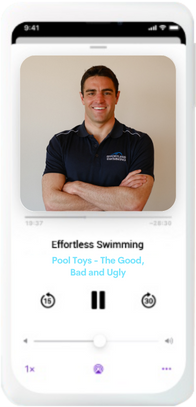
In today’s episode, I will talk about the equipment and pool toys that I recommend to the athletes that I coach.
00:41 Have A Good Pair Of Fins
03:38 Paddles
05:51 Pull Bouy
06:45 Kickboard
07:20 Snorkel
08:15 Noseclip
08:38 Goggles
10:56 Heart Rate Monitor
11:50 Powermeter/Analysis
DMC Fins HERE
Front Swim Snorkel HERE
EneyBuoy2 HERE
Form Goggles:
http://formswim.com/effortless
Change your technique and swim smoother, easier freestyle in the Effortless Swimming membership:
https://effortlessswimming.com/stroke-analysis-membership/
View our freestyle clinic schedule around Australia:
https://effortlessswimming.com/freestyle-stroke-correction-clinics/
Transcript
Read the full transcript
Welcome to the Effortless Swimming Podcast to show that help swimmers and triathletes love the water, become a better swimmer and live a better life. Here’s your host, Brenton Ford. Welcome to episode 268 of the Effortless Swimming Podcast. On today’s episode, I’m going to talk about what equipment, what pool toys I recommend to the athletes that I coach. There’s so many different options out there, but more times than not, a lot of it is not that good and can actually make your stroke worse, can make your technique worse compared to making it better, which is what we want to do. And we don’t want to impact our stroke in any way just by using the wrong equipment. The thing that I would recommend every swimmer get is a pair of fins, a good pair of fins. And the brand that I’ve used for more than a decade now is DMC. I use the DMC Elite Max Finns, which is a short blade fin. They’re not the longer ones that you might see with some younger kids using, but they’re
a shorter blade fin. But the benefit to that is you don’t change your rhythm and timing of your stroke. With a longer blade fin, it makes you kick a little bit funny and differently than what you’d normally do when you’re not wearing fins. So we don’t want that. If that’s all you’ve got, the longer blade, look, it’s fine. But if anyone’s looking to get a new pair of fins, I would say get a pair of the DMC fins. Now if you generally have tighter ankles and you don’t have great ankle flexibility, these are a really good option. And I’d recommend get the DMC Elite 2 Triathlon Finns. It’s a softer material, still gives great propulsion, still very similar to the Elite Max. But because they’re that little bit softer, it will put less pressure on your ankle joint. And that can be something that can cause triathletes to not really like fins is if they’ve got too much pressure on that ankle joint, it can impact your running a little
bit. So the softer version, which is the DMC Elite 2 fins, is a really good option there. Now a similar brand to that, I’m not sure if they ripped off the design or not. But you got I think the Arena Power Finn, which is fairly similar. If you can’t get the DMC Elite Finns, that would be another alternative option. This episode of the podcast is proudly bought to you by our sponsor, Form Goggles. They’re more than a pair of goggles, meet the world’s most powerful swim platform. See yourself improve with form smart swim goggles, including a free one year membership when you purchase your goggles for only $228 US dollars. Now they’ve currently changed up the offer where you can now get the goggles and you have that one year membership included for free. And then if you’d like to continue with the membership going forward, it’s only $15 US dollars a month where you get access to their workouts, training plans and their
custom workout builder. But you’ll always have access to the real time data of the goggles, so you’ll never lose access to that. So if you’d like to swim without stopping to look at a pace clock or your watch and get live metrics right inside your goggles, including your time, distance, pace, they are right there in your goggles with form goggles. I’ve used these for over 12 months now and I’m a huge fan of these goggles and use them for a majority of my sessions and find them very helpful, especially for gauging my time, my effort and my pace. And I think it’s a very helpful tool for the majority of swimmers that I would normally work with. To get your pair of form goggles and save 15% off, use our link formswim.com forward slash effortless or use the coupon effortless at checkout. That will get you 15% off your pair of form goggles using our special link formswim.com forward slash effortless or use the coupon code effortless at checkout.
Now paddles. So if you’ve listened to this podcast for a while, you’ll know that for the last couple of years I’ve had this paddling development. It’s been a very, very long process. Still not there yet. We’re still working with the manufacturer to get these done. It was a lot harder than what we expected, but we’re hoping in the next couple of months that this will come to fruition. Now, once it does, I will let you know. But in the meantime, the paddles that I recommend, there’s two styles that I quite like, synergy hand paddles or the stroke master hand paddles. And these are available through Amazon or through a lot of different websites online. Now there’s synergy hand paddles. It comes in three sizes. You’ve got your small, medium and large. Don’t go for a large pair unless you’re fairly tall or you have quite big hands. I see people overdoing the size of their paddles, which can put too much pressure on their shoulders and can lead to injury or it can just
reinforce bad technique. So I personally use the medium sized ones. If you are a little bit shorter or have smaller hands, you might go for a small pair, but I wouldn’t recommend most people go for the large ones. You would probably see some elite triathletes using some bigger dinner plate type paddles, which can be OK, but especially if you’re still learning good catch and pull technique, you’re probably better off going for a small or medium sized there. So the synergy hand paddles are great and so is the stroke master. It’s fairly similar design, but they don’t change your stroke in any negative ways. There’s some paddles that I’ve seen that, for example, you put your thumb through quite a curve to the paddle. And the only way you hold that the paddle on your hand is by putting your thumb through it to me. That really sort of changes your stroke, especially as you exit the water. So there’s quite a few paddles out there that I wouldn’t recommend it.
I’d say don’t wear them because it’s going to make you a worse swimmer, even though they’re marketed as making you better. So I’m just not a fan of quite a few different paddle designs out there. I think simple is usually quite good. So yes, I’d stick with those two brands for now until we get our paddle out, which I hoping to do by the end of the year. Now, Pullboy or Pullbilly, if you’re in the US, the one brand that I love and have used for many, many years now is the EniBilly 2. So designed by my friend, Eni Jones, most of the top triathletes, the pro triathletes that I see, they’re using this Pullboy. It is narrow in the middle, so it means you can keep your legs close together. So they’re not sitting out really wide, which is creating extra drag. You can keep your inner thighs, your knees close together like you would when you swim. And that’s an important thing to having good connection through your core and through your hips.
And it’s got these two plastic, almost like plastic bottle shapes on the end of it, which provides a really good buoyancy because it’s filled with air, more buoyancy than what you’d have with a foam Pullboy. So that’s why I think that’s a really good option. Great buoyancy, keeps your legs in the right spot. And you could also use it as a water bottle if you want to. Now, in terms of kickboards, this is something that I’d say you probably don’t need necessarily. This is one that I wouldn’t normally carry around with me. But in terms of kickboards, I don’t think you necessarily need any fancy designs here, just a basic board would do. Just depends what you use it for. But not something that I would typically carry around in my kickbag, but it does just it does depend on what you’re training for. A lot of elite swimmers will have them because they do quite a bit of kick. So it really just depends on what you’re doing in your training sessions.
For going to snorkel, so I am a big fan of low profile snorkels, meaning ones that aren’t excessively big or wide or cumbersome. I like low profile ones. We stock some in our shop, so I’ll put the link below. So our online shop to where you can get some. Otherwise, the TYR, the Tier Ultra Light Elite is quite a good design. It’s narrow, fits on your face easily. It’s not going to move around too much when you go through a turn. So I think that’s a pretty good option that would be available in most countries in the world. But there are I have used the Aquasphere and Michael Phelps one. That’s pretty good, but it is quite large. And I do find when I push off, especially at speed, if I push off the wall, it moves around quite a bit. So I do prefer the lower profile options of a narrow, thinner snorkel. Most people tend to need a nose clip when they’re wearing a snorkel. So if you’ve tried on in the past, try it with a nose clip.
If you’ve had trouble, if you get water up your nose, a nose clip is just necessary. You’re going to have to wear it when you have a snorkel on because especially if you’re doing any turns, it’s very hard to keep the water from going up your nose if you don’t have a nose clip. So that’s a five or ten dollar investment that can make wearing a snorkel much more enjoyable. Now, if we go to goggles, this is definitely a personal preference. So I wouldn’t recommend the one brand of goggles for every person. It just depends on how your face is shaped and all these different things. So a couple of recommendations I would have for goggles, though, is obviously if you want to track your swimming and not have to stop and start your watch when you’re training and just be able to track your swimming, obviously the form goggles I’m a huge fan of, they’re a sponsor of the podcast. So that’s a really good option for tracking
in terms of just general goggles and perhaps when you’re racing. If I’m swimming in the open water, I usually want to wear goggles that are slightly bigger. So the lenses are slightly bigger than my pool training goggles if I’m not wearing form goggles because with slightly bigger lenses, you can see better visually. It’s a bit better and that might be needed if you are looking for where the buoys are. If you’re looking for trees or landmarks to be able to see. So I find that’s better when swimming in the open water. But otherwise, I’d normally go for a smaller type of goggle in the pool because it’s going to be a little bit faster. Perhaps might feel a little bit better as well in the pool. One thing that is usually required if you are swimming in open water is tinted goggles. Unless you’re swimming early morning, late evening, if you’re swimming through the middle of the day, you’re probably going to need some form of tinted goggles.
So I’d recommend getting a pair of those, especially if you’re racing any time where there’s going to be sunlight or it would be quite bright because that’s going to make it much easier to swim if there’s any sort of sun in your eyes. Otherwise, it’s going to be too hard to to see. In terms of keeping your goggles free from fog,
a lot of people will say baby shampoo. Now, I haven’t personally tried it, so I can’t say for certain whether that’s a good option. But if I’m doing an important race, I’ll usually buy a new pair of goggles for it. And I might have one or two key races each year. So it’s not too bad to wear it for those one or two key races or buy a new pair for those one or two races. So it’s not super expensive, but that way I’m sure that my goggles won’t fill up. But baby shampoo is what a lot of people recommend, but I haven’t really tried it. If you’re looking to track your heart rate, the polar verity sensor, optical heart rate sensor, is a good option. I see a lot of swimming clubs using that where you can actually hook it up to an iPad and the coach can stand on deck. They can see what everyone’s heart rate is at to make sure people aren’t going too easy or too slow. And you can buy that for groups and clubs. Or if it’s just for yourself,
you can hook up your the polar verity sense heart rate sensor to your form goggles. And I think usually to your garment as well, if you wanted to or your your training watch to get more accurate reading of your heart rate. And you can either wear it on your arm. So there’s a band that goes on your arm or there’s like a there’s a goggle attachment. So you can attach it, sits on the side of your head and can track it pretty well that way too. So it just depends on what you prefer. But that would be a good option if you’re looking for a heart rate monitor or sensor for when you’re training. The last one here is a power meter or a way to really dig deep into your technique. And you might have heard me talk about this in the past. The EO swim better, which they have now released. A lot of the athletes that I coach through video analysis have purchased these and are starting to send through their data from what they’re getting with the EO swim better.
So this is a device that you wear on your hands. And it measures the direction and the force as you’re going through your catch and pull. So through all phases of your stroke and measures, where your hand is, how much force you’re applying, where’s that force directed. So it allows you to see a lot of a lot of detail with your stroke, where you’re slipping in the stroke. Are you applying force in the wrong direction? Maybe through your catch, there’s too much downwards force or side to side force. And you can also look at the path of the hands too. And I’ve seen with a lot of the swimmers that I’m coaching. Who have sent through their data that on their breathing strokes, we can see there’s too much side to side, too much lateral force. So we’re working on how do we smooth that path out to keep pressure on the water so that they can have more propulsive forces through those breathing strokes, for example. So you can really dig deep into what’s happening through the stroke.
So that’s the EO swim better. I’m partnering with them. I’m doing quite a bit of work with them because I see it is a really good tool to analyze and break down the technique. And it goes hand in hand with the video analysis. It just gives us more data to see. All right, we can see this on the video, but what’s actually happening with the catch and pull, the hand and forearm. And we can dig deep. So I’m looking forwards to taking all these learnings from there and sharing them with you on the podcast. So they’re the main types of equipment that I would recommend. Now, if you’re thinking of keeping things really simple, I’m a big fan of fins, as I mentioned. A snorkel can be very handy because that way you don’t need to turn your head to breathe and you can focus just on what are my arms doing through the stroke. And it’s a much easier way to develop your catch and pull. So I think fins and snorkel is required.
And then if you are doing triathlon, you’re looking to build up your swim strength. Pull boy and paddles is a good tool as well. So they’re sort of the key things that I would have in a kit bag and and would recommend most people get. Thanks for listening to the Effortless Swimming podcast. If you’d like us to help you become a faster, more efficient swimmer, go to www.effortlesswimming.com.