








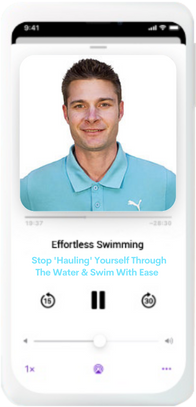
Carl joins us again on the podcast. He has a background in Exercise Physiology and Pilates but primarily in Functional Movement. In this episode, we will talk about how Carl has helped many swimmers with their pain and injury and understand the root cause of some of the injuries that they’re having.
01:26 What Injuries Do You Usually See Among Swimmers
05:16 Working On The Posture
07:55 Getting Blood Flow To The Injured Part Of Your Body
10:41 “Voltage Is Healing”
12:27 From Hauling To Floating
14:39 Trying Too Hard Puts Tension In The Body
16:17 Swim From Inside Out
18:20 Learn How To Hold Your Body Correctly
18:42 Squatting
20:36 Don’t Brace Too Much In The Pool
24:00 Connection Improves The Whole Mobility
26:29 Get In Touch With Carl Read
More About Carl Reader:
website: https://carlreadercoaching.com/
email: [email protected]
Change your technique and swim smoother, easier freestyle in the Effortless Swimming membership:
https://effortlessswimming.com/training-and-membership-plans/
View our freestyle clinic schedule around Australia:
https://effortlessswimming.com/freestyle-stroke-correction-clinics/
Form Goggles:
http://formswim.com/effortless
Watch the episode on YouTube:
Transcript
Read the full transcript
Welcome to the Effortless Swimming Podcast to show that help swimmers and triathletes love the water, become a better swimmer and live a better life. Here’s your host, Brenton Ford.
Welcome to episode number 269 of the Effortless Swimming podcast. My guest today is a repeat offender. It’s Carl, Carl Rita. Welcome back to the podcast. This is probably the fourth time I’ve had you on here to talk about how the body moves, how we can do things outside of the pool to become better swimmers. So I want to get you on today, talk about a couple of case studies, a couple of people that you’ve been working with and some changes that you’ve helped some swimmers go through outside of the pool to help them swim better, but primarily remove the injury or change the way that they’re moving so that they’re not injured and not in pain because I think that’s really your specialty is helping people understand what the root cause of some of the injuries that they’re having are. So welcome to the podcast. Well, Brenton, good to be here again. And yeah, it’s great to love working with the members. And yeah, it’s always
good to be learning new things. And so yeah, thanks for having you back. Great to have you. And your functional movement courses inside of our membership. And I know a lot of the members end up going through that, maybe not going through the whole course, maybe choosing a couple of different things that is more relevant to what they’re looking to focus on. And then a lot of them end up getting in contact with you if they’ve got particular injuries. What have you seen in the last couple of months since the last chat had you on that’s really stood out to you? What sort of injuries are you seeing? Yeah, it’s good question. I’ve had a lot of members, it’s been wonderful working and just reaching out especially with shoulder problems. And we know that’s quite a common injury and lower back. And just really this thing of struggling to this feeling of having to haul themselves through the water and putting too much pressure on their shoulders
and just really helping them to, you know, understand like how they can get around that and work the right muscles to build that strength. And we can we can get into that, you know, dive deeper into that now, like that just getting in that the body connected that there’s actually a connection issue there at the at the roots, like you talked about getting to the roots. So it’s just been very interesting because it’s a common, I see that, you know, work with someone every day. It’s a common, common problem. I think there’d be a big crossover from the consumers that would describe themselves as hauling themselves through the water. I think it’d be a big crossover from how they would all swim. I think that there’d probably be a lot of similarities there with how they all swim. And then you’d probably see that play out in some of the exercises and the movements that you have people go through. And what comes to mind when I think of someone hauling themselves
through the water is that they’re probably not using the lower half of their body very well, their kick, they might not even have one where the feet are just dragging through the water, their rotation, they’re probably too flat. They’re probably very, very flat with their hips. And it’s just all upper body. And when it’s all upper body, that’s when the upper traps, the neck, shoulders are just doing the majority of the work. But if you can get the whole body to work together with the right amount of rotation, an effective kick, then swimming is so much more enjoyable and it takes the pressure off. It takes the effort out of the upper body. So what do you, how do you go about kind of diagnosing where this might be coming from? Yeah, I mean, so, you know, we’re taking through like a full body movement assessment. But what I’ve picked up now recently, I just also that this years of working with back problems is that there’s a weak core. And, you
know, if you talk to most people, whether they do sport or not, the average person knows that you’ve got to have a strong core. But what I’m finding is that even though people are doing sort of like body space exercises, maybe they’re planking, maybe they’re doing some sort of like, you know, CrossFit, they’re just struggling to actually get the core to engage. So a lot of them will say, I feel my upper core, but not my lower core, or I feel my pecs and my glutes, but not my core, or I feel my left hand core, but not my right hand core. It’s quite interesting as you work with the guys. And, you know, if one thing I’ve also picked up is when the lower core is weak, then the hips and the buttocks and the hip flexors, they really get tight. Like you talked about that stiffness to get the legs. So once we get that core connected, and that’s a lot of work I do online, it makes a huge difference because now they get the power generated from this, from
this sort of, you know, I really want the list of pictures of the muscles as like battery packs. So, you know, you’re as big torches you have, you have to stack the batteries on top of each other. It’s kind of like, that’s kind of like your abs and the core muscles. They’re like a battery pack. And if there’s one of those batteries is not holding a charge or is, you know, not working, then the whole body is just disconnected. And so that’s a big part of what I’m doing is trying to help these swimmers like connect, get connected, basically. And how are you going about assessing that? Well, the thing is to try to find what are the things that they could sort of break up that connection. And so one of those is posture. We talked about poor posture, old injuries, then also just weaknesses in the tightness of the fascia. So, you know, you probably talked about this before, but your fascia is like that connective tissue
around the muscles that this around pretty much every organ. And that’s referred to as a semiconductor. So that means that electrons can actually go down those chains or those lines at the speed of light. So you’ve got this sort of like, so you can imagine that’s tight or damaged or the scar tissue there. There’s emotions as well, which you don’t touch on, but it’s just important to bring people’s mind that strong emotions can also sort of tighten up that connection through there. But my big thing is just to just really working on the posture, like getting them into better alignment. Once we align the pelvis and align the body correctly, then suddenly they feel, oh, I can feel my core muscles are working. Just basically asking them, do you feel the cord? No.
Do you feel the glutes? No. They don’t feel it. And they can be even in a playing position and they say, I just feel my back or I feel my neck. And I’ll say, do you feel anything in the tummy? Nothing. So, which is, you know, you think, OK, hang on a minute, that should be really targeting. So those are sort of the diagnostics, very simple questions. And then once you dig a little bit deeper into what the issues are, what and I remember you sort of sent through a case study that you had recently with someone with a shoulder issue and you didn’t start with the shoulder. You started somewhere else. Can you talk a little bit about what you what you’re looking at there? Yeah, you know, great. I mean, she had her posture was, you know, she had like a very high over extended lower back. We went to straight away into the glutes because, you know, me, the glutes, just trying to get that movement, a functional movement to open up a lower back, do lower back
stretches. Once you got the glutes firing, which she said she had an experience. And that’s also quite common again, like the client saying to me, you know, members saying, I just I never felt my glutes. And so once that started working, then we started doing some core strength and exercises. And that was doing the going back now, going back to like plank type movements and Pilates based up, which is really interesting because members have heard me talk about glutes and core and squatting. It was taking the members back now and just going back to sort of even like Pilates based exercises and the plank now the plank on the elbows, in my opinion, is not so functional. But I get my clients to plank in a sort of a push up plank position and we just modify that a lot because that sort of brings in the pics. The serratus anterior kind of connects the chain through the ground and you can even get them doing on a box or a chair
for those who are really weak, but really just trying to get that core and you know, we’re doing start off with some time that’s holding it for seven seconds. I know around the world you get these like playing competitions, you can hold it for like an hour kind of stuff, you know, but it’s really just like starting up with seven seconds, pulling at that strength, coming back and saying, do you feel it? Yes, I feel the top part, not the bottom part. Then we’ve got to go down and mobilize the lower back and and each level of the spine, each battery pack has got a level of the spine. So when they tell me that they don’t feel a certain part of the core working, we go mobilize that spine, try rotate it, try and unlock it, do stretches, then go back to the planks. It’s a bit of a, it’s a bit of like a jigsaw puzzle, trying to figure it out. But it’s, once you get stuff working, it’s like a puzzle that comes together quite nicely.
What I’ve found personally is that with a lot of injuries, unless it’s something more sinister, I guess, is if you can move through the different parts of your body, you can get blood flow to those injured parts. That’s when it starts to heal, because quite often in the past, I’ve heard physios who aren’t familiar with swimming, take a month out of the pool, take six weeks out of the pool and let it rest. Now, in some cases, that might be what’s required. But more often than not, you’re better off actually to keep it moving and adjusting what you’re doing. And you can’t take six weeks out of the pool without seeing a big drop off in your swim strength, your feel for the water, your kick, all these things. So swimmers need to stay active. They need to stay in the pool. And so that advice, you know, and I hear it from other coaches as well, like they will only send their swimmers to physios who know swimming because there’s
often a big gap for those that aren’t familiar with it. So what sort of with that moving through the different positions and getting blood flow to these injured parts, what role does that have in recovery or this episode of the podcast is proudly brought to you by our sponsor, Form Goggles. They’re more than a pair of goggles. Meet the world’s most powerful swim platform. See yourself improved with Form Smart swim goggles, including a free one year membership when you purchase your goggles for only two hundred and twenty eight US dollars. Now they’ve currently changed up the offer where you can now get the goggles and you have that one year membership included for free. And then if you’d like to continue with the membership going forward, it’s only 15 US dollars a month where you get access to their workouts, training plans and their custom workout builder. But you’ll always have access to the real time data of the goggles, so
you’ll never lose access to that. So if you’d like to swim without stopping to look at a pace clock or your watch and get live metrics right inside your goggles, including your time, distance, pace, they are right there in your goggles with form goggles. I’ve used these for over 12 months now and I’m a huge fan of these goggles and use them for a majority of my sessions and find them very helpful, especially for gauging my time, my effort and my pace. And I think it’s a very helpful tool for the majority of swimmers that I would normally work with to get your pair of form goggles and save 15% off. Use our link formswim.com forward slash effortless or use the coupon effortless at checkout. That will get you 15% off your pair of form goggles using our special link formswim.com forward slash effortless or use the coupon code effortless at checkout. Well, I mean, it’s a good you make a great point that she just said to me in the testimonial that
she said when she rest of the shoulder got worse, you know, so likely and she said he made you on point that it’s a good segue into this thing, which I’ve been following this guy called Dr. Jerry, Jerry tenants, he’s got a thing called voltage is healing. And so what’s interesting, you mentioned blood flow and yes, that brings oxygen and clearing up toxins and healing. But what’s what I’m on this thing is like is the voltage, the energy, the power supply that comes to the shoulder through the chain, through the core muscles is where I feel like that’s been a major breakthrough. So like when you’re doing a shoulder press, this is simple pressure. And most people just get in the deltoids and a little bit of pick, but actually, it’s got a lot of that part comes from the lower core. So like there’s like there’s like energy that comes up through there. And the Chinese talk about the energy meridians, you’ve got the spleen meridian stomach
meridians. And for me, those are like, and those are just sort of battery packs. But so it’s to think of it as current that’s flowing. I mean, your shoulder muscles, the attic, the top muscles are Delta quite strong. But the rotator cuff muscles are quite small. And they’re not really significant. It comes to generating power. The power’s got to come from the pick lat like we talked to we’ll talk about later. And then the core but it’s it’s it’s more than just like this idea of these muscles working, it’s that they generate charge. And that’s the really key point is it’s an electrical, it’s an electricity that’s going as voltage. And so when a client you’ll notice with planks, for example, they start shaking. And that’s because the voltage is dropping. And that’s because the load’s too much. So you’ve got to go back and someone will say after three it starts to fatigue and there’s little pain is that weakness is actually there’s
no charge coming through if you see it in electrical terms. So I’m really trying to relook at how I how I how I’d go through my rehab and just strengthening people you know with this whole you know, can they get in the whole body to work together. I mean, you’re using those that kind of terminology in those phrases with them as a way to get them to say it differently. Absolutely. I mean, she even said in a testimony, I feel like you switched on my muscles. I feel more connected. You know, so you give an example, you take someone does a plank and they go into the plank and the push up position kind of like against technicians now but it’s and they’ll say, oh, I feel so heavy. It feels really challenging. And you stop and you’ll go loosen the hips up, do some posture work and I’ll come back and they’ll do like 30 seconds and I’ll be like, am I doing this correctly? Because it feels really light. Now, I mean, what if you what
did you change? Do you haven’t increased their abdominal muscles? You know, something has changed. It’s gone from really heavy to this feels ridiculously light. And that’s because this connection, you know, and I think that’s what we want to get in the pool from hauling to just feel like they’re just floating through the water and flow flowing through the water. You know, so and that’s the key. Yeah, and the same thing with swimming is when you’re swimming well, you feel light and you feel relaxed and your breathing is easy. It doesn’t feel feel heavy. There was I was watching a video of Gwen Jorgensen who won the Olympic gold in 2016. And she talks about her coach has set a swim program and one of the effort levels that her coach wanted her to go at, he just called it tracing. And she explained it as tracing as though you’ve got a pencil and you’re trying to not make any holes in the paper. You’re just or you’re not trying to break the pencil.
So just just tracing really lightly. And that was part of a preset to the main set where he wanted her to stay relaxed and just feel very comfortable and just just really light, really easy. And I think that’s a great way to think about your swimming or about a lot of the movements that you that you do. And the comparison I would make there would be to to surfing and you see this at top level of competition as well. When the guys try and go too hard, if they try and push a turn too hard, or they try and get more air than is required off a off a ramp, they end up overdoing it and they’ll fall or they’ll slip. It’s when they’re just loose and light things are working together, then naturally they just have this power in the water without trying to to force it where you see that lightness. So I think that’s a really good way of thinking about it. Well, look, I mean, take as effortless swimming. I mean, I love that effortless. It’s
whether you’re looking at golf or surfing, anybody likes ice skating. It’s just when professionals do things that looks effortless.
But you touch on a good point as well like this, what I pick up, you know, we all have different personalities and people who you know, like who are ambitious. We tend to gravitate. I know I’ve been guilty of that as well like we just try to hard sometimes and that, you know, try to hard to get your technique or you just really want to get something down and that trying to hard puts tension in the body. And that tension is in electrical terms is impedance or resistance or blocks the flow or slows down the flow. So it’s just really and I wouldn’t say it’s a new way of looking at the body. It’s just it’s just kind of like putting all the puzzle pieces together now.
One of the things that comes to mind there is how to an athlete that I’m doing some stroke analysis with. And he was saying that he’s not really feeling his lats working a lot when he’s swimming yet he’s got a he’s got a good catch. He’s got the right rotation. He’s doing all the things he needs to to be using his lats the right amount. I think he was of the belief that at the end of a session, my lats should be pretty, pretty cool. They should be feeling like they’ve really been used. But while you do want to use your lats, it’s some of the muscles that you want to be using when you’re actually swimming. Well, it’ll be part lats, but everything’s working together. So you won’t necessarily just feel that fatigue in the lats. You feel a little bit of it, but not necessarily. And so I just had to change the way he thought about it is that we want them to be used if you’re doing the right positions. Yes, it’ll be there. But as you’ve sort of
mentioned on previous conversations, it’s not just the lats working on their own. It’s connected to different parts of the body. Can you go into some of those muscles that that are connected to the lats and how we may actually want to be thinking about that instead. So there’s just two points there. Number one is that the lats, they’re not nothing works in isolation in the body. So as you’re doing that pull, you’ve got a slight rotation. That rotation is driving is your oblique muscles, your core rotational muscles and their abdominals. So when you’re doing that pull, it’s getting power and it goes back to my electrical thing again, like it’s the lats doing the work, but it’s not that the lats have to be the only source of power. And so if you just think about just doing like a pulling a band behind you, for example, eventually after 10, 20, 30 reps, your lats are going to just feel so pumped and fatigued because it’s like you’re just getting power
from that muscle where in swimming, if you’re able to with a kick from the opposite leg, so the right hand leg, as you get in that kick in rotation, there’s electricity that this power coming to the lats the whole time. It’s kind of like your lat muscle has been replenished or recharged by other muscles. And so it’s not going to feel fatigued where if he’s just swimming from the lats, he’s going to he’s going to fatigue and feel pumped. Does that make sense? Yeah. Yeah. And that’s and that’s the thing about it is that I think he was doing everything he needed to. To he’s swimming really, really well, basically. And that showed with how his his rotation was coming in. And yeah, and that’s that that’s the thing we’re swimming. It should be from the inside out from the core outwards or else you just cannot deliver that power to to the extremities if it’s not from the inside out, you don’t swim from your hands and feet going inwards because you’ve got
no power source there, nothing central. So we need to get that that right. And sometimes in in terms of drills, how we develop someone stroke, you’ve got to start with some very basic movements like some kicking drills, even with your arms by your side, putting a snorkel on and some fins and just getting them to rotate side to side and keep the body together as they’re going side to side and not having this big twist through the the body. So just learning how to hold your body correctly is really step number one. And that’s if that’s not in place, then it’s going to be hard to change the other elements of it. For you, do you see that as being able to squat? Well, because I know on our previous podcast, we sort of talked about you as the squat man. That’s like your your main move and getting that right is very important. So what is that movement for you? Yeah, and you know, when you when we talk again, why I’m such a passion about squats is when you
when you squat correctly, that opens up the lower back joints that helps to strengthen the muscles to help maintain the normal curves of the spine. It opens up the rotational senses. So we talk about your T 12 L 1 T 11 and 10. That’s kind of where the spine really rotates there. And that’s so that’s a very big problem or common problem with a lot of swimmers and just people in general with low back problems. So there’s a squat is a great way to to free that up and to open up those those movements, such those sort of channels. But it’s it’s just really just getting that getting once the core strong, then the squat becomes easier. And then you can start to progress as you load that. And that’ll that’ll definitely help, you know, especially with lats because lats you make talk about rotational, but that’s a massive one. If it’s rotational restrictions, the lats don’t, you know, because lats is actually a rotational muscle.
We think of lats sort of like a shoulder pull down, but actually lats, if you think about a pullback like we’ve done in my videos, that’s actually what lats lats do. But a good point as well with the rotation is that it’s saying, obviously it’s something coached, but it’s to look for clients who do have poor posture that’s to get them set maybe in the pool. I find like, like people have got too much curve is to first get them in a better position and then go into the squats because they, most people struggle with body awareness. And if you say like, dude, you know, correct the low that they don’t read. And like, what do you kind of mean? Do I have to be here or there? Or, and in the pools and even a different feeling is you’re trying to breathe and not drown. So you kind of like, where my pelvis is, I don’t even know like, I can’t even feel my pelvis in the pool. Like, like, so just to get them set them right in the pool.
And then they, they get that connection quite quickly. But that’s kind of the work we do as well. Cause you don’t really want to have to think about it too much. You don’t want to have to, but a good point as well, you brought up with that core. And it’s such a tricky balance depends on each person, but it’s to not to like over, we talked about that bracing. You don’t want to brace too much in the pool because you lose rotation. You know, you, some clients really want to suck in their tummy and muscles as far as they can. And that, that really restricts movement and it’s acts as a barrier. It’s actually slows down the talk about again, electrical stuff again. So yeah, that’s a, that’s a tricky one, isn’t it? Because you, you need some taughtness and stability through the core and through the hips, but it’s only very light. And the way that I’ve explained that to some of my swimmers is that if you were to pick up a glass of water,
you wouldn’t grab that glass really hard and try and crush it. You’d have just enough tension to hold the glass and not let it slip. That’s, that’s a good amount of tension to sort of hold through there. That’s a good amount of taughtness to hold through your body. And, but it takes a while to learn, especially in a foreign environment like water, if you’re not an experienced swimmer, sometimes you can either go too, too loose and relaxed or too stiff and tense. So it takes a little bit of practice to get there. But I really like your point of learning something, getting something right out of the pool first, because if you can’t get it right out of the pool in a stable environment, it is going to be very hard to get it right in the water. And even just, I used to catch it, one of the main pools in Melbourne and I’d see some of the Australian Olympic team there training, they’d be doing a bit of a warmup. And they’d be on,
one of the things was just on all fours. So they’re on their knees, on their hands, and they’re just doing like alternating left arm. Yeah, so one foot, one leg, just bringing it out and trying to keep the body still. So not letting that lower back arch. And they were very good at it. But when I’ve done that in the past with some athletes, initially it’s, there’s a lot of movement going on. There’s instability through the body, the lower back is arching. They don’t know if their hand is too high or their legs up too high. So even something as simple as that can be quite challenging until you just bring yourself to, to that awareness of where you’re, the different parts of your body are. And again, there’s a list of, they maybe even do that. Cause that’s quite a standard exercise across the board in most backpains, rehabilitation programs, swimming programs. If they can’t get the tummy to work, is to find out again,
why is the tummy or core muscles not getting involved in this process? And that’s kind of what we do on online. And as you said, go through the diagnostics to see, like, cause that’s very frustrating when someone is planking, is doing Superman, is trying to get stronger, but there’s just no connection. It’s like having the wifi and the router and everything, but your ISP, your internet service provider is just not playing game. And so you can do all the settings and go through all the movements. But if you’re not getting that signal from the ISP, it’s just challenging. And so that’s kind of, that’s like, you talk about that root thing. And I think that’s where for people who enjoy exercises out of the pool exercises and really want to get that feeling, I think it makes a huge difference, not only just the injuries, but just general performance, like having a, again, like wifi, it’s nothing worse than having like a bad signal.
You just, you know, you just can’t do anything and it’s frustrating. Well, like South Africa, you have no electricity. It’s just like, you can’t even swim, you know? Yeah, I’ll take no wifi, I have no electricity any day or even just having, yeah, that’s right. No internet, no signal is very frustrating. And to have that comparison, that’s kind of like your core when it’s not working well. It’s a totally, totally get it. The thing with all of this is that once, I’m speaking from my own experience, once you get into it, and once you start to understand where your limitations are, where those blocks are, and you start to get better and you start to move better, what I’ve noticed when I swim, what I’ve noticed when I surf is I’m just, I’m just so much better at those things. I get into flow much easier and I see that progression and I can see that improvement. So it’s quite not addictive, I’d say, but it’s really, it’s this very positive feedback loop
that you get from it. When you start to see how these little changes can impact you down the track. But even like shoulder mobility as well, when you put a stick behind you and you kind of do these shoulder movements, it’s like, my shoulders have, I’ve been doing a lot of core and planking and squatting as well, and I just feel like it’s just so much easier and I don’t spend hours stretching. It’s like the body lets go of that tension and there’s a connection, that connection actually, the connection improves the whole mobility as well because now the other muscles can relax and that’s kind of what you’re trying to do. You’re trying to stretch them out and relax them. So I mean, something it’s, there’s nothing better than feeling loose in the pool. It’s just that freedom and connection, like when you feel like your shoulders is catching and your hip doesn’t want to quite kick. You know, and I mean, I’m not old, I’m only 43,
but like what I find is like, I’m feeling like my best. Like I’ve never been this mobile and this connected and strong. Like it’s such a, you know, you think like, you know, I’m gonna be 21, but like I’m seeing people even in their 80s and this is like my other work that I do that are like, they’re feeling their best at 80, you know? So that’s incredible, you know? Yeah, it’s so promising, isn’t it? And it goes to show that it is possible to still be feeling good as you get into your later years. And I think swimming is one of those activities that you can do for life and mine now is 94 now. And she still goes the pool two or three times a week and does a few laps. And I think, Jesus, if she can do that at 94, then that’s, to me, that’s quite inspiring and that’s something that I wanna be doing as I get into my later years as well. And if you can have a really good routine out of the pool that assists with that,
then you’re gonna be looking good as you get older. So Carl, I really appreciate you being on the podcast. Those that are listening, if you’re a member, you’ll see Carl’s functional movement course inside the membership. You can also purchase it separately, which I’ll put in the show notes. But Carl, anyone who’s listening who might be having some sort of shoulder pain or hip pain or any issues with how they’re moving, what’s the best way for them to get in contact with you and perhaps set up a Zoom call or something along those lines to get that fixed because we know what it’s like being in pain. It’s not much fun when you haven’t got your health, yet you haven’t got much. So what’s the best way to get in contact? Yeah, there’s two ways on my email address, which is callwellnessatgmail.com and Carl will be with us see Carl wellness at Gmail. And then CarlReaderCoaching.com and they can even reach me there or there’s my officer all out there.
But yeah, even on through the membership, they can drop me a message on your portal there and it’s great. A lot of people are reaching out and just even if it’s one session or a couple of sessions or it’s personal training, just to get those whatever you need and just to get you along the way. You don’t have to be stuck in pain. I think that’s what you’re saying. And just there’s a few simple things that can be changed and you’re away. Absolutely, thanks again Carl and looking forward to having you back on sometime in the near future. Thanks Ben and always pleasure, keep well. Thanks for listening to the Effortless Swimming Podcast. If you’d like us to help you become a faster, more efficient swimmer, go to www.effortlesswimming.com.