








If you’re taking 50 strokes a lap but should be in the low 40s, the issue might be your body connection — not your strength. In this episode, we explore how elite swimmer Becca Mann fixed her “shoulders and hips not connected” problem, dropped her stroke count by nearly 20%, and became a record-breaking open-water athlete.
You’ll learn what shoulder-to-hip connection really means, how to tell if you’re disconnected, and the simple posture cues and drills (like 6-1-6 and side-kick rotation) that instantly improve your distance per stroke.
A quick, practical guide to swimming farther and faster with less effort.
Join a camp:
https://effortlessswimming.com/camps/
FREE Freestyle Technique Checklist ➡ https://effortlessswimming.com/freestyle-checklist/
A simple 1-page guide to help you spot what’s holding you back in the water.
7-Day Freestyle Fix ➡ https://members.effortlessswimming.com/7-day-beginner
One tip a day for a week to help you swim further without getting tired.
Courses Membership ➡ https://effortlessswimming.com/courses-membership/
Get access to all of our online courses, drills, and training plans.
Transcript
Read the full transcript
Welcome to the Effortless Swimming Podcast to show that help swimmers and triathletes love the water, become a better swimmer and live a better life. Here’s your host, Brenton Ford.
You’re taking 50 strokes a lap. You should be taking somewhere in the low 40s. The problem is that your shoulders aren’t connected to your hips. That is what Beckerman’s coach told her when she moved across to North Baltimore Aquatic. Now Beckerman was the promising up and coming American athlete and already one of the fastest in the country, yet she had this issue with a stroke where her shoulders and her hips weren’t connected. Now, what does that mean? And how was she able to eventually get to the point where she was consistently swimming 41 strokes per lap every single time? And how did she go on to become a record breaking marathon swimmer and a two time national champion in the 10 kilometer open water event? I’ve been reading Beckerman’s book recently outside the lanes and some of these anecdotes that she makes from the in the book I’ve found really interesting. And that in particular with her hips not connecting
to her shoulders. Hey, real quick, in case you didn’t know, we run swimming camps around the world from the Maldives, Thailand, Japan with Sundays, Galapagos Islands, plus a bunch of new locations for next year. So if you’d like to join us at a future camp and improve your swimming and explore and experience some of the best locations to swim in the world, then go to effortlesswimming.com forward slash camps. We’ve got all the dates and locations listed there. A question I get all the time is I’m not that quick. Will this camp be suitable for me? We have a wide range of speeds and abilities come to the camps. So as long as you can swim a kilometer, there’s a very good chance that these camps will be suitable for you. And if you’re not sure, just get in touch with us and we’ll make sure that we do find you a suitable camp. Thanks for listening. Let’s get back to the podcast. Now, the thing with Becker is she was already very
experienced. So as soon as her coach told her that, she said, hang on a minute, let me get in the water and practice what I think you are trying to tell me. And she said, pretty much straight away, she was able to make that connection from her hips to her shoulders. But what does that mean? And how can you do it? And how can you know whether or not it’s a mistake that you need to address? Now, the way that I say it when I’m coaching swimmers in clinics is that people who are disconnected from their top half to their bottom half, often their stroke timing is out. And the way that they connect through the midsection is not done correctly. So how we can firstly make sure that we are connected from hips to shoulders, we need to firstly think of good posture. So we’re building the frame of our body. So we get length through here. And then think about trying to squeeze into a tight pair of jeans, like may have heard from Andy Donaldson in one of our videos.
Think about squeezing into a tight pair of jeans where you suck your tummy in, you squeeze your butt cheeks together. That will give you this tautness through here. That way, when we’re rotating around the spine, our hips and shoulders can go together because we need the frame of our body to be working as one unit. If we’re disconnected, then usually the hips will stay too flat and the shoulders are just moving around. But we need to get everything working together. The other result of that is when that’s disconnected, quite often people will come into the water and pull through straight away. What they won’t do is reach forwards, extend out and delay that catch a little bit until this arm gets to here and then pull through. So we need to make sure the stroke timing is a little bit slower in front and a little bit quicker in the back. Now, if you are not sure whether or not this is something that you might need to
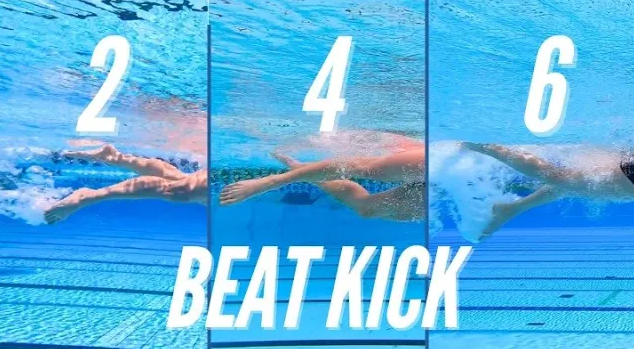
address, it’s the way that you can know it is if you feel like you get very little purchase on the water when you’re going through your catch and if you feel like you’re windmilling through the water, there’s a very good chance that things are disconnected. And I had a swimmer that I used to coach several years back. When he first came to me, we could see that he’d come into the water and he would just pull straight away. And so his arm was moving separately to the rest of his body. It was completely out of whack in terms of the timing. And part of that was because his shoulders were just rotating on their own and they were completely separate from his from his lower half. And so a way that you can build up on that is doing something like six one six drill where you’re kicking on the side and then when you bring your arm over and you swap sides, you make sure that your hips, your shoulders are going together as you rotate.
And then we can start to build up from that and we work on that connection through that drill. Or another drill is arms by side, kicking with fins on face down the water and we just rotate in the body around the spine and we’re working on that connection from hips to shoulders. And when you get that right, you will notice that you get a lot further with each stroke because with Becker to go from 50 strokes a lap down to 41 strokes a lap. That means that she is increasing her distance per stroke by almost 20 percent. And that is a huge amount. That’s probably another was another 20 centimetres or so from every single stroke that she’s taking because she’s getting more propulsion because things are better connected through the stroke. And so that is why we want that connection to happen. And there are a lot of swimmers out there that don’t have that connection. So it’s something that I think is worth identifying. Some people can just make that
change straight away once they know the issue. Some people need a few more drills to build up to work. So if you’re not sure exactly what to work on, check out our freestyle checklist, which is a you can get free below. And that’s got the order of the stroke to work through and exactly what to work on at what point in the stroke if you’re not too sure. So check that out below. If you like this video, make sure you like and subscribe and I’ll see you next week in another effortless swimming video. Thanks for listening to the Effortless Swimming Podcast. If you’d like us to help you become a faster, more efficient swimmer, go to www.effortlessswimming.com.