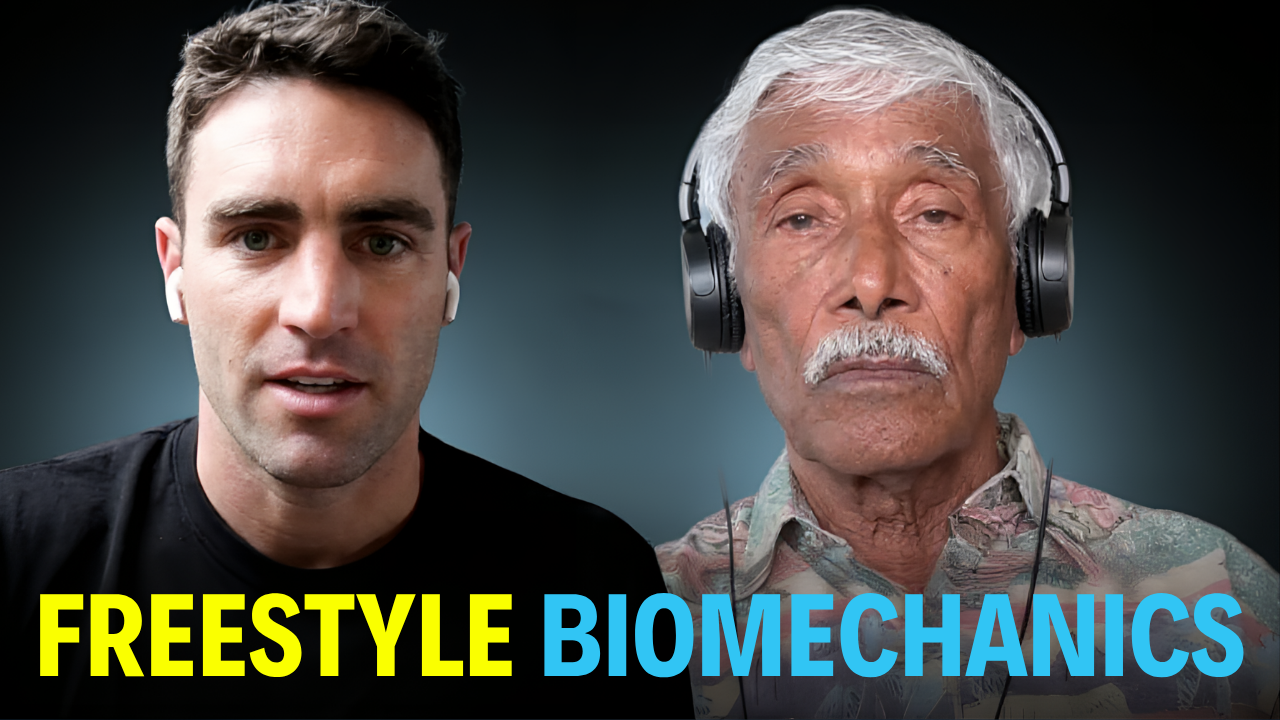








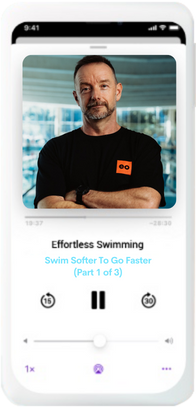
Brant Best will be joining us for a three-part podcast. We worked together on a product called SwimBETTER by EO, which helps athletes swim faster. This episode will discuss what he learned from working with elite athletes. Watch out for the next episodes!!
00:58 Canberra Camp
02:27 How To Swim A Good 100 Freestyle At The Elite Level?
05:40 Kyle Chalmers Is A Beast
06:12 Tension Needs To Be Optimal Rather Than Maximal
10:59 EO Swim Better
13:01 Soften Up, To Go Quicker.
16:00 Putting Too Much Force On The Water
19:14 What Is It That We Should Be Focusing On?
Pre-order your SwimBETTER now!
Head to EO’s website and use the code Effortless at checkout, to get your first 12 months free on a single gold license with any handset purchased.
Form Goggles:
http://formswim.com/effortless
Related Podcast: What Amateurs Can Learn From The Mistakes Of Elite Swimmers with Brant Best
Watch the episode on YouTube:
Transcript
Read the full transcript
Welcome to the Effortless Swimming podcast to show that help swimmers and triathletes love the water, become a better swimmer and live a better life. Here’s your host, Brenton Ford.
Welcome to the Effortless Swimming podcast. My guest today has been on recently on episode number 234. It’s Brent Best. Brent, welcome back to the podcast. Right to be on, Brenton. Last time we spoke about some things that amateur swimmers could take away from elite swimmers because your experience is in working with swimmers at the top end or those that are looking to reach the top end. And so we covered some really good topics on that episode. And on today’s episode, I want to talk about some similar things and just get some learnings that you’ve come across over the last couple of weeks and months with working with some of those elite athletes or those that are looking to make the hopefully the Olympic team in 2028. We’ll talk a bit more about that. But I think there’s a lot that we can learn from you and the athletes you’re working with. So I want to dig deep into some of these topics. So we might kick it off with you
mentioned you’ve been in Canberra recently on a camp there. Do you want to talk a bit about what you were doing, who you were working with, and what were some of the things that you were looking to uncover there? Yeah, absolutely. So I was lucky enough to be asked to lead a camp with Swimming Australia where we basically have worked out that it’s obvious really that the more depth we have, the better we’re going to be performing on an international stage, putting pressure on the guys at the top, but also bringing the next run through and not waiting until 25, 26, 27 to get that happening. So we’re jumping early on that and getting our best young guys are patting for that meet and a little bit before that, hopefully, to give them the skills and the understanding of what it takes us to 100 meters freestyle at an elite level and jumping them from an age understanding to an open understanding. So that was the premise of it and giving them and their
coaches an understanding and education really about what it takes. I think we had most of the coaches there as well, which we’re very, very lucky to have because if you can’t make a change, if you can make a change with an athlete, but you can’t make a change with the coach, then you can’t make a difference. So that was the initiative. And then we basically spent the week telling them how to race their race and technical aspects, when to apply power, when to put your stroke rate on, when to sort of drive with your legs and some skill based relay skill applications as well. Now, someone might hear that and go, we’re teaching them how to swim 100 freestyle, they might hear that and go, it’s just up and back, just go fast. But there’s a lot more to it than that. Do you want to go into some of the details there of how to swim a good 100 freestyle at the elite level? It’s a bit misunderstood, I think, from my point of view, we look at, we call the 100
freestyle a sprint that really isn’t a sprint at all. From my point of view, it’s we spend a long swim in the 100 freestyle than a 400 meter runner does on the track. And you look at a 400 meter on the track and most of the best in the world seem to accelerate sort of into the last bend. I’m no athletics coach, but I watch them and I watch other sports that leads into what it takes to do well in swimming. And they’re definitely not sprinting from the start. And they’re a long way from it. In fact, from a novice’s point of view, it almost looks like they’re they’re doing a high level jog around the first 100 meters. So I relate that back to our swimming and look at the effort that’s put into the first 25 meters. And I see that a lot of swimmers and a lot of men and the up and coming swimmers get after it early and hurt a lot late. And then what we’re really looking for is a fairly even and a level velocity through the race. And we get a
fairly big drop off, especially in their age which is ones who don’t understand to get after it early. So early in the race, you want a lot of control because later in the race, you want to come back fast and not lose your velocity. But that’s as simple as I can put it. The intricacies around that and I put it very simply because I like to put it simply because I’ve got a simple brain. And I need to think about like that. And our athletes need to hear things simply. But there’s a lot more sort of complications around it. But if we can come home faster, then we’re going to produce a faster race. We’re seeing the best in the world. Come back quickly and we’re seeing at 75 meters when the whips are cracking then the last 25 meters is where the best in the world have come through over the last 10 years or so. So there’s a lot of talk about the back end and how important is to train the back end. We’re looking at how the front end affects the
back end specifically on this camp. This episode of the podcast is proudly brought to you by our sponsor form goggles. They’re more than a pair of goggles meet the world’s most powerful swim platform. See yourself improve with form smart swim goggles including a free one year membership when you purchase your goggles for only $228 US dollars. Now they’ve currently changed up the offer where you can now get the goggles and you have that one year membership included for free. And then if you’d like to continue with the membership going forwards it’s only 15 US dollars a month where you get access to their workouts training plans and their custom workout builder. But you’ll always have access to the real time data of the goggles so you’ll never lose access to that. So if you’d like to swim without stopping to look at a pace clock or your watch and get live metrics right inside your goggles including your time distance pace
they are right there in your goggles with form goggles. I’ve used these for over 12 months now and a huge fan of these goggles and use them for majority of my sessions and find them very helpful especially for gauging my time, my effort and my pace and I think it’s a very helpful tool for the majority of some is that I would normally work with. To get your pair of form goggles and save 15% off use our link formswim.com forward slash effortless or use the coupon effortless at checkout. That will get you 15% off your pair of form goggles using our special link formswim.com forward slash effortless or use the coupon code effortless at checkout. And you see Colchamas being one of the best at that because from the racing that I’ve seen he does it’s he’s a very good in that last 25. Carl’s a beast, yeah, especially in the back end of his race. He’s got good physiology for that. He’s obviously got good speed but also good control early in the race.
So he’s able to focus on the last 25 meters where he where he it looks like he’s accelerating. The truth of it is he’s not accelerating. He’s just decelerating at less of a rate than everybody else is decelerating so it makes it look like he’s taking off his effort is higher than earlier in the race. But he’s got a lot. He still isn’t quite what it was at the beginning, which is also misunderstood about the hundred. So his ability to control a good technique at the beginning of the race. So Mr. Softness is is absolutely what Carl’s all about. Now you mentioned softness there. Do you want to talk about what you mean by by softness? And I want to sort of preface this with how does my email be this morning? He’s sort of struggling to go beyond that hundred meters without feeling totally, totally gassed. And in his email, something he mentioned was the first 25 like I feel good. I feel lots of power in my in my catch in my pool. And I
had to ask him, I’ve asked him another question, which I’m waiting for him to reply. I’m asking you, how much effort are you putting into that that catch and pull? Because if every stroke is like a maximum effort, each one, that is not sustainable, no matter how, how good you are. So when you talk about softness, what are you talking about there? Well, I think that we’re talking about myths and misconceptions. I think the myth is that the maximum amount of power you put on the water and also the maximum tension is going to produce the maximum speed. And that’s, we know that’s not the case. Look, it might be the case of 15 meters, we’re even finding that’s not the case even over shortages like that. But if you have maximum tension, I can’t stand here and hold my fist closed of maximum tension for 47, 48 seconds without getting very, very tired and running out of juice in my shoulders. And in my hands, these guys have got
their physiological range of responses happening. And they’re trying to do that from the start. So for me, the tension needs to be optimal rather than maximal. And then when we’re looking at extend extending that across and you assume I might be going a minute or a minute 10 or even 55 seconds or even if he’s very, very good at going 50 seconds, you can’t hold maximum tension. You can’t probably even hold eight or nine out of 10 tension for that amount of time. So you’ve got to find the right amount of tension in your hands to extend across the race. So obviously we don’t want to have zero out of 10. I did something recently with a team where we dropped their tension to about six or seven. And they were only going to slower over 25 meters because they were setting better body position. They had a better length of stroke because they traveled better because they weren’t gripping and switching off their deeper controlling
muscles. They were able to access better muscles in their core when they’ve got a little bit of control, their strength, their stroke length increases. Their stroke rate holds on as well. So the basics of your technique are maintained and probably enhanced by defining that optimal level of control through the first part of your race. It’s a long answer to a short question, but that’s what I mean by softness. It’s not complete softness, but it’s just finding and testing out what the optimal range is. So with that, when we’re doing this exercise, whether it be on a clinic with swimming Queensland or one of these camps with swimming Australia, we’re finding out what optimal is. For me, if a swimmer is swimming at 12 seconds through the first 25 and they’re at maximum force and then they have a crack at one and they might be seven out of 10 and they’re point two slower, I’m happier with the point two slower because we’re going to gain much more than
that on the back end of the race. We might gain a second on the second 50 and I’m happy to give up point two of a second to gain a set to gain one second on the back of the race. So it’s just about finding where that sweet spot is to be able to come home the speed that you want. And is this them judging their own force, tension, like their perceived tension?
It’s hard to judge and it is a trial and error. I spent some time with one of our very good clubs in Brisbane yesterday working this out, just going through repeats. 30 meters sprints yesterday, caught sprints because we started going, they tried to go very hard at the beginning and we found that they went equally hard at my faster, a little bit lighter. So it is a trial and error thing. We would like to be able to quantify as closely as we can. We’re finding out with our swim better devices that we’re working out that peak forces aren’t exactly what we’re after if we’re going to get peak speeds as well. What we’re also finding is that the peak forces that we’re seeing when there’s maximal application. We get higher peaks but we don’t get the width of impulse. So we’re looking at our force versus time curve, which is my go to which I love looking at. We want to get maximum volume under the curves we can. When I’m looking at the swimmers
that are putting maximum force and we’re getting really high peaks, but we’re also getting gaps in force through the middle of the stroke. Which are easily identified and quantified. And honestly, so far when the athletes look at it, they can’t believe what’s going on. And it’s not a question as to whether they are or they aren’t losing force. They can see where it is and they can fix it a lot more quickly and they buy in a whole lot more quickly, which I think is super important when we’re trying to sell this concept to our athletes. So again, going a little bit deeper than the question asked, mate, but yeah, quantifying that is massively important. That’s I want to dig into that a little bit more. So we’re talking about the EO swim better devices, which are force measuring devices that you can wear on your hand when you swim. And a lot of the clients that I work with in the stroke analysis coaching where they send me their videos. And I give
them an analysis, I give them certain things to focus on with specific drills. Those that have those devices are sending me their data. And it’s very interesting just to see what we’re seeing in the video. How does that come out with these devices? And there’s a number of different things that we can look at as a few different screens. And one that you were talking about there was the force over time where we’re looking at the how much force is applied in a stroke through the different parts of it. And as you said there, if they’re going at maximum force, you get this big peak, and then it drops off. But we’re better off just making that force applied for longer and have less of a peak, just so you can have more area under that, that curve, which is which is really interesting, it really interesting. And before you could never, you’ve never really be able to measure that at all. But this is putting numbers to something as coaches, I think
we have known and we know we want to do it, but we’ve never been able to actually see that properly. Yes. That was a lot of what Cam was all about for us was almost selling the idea that maximum force does not equal maximum speed and you’re going to die badly and you’re just not going to be able to finish 100. And that was a that was a very cool part of it. But we were using just times and stroke rates and perceived exertion, but adding the element of actually having proven front of them, we can use video as much as we want, but some is like the flight, they’re in a race and they’re competitive and they want to rip and tear. And you know, for me, you look at the best swimmers in the world, you stand back and very rarely do you say, gee, they’re making that look hard.
These devices prove that that level of hardness is not the best way to produce swimming speed. And when you get, when you get your head wrapped head around that, then you can go lighter, faster, earlier in the race and continue speed and beat the people who are trying to rip and tear. It’s a massive, massive switch. We’ve known it sort of at a high level. We’ve had a gut for it. I’m trying to convince a big, strong 100 meter body, you know, wants to do is beat his chest and rip and tear and do 150 chin ups and bring pressure a million kilograms and to tell them to soften up to go quicker. But as you said, this device proves what we’ve been saying to the better athletes, we just get some message across so much quicker because we can’t sell it. It doesn’t matter how good our info is or how good our gut is. If they won’t buy it and they won’t buy into it, then when our back is turned, they’re going to rip and tear and they’re going to pick it up
like it’s like they’re picking up their dumbbells and rip in like they do in the gym. It’s also probably not ideal either for the their satellite body. So there’s a parallel there as well. Yeah, absolutely. I mean, you get a bunch of 16, 17, 18 year old guys in one place together all at the top of their game competing for the same spots in the next couple of years as they lean to the these Olympics. And you you will get that sort of energy level where where they are wanting to just go as hard and as fast as they they can. But if you look at someone like David Popovich, who he’s not muscly, he’s not he’s not that big. He’s he’s got a good physique for swimming. But he he I think zoos that that softness on the water when you watch him swim. Just great control, incredible feel for the water and just incredible distance per stroke as well. And you can just see that that is that is what we want. That’s what’s going to make you make you faster.
Absolutely. I one thing that isn’t talked about with David with regards to his swimming is the amount of trust he has in to be able to do that because it would be easy just just to want to get after it. But I haven’t spoken to his coach about it. But he’s absolutely sold that this is the best way to swim a hundred. But only because he’s done the work and he’s had that proven to him time and time again that he trusts that enough. And I think we misunderstand that we don’t do enough of that to sell the athlete. We say this is the way to do it. And we expect them to buy into it. It’s against the instinct. They do want to get after each other was a challenging camera when we got eight good boys up against each other and very similar to the environment that when we get eight good boys up against each other when we get into whether it be a national championship or a state championship or an Olympic Games, they want to beat the chest and get
after it. James Magnus and struggled with that internationally because he’s such a competitor. All he wanted to do was go. And even though we’re training and he’s got set to control, the adrenaline was hard for him to control. He brought into it really, really well. So it’s a challenge for all of our guys. So to have a device that proves it rather than for them to say, I just trust me, mate. It’s just another level that I really wish that I had when I was coaching because I think that potentially might have won a few, even a few more races and maybe a couple of critical ones to have that evidence in front of him. Hey, you don’t need to go that hard to go fast. And let everybody else get up and you can have a little bit more control. Yeah, I’ve been the clients that I’ve been working with who have sent through their data. One comes to mine. So he was when I looked at his average force per stroke, he was he was quite high. Now it
was he was up around was like averaging 2.8 to 2.9 with each each stroke. And when I look at when I look at my own, if I’m assuming it like a two to 400 meter effort, it’s generally anywhere from about two to 2.7. And and yes, I and I’m assuming that I put almost twice as fast as this athlete that I was that I was working with. And so first of all, to me, that just says, all right, you’re probably just putting too much force on the water. So let’s let’s just back that off. Let’s really ease off that. And the other thing we were looking at was the direction of the forces. And there was a lot of upward force. And we see in the back of his stroke, that he was finishing quite deep at the at the back. And so rather than pressing back and exiting past the hip, which would moving forwards really well, he was coming upwards, which would sends the hips down. And it’s just not helping you, you go forward. So there are two things that we’ve we’re
working on now from seeing that that data, which I wouldn’t have known about the force that I could not have told you and said, yeah, he’s just really going hard each stroke that I couldn’t really distinguish compared to someone else. And but the back part, I certainly knew, but to see the percentage of his stroke that was upward forces, which was about 5%. And we really want that to be less than 1%. That was good to have that quantified. And a similar thing, just get a lot more buy in that way. You make you make a good point on the forces because we’re seeing that with it with quite a few that our total force is very high. But then when you get a propulsive force is for some of them, especially the ones that want to grip, it’s a much lower percentage. So they feel like they’re holding a lot of water, which they actually are, but it’s not sending in the right direction. And it’s misunderstood by them that they feel what they got all the power and
pressure on the water, which they have. It’s not sending forward and it’s wasted energy. And it’s energy that you’re never going to get back. You’ve only got a certain bucket of energy in your brain and your muscle system only have a certain amount of energy to put out. And if you waste it early, you’re not going to have it at the end. And having at the end, when you’re more fatigued, you know, you can control more of it at the beginning of your race. And you might lose that point too. But once you’re gone, you’re gone. You got my balance on the water, you can make control on the water, your brain is sending signals that you’ve got to stop and you need to get more air in, lactate is going through the roof. All your systems are failing because you put in too much force at the beginning. And if it’s gone in the wrong direction, you just thrown out the window and your race is gone. So this is the evolution of the 100 freestyle
we’ve seen, probably do it, we’ve seen a few more do it. But we’re reaching into having more athletes going into the 46 and all the way down through the age group is getting into making 49 a common thing. And it’s going to not be because we’re producing greater forces, producing smarter force and then spreading it across the race and understanding it. I’m still trying to understand it because force is only I’ve been able to measure for six months of my coaching career, which has been like 30 years now. So still learning how to use it. But the data we’re seeing is guiding us into some some really good and interesting understandings with our coaches, especially in Queensland. It’s interesting to say I’m finding this the same thing because it’s only the last couple of months I’ve been using it with some of the athletes I’m working with. And I first one’s like I don’t know exactly how to use this and use this in a way where I can come up
with a plan to let’s make changes to your stroke this way. Just off the bat. The first one was was a bit of a challenge, but now I’m starting to do it with more people. We’re starting to see what those results are. We’re getting better ideas of what the what the data means. So it is. It’s all it’s all quite new. But the last couple of months that have been doing it, it’s becoming clearer and clearer of, OK, what’s what’s the important stuff here? What is it that we should be focusing on? Because there’s so much data there that if you try and read into all of it, you’re probably going to be confused and do nothing with it. So let’s how do we keep it simple and choose one or two things. Thanks for listening to the Effortless Swimming Podcast. If you’d like us to help you become a faster, more efficient swimmer, go to www.effortlessswimming.com.