







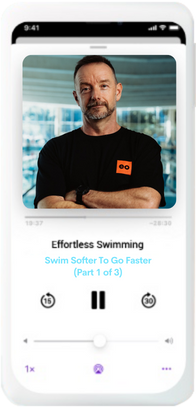
Brant Best will be joining us for a three-part podcast. We worked together on a product called SwimBETTER by EO, which helps athletes swim faster. This episode will discuss how it’s valuable to be able to quantify data and drills that he loves and doesn’t like.
00:33 Do you have a standard process when looking at the data?
08:38 Force Field
12:14 Should you have more power on one arm if you’re just breathing every two?
13:20 I’m not a big fan of breathing three
14:12 I’ts super valuable to be able to quantify data
17:01 Drill that I love and hate!
20:31 Thumb Drag Drill
Pre-order your SwimBETTER now!
Head to EO’s website and use the code Effortless at checkout, to get your first 12 months free on a single gold license with any handset purchased.
Form Goggles:
http://formswim.com/effortless
Related Podcast:
What Amateurs Can Learn From The Mistakes Of Elite Swimmers with Brant Best
Swim Softer To Go Faster with Brant Best (Part 1 of 3)
Watch the episode on YouTube:
Transcript
Read the full transcript
Welcome to the Effortless Swimming Podcast to show that help swimmers and triathletes love the water, become a better swimmer and live a better life. Here’s your host, Brenton Ford.
Do you have a standard process or order of things that you’re looking at when you’re reading the data? And before you go into that, I mean, someone listen to this, whether or not you’ve got the AOSwimBetter devices or not, this stuff is still relevant, even if you haven’t got them because these improvements in technique can come whether or not you have the devices. These are the things that becomes very clear when you do use them and actually measure these different things in your stroke. Yeah, yeah, you make a good point there before and before we go into the data, I really like the point that you’ve got to focus on your one or two things. Because there’s a million things on the net. There’s a million articles you can read if you try to change all of them in your stuff. Because most of them, probably all of them have never seen you swim. And if they haven’t swimmed and you swim, then they are solution for someone else’s problem. And what
uses that? They’re great gen fixes. What I like about the device, it actually narrows down into where your stroke is missing. Now, I would have seen probably, there’s probably four or five common patterns within the swimmers that I’ve been working with on the device, you can miss it at the front, you can get it at the back, you can get it at the front and then miss it at the back, you can get it at the front. This is pretty common when you get at the front, miss it completely through the middle and then get it at the back. There’s plenty of them in each of those individuals with the athlete. But if you’re worrying about what everybody else is saying on the internet and what everybody else is solving, how they’re solving their problems and they’re not your problems to solve, then you’re not wasting your time, but you’ve definitely not the most efficient way about it. So I think that’s a really important point to make that whether it be with
these devices or with your coach, most of your problems are solved with the top two issues. Rather than going into everything, find out what’s wrong, get someone who understands swimming or get a pair of these devices and work out what’s wrong. Otherwise, you’re just going around around in circles and trying to change something and that doesn’t work and try something else doesn’t work. It really is a waste of time. So I’d say narrow down to the one or two things. And to that point, I hear coaches. And while I work with a lot of very good coaches, I get some that will stand there and tell the whole squad there’s six things that they want done well in this in this set of 6 100s. And even that, I can’t get six things right at once on it. As I said, pretty simple brain, I can get one or two, one, like you give me to it, I’m probably going to battle. So I’m going to get one. So you need to find the one thing
that’s going to make a difference. And you go searching for the one thing, you don’t go searching for the six. And then once you nailed the one that’s the most important, then find the one that’s next most important. But I’m going to almost guarantee you that the one is most important is probably 80% of your problem. That get down to why that’s happening. Then you can get to what’s next, which is why I love these devices, but also why I love coaches because they can help to get there if you’re that swimmer. And if you’re a coach who doesn’t know, and isn’t sure, get into a coach that does and build your network and get some opinions as to what the number one most important thing is a little bit off track, but that’s super important to say, as far as with my with the devices go, I like to go to the to the overall where we get the all the total force bars at the beginning, we get the stroke rate. And I like to see the
trend and compare our right arm to our left arm and see what’s happening on total force. That’s my first snapshot. And then from there, like, there’s some great stuff in the middle of that, I like to go straight from that into what’s happening within each stroke and then work out where my total forces and then work out how my total force reflects and relates to my my propulsive force. I’ve seen some swimmers, plenty of swimmers with where it looks like we’ve got a right hand that’s really powerful. And they feel, oh, my right hand is really, really strong. My left hand isn’t so strong. And then I go into their propulsive force and I have a look and their propulsive force on that right hand is weak, but their total force is high. If there’s a high percentage of it isn’t actually driving forward, but they feel like they’ve got force on their hand. So and it’s been exactly opposite of what they’ve been trying to fix. So that’s
kind of sort of my go to, because I like to I like to look at graphs and see how the see how it’s represented in the force code in the force versus time graph. So that’s where I go with it. I like to look at the force field. I look more at the numbers on the force field and the graph itself, the visual representation is good for me, but the numbers represent for me something really important when we say, okay, well, you are spending 10% of your force on the right or on 10% right, one was 2% left. You’re pushing pulling up too much. Like I said, and that gives me a good overall snapshot is because I think to be able to open up and get a snapshot and then to be able to compare the snapshot. So go from one event, check it out, test it out, show the athlete and then go again and say, Hey, what you’ve just done has minimized your your when you’re slipping under your body, you’re actually slipping half as much as you were before. And that has
meant that your total proposal force has jumped up by five or 10%. It’s super, super valuable. And I think because of simplicity of it, we don’t need to go into the deeper graphs with the swimmers, because we don’t want to over complicate the process. We just say, look, the numbers are better. We don’t even have to show them. We can just say, if there’s five as an increase, you’re going the right way. What did you do there? How did you find that? Go again and see if you can sitting shift a little bit more. So my processes are a lot more around those graphs. I also like to look when I’ve looked at the force field, I think I go into the hand paths, because we’ve got a hand path, the guess is an idea of what’s happening from side on. If I spot too much lateral force, I’ll look at the hand path from above. So with if you haven’t seen the swim better screen, it shows a swimmer from above and then the path of their hand
through their stroke. If we’ve got too much lateral force, it shows it up without even eating a video. And because we can’t get a video above an athlete, we get a really good idea of the hand path. It shows that almost as if we’re seeing through the athlete. I really like that one. And then we can look at the head on and see from head on how deep they’re going, but then how wide they are sweeping. We’ve got a lot of athletes. I’ve seen a lot of athletes with a sweep across the body. We tend to see quite a few who are moving back from the camera a little bit, but are sweeping out and catching quite wide out here. We catch that really nicely. And then we head back into the into the force field. We can then quantify that. And then if we need to, if we need to go deeper, and if probably more, if I’m in a meeting them rather I’m on pool, they’re going to meet with the coach. I’m going to say, well, this is what your numbers look like. This
is what your path looks like. And here is how it’s affecting your force, because your total force might look like this. When we drill down your repulsive force, you’re actually about half of what you’re doing because your hand is waving around all over the place or collapsing under your body. So that’s my process with it, which differs on each athlete, because some athletes are too much downforce, too much upforce. And then we go back and forth with the data. But that’s how you can, for me, that’s how I talk to my coaches. And I simplify that with my athletes. This episode of the podcast is proudly brought to you by our sponsor, Form Goggles. They’re more than a pair of Goggles meet the world’s most powerful swim platform. See yourself improve with Form Smart Swim Goggles, including a free one year membership when you purchase your Goggles for only $228 US dollars. Now they’ve currently changed up the offer where you can now get the Goggles
and you have that one year membership included for free. And then if you’d like to continue with the membership going forward, it’s only 15 US dollars a month where you get access to their workouts, training plans and their custom workout builder. But you’ll always have access to the real time data of the Goggles. So you’ll never lose access to that. So if you’d like to swim without stopping to look at a pace clock or your watch and get live metrics right inside your Goggles, including your time, distance, pace, they are right there in your Goggles with Form Goggles. I’ve used these for over 12 months now and I’m a huge fan of these Goggles and use them for a majority of my sessions and find them very helpful, especially for gauging my time, my effort and my pace. And I think it’s a very helpful tool for the majority of swimmers that I would normally work with. To get your pair of Form Goggles and save 15% off, use our link formswim.com
forward slash effortless or use a coupon effortless at checkout. That will get you 15% off your pair of Form Goggles using our special link formswim.com forward slash effortless or use the coupon code effortless at checkout.
That’s good. The thing of how I go through it, I’m similar, particularly the force field. So it tells you the percentage of where the forces are going with the left, right, up, down, backwards, which is just an amazing snapshot to see how effective you are with your arms under the body. And then, yeah, going back and forth to actually seeing the path of the hands. I’ve got one athlete that we saw on all of her breathing strokes when we look at the above bird’s eye view, where is that hand going? We saw so much lateral, so much side to side force compared to the other ones, that we’ve just focused on that. How can we go about making that a smoother path? So it’s like a skinny S shape rather than this big wide S that is just not doing much to move you forwards. And if you’re breathing every two strokes or every three strokes, and that’s happening, well, that’s a large percentage of your total strokes where you can get perhaps another
25 or 30 percent out of that stroke, which is not insignificant in any way.
It’s massive to be able to pick that up, especially as they’re fatigued. And probably there’s a second thing worth talking about there is and why I go to my overall view right at the beginning is the decline in power as they go through the race and we’re wanting to hold on to power through the race. When we see the graph just fall away in power, as we watch the maybe through 100 or through 200 or 400, we watch it fall away or through a set. Looking at one the other day, we did 6100s and the first 100 was great and they kept the power up. But as we as they went through the session, we were we’re at 50 percent of the power, the total force by the end of the session and they were at the beginning, which is a really distribution of force across the race. So if you’re swimming a 400 or an 800 or even a 200 year, half as much power at the end of the race and you do a beginning because you’ve used up too much. That’s significant
for your loss of speed, but it’s also significant in picking a particle. What are we doing at the end of the race? Are we losing power? Are we running out of energy? Are we less efficient to your point? Are we breathing higher? And then are we rolling more and is the increased roll? Meaning we’re off balance and then we’re losing power. So then we can not only say we’re losing force, but why are we losing force? Let’s have a look at that one stroke at the 150 meter mark or 175 meter mark and compare it to the one stroke of the 25 meter mark. And let’s have a look at the comparison where you’ve pulled them away. That data is unbelievably valuable. So I’m starting now to look into not only fixing up a stroke within within 25 or 50 meters, but how the decline starts to happen and what’s happening towards the end of the race. Now what’s happening when your legs are on versus your legs being off? The more we’re understanding about it, the
more I’m evolving probably in my use of the data as well.
Yeah, that’s that’s a really good one to be able to actually show a swimmer how that’s impacting how their fatigue is impacting them across a 200 or 400 time trial. Yep. That’s a great way to use it. The one thing I noticed when I have recorded myself is when I breathe every two, the if I breathe my left, my right arm power is quite a bit more. So typically, if I breathe my left hand side, my left strokes are averaging around two. And my right strokes averaging 2.6 to 2.8, I think it was. So I attribute that to having the perhaps I’m perhaps I’m just rotating a bit more, but having the head come back down and just putting a bit more into that stroke. When I come back with the breath, and the same thing happens when I breathe to my right, the left stroke is more powerful. And then if I’m breathing every three, it’s quite even. It’s about 2.3 to 2.4 per stroke. So that as well had no idea, but was was very interesting. And I’m yet to decide whether
yeah, is that the right thing to be doing? Is it should you have more power on one arm? If you’re just breathing every two, I’d probably need to get a wider data set, I think for that and see what the some of the top guys are doing. But I just found that really interesting. It’s super interesting on a few levels. I like to we did probably 80% of our work, technically on our breathing stroke, because the other strikes looked up and looked up and subject to breathing stroke. So to be able to measure it is one thing. The other thing I remember having an athlete who loved breathing on one side over the other. And she was insistent because it was familiar and what she’d been doing since she learned to swim breathing on one side. And I thought the other side was a more efficient stroke. So it was always an arm wrestle to get her to change sides. But I know that the other side was great. But because I felt unfamiliar, and it didn’t
feel right to her, because it’s unfamiliar, she wouldn’t change it. I had another athlete that loved breathing threes and I’m not a big fan of breathing three. She is a middle distance kind of girl. And I like breathing too. So she wouldn’t get out of her three pattern. So I had to actually physically say, okay, let’s do a bunch of 50s on your right. And a bunch of 50s on your breathing threes. I’m going to see which one’s faster. It was point eight quicker breathing, breathing twos and it was breathing threes because she had one side of the solar inefficient. But it was an arm wrestle. And she always kept wanting to go back to threes because that felt familiar and she just watched both sides of the race. It was like, you can watch both sides of the race. But if you’re watching somebody go past you, that’s no fun. So it was still an arm wrestle because I have to be a salesman. I mean, if I haven’t got all the tools available as a salesman, then
I can’t sell the product as well. So this data would have helped me sell it and say, hey, you can do all you want there. But you’re actually swimming a slow race with less power across across whether it would be a 50 or across a bunch of hundreds or across, you know, 800 meters. So this is where I think it is super, super valuable to be able to quantify what we’re doing, mate. For the core, you mentioned there’s a coach been mentoring for about five years. And there was something that you’re sort of able to, like a point you’re able to get across because of the data you could show. Could you go into? Yeah, we’re starting to play a little bit with these now, now that we’re understanding a bit more about what they’re about and what they can apply. We’re starting to play. So I like to go back to good drills. I hate rubbish drills, but drills done well, super, super important. And I’ve only I’ve got probably two or three to take up 80% of
my of my repertoire with drills, because I want to travel as much as I can from the front to the back of my strikes. I use drills are going to do that. So we were starting to get a drill profile on our right arm and our left arm and have a look of what the impulse looks like on our forces as time graph and then start to swim, swim aerobically, see what it looks like there, swim at around about PD plus five to six and see what it looks like there and then to send down to 100 meter race speed and work out where our sweet spot is what we call the I like our Goldilocks power where they had the most amount of power and they had the most amount of travel before they went too fast and they started to slip to get speed and then compare that back to the drill and see where we were at best. And for one athlete, we had the drill was done really well and then as soon as they started to swim, they fell out of balance because they were rolling around too much
and the drill they were very stable. So we had a completely different stroke pattern. It was like, well, this is fantastic, but there’s no drills of state championships as well as you’re doing it. It doesn’t matter if you can do one arm at a time if you can’t put it into your swimming that it doesn’t count. So that’s an argument I like to put forward before the devices, but again, when we’ve got physical data to say, hey, you can hold water like this, yours is not doing it in the thing that we’re training for. So we started to play with that and that concept was very, very cool. So we started to make up drills and play with drills and which was the drill that would lead most closely to the stroke that we wanted for the athlete. So then they tried the drill, we looked at the data, which one links best into your freestyle. This drill works best. This one you can feel in your freestyle. Here’s where your freestyle data looks closest to your
best drill data. That’s the drill for you. But this drill here, which was the drill that is done very, very badly, which is single arm with your hand by side. Actually, it was promoting slipping through the stroke where there’s athlete did this particularly bad. And then that was the drill that they were using as a go to to get to adding more power to their stroke. They’re actually detraining the stroke. So we learned all of this by being able to show them that this is data on their favorite drill was actually getting in their way. What drills do you go to and what drills we’re using? So single arm with the arm by the side. First of all, are you having them breathe to their opposite side or to the same side that they’re stroking? Yeah, that’s a drill that I like when it’s done well, but the majority of the time I dislike because it’s done so badly because I want to stable body through from the catch to the pull. Basically, I want the body
to be stable and I want that force to be maintained. What we’re seeing with that drill, what I see, and I’ll move the camera back a little bit more, what I see with that drill is the swimmers miss the front of their strike and they slide across their body and they miss the back of their strike. And we’re seeing that in the data as well that they will basically be getting almost no impulse versus what they can do in their swimming. So it’s significantly worse. If they do a well, they anchor on here, they hold their angle and they produce good power through their core. But most of our swimmers aren’t balanced enough to swim well enough. Let alone to do a drill is harder than swimming. So they can do that drill great. It’s fantastic. So most of the swimmers can’t. So I like to start with the drill where their hand is out in front because I like when they’re learning something or any athlete in any sport, when you’re learning, you need to be balanced.
If you are off balance and can’t, the uptake of a skill doesn’t happen as quickly. So I like them to be balanced. So when your hand’s at the other hand in front, then you can pull through and you get your balance and you can actually apply force the way you want. And then your brain can send the right patterns to your muscles and the muscles can send the right patterns back to your brain and say, hey, this is a good effective way to reproduce force. So hand in front is my number one. That’s my number one drill. Also, don’t mind it with a fly kick because it helps engage the core and keep the hips nice and stable and we seem to get stable patterns of those. So those two for me are very, very for establishing how you want to feel through the water and up to now because we’ve had to use that gut. It’s all about feelings, feeling the amount of power you’ve got on your hands in front of your stroke and then hold through the back of your stroke.
Feel how much hand on a single arm butterfly drill feel how much power you’ve got. Is that more or less powerful than your butterfly? That’s sorry, than your freestyle stroking. Generally, it’s more powerful What are you doing? Having more power in the drill than you do in the stroke that you’re actually being timed at. So we make the crossover, we make the connection. So they’re two of my big ones. I like a long dog drill. That’s another one I like to like to use to get them to feel the power without having to deal with a with a rotation. The drill that I absolutely despise has done worse than a single arm drill. Here’s a thumb drag drill because it seems to as soon as you put a thumb drag drill they’ve either got to wait and do catch up or their arms swimming around under their body and producing the force that we’re seeing is detrimental to the stroke. So drills that I love, drills that I hate, hate’s a strong word. But if I were kids in the water
for 12 to 18 hours a week and they’re doing drills that are making their stroke work I just want to just get them out of the water and just, you know, just, just you’ve got a limited amount. Actually, you know what? You haven’t always got a limited amount of time. You’ve got so much time, much time as you want in the water. And then you’re doing drills that are going to make it worse. You’re waking up at 4.30 in the morning to make us remain worse with the drill because you’re not thinking about it. I’m going to get on my soapbox a little bit, but what we’re learning is that these drills actually are detrimental to the stroke. We’ve known it, but now we can tell them don’t do that drill. It’s destroying your stroke. Let’s do a drill that adds to your power. So again, long answer was your question, but they’re the drills that I like and the drills that I hate. But more importantly, probably why for me. That’s great. Look, you and I
I think are on the same page with like a thumb drag drill. I come across quite a few somers that adults that are jamming themselves up in their recovery because they’re trying to swim like they’re doing a thumb drag drill. And it causes that over rotation, causes them to lose balance. So the closest thing that we would often do to that would be just your 616 drill. Your 6kicks one straight changeover. But I make sure when they’re doing their recovery that they’re not coming like really high over the water and hand close to the body. Just keep that hand away around the side a little bit where you’d be if you were swimming well because that way you can keep your balance with your arm out in front. And you’re not going to be going past 90 degrees rotation and losing that balance which we sometimes see with some drills like that. So that’s interesting that you have come to the same conclusion because I don’t think I’ve given that to anyone before
because I just see it as making the stroke worse. And we’ve had to come up with our own drills sometimes just to work on the catch in the pool and get adult on sets from those people who haven’t learnt as kids just to be able to find the position that they need to be in for their catch and pull and just to slow things down and break down that movement. And then you can build it back up. And I love long dog, love, love single arm. And I did a video a couple of months ago where I asked Kea Melvitan who you know up in Queensland I said, what drills are you normally doing? Long dog, single arm and there’s one more I can’t think of off the top of my head but they’re the go-to drills and she is a great, great swimmer great looking stroke and it’s no wonder that she’s doing those drills and she’s got such a good hold of the water. 100%. Getting back to what you said before about the thumb drag I understand that people want to look pretty
and ours look pretty. It looks beautiful but if you’re pretty and swing slower then what’s the point? I changed a swimmer worked with a swimmer a couple of days ago she said feels weird doesn’t feel right it feels messy. I said to her, does it feel messy or does it feel unfamiliar? She said, it feels messy. So I was like, okay, well would you prefer to be messy than first or pretty and last? But she was, she had her elbow directly above her shoulder in a friend’s thigh. And we want to be balanced we want to have our friend the positive phase for most of us we want to have her belly facing the floor facing the bottom of the pool to keep that floor on to keep balanced. If our elbow is above our shoulder we can’t physically be propulsive we can’t be on the belly if we’re on our side.
Which is why to your point right at the beginning if you don’t get your breathing strike right at the right time then you’re trying to be propulsive when you’re on your side you can’t do it. And I challenge everyone to go home go back into the pool and try it get on your side and then try to pull through while you’re physically on your side or while you breathe we know it doesn’t work. Anyone that can do it you’re probably either in surface or lay where you’re or you’re better than you think you are because most of the best in the world some of the really really good kids can can roll a little bit and be propulsive because they can hold their core stable but it’s a rare thing or more often than not you lose control and just what what looks to be like an elbow drop at the back of the stroke really is about you’re losing your balance position and when you’ll see if you are losing your balance position your legs will switch or your arm will go across your body
or slide out of the front and there there your indicators that you’ve lost your balance. Thanks for listening to the Effortless Swimming Podcast. If you’d like us to help you become a faster, more efficient swimmer go to www.effortlesswimming.com