








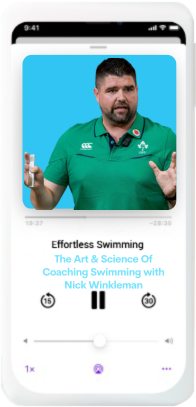
Have you ever felt like you know what to do, but you’re just not sure how to make it happen? Whether you’re an athlete looking to unlock better performance or a coach wanting to make lasting impact. Today’s episode is for you. Our guest is Nick Winkelman, author of The Language of Coaching, a groundbreaking book on how the right words can transform how you move.
Train and perform. Nick has worked with elite athletes and coaches around the world. And today he’s sharing the secrets of using cues, analogies, and storytelling to spark real lasting change. In this episode, we’ll cover how the words you hear or tell yourself can supercharge your improvement. Why using the right cues can make your stroke smoother, your technique sharper, and your training more effective, and the power of storytelling to break down barriers, shift mindsets, and help find your edge.
And it’s not just for coaches. This is about understanding your own journey. Nick’s insights will help you spot what’s holding you back and how to focus your energy where it really counts. Whether you’re looking to shave seconds off your swim, find more confidence in the way that you’re moving or performing, or learn to enjoy the process of getting better.
This episode is packed with a heap of takeaways that you can use in the pool and beyond.
02:16 The Start Of Language of Coaching
06:02How My Role As A Coach Is Making An Impact
09:49 Internal And External Cues
22:12 How Often Do You Repeat The Analogy?
29:54 Nothing Seems To Stick
35:55 Storytelling Technique
41:07 Writing The Book
Get in touch with Nick
https://www.thelanguageofcoaching.com/
Want to really transform your swimming? Join us on a swim camp in 2025 in the Maldives, Galapagos Islands, Whitsundays or Thailand: https://effortlessswimming.com/camps/
Change your technique and swim a smoother, easier freestyle with the Effortless Swimming membership:
https://effortlessswimming.com/training-and-membership-plans/?el=blog
Transcript
Read the full transcript
In terms of, of when to say it, if we go through the technical piece, I give you the cue and let’s say, you know, you’re doing a full length of the pool and you do a few repetitions and then you come back, especially if I’m giving a cue early on, I just want to check and challenge early on just to make sure I don’t let anything run on with the athlete that might be misinterpreted or unproductive. Welcome to the Effortless Swimming Podcast to show that helped swimmers and triathletes love the water, become a better swimmer and live a better life. Here’s your host, Brenton Ford. Have you ever felt like you know what to do, but you’re just not sure how to make it happen. Whether you’re an athlete looking to unlock better performance or a coach wanting to make lasting impact, today’s episode is for you. Our guest is Nick Winkelman, author of The Language of Coaching, a ground breaking book on how the right words can transform how you move, train
and perform. Nick has worked with elite athletes and coaches around the world and today he’s showing the secrets of using cues, analogies and storytelling to spark real lasting change. In this episode, we’ll cover how the words you hear or tell yourself can supercharge your improvement while using the right cues can make your stroke smoother, your technique sharper and your training more effective and the power of storytelling to break down barriers, shift mindsets and help find your edge. And it’s not just for coaches, this is about understanding your own journey. Nick’s insights will help you spot what’s holding you back and how to focus your energy where it really counts. Whether you’re looking to shave seconds off your swim, find more confidence in the way that you’re moving or performing or learn to enjoy the process of getting better. This episode is packed with a heap of takeaways that you can use
in the pool and beyond. Alright, Nick, welcome to the podcast. Thanks for joining me on here. It’s been hard to organize the right time zones here with you being in Ireland, me being in Australia, but we managed to make it work. So I appreciate you finding the time. Yeah, well, hopefully the lack of the effort it’s taken to do this is in contrast to the effortless swimming, which is the namesake of this podcast. So hopefully make it good here. Well, I wanted to start with where does the interest for you in the language of coaching? Where does that start for you? What sparked your interest in it? You know, I’ve you go back and you look at a lot of different things. I think I’ve always I’ve always had an interest in language and communication and connection. My mom would have said I talked too much as a kid. So maybe that’s where it started. I think I think when it came to coaching, I had an early an early experience with
you can call him a mentor. And he was he was just a personal trainer. And I was I was learning to get my my early cut my teeth doing personal training myself on my way to being a strength coach. And I would I would shadow him. And it was interesting at the time, you know, I’m just I’m taking everything on board. I’m learning about strength training methodology and movement and all the things that kind of go into developing the body. I’m in school at the time. And I remember watching him. And at the time, what stood out is the programming, you know, he would do bench press on Monday, he would do biceps and triceps at the end of the work. He would do all the same normal things programmatically as the other coaches as the other trainers I would see. But he seemed to use language differently. He seemed to really be intentional. And he was a funny guy. And, you know, he would he would make a lot of jokes. But he
was very purposeful in the moment before the movement in saying one thing, and really encouraging the client, the athlete, whoever to focus on that. Something about that moment, that was, you know, gosh, I was probably 2001 2002. Around the time I was doing that, it stood out it stood out to me. And as I progressed through my career, I think that just kind of stood in the background. And as methodology and biomechanics and all the core sciences, theologies that we learn in human performance, started to become standard operating. In terms of my experience level, I found myself saying what’s next, looking for what’s next. And it kept coming back to coaching, and language and how we communicate. And what was funny is when I would ask coaches now we’re talking, you know, 2007 2009, hey, how do you get better at coaching that kind of would look at me so I like what do you mean, which I thought was interesting by itself that there wasn’t a
common understanding of what that question even means. And well, gosh, you know, you read books on strength training on methodology on program design, like no, no, no, no, not about you know, what to do about how to do it. And again, I get this puzzled look, I’m like, literally, you stand in front of people and you talk all day long, how do you get better at that? Like, oh, okay. Well, that’s the art of coaching. Yeah, you just got to practice, you know, there’s no science there. And I wasn’t, I wasn’t satisfied with that. I felt there was and as it turns out there is and hopefully we can talk a bit about that. It’s that’s so interesting. My when I was 19, 20 years of age, my dad said, there’s this guy that I’ve gone to see. He’s a he teaches teachers how to teach. And he’s seen him years ago, like a decade before this. And so he said, like, go to New Zealand where he’s doing this talk, his name’s Rich Allen,
and just go to this three day course and see what you think. And that course was just struck like a light bulb just turned on. And I was like, wow, okay, now I’ve really see what coaching is about. And some of the things that he talked about at that course was similar to some of the things that you talk about in your in your book with cues, using stories, analogies, and it just like it just opened my mind up to what’s possible and how to coach. And it sounds like a very sort of similar realization that like, yes, you got the science, you got the technical things that we all generally know about. But the art of it is is what is I think is really interesting. What were some of the the early things that you started to pick up and take on board and learn in your coaching career? Yeah, so I’ll never forget it was like a lightning bolt hit me when the realization that this was important to smack me in the face. And I was I was coaching probably 10 10 American
football players at the time, preparing them for the NFL Combine. And you can kind of imagine I’m standing on the side of a track. And we’re just doing a basic acceleration warmup. So we’re doing our marching or skipping patterns, dry land type type work for probably many of your listeners. And I have, you know, 10 of them out there. And I all of a sudden just have this this sense, this out of body sense, like I’m watching myself coach, I’m observing myself coach in real time. And I was listening. And I was like, wow, I’m saying, I’m saying a lot of things. I’m talking about, you know, put your drive your knees up, push the ground away, stay tall. And I’m feeling myself with this, you know, I’m saying all these great things, I’m checking all the biomechanical boxes, everything, you know, my interns are getting carpal tunnel, writing down notes of everything. I’m saying this is great. And I’m like, who am I talking to? All of them are moving
simultaneous. I’m yelling out more things that even if they were going one at a time, that any of them could focus on. And even if what I’m saying is accurate, they couldn’t focus all on on at all at the same time, even if they could, I don’t know which things are working and which things aren’t. And so I realized I had no mechanism to really understand the direct as best anyone can impact of what I said, how I said it when I said it on their learning process. Granted, you know, the physical work itself, the physical act of practicing any skill does most of the heavy lifting. We know this. So athletes, especially ones earlier on in their development, are going to get better just by doing activities, independent, or maybe even in many cases, despite the coach. And so I really wanted to tune in to how my role was actually making an impact beyond just designing an environment. And so it was in that moment that I
started to get curious about what to say, when to say it, how to say it. We all know that the same message delivered with a different tone, a different energy, a different way of words either directly, indirectly with story or not changes the feel, even if the core message is the same. And so that whole space just kind of exploded into me. Now, still, if you were to come watch me coach and I have 10 people out there on the field doing marching and skipping. Yes, I’m actually still talking most of the time. But now I realize a lot of what I’m saying is to energize the group for crowd control. I don’t necessarily associate setting a vibe setting a feel and yes, that has an impact. But I’m able to dissociate that from what I’m trying to communicate in a moment to actually make a meaningful change in a movement. In those cases, instead of everybody going together, I might waterfall start them and have them go one at a time, give me myself an opportunity to
say maybe one little sound bite to each. And so ultimately, I started to come into contact with I like music. So if you think of kind of like a DJ soundboard, I started to understand what are the dials to dial in my coaching, to really meet that person where they’re at in that moment to make the most impactful change. I love it. Let’s let’s dig into some of those things that the what the how the why so in terms of cues, you’ve got internal external cues. Can you talk a little bit about the difference between the two and when when to use the different kinds? Yeah. So, so let’s do a few let’s do a few definitions because I think when when you talk about anything what you omit at times people think you are bi omitting it implicitly saying it’s not important. And so let’s go ahead and name a few things outright. We’re talking about communication. It is a huge space. We can’t cover it all. And so the way I like to
think about communication when it comes to coaching is we have our interpersonal communication skills kind of what you and I are doing right now, right? We’re connecting. We’re getting to know we influence motivation. We are extracting information about a person. We’re sharing information about ourselves. Right? It’s it’s it’s the humanistic side of interpersonal communication. Many many courses and books on that. We’re and it’s critically important and everything we’re going to talk about depends at least in part on being an effective communicator generally. What we’re going to specifically focus in on you and I is what I refer to as movement communication. How I use language to specifically communicate to an athlete how to move better. And so that’s where we’re going to focus our time. And so when we look at movement communication then we’re talking about the specific things that we can say influence a movement pattern
and we’re targeting even within that more specifically the moment before the movement. The thing that we’re offering the athlete to think about while they move such that we have the hope that they’ll not only move better in the moment but through the process of understanding the moving better in the moment that will help them learn and transfer those skills to whatever the task is. Whether it be swimming, biking, running, or in my case rugby at present. And so within there this idea of a coaching queue as you rightly say Brenton is I like to think of it as a continuum and it’s a continuum in that I’m trying to have them approach the movement through a lens. So think of it just like you’re going to get glasses you’re trying to give them the right prescription. The right lens with which to look at, feel, examine, and execute the movement. And so you’re right the words oftentimes used here are internal queues and external queues. I like to use a bit of a
thought experiment to explain those and then we can unpack them. And so the thought experiment goes something like this. Imagine you’re you’re in Las Vegas and you walk into a casino and you see this big sign you know let’s make a bet athletic version like okay this is interesting I’m an athlete. You walk in you see a you know a 20 meter track to your right you see an attendant on the left. You walk up to the attendant you’re like what’s this about it’s like very very simple. We have a card here with three queues we’ll call it a queue card and you’re going to read each of these queues and you’re simply going to make a bet on which queue if focused on is going to allow you to run the fastest 10 meter time. You’re like okay I used to do a bit of running in my day I’m going to give this a go. And so you read the first queue and the first queue says okay when you’re sprinting focus on rapidly extending your hips. Folks on rapidly extending your hips so
you’re kind of closing your eyes you’re imagining okay what would that be like you know line up on on the line you’re in a two or a three point start folks on rapidly extending your hips okay how how fast is that going to let me be okay when you read the next queue focus on rapidly pushing the ground away right okay those are kind of similar but then when you start to notice it in your body they do land differently folks on rapidly pushing the ground away. Now I’m sure Breton for you and the listeners you already have one that you didn’t choose it shows you and I think that’s an important thing already to say and if you choose as you you can’t forcibly make yourself like one thing over another you know if you like apple pie over cherry pie you can’t all of a sudden force of will of nature your nervous system to say no I’m going to go with cherry pie no it picks you but then there’s one more and you read the final one fitting for
an Australian audience and that is imagine there is a rattlesnake right behind you beat the bite beat the bite or maybe maybe a brown if we want to add the venom level up and so we have we have three different queues that point at the same thing a b and c so Breton for you which one if you were the one making that bet do you think allows you to run the fastest 10 meters that would be it probably be the third one the third one so most people the vast majority nine out of ten are going to select c in that example if I then said c was gone and you can only select a or b which one do you choose b b okay and so I have I’ve unpublished data we did this with over a hundred athletes or over a hundred college students half of which were athletes half of which were not and we gave them kind of those scenarios and we see just intuitively systematically people choose answers that are more in line with the b and the c so so what’s the difference well the the a example folks on
rapidly extending your hips right it is what we refer to as an internal focus it’s because you are focusing on something internal to your body inside your body so that’s limbs it’s joints it’s muscles typically biomechanical speech that describes what a pattern should be the second you leave the perimeter of the body and we say things like drive the ground back or beat the bite all of a sudden now we’re not asking anyone part of the body to do the heavy lifting we’re treating the body once again as a whole symphony as a oneness and we’re giving it a singular attentional focus which in this case is outside the body so we refer to it as external the third example with the the snake is technically an analogy it’s figurative right it’s moved as if a snake was there even though a snake is not literally there so I oftentimes refer to that as a figurative external cue it’s still external in the way you are mentally orienting yourself
is in terms of something outside of you even if it is not literally there and as I’m sure you and I will get into not only do we find intuitively we’re pointed to external cues and analogies we’re emotionally interested and find it more memorable when it’s an external cue and specifically an analogy but also when we go to the evidence our intuition is not betrayed we would see that objectively those states of mind also tend to result in better movement performance across a whole domain of measures that we can get wow that’s very interesting and so is there ever a time there that you would use an internal cue with someone so this is the this is the big this is the big question everybody wants to know you know so listen any coach knows that you will use a whole host of of language when when you coach my big thing is moving your coaching effectiveness from chance to choice it’s knowing the impact of your language
it’s having the mechanisms to see it reflected accurately in your athletes performance and knowing how to use that as a feedback loop to update and course correct the way you you teach and so when we look at that I’m going to say categorically here it’s an and not an or okay we do not need to kick internal cues off the block okay they can they can stay in the house the key thing is to understand the difference between internal language and external language in terms of the impact it has on a movement and so to do that I always like to to present this back when I’m when I’m when I’m answering this question so Bretton for you have you ever had the experience as a coach or as an athlete where you hear or have said the following I know what to do I just don’t know how to do it yes yes okay it’s the perennial problem it’s the perennial problem for athletes now I don’t know the level you work with or your audience work with but for me for the most part I’ve worked with
professional and elite level athletes but I also coach my my children’s sports team so I get to work with that level as well and what I find especially at the elite level and it’s no different at the younger levels is these individuals don’t have a lack of understanding of what needs to change in terms of skill execution and especially that the sports right you know the swim the bike in the run these are highly technical biomechanically predictable patterns of movement and yes there is individual variation but ultimately swimming looks like swimming running looks like running cycling looks like cycling within a very fixed bandwidth and so what we find then is internal language tends to be our go-to currency when we describe biomechanics right this needs to be there this needs to be there so on and so forth this amount of flexion this amount of rotation at this time point before the water through the water on exit so on and so forth brilliant
so internal language describes what should happen but Bretton where oftentimes fails is it does not lend itself to the energy flow and dynamic nature of movement so it tends to fall short in explaining how to do something now granted with an elite athlete or an athlete that’s very in tune with their body you might be able to say hey you need a little bit more elbow flexion and they can go ahead and solve that but for me that tends to be the exception not the rule and that’s not not the the check I want to cash at the bank it’s going to bounce as often as it gets cashed in and so if I want a more dependable mechanism that’s where external cues start to come in and so forgive me because I’m not a swimming coach I don’t want to falsely try to use those examples so let me stick with the running sprinting example hopefully people can relate to it if I say something like I want you to rapidly extend your hips it’s not a misstatement I do
what athletes when they run fast do rapidly extend their hips so that in itself is not false the challenge is if all I think about is just extending my hips it’s like going to a symphony and having the volume turned up on the flute section higher than all the other instruments it’s just not going to sound good it’s not going to harmonize and so this is why I like the idea of a symphony and the fact that what does a symphony require requires a conductor and that conductor is a singular point of focus for all of the instruments to bring a harmony and oneness that gives this experience whereby right the sum total is greater if you would than the sum of the parts same thing for the body and so now when I bring your attention to push the ground away it allows the entire joint muscular network to work together as it should it needs to to achieve that outcome and so ultimately that results in something being more
effective and so long-winded but it’s important to take people I think on the journey to understand how we arrive here if I’m working with an athlete especially if I’m trying to make a change to something and especially if this is an athlete an elite athlete understands a lot about their body I’m going to respect them and say hey this is what we’re looking to change and it usually is going to be using internal language now I’ll have the dot dot dot to do that to do that I want you to put on these pair of glasses I want you to focus in this way and that’s where I’ll introduce the right external cue push the ground away or the right analogy beat the bite and just systematically do that as I identify errors and I look to correct and ultimately course correct them what I really like about that is that I find a lot of the athletes I work with they want to they want to understand because I work with a lot of intermediate level athletes maybe people have been
swimming for one two three years they don’t have a lot of experience that’s probably the majority of who I work with and they want to understand the what to do let’s say we’re talking about rotation perhaps they’re over rotating as an example and we sort of show them this is how much we need to rotate side to side so that that’s helpful but then giving having the cue the so that okay this is what we want to do but so that we can do that we need to have this in mind this cue this analogy whatever it might be so I find that a really good good approach and my next question there is particularly with these elite athletes like you’ve got the analogy that you’ve you’ve got for them how often are you repeating that to them like it’s at is it a multiple times per session is it like a once a week like obviously it’s going to change but of course and and going back to my mentors this is this Britain is where the art then
comes in and it’s art because there is no objective consistent universal answer right there there’s always an answer but that answer can only be born out of the context that you’re in and so for me I like that I like the term you know what’s what’s your what’s your heuristic what’s your cheat code what’s your shortcut to figure out you know to speak or not to speak to coach or not to coach that’s what we’re asking here and for me in a very pragmatic way is the queue continuing to work without having to repeat it you know and the power of observation comes in here so you know I’m working with you on a skill we code we define it you understand okay this is technically what we’re looking to change and let’s just say Brent not everybody needs the the internal technical description you absolutely have some people that want it but I’ll be honest if if they’re not overly attached to understanding everything inside the under the hood of the bonnet
you know then I’m not going to flood their mind with unnecessary information the ironic thing is when we’re on a podcast we’re talking a lot but the actual expression of what we’re talking about brevity needs to be your best friend it literally is saying the most with with the least because we know that our attention is like a funnel right and it can only handle or a spotlight there’s many analogies for this it can only handle so much information at once and so with the best will in the world and the best intention we can oftentimes author what we’re trying to avoid by giving too much information so we’re trying to give we’re just trying to give the right amount to the athlete and so in that regard I think that’s just an important thing to recognize as a coach that how much we say is critically important in terms of of when to say it if we go through the technical piece I give you the cue and let’s say you know you’re doing a full length of the pool
and you do a few repetitions and then you come back especially if I’m giving a cue early on I just want to check and challenge early on just to make sure I don’t let anything run on with the athlete that might be misinterpreted or unproductive and so I give the cue understand it yep I might have them repeat it back to me what does it mean to you how does that feel depends on how elite they are right how experienced they are there’s a bit of dialogue and then they go do it and now I watch when I watch I’m this is where your coaching experience your biomechanical eye matters I’m looking to get a sense is the cue assuming they’re focusing on it which is which always is an assumption is it working you know you use the example of of rotation am I getting the lift I want out of the water am I getting the extension I want through the push in the run am I am I getting the power you know or the body position on the bike whatever it might be
and if I feel yeah I’m getting some of the change I’m getting some of the essence that I want then I’m gonna have the athlete say how did that feel to you so I observed the outcome I want to know what what the lived experience of expressing that was like for them did they feel a change they either say yes I did no I didn’t or I’m not sure and you get a lot of I’m not sure okay and if I get an I’m not sure did it feel bad like no it didn’t feel bad felt different I was okay difference okay difference okay you know what I saw is looked like we’re getting a bit more lift what do you think about giving it another go for a few more reps yeah let’s give it a go perfect and then I might let that then once I’ve done the check and challenge I’m going through what I’m referring to here I talk about as a coaching communication so Q do debrief Q do debrief I you know we queue or we coat we co-create the Q they do it and then we debrief when we’re debriefing
I’m trying to figure out one of three things which is what I just described that do I repeat the Q do I refine it which means I just tweak the language a little bit maybe from an external Q I go to an analogy or I go from an analogy to an external Q whatever or do I retire it you retire a Q if it’s kind of like the peanuts walk walk walk from the parents they just hurt it too many times lacks its potency or it backfired it did not work it made them worse or didn’t give them a good vibe a good feeling it just wasn’t a healthy mental state for them to execute and we just go through that cycle again and again and so I take early on I probably give them multiple boosters of the Q just to make sure it lands that we get the right dose and then once the dose feels to be at the right level and you tweak it a little bit just like if you’re going to a doctor then we let it we let it ride and we and we watch it and we just check in
every so often and again if you’re working with a group versus one-on-one these things are going to change the biggest cheat code is and it sounds simple is it working is it are you connecting what you said in the intended change that’s meant to be the echo of what you said is it actually happening if it’s not then skillfully figure out a way to come up with the next best Q you know or the next best drill or both to start to institute the change or recognize that hey maybe this thing isn’t changing because it’s not subject to being changed by coaching language you know no q can magically give you more hip or shoulder mobility no q can magically make you exponentially stronger right so if you have a physical impediment to progress this is me putting my strength coach hat on then i need to get those speed bumps those barriers out of the road and so it’s not trivial that actually really effective intentional connected
coaching in the absence of its effectiveness when you’re going through a process like we’re describing it actually can inevitably point to actually the solution might not be available to me directly in the pool or directly on the track there might be additional work i need to do over here which is why having a sound physical program and assessment program at times is is the best friend of a coach that happens a lot in swimming they’re just like overhead range is a big one and the catch this movement here is just as you know a lot of adults can be very stiff through through there through thoracic spine as well so yeah that’s that’s a really important part of it the other thing then is like how do you like keeping the the mental i guess the mindset of the athlete like how do you sort of keep them at that level where they’re not getting down on themselves so let’s say you were trying to q you’re working on a few different things but it’s just not clicking like if
you ever have one of those sessions where nothing seems to stick and the athletes just getting maybe down on themselves like is this ever going to change what do you do there and when’s a good time to to give like the feedback and give that positive reinforcement again where i think we’re starting to venture into the in the art side of it and i say that because you have for one you have people who have different if you want to call personality if you want to call it learning preference all of these characteristics right vary across individuals for anyone who’s coached knows that oftentimes the same you know three different athletes who have a similar error you might need to have three slightly different approaches you’re not not catastrophically different but slightly different approaches to to get the same point across so that’s one thing to say but then we’re also variable creatures from day to day we rock into a session we’re
tired we didn’t eat enough food whatever it might be interacts then with our personality with our learning preferences and so the amalgamation of that is what we see on a day to day basis and some athletes some individuals are very stable and you know what you see is what you get all the time and then we have others that are all over the shop and then everything in between you know one of my favorite quotes is you never step in the same river twice finally you never meet the same person twice even moment to as you said a session could start well they get frustrated and they lose the plot we see that with some athletes who they they can go high high and low low and back again in the same session so we have all these different individuals that we’re working with and sometimes the different individuals are the same individual how do you deal how do you deal with that I like to refer to this generally as what is what kind of learning mood
what kind of learning mood is my athlete in today I only recently came up with that because you know people type of learning styles which is a bit of a misnomer learning styles suggest that you preferentially learn better one way over the other it’s just simply not factual which is a surprise to a lot of people what it what’s more correct to say or what is more accurate would be learning preferences meaning you tend to more readily deploy attention in a complete manner when information is presented visually or analytically or experientially it’s not that you can’t learn in the other ways especially if those other ways are made to be more effective so someone who says I just like to experience things if they’ve only ever had very analytical coaches in the way they communicate let’s say a lot of technical information a lot of internal queuing that athlete might say oh I prefer just to do it well they prefer to do it because they actually didn’t understand or like the
way the person was verbalizing information if they then meet someone who uses a lot of analogy a lot of what I would refer to as verbal demonstration when you give analogy it’s very easy to visualize and feel what that visualization would be like as if I did it and all of a sudden the experiential athlete says oh actually I don’t mind being coached I don’t mind hearing language he’s just I was you know I was eating cherry pie and I wanted apple pie okay and so now I got the apple pie now okay I can learn this way so it’s all to say that people can learn through varied mechanisms and so on a day-to-day basis if you come to me and you are highly anxious you know you’re just you just and you just want to move you just got to get into it I can I can tell that your patience for information and thoughtful discourse is not going to be high today then likely in those sessions I’m going to get you moving and I’m going to coach on the fly I’m going to coach on the fly using
simple language I’m going to use languages more energetic push push drive snap let’s get long single words high high or right energy I should say and I’m going to keep you going and I’m going to try to build the plane in flight and I’m going to energetically match you if you seem to be in a place where you have the space and we’re trying to make a technical change then again I might introduce a little timeout so like when I’m coaching my daughter’s basketball team I took 30 second timeout so I’m already pre-qualifying it’s going to be short 30 second timeout boom boom boom boom boom okay we’re back into it so even how I frame that we’re going to pause and we’re going to talk about things it’s as best I can in a sporting context it puts boundaries on how much I’m going to say and it allows them to know that hey I’m going to have to only focus my attention for a short window of time and then I’m going to get back at it
and so if you’re to come watch me coach I use very tactics and it’s very felt because even in the session I might feel that hey I have their attention I’m going to I’m going to say a few things we’re going to try a few things but then as the session goes on I wanted to become more active more coach on the fly and it doesn’t mean that I’m not being purposeful and intentional but if I’m coaching on the fly I can’t use a lot of detailed information so that the coaching tactics I use when we’re in flow if I was on the side of the pool and they’re actively swimming I can still coach while they’re moving but what I’m saying and how I’m saying it is very different than if they’re on the pool’s edge and I’m going through a few things where we’re trying to make robust technical changes usually if they’re in motion I’m just tweaking the dials on my on my soundboard here right I’m not I’m not trying to put in a new track
I’m not trying to play a different song I’m not trying to give a different cue I’m using things they’re familiar with and making slight modifications that are not intentionally demanding it’s one of the things that you also mentioned the book and you sort of referred to a bit here is the storytelling aspects and one of the ways I’ve had to I’ve found that I can get across to my kids to get them to listen to me anything to do with swimming or even just other things it’s like I say I talk about a different person said this so there’s I’ve got a friend of mine who’s a swim coach and I said his nickname is Big Sam I said Big Sam said and they know he’s a good swim owner good coach I said Big Sam said that if you do this certain movement in freestyle that like that’s what all the fastest swimmers do and then it’s not me telling them what to do because I can not get them to listen to me when it comes to swimming so
just even like that like that is a bit of a story or something that someone else has said sort of takes it away from them being told what to do and I really like that because then they can sort of derive the meaning from that story what they want and it’s not me saying you need to do this so what have you found with with storytelling if you found a similar thing where it’s like people can they sort of take a step back and those barriers or those walls go down and it just allows them to sort of take on maybe a new way of thinking about something or a new approach with whatever you’re trying to teach yeah I think a good a good story allows you to find the meaning in the story right it isn’t necessarily or the moral of the story it’s not necessarily directly stated it’s it’s indirect and therefore a story is like a present that you get to unwrap as it unfolds and only you then get to and so there’s this sense that
even though you told the story they are the one that has the aha moment and that has this sense of curiosity and learning and learning is what learning is a gift if we think about it it is a gift because to learn something means I have something that a moment prior or a day prior or a week prior I did not and so in quite a literal sense it is an offered gift and what a story does a good story has the gift of the aha of I get it I see that and because I found it there is a sense of ownership of autonomy if not possession and that I now possess the secret that was told in this story and in doing that it feels I think good coaches are stewards their servants and their gift givers and the gift is the opportunity to extract the learning because we can’t forcibly right you can bring a horse to water you can’t make him drink but you can put salt in the oats that’s what we’re doing i’m putting salt in the oats
what we’re trying to create offers that encourage certain behaviors but we can’t ever we’re not puppet masters forcibly tell them so I think when you just say do this you take the intrigue you take the curiosity you take the memorability you take the journey you take the aha away a penny doesn’t you know the penny can’t drop for me if I’m the one as the coach dropping the penny every time you know I can’t I or I’m the one trying to click on the light know they have to have the penny drop they have to click on the light or they have to have the light clicked on so to speak and what you’re pointing to in a in a psychological sense is the value in the importance of perceived autonomy perceive that I have causation in my journey that I am authoring my success that’s really important to us as humans to really important because we see a dissociation with outcome if we don’t feel we were actively involved in what it took to get
it and this can leave athletes who for example have a coach that overcoaches them that they’ll they’ll blame the coach at times now I’m not saying that’s an effective mindset to have because the coach is probably doing the best they can but a coach that coaches in a way that really puts the player the athlete in the driver’s seat through using tactics like you’re saying I think gets far more out of the player far more out of the athlete far more ownership and effort and so for me autonomy equals attention autonomy equals attention the more perceived and that’s the keyword perceived autonomy not that you know the I’m not I’m not having them write their own programs necessarily there’s an expertise they’re coming to us for but the more perceived autonomy they have the more attention that they deploy to what that autonomy creates in them because they feel they are the author of it and if I author it I value it if I value it I pay
attention to it because I pay attention to it I believe it’ll lead me to a better place that’s that’s such a good way of explaining it it’s and it’s such a just such a powerful way of getting getting that yeah that that ownership getting the message across and it’s something that I’ve when it’s done well I’ve found that it’s made such a difference in the in the way that I coach in there and the lessons that people take from it now we’ve gone for for about 40 minutes here so I really appreciate your time and I’ve got just one more question in terms of the book so this thing is a this thing is a beast that is it is a massive book what what did you what did you learn in writing the book because this cannot have been fast it could not have been easy to do uh like what what came out of you having to sit down and write all of this stuff down that was up probably just in your head I can only imagine what what goes into it
I don’t know if anyone’s ever asked me that Britain that’s that’s a great the this is going to sound silly but you you hear you hear authors especially fictional authors which I’m actually working on a fiction book I’ve been working on it for a long time the book in a way writes itself and you’re you’re waiting that’s why it’s a long process at times you know it’s like you’re co-authoring the book with your with your many selves because each time you go back to it and you reread something you reread it with a fresh set of eyes new experiences again you don’t step in the same river twice there’s many authors even though there’s one name on the front of the book there’s many authors I can tell you that the Nick that was writing in the fourth year and it took about four years to write the book was not the same Nick that started it the table of contents when I started it was not the final table of contents that you now find in the book and so there are
there that are in that book that came out of the creative process of having to put words on a page so there are now models that I use in my coaching that I learned in writing the book not because they didn’t exist already behaviorally in what I was doing but I had to necessarily put them into words put them into a framework now there’s not many of them but there there are critical aspects of that book that only in the act of writing it and having to tell a story did I learn how to tell that story better and in doing so it actually writing the book made me an even better coach which is was it was just such a joyous a joyous process to to go through hopefully I think next year I’ll start on the second edition of it which I can’t even believe it you know the book’s been out for for nearly five years now it’ll be five years in May of next year but we’ll start working on on a second edition and I’m really excited
to uh to go through albeit it’ll be a different journey hopefully an easier one but the journey again because it uh it’s a learning but the key thing for me is you can’t write a book on coaching let alone coaching language that doesn’t honor the principles the book is about and so for and I’ve had people say this to me for someone who takes the time to go through it what they’ll find is I wrote the book using the same principles the book is about and that’s I’d like to think one of the reasons why it’s been it’s been fairly well well received I try to use story but you’re right the first component of it it’s it’s still meant to be an industry standard text on the topic so it doesn’t shy away from going into the detail in part one but the second someone gets to part two and part three we try to get into the fun stuff and focus on how to do this not just what underpins it the first thing I noticed there was
like a start of each chapter and and throughout the books like story story story there are lots of visual aids and like the don’t know if you call them key cards and stuff but like lots of visual aids and uh yeah like you you live what you preach which is yeah which is always what you want as an as an author right so Nick I’ll really appreciate you jumping on the podcast I love this stuff and like just to someone I can’t remember who it was but someone recommended you and they said get in touch with with Nick because he he’s really into the the language of coaching which I’ve talked a little bit about on the podcast over the last couple of years but I’ve learned a lot today so I’m looking forward to applying some of the stuff that I’ve picked up so appreciate that anyone who is listening grab this book the language of coaching you find on Amazon you can grab it through your website as well which will include in the show notes anything you’d like to sort of leave
with the audience if they are a coach or an athlete anything that we haven’t covered so far no no I think the biggest thing I would say when it comes to this topic is you know looking listening and just just being aware of the echo of your coaching in the way your athlete moves and the way your athlete responds if you’re if you’re in tune with that everything we’ve talked about even if you had never listened to this podcast will inevitably reveal itself to you naturally so that’s it coaching is a two-way street to make sure it is a two-way street fantastic Nick thank you again thanks Brent all the best thank you so much for having me thanks for listening to the effortless swimming podcast if you’d like us to help you become a faster more efficient swimmer go to www.effortlesswimming.com