








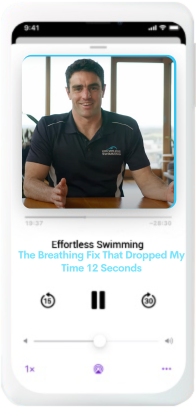
I watched a swimmer fix one breathing mistake and drop 12 seconds per 100 meters—not in four months, but in four weeks.
No extra fitness.
No added training volume.
Just one specific change in how she breathed.
That single adjustment took her from 1:48 per 100 down to 1:36 per 100.
In this episode, I break down exactly what she changed, why it worked so fast, and how you can apply the same breathing fix in your very next swim—whether you’re training for endurance, speed, or just want to stop feeling rushed every time you turn your head to breathe.
If your breathing feels like the limiter in your freestyle, this episode will change how you swim.
01:45 Head Lifted Forward Out Of The Water
03:49 Correction No. 1 Your Head Should Be Like An Iceberg
04:32 Correction No. 2 Exhaling Ender Water Mostly Through Your Nose
05:14 Correction No. 3: Breathing Every 2 or 3 Strokes and Learn To Breathe On Both Sides.
Try the new Nanoclear Anti-fog Goggles: https://bit.ly/nanocleargoggles
Transform your freestyle with me through online video analysis:
https://effortlessswimming.com/es-training-and-membership-page/
Need to break 2:00/100m? Start here:
https://effortlessswimming.com/courses-membership/
Transcript
Read the full transcript
So she practiced this for four weeks, so she sent me another video after those four weeks and the difference was dramatic. Her head stayed low, her breathing was clean and relaxed and her hips stayed horizontal. No more swing uphill and her time a minute 36 per 100. 12 seconds faster, same fitness, same training volume, just better breathing mechanics. Welcome to the Effortless Swimming Podcast to show that help swimmers and triathletes love the water, become a better swimmer and live a better life. Here’s your host, Renton Ford. I watched her swimmer fix one breathing mistake and dropped 12 seconds per 100 meters in four weeks, not four months, four weeks. She didn’t change her fitness, she didn’t add more training volume, she changed one specific thing about how she breathed and that single change took her from a 148 per 100 to a 136 per 100. I’m going to show you exactly what she changed, why it worked and how you can apply the same fix in your next swim.
This is one of the most common breathing mistakes I seen age group swimmers and triathletes and it’s costing you massive amounts of speed. She came to one of our coaching calls a few months ago and she’d been swimming consistently for over a year, training three times a week and followed a structured program and she was doing everything right, but her times weren’t improving. She was stuck at 148 per 100 and couldn’t figure out why. When she swam, she felt like she was working incredibly hard so her heart rate was high, her breathing was laboured and after 50 meters she already felt quite exhausted. So she asked me, branching on fit, I can run 10Ks, no problem, why am I so exhausted when I swim? So I asked her to send me a video of her swimming at a normal training pace and when I watched it, I saw the problem immediately. Every time she breathed her head would lifted forward out of the water and not to the side. She went forwards with it. So every time her
head lifted forward, her hips dropped and she was literally swimming uphill every single stroke. Now let me explain why this is such a massive problem. Your head weighs about five kilos, roughly the weight of a bowling ball. So when you lift that bowling ball up and you go forwards to breathe before you turn, basic physics takes over. So your head goes up at the front, your hips drop at the back and your body goes from being horizontal to dropping through the hips and the legs. Now instead of swimming through the water, you’re swimming uphill and swimming uphill requires significantly more energy to go the same speed and that’s why she felt exhausted after 50 meters. She wasn’t unfit, she wasn’t necessarily slow either, it was just that she was tiring very quickly and so she was working a lot harder than she needed to. So here’s what made this even worse. When her hips dropped, she created more drag, more surface area pushing against the water
and more resistance. So now you’re not only swimming uphill, you’re also dragging a parachute behind you and to compensate most swimmers will kick harder. They think oh my hips are dropping, I need to kick more to keep them up. So now you’re burning more energy with your legs while you’re trying to fix that problem that your head position created and this has a cascading effect of the one breathing mistake which is just lifting up, lifting the head up high, well above the surface of the water so the hips drop, you create more drag, it’s harder kicking which leads to exhaustion and the solution isn’t to get fitter, the solution is to fix how you breathe. So here’s what I told her to focus on. Firstly I showed her a side by side comparison. On one side, head lifting up, hips dropping, body angled which was her stroke and then the comparison was with an elite swimmer where the head would just turn directly to the side
and the body stays horizontal and once she saw it the difference was obvious. So I gave her three specific corrections to make. The first one is your head should be like an iceberg so this is the key cue. Think of your head like an iceberg where when you’re swimming and you’re looking down 10 to 20 percent of your head should be above the water and when you breathe you turn your head to the side, you don’t lift up or you don’t look forwards first and then turn, you just turn directly to the side. So one goggle stays in the water, the other comes out. Now it’s okay if it comes, that bottom goggle comes out a little bit but for the most part we want almost half the head in the water. If both goggles come out you’re probably lifting or turning too far and that is the mistake. So your head should rotate as part of the body roll staying low and relaxed and not popping up to breathe. The second correction was exhaling underwater mostly through your nose.
A lot of swimmers hold their breath underwater and then they try and exhale everything just as they turn to breathe. This can create panic. So instead what I’d recommend is allow a little bit of an exhale primarily through the nose to happen as your face is in the water and then as you’re turning to get your breath that’s where you can have most of the exhale but by that point your lungs are mostly empty so the inhale is calm, it’s quick and it happens naturally. So allowing a little bit of an exhale primarily through the nose while your face is in the water after you’ve taken a breath is how to do it so there’s no rushing, there’s no gasping. Correction number three so breathing every two or three strokes and learn to breathe on both sides. So a lot of new swimmers actually have a tendency to breathe every four or six strokes and they’re not getting enough air in and for most adult swimmers and triathletes that’s too long between breaths
especially for longer swims. So breathing every two strokes or three strokes helps keep your oxygen levels up and your heart rate under control and being able to breathe on both sides can help with balance of your stroke and it exposes some of the technical faults that often show up when you only breathe to the one side. Now the drill that I gave this swimmer to lock this in it’s side breathing drill with a kickboard. So you hold a kickboard out in front with one arm your other arm is by your side you’ve got fins on and you’re kicking face down in the water and then when you’re ready to breathe you turn the head to the side you rotate a little bit and then you get the breath quickly you get it low and you bring the head back and the board out in front is used for balance and stability so it helps you practice that low quick breath where you’re turning directly to the side and not lifting up and this way your head stays low in the water it’s like an
iceberg and you’re not lifting and throwing the head around. So she practiced this for four weeks so she sent me another video after those four weeks and the difference was dramatic her head stayed low her breathing was clean and relaxed and her hips stayed horizontal no more swimming uphill and her time a minute 36 per 100 12 seconds faster same fitness same training volume just better breathing mechanics and she emailed me afterwards and said I can’t believe this one change made such a difference. Swimming feels completely different now and I’m not exhausted anymore and that’s the power of fixing a fundamental flaw you’re not just getting faster you’re making swimming feel easier because you’re no longer fighting physics so here’s what to do in your next swim firstly film yourself from the side and watch your head when you breathe if both goggles are coming out of the water you’re probably turning too far or
lifting the head so you can practice the side breathing drill with a kickboard 200 meters at the start of each session for two weeks getting used to that way of breathing make sure you breathe every two or three strokes and practice breathing to both sides and the last one is exhale from your nose so your inhale stays calm and controlled that’s okay to have some breath exhale through the mouth as well but primarily through the nose so one breathing mistake can cost you 10 to 15 seconds per 100 that’s 90 seconds over a 1500 meter swim that can be the difference between finishing mid-pack and finishing at the front of your age group and the fix doesn’t require more fitness or more training it requires fixing the mechanics so if you want personalized feedback on your breathing technique join our coaching membership which is where you can send a video of your swimming we’ll analyze it and we’ll give you specific corrections like we did with this
swimmer and we’ll identify a highest leverage technique flaws and tell you exactly how to fix them so you can submit a video once a month get feedback from our coaching team and track your progress over time the link is in the description below but whether or not you join fix your breathing technique stop lifting your head up when you breathe and start rotating to the side keeping mostly one goggle in the water and this change could drop your time by 10 seconds or more per 100 so try it in your next swim and let me know how it goes in the comments thanks for listening to the effortless swimming podcast if you’d like us to help you become a faster more efficient swimmer go to www.effortlesswimming.com