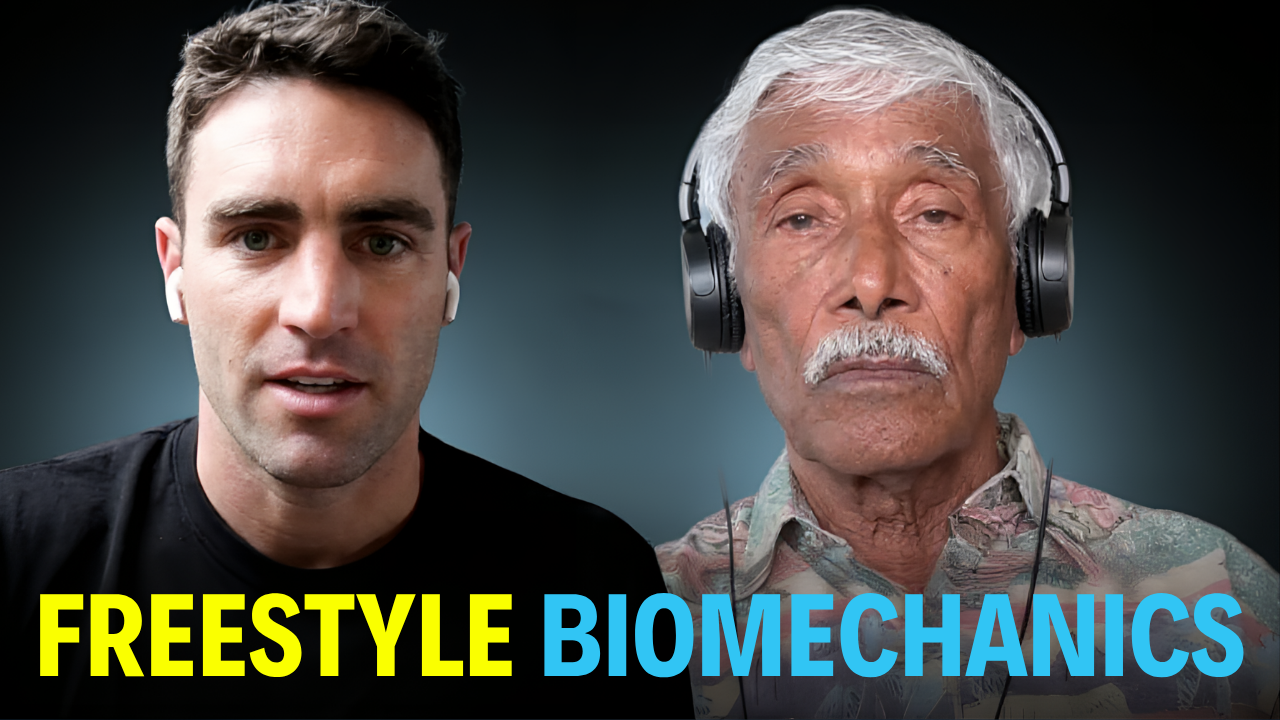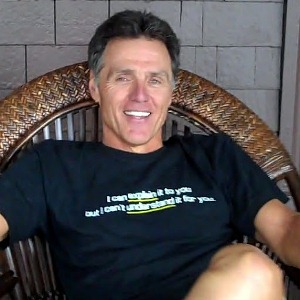








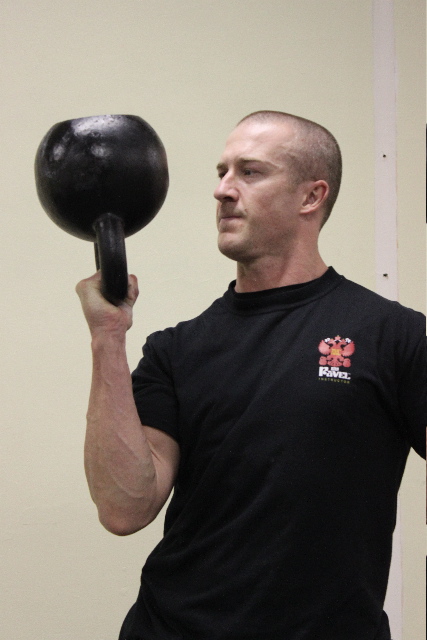
 Andrew Read owns Read Performance Training. His specialty is helping triathletes improve their results, overcome and avoid injury and be healthy for life through a different approach to strength and conditioning than most trainers.
Discover how strength and conditioning play a part in endurance sports, the difference between goals versus systems, the process to building strength, which habits that have the biggest impact on health and the right approach to health, fitness and well-being.
01:58 – His body wasn’t working properly.
03:55 – My back started hurting…
04:24 – The mechanics of the swim stroke
06:51 – Why being a skinny kid changed everything
09:01 – Zero to Ironman in 12 months
12:23 – How I lost 6 kilos.
13:04 – You can’t be awesome at everything!
17:07 – The biggest benefit of sport
19:13 – Why the solo mindset doesn’t work
20:26 – Animals can’t sweat like we can.
21:44 – The ancient hunt
25:47 – On the edge of death
28:13 – Why most people can’t stand straight and how it’s impacting their health
40:36 – The sign of old age
47:01 – Getting the edge on race day
49:28 – When extra weight can help
52:03 – Not big enough, not strong enough
54:46 – Swimming and gymnastics are quite similar.
58:08 – Help them love the sport.
1:00:37 – Kids aren’t designed to do that
1:02:21 – Rebooting The System
1:03:42 – Less Recovery, Less Work
1:07:25 – No distractions
1:12:12 – They don’t have any idea how to get there
1:14:18 – Resort back to your system
1:18:16 – What’s my system to deal with this?
1:20:56 – Work, Relationships, Training
1:22:12 – Why “No” is one of the hardest but most important things to say
1:22:33 – We are not far off monkeys…
1:25:19 – Andrew’s long term goal…
1:25:40 – If you don’t have your health, you have nothing else…
1:26:23 – Breaking Muscle Australia Launches March 2
Visit Andrew’s website at http://www.readpt.com/
Transcript
Read the full transcript
Thanks for joining us on the effortless swimming podcast to get transcriptions, bonus videos and to be the first to hear about new episodes, go to swimmingpodcast.com. Welcome to the effortless swimming podcast. My name is Brenton Ford and today’s guest is Andrew Reed and he owns Reed Performance Training pretty close to where I live here in Melbourne actually and we got introduced to each other through mutual friends. And the reason I wanted to get Andrew on the podcast today was he knows a lot about strength and conditioning, but it goes a lot deeper than that. He has a background in competitive martial arts. He’s also done a couple of triathlons himself, but he works a lot with triathletes in strength and conditioning. And we’re going to talk a little bit about that today, how he sees strength and conditioning playing a part of endurance sports, but we also go into a lot of stuff in terms of goals versus systems, the process that you go through to building your strength
up from someone who’s just beginning, what habits have the biggest impact on your health and what kind of approach he sees as being the right approach to health, fitness and well-being. So it’s a really good podcast, I hope you enjoy it. And make sure you go to effortlesswimming.com to keep updated with the latest clinics and camps that we’re doing. We’re about to release the new or the next Hell Week in Tanyapura in Thailand. So be sure to check that out. And we’ve also pretty close to finishing the art of triathlon swimming program with Annabelle Luxford and Clayton Fatale, two of triathlon’s quickest swimmers. So that’s almost finished too. So make sure you go to effortlesswimming.com and check that out. We joined today’s podcast when Andrew and I are talking about a mutual friend of ours, so let’s get into it. I met Mitch at a bike shop and he was complaining about how they were going to cut holes in him and all this stuff wasn’t working.
And like of course he was in pain, his body wasn’t working properly. And even with the surgery, if they’ve gone ahead and just done the surgery, which is what they wanted to do, the same problem would have come back because they didn’t fix the underlying problem. So I managed to convince him to wait a little while and we fixed the underlying issues. And then he had the surgery and so the pain actually went away and then he was able to go and race last year in Europe up until I think he ran his bike off a cliff or something, but he banged himself up pretty badly. Yeah, that’s right. And so, you know, like elite performance is slightly different because you’re always going to be on that edge of hurting yourself. And then you get normal kind of age group triathletes. And I don’t even mean like age group is at the pointy end, which these days are almost like pro athletes anyway. But you know, a lot of triathletes like Joe or even like me,
who aren’t very fast and all I want to do is then just do all the endurance stuff. And then I realize that, hey, you know, mate, you’re 85 kilo, you’re not designed to be an Iron Man for starters. You may be coming with no real athletic background, your general movement quality, like you’re not very athletic. So the expectation that you’re going to be a great athlete is a little bit wrong.
And so, you know, sooner or later, they just break down. And, you know, this is one of those things with I think the strength training guys, a lot of them come from, you know, we lift heavy and they have no idea what it’s like to go for a five hour ride.
And then you get the insurance people who have never been in a gym before and can’t even do a single push up. There’s no surprise that the two groups don’t really talk to one another, but there’s not many people actually kind of dealing with both in any sort of an effective manner. So some of the stuff I see is just terrible. I mean, you know, when I was getting ready for Iron Man, a guy who really knows a lot about strength training, I asked him for some advice. He said, oh, you know, make sure your deadlift is really big. And I was like, why? He said, just, you know, that stride length and posterior chain strength and all these stuff. And so I tried it and then my back started hurting from all the riding and you know, heavy deadlifting after you’ve been stuck in a single position for a few hours the day before that just, you know, I could see injuries coming. So I stopped and made me realize that. Hey, all of these strength guys don’t know shit about this thing.
Yeah, exactly. I mean, I find the same thing with so physios, for example, if they haven’t specified in swimming, they give very generic advice and they just don’t know the mechanics of the stroke and how the muscles work to even, you know, if you’re so I’m 43, if you go see most physios at 40 years old, because you’ve got a car for Achilles problem from running, they’ll just say, what do you expect? You’re over 40. That’s pretty normal. And while there is research to show that, hey, it’s more prevalent in older runners. I mean, the problem is that they don’t, they’re not runners. They don’t know how to fix it. They don’t really have a treatment plan that gets you back to running. I mean, I would actually suggest that this book I’m writing is about running. I’m probably more up to date on running rehab than most physios are. And it helps. I’ve got a buddy who’s head of sports made at Institute of Sport Level.
So and he actually is a runner and deals with a lot of AFL kind of eyes and hockey players and stuff like that. So I’ve learned a lot about running rehab from him. But there’s a lot of people who come to some of the workshops I run. And I’m always a little bit freaked out by how low their level of education is. Because I mean, like you said, I mean, they know nothing. And then they tell you how you should be treating it and fixing it and all that kind of stuff. And most of the treatment involves don’t do the thing that you love doing. I don’t think that’s much of a treatment plan. Yeah. And that’s the same thing with the physios who don’t know something is they’ll say, take a couple of weeks out of the water and let it heal. But as a swimmer, you can’t spend you can’t spend that long out of the water unless you want to go back three months of training. So I find that, you know, if you if you want
if you want something that’s really going to work for you, you’ve got to go to someone who’s got expertise in that specific area. If they’re just generalists, then, you know, it’s not going to work for you. You’re not going to get the right advice like you were saying with the deadlift for a strength, a strength guy, giving you that for Ironman training. Yeah, well, I mean, you know, for but how many shitty coaches are there? And I mean, she did just in every field of employment. I mean, you know, you can bring up the bank or Optus or whoever and find a horrible person to talk to on the phone. It might take you three or four goes to actually find someone who actually can help you.
How many bad triathlon coaches are there bad running coaches? Bad, you know, like there’s just so many of them. There’s not many who are actually, you know, legit and know what they’re talking about. They just don’t have the experience. And how do you get into strength and conditioning? I mean, I know you’ve got a martial arts background and then sort of how’s that had that turned into strength and conditioning and then working with triathletes. I was I was just a skinny kid and I really wanted to compete in sports. And I could see that, you know, developmentally and I don’t know why I realized this when I was like 13 or something. But I could see it 13 that I was already behind other kids. And I thought that maybe if I lifted weights, that might.
Well, I wouldn’t be so skinny. So that was that was just I mean, aesthetics I was worried about. But B, I thought it might help me play some sport better. So I started lifting weights and, you know, sort of went down the bodybuilding path because that was about the only thing that was available back then. But then, you know, I got to about, I don’t know, like 21, 22 and started finding and this is all pre-internet. So it’s not like it is now. I mean, you know, it was very difficult to find books. And, you know, the only way you were getting in front of good coaches was to actually be in a high level sports program yourself. So because I was actually pretty good at tackle. No, so I had a little stint on the national team. I got to meet some higher level kind of people and started learning some stuff and realize that, hey, this thing I wanted was strength training, not bodybuilding training. I learned the difference and went down that path.
And, you know, for martial arts, strength training is actually pretty simple. I mean, most martial arts fights are even boxing, which is, you know, like a championship fights, 12, 3 minute rounds. So it’s a 36 minute fight that’s quite short compared to something like well, like Ironman or like, let’s say, like a military selection, recruit training kind of thing, which might go for weeks and weeks at a time. And, you know, so as I’ve gotten a little bit older, I’ve started looking at, you know, I had these gaps in my knowledge. So that’s that’s how Ironman came about for me. It was a standing at the finish line for the first Melbourne Ironman. Of course, Crowey won in, I mean, he went under eight hours. And in fact, I think Cam Brown did like the top three guys were around the eight hour mark. So blazing fast, perfect day. And they all look so good doing it. I was like, well, that’s awesome. I should do Ironman.
And I’ve never seen one in person. Like I’ve watched it on TV, but seeing it live was pretty neat. And so I said to the editor of Breaking Muscle, hey, what do you think? Like I was zero to Ironman in 12 months. And she loved the idea, which unfortunately meant I had to go and do it. And, you know, that’s when I started learning about all this other stuff. So the and that was 2013, I think. So, you know, the last two years has been a journey of rapid discovery of a whole bunch of things. And I was probably a little bit lucky compared because I did swim at school. So I was a little bit lucky compared to a lot of people. I didn’t have to learn three sports. And the year before I did Ironman, I did a charity bike ride where we did a thousand kilometers in a week. So that was a fairly serious week.
And so, you know, I could swim a bit and I could I knew the ride wouldn’t be so much of a big deal, but I just had to teach myself how to run. So that was actually where the biggest problems were over the time. But, you know, it’s been it’s been very interesting. And it’s weird how, you know, from an endurance point of view, I don’t think I’ve really got great chops. I mean, you know, I’ve done some stuff, but I don’t really feel like I’ve got an enormous street creditor. You can go to any triathlon and meet, you know, some 50 year old guy who’s done, you know, 20 Ironmans or something and all of them faster than me. But in the strength world, doing one just puts you miles ahead of everybody else because no one else will even try it because they think doing anything more than like a minute of training is cardio.
And of course, they’re all fearful of doing that because they don’t want to lose their precious muscle, which I think is hilarious because what most of them might find is that actually if their aerobic system was working better, they’d probably be, I mean, in all round better shape, which is kind of what I said before. I mean, people get into this triathlon thing wanting to be a lead athlete. I mean, maybe just try to be a healthier, fitter human being, which probably means you’re going to need to do some strength training. But the strength guys are in the opposite boat. So they do way too much strength training. And one of the downsides of the strength thing is it actually causes like a stiffening of the heart. So your heart’s supposed to be able to stretch. It’s like the other muscles. So as you push harder, you know, it should actually be able to kind of expand a little bit more to allow you to deal with more blood.
But if you do tons of like breath holding with high blood pressure, you stiffen the heart up so you actually make yourself less fit. So this is where you get these guys who are like, oh, yeah, I squat, you know, 200 kilo, but I can’t walk up a set of stairs. Well, no kidding, man. You’re like a rock. Like it’s just not going to help you like that. So, you know, if they would just do a little bit more cardio stuff, maybe they don’t lift as heavy, but they’re probably going to live a better life. And so, I mean, that’s become really what what we do. And so, you know, Joe is there doing some strength stuff. And and even the stuff I did with Mitch, I mean, when he first came, he was with Darren Smith at the time. And so Darren came in one day and said, look, this is this is what’s wrong with him. This is what you need to look at. Basically turn him into a ninja. And so he wasn’t saying make him a faster runner.
He was just saying, hey, fix all the stuff you can’t do like these basic motor patterns that someone would need to be called athletic. And so that’s what we worked on. He said, you know, you have to do car wheels and some assaults and all that kind of stuff, which is lucky because that’s the sort of stuff we do anyway. Yeah. And I’m I’m interested in how you went from being from that sort of strength background or strength base to transitioning to a more endurance athlete. So what were the sort of changes you found yourself going through and what did you have to change to your strength regime? Well, I lost six kilo. It would have felt a lot lighter. Well, that wasn’t intentional. That was just what happened. I mean, you move around or your body adapts and, you know, it was one of the interesting things. I was in Korea teaching at this thing and and the two guys who were like looking after me and hosting me and stuff, one of them said to me,
how do you stay so lean? I said, do two and a half hours of cardio every day. And he laughed. He thought I was kidding. I said, no, no, I’m serious. Now, seriously, two and a half hours of cardio day, eat whatever you want. Stays your diet plan. So and he said, you know, how do you do strength on top of that? And so, well, you know, to start with, do you have to accept the hit? I mean, because you can’t be awesome at everything. That’s what I’m lying. I mean, you know, you have to accept that your strength is going to drop a bit, or if you’re coming from the other end, you know, and you’re a really fast runner or swimmer or whatever. And you get you want to start lifting some weights. It is going to affect how fast you swim or run or whatever to start with. But then what you’ll find is it actually kind of evens out once your body gets used to it. And that could take a while. So for me with running it, I think it took about two years to get
to the point where I was running comfortably, where the recovery cost of it the next day was minimal.
You know, and part of that was to begin with, I was just too when I said too big, I mean, you know, I was just under 90 kilo. And I was too heavy to run well. And, you know, part of this sort of journey recently, I’ve even been looking at the physics of it. So there’s an excellent book called Faster, written by a guy who was a rocket scientist. So, you know, he’s designed satellites for NASA and stuff like that. So I mean, he’s a legit rocket scientist who happens to be into triathlon. And in it, he breaks down all the physics of, hey, here’s what happens to heat exchange for a big runner. Here’s what the forces on the body are. And you’re looking, you know, well, you know, for someone my size, at just over five minute kilometers, I’m actually already starting to overheat. So, you know, if you added even another few kilo on top of that, well, maybe you go, well, it’s five and a half minute kilometers. And then, you know, the clocks are already ticking as to how
much longer you can hold that pace. So meanwhile, the 65 kilo elite triathlete, he can get down to four minute kilometers before he’s starting to overheat. So, you know, the, you know, and then the good thing about that is you can say, well, try to push for four minute kilometers, for instance, in a half Ironman for someone my size, just isn’t going to happen. You know, and I need to realize that if I try to do that, it’s going to be a disastrous day out. So I need to be far more realistic about my goals. And I found it allowed me to be very relaxed about sort of the pace I could expect from my body. And the other thing is, you know, 40 plus, I’m not going to be the fastest person in the world taking something up at 40.
But the journey along, I mean, you know, everyone, everyone wants to be awesome at everything. And I think, I mean, sport, sport, the way I grew up is very different to sport, the way it is now is metal for participation thing, where everyone gets a pat on the head and we don’t keep score. And that’s really different. I mean, back when I was a kid, if you weren’t good enough, you didn’t make the team. And not everyone got to play on the team. And you were told that, hey, you weren’t good enough. And this is the things you needed to improve. And, you know, I think it’s a great lesson for people that, you know, you’re not always going to get what you want. That things in life are going to suffer when you take on new things. And so that can be, you know, if you’re a happy triathlete and you’ve got family commitments and work commitments and training stuff, and then you decide you’re going to take on something else, whether it’s strength,
training or whatever, you’re probably going to have to give up time somewhere else. So that could mean maybe you’re not going to hang out with your family so much. Is that a decision that’s OK or not? I mean, that’s a decision only you can answer to. So, you know, the self-correcting nature of it, the idea that it’s OK to be moderate at things, I think that’s pretty important lessons for a lot of people. So my big thing with people at the moment is that what we do in the gym should be helping us outside the gym. So, you know, if I can get you to be disciplined with yourself when you’re working on something that’s quite taxing, there’s a fair chance that the willpower and the discipline you developed to not quit when things are hard will pay off somewhere else. If I can get you to commit to coming in four days a week, even when you want to stay home in bed, again, that willpower is probably going to pay off somewhere else where, you know, you don’t want to do
that report for the boss or you don’t want to go do something else and, you know, you basically start relying on these ingrained habits to get you through things. So, yeah, that’s what I think is one of the biggest benefits of sport is the life skills it teaches you in day-to-day life because I’ve spoken about this quite a bit on the podcast, but when I was growing up, my dad was my coach, he’s still a squad back where I grew up and every new summer that came through, it was, you’ve got to say, hello, goodbye, thank you, please, just general manners, teach that to everyone coming through and some kids, it takes them six to 12 months to actually learn the basics of having good manners, but they become better people when they, you know, when they stop swimming, when they go to work, they get along with people, they, you know, better socially and just those sorts of things come through and then I coach a master’s group and 95% of people
will say hello, goodbye, but you still get a couple who haven’t sort of gone through that as a kid and, you know, they don’t say hello on the way in, so it’s about, you know, if you can teach people as kids or whether you’ve got to teach them as adults if they haven’t been to it when they’re younger, it makes such a difference and I think people are more receptive to learning doing sport. You get two pets at my place before I ask you what other people’s names are or I ask the existing customers what the new person’s name is and if you’re late, there’s a punishment as well. So, you know, because, you know, I think punctuality is this weird thing these days where people think it’s okay to kind of turn up around a certain time. I mean, you know, and with an editorial perspective, I mean, hey, if the article needs to be in by nine o’clock on Monday morning, it means I need it at nine o’clock Monday morning because maybe we need to put it up in 24 hours time
and there’s a lot of work that needs to go into it before it goes up. So, you know, it’s punctuality, I think is something that’s really gone, but I totally agree with you, you know. So if people come in and they don’t know each other and they don’t want to talk to one another and just do the right thing, we actually ask them to leave after a little while. So I’m not interested in people just kind of coming and doing their own thing, but like that’s okay. But, you know, if you want to train on your own, then you need to go and train on your own. Don’t come to a group and bring your solo mindset with you. You’ve got to be part of the community because I think a lot of these endurance sports, if you look at like the history of evolution, so have you read Born to Run by any chance? Yeah, yeah, I’ve listened to the audio book. It was one of the best books. It was just so interesting. I couldn’t stop listening. If you look at some of the stuff,
so there’s a section where he talks about persistence hunting and persistence hunting is this thing that we had to have done at some point because we didn’t even have basic tools for the first couple of 100,000 years we were around as a homo. So, you know, we had like homo habilis and homo erectus and then into homo sapiens. And so in the early shapes, we didn’t even have, and they had these things called handaxes. You think, well, a handaxe, that’s pretty cool. That’s like an axe handle with a stone, but I mean, a handaxe is a sharp rock. So that’s a pretty basic tool. So that’s the very start of tool making. And so you’re not gonna kill many animals with one of them. The animal has to be maimed or fallen over or something before you can even get to it with your sharp rock to kill it. But we were still eating meat at that point. And how we were doing it was actually by chasing stuff until it fell over, because animals can’t sweat like we can.
So we can run long term. So there’s this great aerobic thing. And so this has been, again, for me, like I’ve learned all this stuff. And as I’ve learned it, I’ve gone, well, actually we’re supposed to be moving for periods of time. So I mean, we were designed to do this. And sitting in a gym, sitting in a chair, not moving is actually sort of denying our humanity.
So we had this persistence hunting thing. The average length of a persistence hunt was three hours. So in the early days of marathon running, do you know what the average marathon time was? No idea. 315 in the 70s. So as a Boston qualifier in the 70s was the average marathon finishing time. People were really serious runners. These days it’s four and a half hours. But because it’s a bucket thing, right? It’s not necessarily for serious athletes anymore. But what you have, you have a big group of people all coming together, all doing this thing we were put on the planet to do, which is basically run because that’s a primary evolutionary adaptation. And we’ve got whole things within us, like some of our muscles, some of the way we do things, the way our bones are formed, basically only for walking and for running. So if we don’t do it, again, we’re denying this aspect of our humanity. But if you get a group of people together
and you make them go for a run, that’s just like being on a hunt. And so when we come together to exercise, we’re actually kind of revitalizing that part that is really hidden deep within us. I mean, people talk about lizard brains and sort of modern man brain. I mean, this is lizard brain stuff. This is gut instinct stuff. This is stuff you can’t. You never can put a word to it, but it’s a gut feeling. And so if you’ve got a swimming group, for instance, and you’re all coming together to achieve this purpose, which is deep down in the lizard brains, hunt the woolly mammoth or something, and you’ve got people who don’t want to be part of it, they just, you need to get rid of them. That’s my opinion, because I think overall they actually bring the group down. Yeah, exactly. That kind of mindset or thinking it, it infects a group and you might have some people who are really keen to be there. They want to work hard,
but then you get a couple of people who just aren’t into it for whatever reason. They can bring the entire group down. And as a coach, every now and then you’ll have just a really good session where it’s usually one of the hardest sessions that you do. But when everyone comes through and they all put in, a lot of times they’re hitting PBs in training and they’re just really pushing past what they thought they could do. And if they came to the session thinking, no, I’m just going to have an easy session today, but then you actually turn that around and get them to really challenge themselves. They’re the sessions where everyone just jails together. They bond as a group. And I mean, you come away with some of the best friends from doing those kinds of activities together. And just like you would thousands of years ago with hunting, it’s the same thing with a good workout with a group of people. Well, that’s the thing where I mean,
so these days I tend to think, we’ve got work at home and then usually people have like another place. So for some people it’s a pub, for some people it’s the gym, for some people it’s the swimming club. Like, you know, you end up with this other place where you feel comfortable. And I mean, PlayStation even didn’t add about this. Remember maybe 10 years ago, they had an ad that was PlayStation the third place. And that’s what it was referencing is they wanted PlayStation, like you going home and playing on your PlayStation, they wanted that to be your comfortable place. But like that kind of security and confidence you get from having a familiar place and environment to go and train, it can’t be spoken about too highly. I mean, this is where a lot of gyms fall down. Particularly, you know, back again, maybe 10 years ago when the kind of the bootcamp craze was going on, a lot of shouting, a lot of your almost humiliation
and stuff with the way people train people. And just like that’s not how you build that. People don’t really respond to that. I mean, some people will respond to that, but the majority of people aren’t going to respond to being yelled at and belittled and things like that. And, you know, again, if you get people who are there for the right reasons and they get one or two who aren’t, I mean, it really throws the whole thing out. Particularly, how many in a swim squad at a time? I mean, you probably run like four or five lanes at once and have, you know, like up to 10 people per lane or something. So, you know, if you have three or four bad ones, I mean, that’s one bad person per lane pretty much. Yeah, exactly. You know, let’s say you’re doing a time 200 and someone drops out. And so there’s eight people in the lane, the six person drops out. Then, you know, the whole group can see that as they’re swimming past.
And it just spoils the whole thing for everyone. And it screws the seventh and eighth person because they’re not getting the draft anymore. Exactly, yeah. That’s it. I was in Thailand at Tanipura last year and the girl leading my lane. So it was meant to be 50s on a five second break from when the last swimmer came in. She was taking a 50, a five second break from when she hit the wall. So I was second in line, so I was getting like about a two second rest. But then everybody else behind me, the other six swimmers were bait, and it was 1500 meters. So they basically swam a 1500 meter at nearly 50 meter pace the whole time. You know, we got to the end of it and everyone that was ready to kill her, I’m not surprised because, you know, she just tamed the mag by accident without even, you know, just horrible lane leading. Yeah, yeah, exactly right. I read an article last week by Rosalind Cogan, the technology guy who said he was,
he walked off a plane once he was the first off and he walked to the left instead of the right where the baggage was. And everyone, that entire plane ended up following him left to the end of the terminal. Not to the baggage area. So it’s, yeah, so, I mean, his lesson from that was you’ve got to be paying attention to what’s going on. So. I mean, if you’re not there to lead, you’re in the wrong place. I read the thing about leadership yesterday saying exactly the same thing. Like, hey, if you don’t feel like leading, you’re doing the wrong job. You know, if you own your own company or whatever. I mean, you need to be switched on every day that, hey, these people are there to follow you. So you better make sure you’re doing it right. Yeah, absolutely. One of the, one of the things I wanted to ask was where do you think the focus is, and you kind of touched on this earlier, is where do you think the focus should be
for adult athletes? So, you know, at the elite level, yeah, you’re just working on, you’re trying to keep everything together. But with your sort of amateur or age group adult, where should their focus be in terms of strength and conditioning, whether it’s, you know, or diet, just in terms of a health perspective? Okay, I think it’s health first. I mean, you know, and this is, if you’d asked me that 10 years ago, I probably would have changed my answer, but you know, I’m older and wise now. So, well, I’m wiser anyway. I think health has to come first. So, you know, if you’ve got, and I had, as an example, a girl came see me and she was a decent 5K runner. So she was verging on a B qualifier for common games. So when I say decent, I mean, she was pretty good. She had, I mean, she couldn’t even stand straight. So she was twisted to one side.
One of her shoulders hurt, knee hurt. She had ankle stuff. She, I mean, all this stuff going on. And what she actually came to me to find out was whether or not I could recommend a pair of shoes that would allow her to keep running. And her coach had sent her for that reason. I’m like, you’re joking, aren’t you? You can’t even stand up like a good human being with, you know, like that Leonardo da Vinci picture where, you know, the guy’s standing straight and he’s got the three different arm and leg positions. So that’s pretty much a representation of how humans should be able to stand. I mean, not with like the star jump kind of thing going on, but if you can stand straight, you’ve got a problem. And I think you’ve now got a health problem before you start worrying about your performance problems as to how fast you’re running. Fix your health stuff first. So for some people that’s definitely going to be diet,
there’s a lot of, even endurance athletes, there’s a lot of people who basically are using their endurance training to hide their crappy diet. There’s a lot of, I mean, you know, I see people drinking Gatorade instead of water. And during training sessions, yeah, you probably need some fuel, but outside of training sessions, just eat some decent food. Like you don’t need a goo on your way to training. You know, you’d better off having a piece of fruit or something. So I see a lot of athletes worrying more about performance when they should be worrying about health when it comes to their diet. I see it when it comes to worrying about their body. I’ve had people say things like, oh yeah, I’ve got, you know, like this heart condition or something like that, but you know, let’s talk about, you know, I want to get my 2000 meter road down to whatever time. I’m like, you’re kidding, right? Like your doctor’s got you having an ECG
and he’s even got you strapped up during the day, you’re wearing a heart rate monitor for 24 hours straight and you’re worrying about performance. Like your doctor’s basically saying, you’re borderline here for going to hospital and you’re worrying about how fast you can row. I think you’ve got your priorities out of whack.
You know, just this idea that we should be pushing all the time. And I think more people would probably have a better life and probably even enjoy their sport more if they took care of like the underlying health problems first. I mean, you know, if your plant of fascia hurts when you get out of bed in the morning, you shouldn’t be going for a run.
Yeah, sorry. No, no, go on, you know, if your knees hurt, hey, don’t go for a bike ride. Like, you know, these are the last things you should be doing. You should be going off and getting some treatment. You should be working out why it’s hurting and seeing if there’s a way to alleviate the pain that isn’t just taking a drug that’s a masking agent because a lot of, you know, my belief is that most injuries that people do, and this even goes for Mitch, the young triathlete I train. I mean, unless you get hit by a car or like hit with a bat or punched in the face or something, the injury you’ve got is because you moved poorly. That’s the bottom line. You caused it by doing something wrong. So if you don’t fix that underlying problem, it’s just gonna come back or it’s gonna go somewhere else. And so, you know, next thing you know, your hamstring problem is now a lower back problem, then it’s a neck problem. And you know, they might just keep putting band-aids
on the problem and giving you some anti-inflammatory, but until you fix the reason that that thing keeps cropping up, you’re never actually gonna be able to enjoy what you’re doing anyway. So fix the health problems before you worry about the performance stuff. And for most people, that may mean that, you know, you don’t get to do performance stuff. There’s a surprising number of people who I see can’t touch their toes, can’t squat, struggle to get up and down from the ground. And these are just basic human movements. So then they wanna wonder about how fast they can ride or how much weight they can lift. And I think you’ve got that back to front. We should be worried about getting the basic stuff nailed down before we worry about the performance stuff. And so, you know, it probably means the performance stuff needs to go for most people. Yeah, absolutely. And I think a good way of looking at it too is, I mean, if you sort of look at that perspective,
that’s the long-term, that the sort of harder approach, I guess, is because you’ve got to think long-term with it. But if you don’t take that approach, you’ll get to a certain limit or a certain place where you can’t break through your best time or whatever it is. You can’t break through it because you’re limited by these underlying issues. Whereas if you take the long-term approach, fix your body, fix how you move, fix your diet, then it might take you longer to get where you wanna go, but then you can really push past that limit. Swimming is a great example. You know, you can get people who, I mean, they’ll come and swim nearly every day and they’ll flog themselves when they’re there, but they’re still slow as a wet week. The reason is because their technique is horror. Now they need to go away and they need to break that down and they need to spend some time fixing it. And that might take six months or a year or whatever.
And then they come back and all of a sudden, they’re going much faster for less effort. But like you said, you don’t take that long-term approach. Okay, you can feel like you flogged yourself and if that makes you happy, that’s fine. But if you actually wanna enjoy it more, it probably means you need to pay attention to this underlying stuff. And I think for most people, and I’m not saying don’t compete in triathlons or fund runs or whatever, but if people would stop worrying about how fast they could go, maybe worry instead about how much they could enjoy it or how pain-free they could make it, you know, it’d be a different experience for them. Like, did you go to Challenge Melbourne a month ago? No, I was away that weekend. The weather was horrid. Yeah. And there were, I mean, my girlfriend’s doing Ironman Melbourne and I hope she doesn’t mind me saying this publicly, but we got down to the start and she’s an okay swimmer,
but she’s not a super strong swimmer and that was definitely the worst conditions she’d ever been faced with. And she was freaking out. Like, she was nearly in tears, standing on the beach and it was raining sideways. And I just said to her, hey, you know, we’re supposed to be here because you enjoy this. If you’re not gonna enjoy it, don’t do it. And I wasn’t racing anyway. So, I mean, I was fine either way. But, you know, I think she felt like she was forced to go and do this thing. But if it’s freaking you out so much, you’re nearly in tears, it’s the wrong thing today. You know, let’s go do something else today because this isn’t the thing for you. I mean, if you’re not gonna enjoy it and that could mean because you’re in so much pain because your body doesn’t work properly and the idea of giant smashing yourself to pieces for three or four or five hours or whatever is a little bit hard to bear. Don’t do it. Because for most of us,
we’re never gonna get paid for this thing. So if you don’t find great enjoyment from it and if you’re the long-term cost or even the short-term cost into the next week of how badly hobbled you’re gonna be because you forced yourself to run a half marathon or whatever when you weren’t really ready, just don’t do it. It’s not the end of the world. And there’s not gonna be tabloid headlines about it and kids will still love you and you won’t lose your joy. I mean, people put so much pressure on themselves but the reality is the pressure is completely unfounded because the only person putting that pressure on them is themselves. And longer term, I guarantee you won’t lie in your death bed and say, I really wish I did that data rate on whatever day it was. And instead you’ll say, I wish I spent more time with my kids or I wish I hadn’t hurt myself so badly back in 2015 that I needed a total knee replacement in 2016.
I mean, those are the things you’ll regret. You won’t regret missing a race because the conditions were bad or your body was hurting. Oh, exactly. And I think there’s something like 200 people who didn’t, who chose not to race that day just because the conditions were so bad. I was waiting for you to say 200 people and they pulled out of the water. That might be the case. I remember hearing 200 and pulled out. So, you know, whether that’s the swim or the, I know there was dozens of people who were pulled out of the water and then just waited for the last person to come in so they could go. One of the pro women who was first out of the water, first onto the bike, pulled in after about five minutes, just came back here as a nut, too cold, forget it. Not even worth it. Yeah, it was one of those days where there’s not much fun about racing in those conditions. It was wet, it was windy, it was cold. And, you know, as you said,
if you’re not gonna enjoy it and, you know, no one’s sort of counting on you to do it, it might be sort of good training, but, you know, if you’re in that kind of mindset, then sort of what’s the point? It’s you’re better off saving your energy and, you know, having a rest day or going to a training session. Talking about the cost. So, everyone I know who did that race has been sick since. Really? Yeah, and so, you know, I’ve read things saying that, you know, like a week off sick will take you four weeks to get back to where you were in terms of fitness. So, okay, you did the race, you’re a tough guy, because you raced in bad conditions, and now you’re a month behind. And so maybe, maybe challenge was your A race, but, you know, maybe Melbourne, Ironman’s your A race, or maybe, you know, you’ve just got a bunch of other races you’re doing this year. And, you know, so you’ve taken a month off training, essentially,
because you hurt yourself so badly on such a horrible day that it’s taking you a month to really recover. So, you know, yeah, I couldn’t believe the number of people racing when I saw, I was like, you know what? Like the entry’s not so much and the conditions are so bad. Yeah, I get it. You’re all very tough and it’s meant to be a challenge and all that kind of thing. But the end of the day, I can’t believe anybody would have called that enjoyable. Yeah. No, I don’t think many would have finished and said I’ve really enjoyed that race. Yeah, but, you know, maybe my perspective is skewed. I mean, I’ve been working, I’ve been fighting in martial arts tournament since I was 13. So, you know, I competed for 27 years or something.
I feel like I’ve been beaten up enough. And, you know, so now when I look at things that I’ve entered for, again, if I feel like it’s just gonna beat me up, I mean, because sometimes it’s okay to get beaten up and you have to have the conversation with yourself whether you decide whether maybe this thing’s important or it’s not.
But just getting beaten up for no reason and being a punching bag, I don’t know anymore that that’s just not me. So maybe it’s because I’ve got a long-competed backup. Maybe people just getting into competing and things at 40, which is entirely possible these days. An ex of mine, she did her first triathlon at like 36 or 37 or something, had never even so much as done a fun run before. So, you know, she went berserk for about three or four years in competing and everything and pushed herself. And of course now, maybe competing in anything again probably. Yes, I think there comes a point in time where you, if you’ve done, you know, let’s say you’ve trained almost full-time for X amount of years, or if you’ve competed a lot for a couple of years at a time, I think, you know, some people get to the point where they’re like, all right, I’m just gonna do this fitness thing or do this sport for fun. Whereas, you know,
somebody might come to the game late and whether they wanna swim in sort of my world, you know, they might wanna swim right now, so they might wanna swim in the channel. They might want to do a certain time in their 100 freestyle. They’ve got a point to prove and prove it to themselves or maybe to other people, but it all just depends what you’ve done in the past, I think, and where your mind is. You know, I mean, marathon, too small. Everyone does Ironman now. That’s what the old guys are into now. And then, you know, I mean, you can climb Everest. That’s probably, you know, if you’re, and you know, not picking on a certain group of people, but you know, if you’re a rich guy and all you and your mates drive the same BMWs and you all belong to the same golf club and you all earn about the same amount of money, then you all went and bought expensive Pinarellas and Bianches to one up each other. And so then you decide you’re gonna try to outman each other
by doing tougher and tougher events. I just saw yesterday, the day before, some guy was gonna swim in the Pacific Ocean. So he’s gonna swim from Tokyo to Europe. Oh, sorry, from Japan to Europe. And I was like, well, there you go. How long is it before someone else attempts to do that? So, yeah, channels. I mean, it’s not a single channel anymore. You’ve got to do double channels. We all know that, like single channels for weekends. And one Ironman, that’s done enough. You can do an Ultraman.
It’s just- Where’s it gonna stop? Exactly, because, you know, these days we just want bigger and bigger and better. And, you know, from a, like just from a gym setting point of view, that’s a dangerous mindset to get into. I mean, there’s a, you know, for me, most of my clients are like 35 plus. That’s the normal sort of personal training client. And there’s, I don’t want to say there’s a limit because that’s not the right word in terms of how much strength they can develop. But there certainly is a limit in terms of when you push beyond a certain point for most people, you’re probably gonna hurt or something is gonna get hurt, if that makes sense. So, you know, like if you look around or if you come to our place, you’ll see most guys using the deadlifters in the app or training around 120 to 140 kilo. That’s what most of the guys are lifting. You won’t find many guys in many gyms anywhere in the world training
with more than about 140 kilo because things start to go pop when that happens. Or you start to do a lot of specialist training, which means that deadlifting is your thing.
You know, so the, there’s certainly, you know, that bigger is better thing. I find most of my job is actually holding people back. Do you find the same thing in swimming? So you’re saying before, I mean, people can come in and unwittingly kind of smash PRs and stuff like that in training. When you see that, do you hold them back or do you encourage them to go to the next step? Well, I mean, it just depends what they’re, they’ve sort of come in for. But I mean, probably the most common thing I see is holding people back in terms of their pacing in a set. So let’s say they’re in 10, 200s and it’s meant to be a aerobic pace. I’m just talking sort of 70% effort.
A lot of times people can’t stop themselves from going 80, 90% trying to get fast reach one and build up and then try and, you know, get close to their quickest time on the last one. So that’s what I have the sort of biggest challenge with and it’s, you know, people get competitive and then they want to try and get more out of the set than what it’s actually designed for or something different out of the set than what it’s actually designed for, I should say. Wind training, right? I mean, no one cares if you win training. They don’t hand out gold medals for training. A whole lot of gold medals because you won the race. Exactly, and it’s, but it’s the hard, I find that one of the hardest things to have people do. And I find it usually takes someone two or three years of training with me to actually, you know, got to drill it into them that you should be going at this effort for this set because of this reason.
So it’s, and it’s all good and well to explain that to them and the benefits of it. But unless they take it on board as truth for themselves and, you know, they’re not going to do it unless they see the bigger goal rather than just trying to do a good job of that set. I think it takes a while for people, I mean, you know, this kind of beginner thing. I mean, I like to think of people sort of perpetual beginners. Like there’s always something we can help them learn, but at the same time, like the absolute basics that someone needs to learn is probably going to take about two years, I think. And that, you know, it was the case for me with running. Certainly with most of my clients, it’s not until they’ve actually been with us for about two years that they start to, like you said, they start to understand that, hey, you don’t need to come in here and try to kill it every single time you train and you’re actually holding back a little bit.
Because particularly these 40 year old guys, if you go all out today, you’re not going all out tomorrow. In fact, you might not be able to see you for another two or three days, because you’re so stiff and sore that you just can’t face the idea of another workout. And certainly for, you know, the strength stuff we do for let’s just call them other sport people, whether it’s rugby or triathlon or whatever, you know, we’ve got to really be smart about it because if you make someone so stiff that they can’t run the next day, you don’t just mess up one training session. I mean, you’re potentially messing up two or three. So way better to get them to hold back. But that takes a long time for people to learn. Because again, they’ve got this bigger, better, faster, harder kind of mentality. And social media is not a help because everyone’s posted on social media about, look at my Garmin and you know, look how far I’ve rode and all this kind of stuff.
And you know, what people sometimes forget is, you know, you’re looking at a friend who’s about to do Ironman, for instance. So my girlfriend, she rode seven hours last week. So I guarantee some of her friends who aren’t doing Ironman are looking at her going, oh my God, like she’s so amazing. She’s riding seven hours every Sunday. Well, no, no. She’s doing a couple of specific weekends before Ironman, just because. I mean, you know, you have to. And after that, she’ll just go back to like a more normal kind of length of ride on a weekend. But you won’t see anyone posting about their normal stuff. Like, oh yeah. I went out and did a 70% max heart rate run. Because that’s not good for social media, right? Like I need to show you that I’m better than you. But I mean, social media, you’re only gonna see people’s PRs, their records, the flashy stuff. You’re not gonna see the, well, I spent 10 minutes on a phone roll
and then I did yoga for 20 minutes and then I went for a 30 minute, very easy run on grass. Which is really, that’s actually the stuff that’s actually supporting them and allowing them to get the great stuff. But you’re not gonna see the unsexy stuff. That’s not what social media is about. Yeah, and that’s, I mean, I’m guilty of that too. Last week, I ran my first marathon and- Oh yeah, three 10. Congratulations, by the way, that is slick. Yeah, thank you. I was, to be honest, it was up until the last 7K. It was really fun. And I think, like I enjoyed the, just the training for it. I really enjoyed that aspect of it because just getting out there, getting some run fitness and strength and building up into it. It’s just such a sort of peaceful thing to do if you’re just out there to run for a certain amount of time or certain distance and you’re not trying to go too fast in the runs. I really enjoyed that side of it.
But I mean, I was using Strava just to record my training for a couple of weeks leading up to it. And a couple of my friends are training for Melbourne Ironman and I see that go out for a 37K run on a Saturday. And I’d go running the Sunday and, for example, one of the days I was just gonna do 5K because I was pretty fatigued. But I thought, well, stuff that, I’ve gone 37K, all right? I’ll just go for 12. I’ll go a little bit extra than what I had planned. But I mean, in that case, it was good because I should have been going for a 12K run, but I wasn’t in the mood for it. But it’s so easy to look at what others are doing and look at those big sessions and think, okay, well, if that’s normal, if that’s what everyone’s doing, then I’ve got to up my game. So there’s- Do you think the pro guys are doing it? Like, do you think, you know, like Rene gets on Strava or whatever and goes, oh, what’s Caroline and Stefan doing this weekend?
Or like, do you think they’re actually on there checking each other out going, oh my God, like, look how much they’re training? I mean, for a while Lance Armstrong was on Strava and this was when he was making his triathlon return and he was actually putting deliberately wrong lines on there. And that’s the thing. I don’t think, you know, 90% of the pros or the elite guys at the very top of the field are probably sharing what they’re doing. They might share it among, you know, their small group and stuff, but a lot of them aren’t going to be giving away everything they’re doing because they want to have that edge leading into race day. Do you think there’s anyone out there doing secrets? I mean, I don’t think there’s any secrets out there. I think everyone’s just doing their work and particularly like at pro level, what you’re seeing is, I mean, like with every sport, all every individual sport anyway, what you really see is individual genetic talent
rise to the top and that’s a couple of, you know, it’s a combination of hard work and discipline and actual who their parents were.
And that’s right. You’ve got to look at the reality of your build and your age and all that stuff. You’ve got to be realistic about what your goals are and where you’re starting from. And that’s not to say, don’t dream big and don’t try and, you know, aim really high, but take a step back and look at what the actual situation is and then kind of work from there because for me, for example, I’m 80, 81 kilos. I know I’m not going to be running 230 at marathons just because obviously, you know, what waits one issue and I’m just too heavy for that kind of thing. So you’ve got to take a step back sometimes. Yeah, I mean, that’s when you start looking at the math in running, I mean, and because swimming, you can kind of hide it, right? I mean, swimming, it seems like you don’t necessarily get penalized for being big. Although, I mean, obviously, the streamlining counts for a lot. So it’s sort of being narrow-shouldered might help
because that, you know, you can pierce through the water a little bit better. So you’re not such a broad object going through the water. Yeah, but a lot of times, I mean, the thing is with, you know, let’s say you get someone who’s swam when they were younger and they might have taken five years out of the water. A lot of those guys will come back with no training and do a 25-second, 50-free style if they’ve got that background. So, yeah, especially for sprints, I mean, yeah, you can get away with having a little bit of extra on you. And even if you’re, let’s say, you’re training. So a friend of mine, Sam Ashby, when he made the Australian team, he, I can’t remember exactly what he weighed. It was something like 85 or 86 when he raced at World Champs. And I think his sort of normal weight was around 81, 82. So he was, he had an extra four or five kilos on him, but he was still, well, he swam his, I think his fastest time there.
So it’s, yeah, Sam means a little bit different with that. Sometimes the extra weight can help. You know, if you read Macca’s stuff, I mean, he talks about how, you know, I was always big for a triathlete. I’m such a big guy and by the way, and he’s like 80 kilo, I’m like, well, I’m like 84, 85. So I mean, there’s not too much size difference between us and it got to meet him in Tendipura. His arms are pretty skinny. You know, his legs are quite thick. So he carries all his weight in his legs, but he’s just not a big guy. And so, you know, it always kind of cracks me up when you hear from these triathletes about how big they are and how hard things are for them. I’m like, are you kidding me?
Compared to the average weight of someone their age, they’re probably 10 kilos less than the average, just for sure. Yeah, I mean, well, I think I’ve read studies showing that elite runners are 20% lighter for their height than most, like the average person in population. And that’s not even, that’s an average BMI person because let’s face it, the average person in the population now is probably overweight. So, yeah, what’s supposed to be the midline for weight at whatever height is in elite runners, it’s 20% less. So, you know, that’s how you get these, like Lisa Martin was in the mid 40s, I think, when she was running successfully and Rob DiCastello, who I actually know a little bit. I mean, he ran at 70. Anyway, he’s 90 now and he’s not out of shape. He’s just, he’s actually quite a big guy naturally, but pretty much starved himself to be at 70 kilo. You read about these Tour de France guys who, I mean, they look, I mean, Bradley Wiggins lost seven kilo
the year he won the Tour de France. That’s a lot of weight. I mean, and you know, the pursuit cyclists are not the big guys. They’re not like the Hoys and the Perkins and those guys. I mean, the pursuit guys are already skinny for a track cyclist. So losing seven kilo is, that’s a lot of weight. Oh, that is. And that’s, yeah, that takes a lot of commitment to lose that kind of weight. And I think it’s a little bit like, for example, training for an Ironman or Ultraman, like there becomes, there’s this point where you’re training for health and fitness. And then I think it gets to the point where if you go too far one way, it almost becomes unhealthy in a way. If you’re going for huge runs, huge rides, huge runs every day. Brett Sutton wrote about this like two days ago. So everyone thinks being lighter is better. And certainly for running, it will help a little bit. But maybe that means you get pushed around on the bike a little bit more
or you lose some power on the bike because you’re just not big enough and strong enough to push a good gear. If the water’s rough, it means you get knocked around a little bit more. So I know I’m 20-ish kilo heavier than my girlfriend. If we swim in the same conditions, I can probably just kind of plow through the water and she’s getting knocked around all over the place. So being lighter, again, for an age group, you start thinking about, okay, so what’s healthy and performance-based and maybe there are two different things. A lot of people who are panicked about what they weigh, well, you know, I think for girls, particularly you get to the point where you lose your period because you’re training so hard and you’ve lost so much weight, you’re definitely into the unhealthy side of things. For guys, I mean, osteoporosis is predominantly a female-based thing, but you see huge rates of it in endurance athletes and that’s men as well.
So they’re basically giving themselves a problem that is largely a female problem because of the weight loss. It’s got nothing to do with the training, it’s the weight loss. And I think you’ve got to be aware of it and you’ve got to kind of, yeah, and that’s not to say don’t go in, do everything you sort of can to try and hit this goal, but if you’re doing that for your lifetime, if you’re doing that for 40 years, then you’re going to wake up one day and going to see the end result, which isn’t going to be what you’re hoping for. So, look, eating disorders, I mean, you know, on the weight subject, eating disorders in endurance athletes are at a really high percentage compared to general population. And that’s, again, it’s men and women. You know, and eating disorders again, link to osteoporosis and amenorrhea and all this kind of stuff that are not positive changes to your body. And I think it largely stems from this idea
that light is right when it comes to endurance racing, that the lighter you get, the better off you are. But looking at Mac, there is an example. So, you know, he is a lot bigger than elite triathletes or most other elite triathletes, Craig Walton’s another one. And that’s actually who was cited mostly in his Bret Sutton article. There are some bigger guys, Torbjorn Simbale, when he came, we was on the podium in Kona, when he was substantially bigger than most of the guys. There are some successful guys who’ve been big and, you know, they realized that actually that was better for them. So, you know, some of these guys who, I mean, they turn up on race day and they look like they’ve been in a concentration camp, not sure that’s actually the fastest way to race. You know, having a body that’s working properly for you because you haven’t starved yourself is probably going to be actually faster for most people.
And I’m, I mean, I come from a swimming background, so I’m always kind of biased in that way. But I think the swimming, it’s kind of swimming and gymnastics are quite similar in that you need the strength, you need the fitness and the, I’m not so much for gymnastics, but you know, and kind of aerobic capacity as well. So I think there’s, that’s quite a good happy medium for a healthy person. About a sport that leads to some messed up like images. I mean, gymnastics is probably that the responsible for more psychiatric sessions than any other sport in the world. You know, the, at high levels, the daily wanes, the policing of food, the, I mean, the super strict conditions they train on. And I know a bunch of girls who’ve been level-tengenous in Australia, so not in the elite category where they’re competing for Australia at the Olympics and stuff like that, but nationally they’re among the top few. And the resulting body images
and insecurities that come from gymnastics as a kid are actually a little bit scary, I find. I mean, I’ve only started realizing this recently, but out of all the gymnasts, I know that a bunch of them that have got these long lasting body and sort of mental issues that all come from weight, basically, and sort of being picked on about how weight, how much they weigh and how tall they are. And you know, some of them, when you can still see their abs, it’s like I got a photo of one of them saying, oh, yeah, my coach said I was fat back then. Like, you’re joking, right? Like, A, you were 14. So, you know, 14-year-old girls are going through puberty in most cases. And, you know, you’ve still got a six-pack. Most people would kill for a six-pack and your coach had the gall to call you fat. Like, I’m not sure that’s actually a smart thing to do to a young girl. Oh, and I’ve, you know, I know some of us who are in their sort of early teens
for girls who have, who their coaches has said to them, you’d be faster if you didn’t weigh so much and just silly things like that. Like, first of all, who you should never really bring up that, you should never bring that issue up, especially with a teenager and a teenage girl, because it can just screw them up mentally and lead to end disorders and things like that. But it’s just, you know, like that, yeah, they want to do well in the sport, but they’re not, she may not be there to be Olympic champion or anything like that. All of a sudden you’ve turned this thing that she loves to do, is still pretty good at, but now she’s, all she’s worried about is her weight and, you know, the sport’s almost in the background of that. Kids’ sport’s tricky though, I mean, you know, if you deal with kids in pigs, I mean, look, let’s be honest, how many kids who play AFL will actually end up in the AFL or how many kids who play tennis
will actually end up on the tour? I mean, the percentage is very low. Even in something like CrossFit now, I’ve got a girl who’s riding for a breaking muscle who’s actually master’s world champion two years in a row. So, I mean, she knows the sport pretty well. And she said that less than 1% of the people that compete in CrossFit will actually go on to even be at the games, they’re the lone, you know, place highly at the games. So, you know, in CrossFit, it’s still a very young sport. It’s still quite niche. It’s not even close to like tennis or swimming or something like that. I mean, you know, the pushing kids, my belief is pushing kids for high performance, in most cases, is wrong anyway, because the kids don’t have the real talent to actually ever make it anyway. Oh, that’s right. It’s about being, you know, help them love the sport, help them enjoy their time when they’re training and if they so happen to…
And learn to be active. Yeah, exactly. And if that leads to them becoming elite down the track at 17, 18, 19 plus, and especially, I mean, for swimming, it’s sort of early to mid-late 20s, depending on, you know, the type of swim they are, but it’s, you’re better off keeping them in the sport for as long as possible, because then they’ve got the best chance of becoming elite in that sport. So, it’s the harder you push them early on, it’s not necessarily gonna translate into them becoming elite in the sport. So, if you’re, especially if you’re a parent or a coach who can be too hard on them, just, you know, just ease up and just enjoy it, you know, and teach them the life lessons and teach them to be active and how to move. And that’s what it’s really all about. It’s not about just being single-minded with these young kids and just wanting them to make the Olympics, whatever it might be. I mean, this is actually one of the things
that Lake and Hewitt’s been going on about at Tennis Australia for quite a few years now, saying that, you know, the process is forward. We’ve had a large number of junior open champions like junior women champions, junior US open champions. And when you look at their transition into senior ranks, it really hasn’t followed on. I mean, basically what we’ve been doing is burning kids out early on. And so, you know, if you go back to, like the start of sport science, which is sort of Russian East Germany back in the 60s and 70s, they had no concern about creating junior world champions because in most cases, if you create a junior world champion, as a senior they do nothing, they’re done. You know, you’re far better off not even specializing them for as long as possible, get them to that point where they’re at 16 or 17, you can see whether they’ve got the passion, you can see whether they’ve got the talent, they’re old enough to understand the sacrifices
they need to make. Then let’s start talking about specialization. And all of a sudden you’ve got an athlete who basically has been athletic for probably the last 10 or 15 years has really kind of got a big pyramid of movement and strength and flexibility that they can use for just about any sport they take on. And that’s how you create actual senior champions. So this idea that we need to push the kids anyway, like there are soccer schools in Australia where the kids are playing year round. And then they’re wondering why the kids are breaking down at 14 and 15. Well, because kids aren’t designed to do that. I was speaking to a woman a couple of weeks ago whose daughter is not a bad runner. So she’s 14, going to nationals for hurdles. So nationals is in now like two or three weeks and she’s got stress fractures in her shins. And she said, it’s actually the second time it’s happened. I was like, well, what do you mean it’s the second time it’s happened?
Oh, well, she was going to nationals like two years ago and this happened. And so we had to stop. And last year she actually ran better than she’s ever run before. And we barely did any running. I’m like, what’s that tell you about how much volume you’re doing? Like it’s clearly way too much. Oh, but she’s not doing much. You’re talking from an adult’s perspective. She’s a 14 year old girl. Her needs and her recovery are very different. I mean, and we even talked about sleep. And she said, oh, no, she gets eight hours. I said, well, I don’t know if you know this, but AIS has just brought out new guidelines for junior athletes in sleep. And actually indicates for a 14 year old that 10 hours for an athlete is optimal. And so, yeah. So your kid’s actually down 20% on sleep every night. So is it anyone that she’s not recovering the way you think she should be? So, I mean, even just as something as simple as that, but they’re determined to push ahead
with this 14 year old girl and guarantee you won’t see her running at 16 and 17. She’ll be done in two years and never be able to run again because they’ll just break her. Yeah, right. That’s interesting. And I mean, sleep, that’s, you get that. And I’m sort of guilty over too, but you get teenagers or school kids who just want to sort of sleep in and sleep until eight o’clock or eight 30 and then just kind of drag their feet into school. But it’s, you know, sleep is the body talking. It’s the body needing that need to rejuvenate and get that rest. So it’s your primary means of rebooting the system. So sleep and food. And, you know, when you don’t have those two going for you. So like, if you’re short on sleep, what happens is you want to eat crap food because that’s the cycle. You know, you basically produce more cortisol. Cortisol tells you to eat sugar. So you go and you eat some bad food. But when you are low on sleep,
you actually need to eat even better quality food than normal because you got to make up for the bad sleep you had. So that’s tough because your brain and body are going to tell you to do one thing and you have to override it. And this is one of those things where, you know, if you instill willpower and discipline in the gym and create habits, then they’ll revert to those habits even when things are stressful. But yeah, the sleep is, I mean, you know, it’s one thing for junior athletes, but you know, if you’ve got a 40 year old who’s trying to be good at something and they’re only going to sleep four or five hours at a time so they can squeeze their training in, that’s not going to last long. Like, you know, you might be able to push it for a few weeks like that and the short-term performance will improve. And the next thing you know, you’re sick or you’re injured and you’ve got a month off training because, you know, and that’ll be the cycle
is people push hard, hard, harder, injured or sick. And then they go, light, light, light, light, hard, hard, harder, sick, light, light, light. And you know, you just see this cycle going on and on year after year after year. And you’re like, maybe if you just backed off a little bit because, you know, if you’ve got less recovery, you have to actually have less work because they need to be balanced, right? If I get less recovery, I don’t get to do more work. I actually have to do less work. Maybe now’s not the time to do all the high-intensity stuff. Maybe now’s the time to do just some basic stuff if you’re going to be under a lot of stress and not sleeping much. But no one wants to seem to back off because we’re all so tough and super and, you know, all my friends on social media saying that they’re riding more than me and next thing you know, you’re injured. You see it before when elites from us tend to taper
a week or two weeks out from a big comp, a lot of times they’ll get sick because their body’s redlining for such a long time and then they finally get that rest in their body kind of whatever happens, it tends to shut down and just say, okay, you know, now we can just, now we can relax. But that change just make people tend to get the flu or the cold and that takes them a week to get better from that. And then they kind of lose that a little bit of strength and a little bit of fitness from it. So it’s, I think, yeah, just being able to rest and recover throughout your normal training cycle makes a huge difference. And swimmers who are training full-time, they, a lot of times if they’re within a proper squad, they’ll get to start at 7 a.m. or 8 a.m. instead of the 5 a.m. starts and that extra sleep just allows them to push so much harder in training. Yeah, yeah, well, and that’s the difference between being a pro and being an amateur, right?
You know, this is, you know, if you ever want to go, like, I mean, at Tanyapura last year, I got the opportunity to go away and it was, I think the total thing was eight days or nine days. I mean, because there were two long rides in it. So we’re definitely there for more than seven days.
But the opportunity just to train at least twice a day, quite often three, with nothing to do but eat or sleep in between. And really, because Tanyapura is kind of, it’s in the middle of Phuket, so it’s not in like a tourist area. There’s not much to do. It’s like a 30-minute drive if you want to go to a bar or something like that. So basically you have dinner and you go back to your room, you go to bed. And, you know, in two weeks, you can cram in an enormous amount of training in a training camp situation as a, even as like an old 40-year-old guy like me. But you can’t sustain that back at home with work and, you know, kids and all that kind. It’s just impossible. Yeah, well, we ran, I was there last year in November, I ran a whole week camp for… I remember seeing that and I was like, holy cow, like the volume you guys did was enormous. That, well, we basically swam twice a day every day except for, I think, maybe one of the days there.
So, and most people were doing three sessions, maybe four sessions a week. But the reason they were able to, to, you know, to do that for eight days was because they would get to sleep in, they’d get to train, go and have breakfast. It was all prepared. They didn’t have to worry about anything. Then they can go back and maybe have a nap or do some stretching with the group. Then you’ve got lunch. They might go and do a strength workout and then they can hang by the pool, read a book and then we’ll train again in the afternoon and then go and eat dinner and it’s all prepared for them and they go back to their room and they’re completely wiped. But they’ve got that recovery time and they don’t have the stresses of work, of kids or anything like that. And, you know, you get people who are in their 40s, in their 50s, who are able to do all of these sessions and perform really well at them and they had never done anything like that in their life
in terms of a swimming week like that. It’s just, that’s more than what a lot of elite, you know, elites from Zaduin in terms of the number of sessions. So, just with that, no distractions. It makes a huge difference. It does, it does. I mean, you know, and it’s, for that kind of training, I mean, God, the setup there is fantastic as you say. I mean, the rooms are great. The pools are fantastic. I mean, because there’s no chlorine and so you get out and you feel fantastic. The food’s good. The running track is great. I mean, even the roads are fantastic and ties are, you know, for people who are a little bit scared to ride on the road here, the ties are so accommodating to cyclists. I mean, my girlfriend was telling me on one of the rides and she went on, they ended up going the wrong way down one road because there was no other way to cross over. So they’re basically doing like a kilometer on the wrong side of the road.
And no, I mean, imagine if you did that here, the reaction you’d get, you know? And, but there, no horns, no finger wading, no, just all cool. And, I mean, you know, just an amazing place to train and the last thing they’d get, like you said, I mean, just an enormous amount of training and the facilities are set up to allow you to do that. So, you know, I actually think for, because, and Thailand is so close for us, you know, for that’s probably one of the best things that athletes here could do would be to go there and allow themselves to be in that training camp situation. Oh, definitely. Yeah, I mean, and whether it’s for, you know, like your whole week or whether it’s for one of their super camps, or you can actually just go over there and be part of their regular training. So you don’t even have, you can just go whenever it suits you. You know, it would be a great experience for a lot of people because, you know, the people who are keen on their sport,
who find time or find it difficult to find the time here to get everything done. I think it’s just a great way to get in a whole bunch of training and certainly makes you feel like a superstar while you’re there as well. Yeah, if you’ve never trained full time without any distractions, you’ll go there and you’ll come away from the week and just think that was absolutely awesome. It’s just, it’s so hard to bet it. You come away from a holiday feeling fit. You’ve met new people, you’ve had a good time. It’s the best kind of holiday you can get, I reckon, I mean. Yeah, I mean, and that’s what my girlfriend and I said. So we both went last year. I actually wrote an article about it for a Try Magazine and it was fantastic. I mean, normally we go on holiday on board after about two days because I can’t handle sitting on a beach for more than about that length of time and there’s only so many temples and churches and whatever you can go and look at.
And that was terrific for me. I mean, you know, got to go away and train a lot. We saw a couple of temples and then we came home. But that, yeah, that’s such a good time though. It’s getting to do all that stuff. And I had my honeymoon last year and we were over in Europe for a couple of weeks and every day I’d have to either get in the ocean and swim or go for a big run and keep that active side up because or else that, you know, you don’t want to come back from a holiday and you’ve eaten a lot of food and you’ve gotten fatter and you come back and you need another holiday because you feel like crap because of just how lazy you’ve been. So, yeah, that’s why we’re heading back there in October for another whole week, which we’re really looking forward to. I know you’ve got to wrap it up here. Just want to go through one more thing and that’s, I want you to talk about goals versus systems. I know you’ve written a good article on that
on the breaking muscle site. But can you talk a little bit about that goals versus systems? Yeah, look, I mean, and it’s like what I was saying before about, you know, if we can set up discipline and willpower and form habits in the gym, so habits are the things that allow you to be successful long term. You know, when, look, I get up at five pretty much every day. I get up at six on Saturdays and Sundays. I mean, you know, so I kind of have a sleeping but I honestly wake up about that time anyway. I’ve been doing it for so long. It’s habit now.
Even like today, for instance, I don’t take all the PT stuff at my work first thing in the morning, but I get up at normal time and the extra time I have from not taking the first couple of sessions is I just dedicated to other work anyway. So by the time the sun comes up, I’ve already got two hours of work done compared to most people for the day. So, you know, like this, having a system and my system here is I go to bed at a certain time. I wake up at a certain time, even down to breakfast. My breakfast never changes because frankly, I’m not thinking too sharply at five o’clock in the morning. But I have this system in place that allows me to get a lot of stuff done very early on. And so what a lot of people do is that they’ll set this goal that says, I want to get a lot of work done. Well, okay, but how are you going to get these work done? What’s the method that you use to accomplish it? And so the goal is the output.
It’s the end result, but the system is what you put in place that allows you to get that end result. So, you know, most people want to focus on, you know, I want to weigh this. I want to run this. You know, like they have this end result in mind, but they don’t really have any idea how to get there. I think for, if you have a straight performance goal, it’s not so difficult anymore because, you know, you can buy a, you know, here’s your Ironman plan, here’s a marathon plan, whatever it happens to be. And so your system becomes this plan. This is how I’m going to complete my marathon. But the problem then, I think longer term for people is when you finish that plan, what’s your system? So, you know, you still need some self-regulation there. So a lot of people, you know, they’ll be on their couch to 5K plan or whatever, and that race finishes. Well, because you don’t actually have a genuine system in place, you’re not going to be very successful.
So, if you look at Biggest Loser, for instance, very easy for them to lose weight in the house. No work, no kids. They don’t even prepare their own food in a lot of the cases. They got doctors there keeping an eye on them. They got trainers there training them. They got all this stuff done for them. They go home and most of them revert back to their pre-competition weight after the show’s over because they don’t have a system in place to make it work in the real world. So, you know, this idea that, hey, I just want to weigh a certain amount. Well, okay, but how are you going to sustain it? What’s the plan? What’s the system? And so most people, if they can think about that rather than what the goal is, because you know, my system of, you know, I have a way I construct my meals. So that allows me to maintain about 10 to 12% body fat year round regardless of what kind of training I’m doing. It allows me to recover from my training.
I have a system about when I go to sleep, when I get up, so I get eight hours sleep every night.
If possible during the day and you’ve kind of put me out of whack here. This is normally my nap time, by the way. Oh, geez. You performed really well for your sleep time. But you see how I’ve got this stuff in place that it doesn’t actually matter what the end result is. So if my end result is to do an Ironman, it’s okay because I’ve got all this stuff in place that allows me to withstand the training. If my goal is to, I don’t know, doesn’t even matter what it is. I mean, I’ve got stuff in place. And so when things start to get stressful, you just resort back to your system and you’ll find that that’s usually the way to be most successful. I mean, the best example I can give, so I was in the Army Reserves, I was in the Commandos. When your weapon jams, there’s a process. You know, because the last thing you want when the bullets start flying around is, is kind of, oh my God, my weapon jammed, what now? Well, I’ve got a system.
You know, I know exactly what I have to do with my weapon jams and, you know, luckily the weapon the Australians use is quite simple. And so there’s only a few things you need to think about. But there’s a step-by-step system that allows you to figure out exactly what’s wrong with your weapon and clear it and get back to fighting. So I think if people worried less about the goals and more about the systems, what they’d actually find is the goals kind of tick themselves off. Because, you know, when you’re just in generally good shape for half Ironman, it’s no big deal. You can go, I did a five and a half hour Ironman on two weeks of training last year. And well, that’s not super quick, but that just shows you what, you know, like general good training system, diet, sleep, how it all adds up. Yeah, and that’s right. And I’ve got a very similar sort of system. I break it down into a couple of areas, but I mean, number one, a simple one is clothing.
I mean, I buy a couple of the same shorts, the same shirts. You’re on this jobs, Albert. Einstein plan. Basically the next Steve Jobs, I think it is. It’s, you know, that way I don’t need to worry about what I’m wearing each day. I can just pretty much wear the same thing or in a different combination. So I don’t want to have to dedicate extra brain power or another couple of minutes of thinking each day to that because that’s not really important to me. And if you’re going to score, when’s your first score? Is it five AM or six AM? Yeah, six AM. Yeah, I mean, the last thing you want to be is rooting around for clothes in the dark at five o’clock in the morning, wondering what you’re going to wear. I mean, so I’m like, I wear the same thing to work every day pretty much. I actually lay it out the night before. So I can just get up and it’s all out in the living room. So get up, go out to the living room. I don’t even disturb my girlfriend
looking for my clothes in the morning. I just, you know, it’s all out there waiting for me. That’s exactly right. So there’s, I mean, there’s clothing, there’s food, I buy food on a Sunday. And so I know what I’m going to have for breakfast, lunch, dinner, pretty much every night. I might change it up once or twice, but keep it simple that way. And then got your workout plan for the week, what sessions you’re going to, or what sessions you’re going to do, or at least what times you’re going to train. And then the same thing with work is you’ve got these dedicated, you know, work hours to get things done. And you’re 80% of the way there. If you’ve got those things, those things mapped out and systemised, then, you know, everything’s going to fall into place, whether or not, you know, you’ve got something on during your nap time like now, or whether you get thrown out of whack because everything else has been lined up
prior to that and you’ve done it. Yeah, yeah, and this is, you know, I think why a lot of people aren’t successful with things, like, because, you know, you can exert some willpower and some self-discipline in the short term, but you’ve only got a finite amount of willpower to use up for things. So, you know, until it’s habitual, until it’s systemised, you know, when life throws a stress at you, like let’s say, for instance, fed fast. So people give up drinking for February. Short term, anyone can give up drinking for four weeks, you know, but what most people should be realising at the end of February is actually they don’t need alcohol at all.
And, you know, but they get to the end of February and they’re like, oh, I’m going to celebrate the end of it by having a few beers. But you just went four weeks without drinking, you approved, you don’t need it at all. But they’ve only done it because it’s a short term thing. If you said to someone, I want you to give up alcohol for good, that’s a very different kind of conversation to have with someone. But if they had a system in place, they’d find it easy. Maybe alcohol is a difficult thing to think about, but you have to think about quitting cigarettes. It’s not usually very successful the first time because the goal is quitting cigarettes, but, you know, when it comes down to it, they don’t have a system like, hey, when I’m in a social occasion and other people around me are smoking or someone offers me a cigarette or I’m stressed at work or the kids are bugging me, what’s my system to deal with this and not have a cigarette?
All of a sudden we start having a successful plan in place, I’m just going to give up smoking, not much of a plan. Yeah, it’s a really good point. You need that system, that kind of checklist of things to do in case of X. So what are you going to replace it with? Or… Because life doesn’t run to your, I’m going to do an Ironman plant. I mean, you know, life is going to go, hey, you’ve got Christmas parties to attend, you’ve got kids this, you’ve got spousal problems with this, you’ve got stress at work, you’ve got all these things. It’s only when you can actually revert to your system go, actually, I’m supposed to eat now and this is what I’m supposed to eat. Or, you know, even though I’m running my own business, like you’ll notice, there’s never a point where everything’s done. There’s always more work to do. You know, and I mean, I can stay up all night, every night addressing different work issues, but the system says I have to go to sleep
at a certain time. And actually the system has another step in it, it says I have to turn my computer off at a certain time, well before I go to bed. So actually my mind is quiet when I go to bed. So, you know, until you’ve got all these things in place, the stress of life is gonna keep messing you around and that applies to training, what you weigh, you know, what you wanna compete in, you’ve gotta have the system in place. I guarantee if you go and you get all the top performers in any field, you know, whether this is, we’re talking business or sport or arts, they’ve all got a system. I mean, Hemingway, you know, if you read some of his comments about writing, he says, you know, right drunk but edit sober. It’s clearly kidding, but that’s a system, man. Like it’s a joke, but that’s a system. Yeah, yeah, exactly right. And it’s, and just on that, you know, you turn your computer off at a certain time and just sticking to that.
I mean, I think that for me, I know at least you want some sort of element of surprise or spontaneity within your day, but you can work that around your, you can kind of work that into your normal system because I know that if I’m gonna be working until 11 p.m. at night, I’m not gonna feel like working the next day, my mind won’t switch off for another hour, so I’m not gonna get to sleep until after midnight. So I’m better off doing less work today, shut the computer off at, say it’s 9 p.m. or whatever it might be. And then I know that, okay, I’ve got this to do tomorrow, but I’m gonna be so much fresher to do it and it’s probably gonna take me a quarter of the time if I’m focused on it. So, yeah, it all works out. Gotta have the system, you know, and it’s, I mean, I used to joke that I had three things in life and so there’s work, there was relationships and there was training and, you know, because if you think about really,
everything comes down to those three things. So work is obviously how you pay your bills and buy your food and all that kind of stuff. So that’s fairly important. Relationships, that’s your relationships with every other human being on the planet. So that’s your spouse who you have a particular kind of relationship with, that’s your customers who you’ve got another kind of relationship with, that’s your family, that’s another different kind of relationship and all these relationships need managing all the time. And then you’ve got like your thing, your third places. So for me, that’s training. For some people it would be art or music or whatever, but you’ve got this other thing. And people would say to me, you know, you’re so lucky that your life is so simple. I mean, you don’t actually understand how difficult it is to weed out all the excess and keep it all at bay all the time. So I can actually just be 100% focused
on these three things all the time. But it comes down to system again. So in some cases that means, hey, you know that thing you invited me to that’s at a pub on a Sunday night? I’m just not gonna come in. It’s not that I don’t like you. I’d really love to come and hang out with you. But you know, I get up at five o’clock on a Monday morning and work is part of this really important thing. And my relationship with you, which I obviously need to address, I can hang out with you a different way that maybe at 10 o’clock on a Sunday night. Yeah, and no is probably one of the hardest things to say. But if you get into the habit of getting a lot of responses, no, what’s that? It gets easier. I mean, we were talking before about how, you know, you teach the kids who come on to say, please thank you and hello and goodbye and all that kind of stuff. And I mean, in some cases, I mean, we’re really quite simple creatures. We’re not far off monkeys really.
And you know, you just got to teach people that, hey, don’t bother inviting me to these social things. It’s not that, again, it’s not that I don’t like you, but it means that I need to make time to spend time with you at a more appropriate time for me because I can’t come to those things because those things then are gonna affect my, like these three most important things in my life. And when you start messing with the pillars, everything’s gonna fall to pieces. And I mean, that’s even like, like health and strengthening. I mean, health is, you know, sleep and food,
you know, and paying attention to your injuries and things like that. Performance is, you know, it’s strength and flexibility and conditioning. I mean, you know, you’ve got these things in there that are all these pillars. When you remove one pillar or you affect it negatively in any way, like the whole thing tumbles over. So when it comes to, like the whole thing, the whole thing has to, for me, come off these three lifestyle things, which is, you know, the work and the relationships and the training. If you start messing with them, then everything’s really gonna crumble pretty quickly. Yeah, absolutely. Oh, I know it’s in that time, so I’ll let you go. Oh, thank you. What, where can people find you? And tell people what sort of stuff you’re working on at the moment and about your gym and all that sort of stuff. Okay, so website is readpt.com, readpt.com. The gym is in Warrable Road, Morabbin in Melbourne.
Things I’m currently working on. So mostly at the moment, I’m focused on helping my girlfriend get through Ironman. I think it’s a, I think Ironman is a fantastic achievement for people. I think it’s a, and you know what? It’s a really,
it’s a really available achievement, like Everest, we’ll call Everest probably the greatest challenge most humans could ever do, but it’s so expensive and time consuming that it’s quite unrealistic for most people to go down that path, whereas Ironman is really quite accessible. And for those of us in Melbourne, I mean, we live in Bentley, so it’s pretty much just down the road from us. You can’t find a more available great fitness test than that. For my customers, I just hope they live good, healthy lives. So, you know, and everyone has a different need for that. So, you know, we are trying to make that happen for a whole bunch of people at once, which is quite difficult. My personal training, I’m just trying not to suck as a human being. You know, and that, that means, you know, we need, I need to move. I need to lift some heavy things. I need to make sure to retain as much flexibility as possible because as we get older,
all these things go out the window. I mean, fitness decreases and strength decreases and flexibility decreases and all of that stuff, they’re signs of aging. So, I’m just trying to, just trying to stay, you know, as good as I was yesterday. So, my long term goal is actually that when I’m 50 or 60, I’m as good as I am now, you know, and I think that’s not a bad goal. Definitely, that’s, you know, that lifelong approach, that long-term approach to feeling good is what it’s all about because if you haven’t got your health, then you’ve got nothing else. That’s, you know, once that goes, everything else goes. Exactly, I mean, there’s a saying, and I can’t remember who said it, I’ve seen it attributed to a lot of different people, you know, that man spends the first half of his life trying to acquire wealth, and then the second half of his life spending that wealth to try to re-acquire the health that he lost in the first half of his life.
So, you know, I’m not very rich, so I hope I don’t have to spend too much, but hope. Thanks for joining the podcast. You should have your own podcast. I think you’d be great hosting your own one. You know, I, Breaking Muscle has a podcast, and I’ll actually be helping to host that from sort of mid-year onwards. So now we’re launching this, that’s right. Everyone needs to, for just all-round general health and fitness advice, Breaking Muscle Australia launches March 2. It’s a localized version of Breaking Muscle, so Breaking Muscle’s probably the, it’s one of the best fitness websites online. It’s got CrossFit, it’s got endurance stuff, it’s got strength training, it’s got kettlebells and yoga. It really is very far-reaching, so it’s not niche-targeted like most websites are. The Australian version will have stuff about AFL and rugby and triathlon and all that kind of stuff, so if people are looking for good health
and fitness information online, definitely come and check out Breaking Muscle Australia, but we’ll have podcasts on there. It’ll be interesting talking to, because some people from America really struggle to understand me. Is that, I’ve had a few comments about my accent with my American audience, but I think once people kind of dial into your accent, I mean, I think you speak normally, of course, but I think once people dial into it, they can understand it, it just takes them half an hour of listening, I reckon that’s, it’s not too bad, but I think you’d be a great, great host on a podcast, so thanks for joining the Effortless Swimming Podcast and those listening, go and check out readpt.com, is dot com, not .au. Yes, just dot com, we’re global, we’re not just Australian. Awesome, and yeah, thanks again for joining me, it’s been great having you on the podcast. No problem, thank you, Brandon. Thanks for joining us on the Effortless Swimming Podcast.
To get transcriptions, bonus videos, and to be the first to hear about new episodes, go to swimmingpodcast.com.