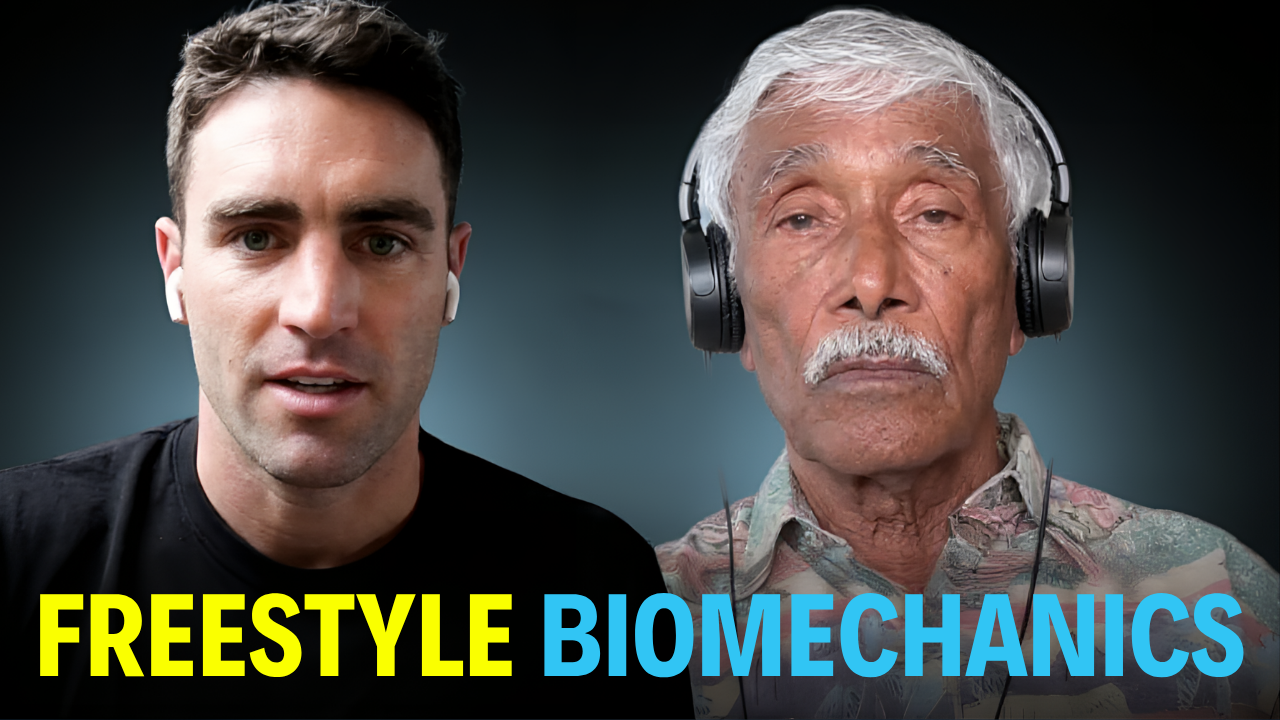








In this episode of The Effortless Swimming podcast, our guest is Mark Breadner. Mark has done a lot of work with the Australian team in relation to some strength and conditioning work, some mindset training. Mark is going to talk about that and how you can implement it into your own swimming and triathlon training to help improve your performance.
00:48 – Working with The Australian Team
 02:00 – Yoga & Freestyle
02:40 – It’s a Balancing Act
02:50 – Alignment and Tone in the Water
04:15 – Good swimmers have mobile spines…
04:50 – It’s very important to mobilise the thoracic
06:00 – Shoulder Flexibility
07:10 – Worn out joint
07:18 – Exercises with the foam roller…
09:30 – Keep going.
10:34 – Focus.
11:18 – Negativity sabotages the higher order.
14:04 – Body, Energy, Meditation
16:15 – It’s also mental.
17:00 – See yourself win.
19:11 – Positive mindset = Success
21:45 – Core work functional exercise
22:20 – Morning Rituals
23:25 – Kapalabhati
23:56 – Coffee without having a coffee.
26:05 – Everyone is an individual.
26:59 – Yoga integrates well with swimming.
29:30 – Try some new things. Don’t be afraid to do something different.
30:21 – Flexibility, Stability and Strength
30:38 – Be injury-free.
31:49 – Loosen up!
35:01 – Get enough sleep.
38:44 – Things that add up to staying healthy, happy and performing well…
To learn more about Mark and his work, visit YogaCoach.com.
Transcript
Read the full transcript
Welcome to Effortless Swimming, the podcast for swimmers, triathletes and coaches. Join Australian swim coach, Brenton Ford, as he reveals the latest techniques and information to improve your swimming. Let’s dive right in. Welcome to another episode of the Effortless Swimming Podcast. Today’s guest is Mark Bredner, and Mark’s done a lot of work with the Australian team in relation to some strength and conditioning work, some mindset training. Mark’s going to talk a bit about that and how you can implement it into your own swimming and triathlon training to help you improve your performance. Mark, welcome to the call. Thanks, Brenton. Happy to be here. What’s your background working with the Australian team? You’ve done a lot of work with a lot of the elite swimmers there. What sort of work have you done with them? Well, I started off with Tracy Menzies when she took over as coach for Ian Thorpe and the elite squad there.
And that pretty much comprised the high-performance team there was Thorpey, Craig Stevens, Kai Hirst at the end, Jason Cram, Simon Cowley, Kirsten Thomason. I started off generally with their yoga programs, and I kind of build over time. I worked with them for about four or five years before Athens Olympics. And so, you know, I worked with the general flexibility. I worked with keeping their balance as body from repetitive movements of swimming. I worked with keeping hot sort of systems, energy systems high and working with mindsets. I mean, in the end, it’s performing all to do with your mind. And what sort of exercises would you work on with as soon as to balance them from the fatigue that they come under from training the same muscles day in, day out? Well, a lot of the movements in yoga, like if we’re talking about freestyle and the butterfly stuff is all internal rotators of your shoulders. And when it’s unchecked, they get sort of shoulder impingement problems and neck problems.
And there’s a lot of problems with the so-as or hip flexors tightening through kicking, especially for sprint swimmers and then leading to lower back problems. So I pretty much target those muscles because they get tight and then start switching on the muscles that stop working in relation to that. So it’s just a balancing act, you know, essentially stretch the tight muscles, strengthen the muscles that aren’t working, keep their joints mobilized, keep their diaphragms freed up. And, you know, in the end, the best way that you swim is all about alignment and tone, you know, especially in the water. It really loves when you’re the water really responds to having great alignment and tone to, you know, just the best energy efficient way through the water. Yeah, you can really notice it as a coach. You can see where swim is the tight. Their technique gets changed depending on, you know, what muscles are sore, what muscles are restricted because of their lack of flexibility.
So I think that balancing the body like that, especially for swimmers who are training 7, 8, 9, 10 times a week, they really need to work on the opposing muscles to keep themselves balanced because there’s, you know, you do see a lot of swimmers with, not so many these days, but you do see a lot of swimmers who can be quite hunched over, particularly freestyles and butterflies, and doing the work to strengthen the back muscles to keep themselves with a good posture and alignment. It makes a big difference. And did you use a lot of, was it mostly yoga or was it other exercises as well to work those muscles? I worked primarily yoga type exercises, so the posture type work. Like you mentioned, you know, big thing is keeping the thoracic mobile. So, you know, the good swimmers have really mobile spines through their thoracic and high perfection of the shoulders. So with that rotation, the high perfection, they get a really good reach.
And yeah, especially notice it with the triathletes with the locked up thoracic because of their bike riding is, you know, especially hunched over for long distances and you didn’t notice a big difference, especially the older swimmers that have been doing it for a long time. The definitely not as efficient through the water. It’s a big important part to mobilize the thoracic. And, you know, really good swimmers have, you know, five degrees sort of high perfection of their shoulders and Thorby had something like 15 degrees. So an amazing reach and mobile thoracic. And when you combine the two together, you get that sort of glide pattern through the water, which is, you know, really important. Yeah, I had Helen Walker on who’s a physio. She works with most of the swimmers that I coach. And she was talking about majority of the top swimmers. They’ve got great flexibility through their shoulders. So if you’re doing the flexibility test of whether someone lies on the ground,
they place their forehead and their nose on the ground and then they put their hands out in front of them, lock their thumbs together and they raise their hands up. The majority of the elite swimmers will get past 20 degrees, between 20 and 30 degrees. And if you see that with your everyday swimmer, a lot of them can’t get past zero degrees. So I recommend a streamline, a streamline that stretch against the wall to a lot of the swimmers I coach, because just having the flexibility through the shoulders, it makes a huge difference for how well you can catch the water and how good a position you can get yourself in for the pool. Yeah, it’s something you have to do regularly, consistently. You know, foam rolls on the thoracic are a good thing to do regularly. You know, you get the other problem too with the elite swimmers where they get hypermobile in their shoulders. So for example, especially the butterfly is like they’re thoracic.
Because they’re doing that internal rotation with the shoulders, but not rotating the spine because they’re just going through that kind of sagittal plane. And so the thoracic gets locked up if they’re not attending to that mobility. And it’s really important to get the arms up over the heads through the butterfly stroke. You need that extension of the spine. And when it’s not there, then they just make their shoulders hypermobile, meaning unstable. And over time, that wears out the joints. So you see people like Patria Thomas and Clemi and people like that having to go in for regularly under the knife because they’re wearing out the joint because the thoracic’s not fully mobile. So what sort of exercises would you be doing with the foam roller to work your thoracic? I usually do it over six weeks period. So the first two weeks is like a long life where your butt is sitting on it and your head is on it.
So you’re laying it along the length of your spine. And then you lay on it five to 15 minutes pain dependent. And the idea is that it’s passively releasing the muscles around the spine. And ideally before bed because then you jump into bed without any axial loading and your nervous system picks up the new position. In the second two weeks, I get them to do it, turn the roller around. So it’s sort of across the spine and do it at the tightest part of it. And then laying back for one to three minutes with the head supported. Because most people won’t get their head to the floor. Again, pain dependent. And that’s kind of just breaking up and sort of to loosen that apex point. The thing is with the spine is you can release the internal rotators and get your, you know, mid and lower traps working and things like that. But the vertebrae are held together with ligaments. So you need a stronger impetus to let it together to start to release.
And that’s why, you know, we use the foam rollers. And then the last two weeks, we start at the bottom of the thoracic spine and then kind of do flat crunches for it. One of the better word three or four times. Move up to the next segment, three or four times up to the next segment, three or four times, you know, until you can’t go any higher. And it’s just progressively starting to segmentally free up the thoracic spine. You know, the other problem you’ll get is when that’s all blocked up, then either side of the spine will become hyper mobile to compensate for the bit that’s all locked up. So in those hyper mobile points is often where people will get, you know, inflammation and leading to injury in the end. And then after the six weeks, you’d go back to the beginning. Yeah, well, it depends. I mean, it’s a program that you can, it depends on someone’s, how consistently they’re doing it and how much degree it’s locked up.
But you can just keep going sort of that second and third two week block and just keep working at getting it to mobilize and release. Obviously, you know, if the triathlon people have to do it more, especially if they’re riding a lot and they’re in that flex position of their spine, especially, you know, and they’re holding tension through it when they’re putting effort through their riding sessions. But again, much more tendency to have tightness through that area. And then with the mindset work that you did with the system is what sort of things would you go through? Was it visualization? Was it goal setting? Was it, you know, what sort of stuff are you doing with them? Well, essentially, you know, anyone that is, you know, a world champion or Olympic gold medalist or elite swimmer has an incredible single-pointed focus. I mean, especially swimmers, you know, they’re doing five hours up and down a black line.
I mean, man, it’s full on to have that focus point. And, you know, the best guys or the best people are the ones that are able to kind of keep that single focus and keep coming back to it over and over again, whether, you know, it’d be that they want to achieve their best time or they want to be the best in the world. And for me, it’s just coming back to that over and over again. Like, I’m never going to make them a better swimmer, but they have that potential in the background. And when it’s all there, they perform it their best. But oftentimes, you know, negative mindsets can come in. And basically what happens is it sabotages all that higher order learning that they have through all that repetition that they’ve done. So I just, if that does come up, we kind of work with that and try to be aware of it, let it go and come back to, you know, the things that they know that work well. Yeah, that’s, I like the point you made there, is it?
I mean, they’ve done the work. They’ve done the repetitions. They’ve trained their body to the point where it needs to be for a competition, but the thing that can let them down is just that negative mindset. So let’s say, when would you see that come up? Is it two weeks out from a competition? Is it the day of or is it during training? When do you sort of usually see those negative, that negative thinking come out? It varies. And, you know, someone like, you know, Craig Stevens or Thorpey, you know, they’ve got an incredible pressure on them. They’ve got an incredible, you know, weight of a nation on their shoulders to succeed and do well. So, you know, in and of themselves when they’re doing it, it’s fine, but sometimes that weighs on them. And you just see it in the times, you see it in the, you know, in the energy systems and it just becomes really low. And like, you know, I work with on the world surfing tour as well.
And, you know, you’d see guys kind of kill it in free surfing and then as soon as they got into competition, they just, you know, had just never performed like they did in their free surfing. And, you know, the mindsets came in around having to perform and being the best and getting it right and, you know, all these sorts of things. You just tighten up and once you tighten up, you lose that alignment and tone in the water, you know, whatever it is. And that’s what we keep looking for. That’s what Tracy and I would keep looking for, you know, they got that alignment and tone, is the energy flow working well through the water, through their activities, you know, they’re breaking down what’s the energy system like. And again, it all comes back to mindset in the end. So what sort of things would you work through with them? Was it very individual to the swimmer? Was it just chatting with them? Was it getting them to do different exercises?
What sort of things would you do with them? I would work, okay, so I’d work with their body first, balancing that up. And then we’d work with their energy system. So in the energy system, we would do a lot of breath work like in yoga, what we call pranayam. So having access to all the breathing muscles. So, you know, full movement of your diaphragm, of your rib cage, being able to isolate the diaphragm, use your accessory breathing muscles. We would use, we used a lot of pranayam actually in lactate tests, you know, sometimes, you know, a swimmer would do a 200 meter race and they’d have to swim two Ks to do a warm down to get all the lactate out of the system. So we basically got that down to half, down to a K, and then we’d do some salute to the sun, some yoga flowing movements, and then doing certain breathing techniques to bring their lactates down to the same level. We’d also use breathing to calm down the nervous system.
And then what we would call, you know, meditation. So learning to bring the mayan back to what they know that they can do, what their potential is, be aware of the other stuff that’s coming in and just kind of setting it aside and setting it aside over and over again. And yeah, it is individual as well because, you know, different people deal with pressure in different ways. And for some, they just thrive on it. For others, they just become a mess before a race and you have to work, you know, a lot stronger with those mindsets. Yeah, some of the, I mean, some of the things you’re talking about there is going through the breathing exercises, some of the yoga movements. It might seem a little bit, almost airy-fairy to some people, but when you’re at that level in sport and you need to train yourself to be calm, be relaxed before a big race and deal with the pressure of a nation in some cases with Thorpey and Stevens
and the pressure that you put on yourself, you really need to have your mind tuned in order to be able to do that. And I think it’s really important to bring that sort of stuff into it rather than just working on, you know, smashing yourself in training and just doing the physical side of it, the mental side of it needs to be trained as well and doing it with the breathing exercises and things like that is really important, particularly for swimming, I think. Yeah, I mean, there’s no doubt that the best athletes in the world they stand out, I mean, they have the genetics, they have the repetition of movement, they have everything in place, but what separates, you know, third and fourth to the world championship and breaking records and gold medals is the mindset. I mean, you look at, you know, Kelly Slater with, you know, 11 world titles, he knows he’s going to win before he goes in. You know, Thorpey, when he was performing like that,
he was going to win before he started, you know, he always looked relaxed on the block and things like that. Those guys, they’ve already seen themselves win, you know, they’ve seen the end result and the cool thing about the nervous system is it doesn’t differentiate between what’s real and not real. I mean, if you see a result happening and you include all your senses as part of that, you know, smell it, taste it, see it, see the crowd cheering, the time, all that sort of stuff, and your nervous system gears you towards that end result. And those guys know it. It’s like a Michael Jordan, you saw it with Tiger Woods before he lost that mindset and it all changed. But those guys, you know, that’s what separates them besides having, you know, having the genetics and everything. Yeah, you look at Kelly Slater surfing. I’m a big surf ride. I love it. And I was watching the Quicksilver Pro, which was up on the Gold Coast last weekend.
I was watching the live stream of it yesterday. And you just watch the guys like Kelly Slater and as soon as they’re in the water, they just get into that sort of state where they’re in tune with the waves. And I mean, you think about it surfing. You don’t know when the waves are going to come. You don’t know exactly where they’re going to break. But the guys that are tuned into it put themselves in the right position to catch the wave in the right spot and do what they need to on the wave. And, you know, it’s something as unpredictable as nature like that. And it just goes to show that you can really put yourself in tune with something like that and you can do it with your own body and your own mind ready for competition. Yeah, that’s right. And, you know, like with triathlons and stuff, you know, I train with, you know, Greg Alexander and, you know, I swim in his lane at the back of the lane, mind you. But again, you know, another guy that’s just,
you know, he’s just got a great balance in life and I mean, fantastic genetics and looks like he’s floating when he runs. But the mindset, you know, incredible mindset, you know, when they’re doing those long endurance athletes, you have to have it. It’s impossible to achieve success without it to maintain that focus. And especially when you’re doing it year after year after year. You know, like that two to three percent is the difference. You know, you see people lose by one one-hundredth of a second and, you know, we would go to altitude two or three times a year before Athens just because it might give you two to three percent, you know, harder training when you come back down to sea level. And, you know, we were doing things with milk names and Shane Gould with the squad and from the outside it looked like it wasn’t, you know, it certainly wasn’t hard training but it was like finding alignment and tone in the water
and moving and trying to find yourself sitting in the energy bubble of the water which is a really subtle skills but so that the water actually is a cushion that holds you rather than having to push through it. And it was fascinating. And, you know, those guys would watch someone swim and then see bubble patterns in the lower back behind the neck and they could tell where they were dragging water or energy wasn’t moving and things like that. So we did a lot of training in those directions as well. Yeah, and you see a lot of top swimmers, top squads will do a lot of slow swimming just to get them thinking about what’s their bodies doing, how they’re pulling through and that sort of thing. And we do quite a bit of stroke count work particularly as we lead into the pool competitions as opposed to the open water stuff. And doing a lot of stroke count stuff, it’s slow, relaxed swimming but it’s really hard work, you know.
It’s trying to maintain the same stroke count and not let it bump up as you get fatigued is really hard work even though you’re going quite slow and it’s training yourself to be able to hold that distance per stroke in the water as you fatigue that gets you the good results in the pool competitions. So even though things don’t look hard necessarily they can be quite difficult. I mean if you look at the fastest swimmers racing it looks as though they’re going easy. If you’re looking at them in a 200 or 400 meter event it is hard work but the training that they’re doing is a lot of slower swimming but they’re thinking a lot rather than just pushing themselves physically. Yeah absolutely and I think the other part of it too is that we would do a lot is that core work, core work functional exercise, being able to maintain a strong core through long slower sessions or through their sprint sessions. Again that’s going to support that alignment
and tone through the water which makes the energy efficiency a lot better. Now do you have a morning ritual for yourself that you do like a yoga sort of routine that gets you in the right frame of mind and wakes your body up? I pretty much know I’ve been doing it all my life. The physical stuff I don’t do a lot of I just do tweaks. I kind of got my body balance pretty well what I keep it sort of toned up for is I’m a mad surfer so you know lunging and squatting and adding rotation into that so I like to keep my spine mobile and my hips open and you know the thoracic and shoulders for paddling. I tend to do a lot more of the breathing exercises and meditation. The breathing for me just keeps the nervous system really finely tuned and with the mind now I’m really busy I’m doing a lot of work I have a lot of projects and it just keeps me focused it keeps me from distractions and allows me to keep a sort of high energy
right through the day. So what sort of breathing exercises are they? I do a thing called Kapalabati which focuses on your lower abdomen and it’s a sort of active exhale and a passive inhale and what it does is it flushes carbon dioxide from the body and sort of shunts blood to the abdominal organs and up to the brain which gives you an alertness and then I combine that with an active inhale and active exhale which we call Bastrika and that’s kind of floods the body with oxygen so it’s your coffee without having a coffee. That’s my morning coffee and it’s the same effect it wakes you up gets the energy flowing feel good in your body and then I kind of circulate the breath up and down my spine and then I do a longer exhale just to chill out the nervous system and then what we talk in yoga is like learning to get both nostrils open most times you’ll notice every 90 minutes one nostril is more dominant than the other
and when you can get both nostrils to open up your energy is flowing most freely and there’s techniques to do that it just kind of centralises your energy so I do that and then that leads me into meditation and basically I focus my attention on stillness and I focus at my heart and when any thoughts come up I just don’t pay attention to them I let them go back to where they were so it gets more stiller and focused and quiet and that’s my practice there and certainly what we did with the Swimmers a lot I mean one of the beauties of Tracy Menzies was she was pretty much an old boys club and when she came in and she took over as Zenian’s coach she approached quite different to how the guys would do I mean she definitely treated everyone as individuals and nurtured them through their particular personalities and ways that were going to work best for them she kept a log on their emotional health as well as their physical health and their mental health
and us as a team together really work with people as individuals to get the best out of them depending on their capabilities and their kind of personality tendencies I think you have to do that because everyone else is an individual you just can’t make everyone fit into the same system and a lot of the old school coaching because I used to do it I just throw everyone together, flog them as hard as you can and then the ones that have got a nervous system that can survive it keep going and the other ones sort of fall off and don’t swim anymore or go to another coach I can imagine that she would have got quite a bit of resistance implementing the yoga, breathing mindset checking in with their emotions and that sort of thing she would have got quite a bit of resistance trying to introduce that to an old boys type of club there and it obviously paid off with the results that she had with the swimmers there and I think yoga in particular
it integrates really well with swimming first of all because it is kind of like a meditation and swimming is the same you’ve got your face in the water for a couple of hours a day and you’ve just got you and your thoughts and yoga is very similar to that and yoga in the physical sense as well it stretches out a lot of muscles where you’re very tight in swimming the last yoga class I did was about six months ago but my hip flexors hadn’t been stretched like that in years it just opened me right up through my thoracic spine hip flexors, glutes and all that sort of stuff and it made a huge difference to how I felt one, two, three hours afterwards imagine if you did it every day, Brent I know every now and then I’ll pull out some yoga moves for a couple of minutes just at home to loosen up if I feel like I’m getting tight but it would be good to dedicate the time to a couple of yoga lessons each week I think it would be really good
but I’m more coaching now so it’s trying to get my swimmers to do it rather than me right well you can get a teacher in there and you can join in that’s what we did that’s the way to go that sort of approach when we did it before Athens, yeah, that sort of old school coaching thought it was just bullshit but when we used to travel and we’d go to altitude we used to go up to Arizona we would do our yoga practice and a lot of the swimmers asked if they could join in from other coaches and other squads they really were interested in being part of it and even with some of the swimmers and Ian we took them off heavy weights and just the body weight staff they couldn’t believe it and just felt like when they muscled up they might have been bigger and stronger looking and out of the water but didn’t translate into the water the ratio of muscle to tone in the water but in the end, yeah Tracy got really good results she’s still, you know, one of the only coaches
lasting down at the Institute of Sport so she’s doing some good stuff yeah, absolutely and I think you need to shake the bushes a bit to get different, get better results if you just stick with the same thing over and over you’re going to get the same results so stick with what works but also try some new things don’t be afraid to do something different if you fail, well, you know, that doesn’t work just doing something different in training I think, you know, it really opens up some new opportunities for swimmers to progress and it keeps it interesting for the swimmers as well but that’s how you make progress in the sport is to continually try and mix things up a bit yeah, and I think it’s important especially, yeah, swimming is very repetitive up and down a black line and, yeah, mixing it up makes, you know, a massive difference you know, doing ocean swimming doing ocean races trying different stuff, adding yoga into it
and, you know, realising that you need a really good balance between flexibility, stability and strength in your body and looking at different, you know, vehicles or avenues to try and, you know, balance that up especially for the older swimmers you know, if they want to keep performing and be injury-free it’s super important super important yeah, definitely as we all know when we’re getting older like a lot of my mates, you know, I’ve been doing yoga forever and I’ve been telling my mates, you know, surfers triathletes, man, you’ve got to do yoga if you want to keep doing this stuff as you’re getting older you’ve got to do it and then, you know, like 10 years down the track 15 years they’re all coming to me I’ve got to sort back got to get my hip replaced, you know, what do I need to do what can I do so if everyone comes looking at some time so it’s better to start before you’re injury before you’ve got the injury
do it as prevention and keep your body balanced keep the energy flowing and you’ll enjoy the sport for a lot longer yeah, that’s right I mean, the amount of time that people spend most people spending cars sitting down at a desk the amount of pressure that that puts on your lower back and through your hips and glutes and all that sort of stuff by the end of the day if you’re finding it hard to stand up straight because you’re just so tight through the middle part of your body you need to loosen up with something and whether that’s yoga whether that’s just stretching for a couple minutes a day your body will thank you for it five, ten years down the track yeah, and we you know, I just see everyone has you know, a set you know, amazing potential for who they are and what they’re capable of and really if you look at it all yoga’s doing is seeing that potential and removing the obstacles so, you know, if you’ve got a tight muscle
it’s an obstacle if you’ve got an immobilized joint it’s an obstacle if you’ve got muscles that aren’t working in the kinetic chain it’s an obstacle so, work to bounce it up and then in your nervous system if you don’t have full access to your breathing muscle it becomes an obstacle to performance and you know, if you’re eating junk food and staying up till three at night and you know, they’re just they’re obstacles to your energy system and if you’ve got negative mindsets it’s the same so, I just try to see it work at all those levels remove the obstacles so the potentials there can express itself you know, can express itself at its highest level Now, what sort of sleep were the swimmers and tracemen she’s squad getting were they starting their sessions a little bit later in the morning to allow them to get a bit of extra sleep like, how many hours a night do you think they’re on? Oh, they were on they were probably tucked away in bed
by 8.30 and you’re at the pool ready in the water by 5.00 a.m. Yeah, so they’re still getting well, would that be like a good 7, 8 hours sleep a night? Yeah, and probably doing, you know, five hours a day two swim sessions and then dry land four days a week I remember, something like that Yeah Yeah, so it’s a lot of hammering on the body and obviously you need the rest to deal with those stresses and you need to have good nutrition and you’ve got to have everything I mean, you know, those guys are on a knife edge all the time like that high performance and then just switching over to getting sick, you know you see a lot of these guys are getting cold and things are just such on an edge of performance and, you know, when I you see it with the difference with the surfers it’s doing something creative all the time and it gives them an outlet to express themselves as swimming doesn’t have that so it has a whole sort of different
different problems involved with it Yeah, the reason I asked about the sleep is that I find it’s something that most swimmers are lacking obviously because you’re waking up so early to go to training but an extra hour or two a night makes a huge difference you know, if you get four or five hours sleep a night and you’re someone who should really be getting six, seven or eight hours sleep a night then it just, it not only impacts how you’re training but it impacts your your mental function throughout the day how you’re thinking, how you’re feeling and, you know, if you’re not getting enough sleep each night, it just adds up and by the weekend if you’re completely wrecked and you need to sleep for three or four hours on a Saturday or a Sunday it probably means you’re not performing at your optimum level so that’s something that I see most swimmers lacking in it is sleep so if you can get yourself to bed an hour early
or two hours earlier to get seven or eight hours sleep it makes such a difference because it helps with your recovery, if you’re training hard it means you usually eat less because, you know, if you’re getting five, six hours of sleep one thing that you do to keep your mind to try and keep yourself on track is just to eat something so it helps in a a lot of different ways Yeah, I did owe. I absolutely agree with you and especially with the triathletes, you know they often have a sort of over-training syndrome which is a big part of not having enough sleep because they’re trying to fit in three sports three activities and then their family life and their work life and, you know, when you do that over time something’s got to give you know, but the big part is the regeneration of the system and, you know, having that sort of anabolic phase where the body deals with the stress and rebuilds and sleep and nutrition just so important
I was doing triathlons you know, big time in the 80s and it was just, then it was like train as hard as you can for as long as you can and that was basically how it worked and, you know, I ended up getting chronic fatigue for two years pretty much just wiped out, wiped my immune system and it happens less these days because the training’s a bit smarter but you certainly see it still quite a bit that over-training syndrome Yeah, you see a lot of swimmers come down with either chronic fatigue or she’s the name that’s escaped me now glandular fever, sorry
a lot of swimmers will get that when they’re getting 17, 18 and I got it when I was 18 actually, I got it at the end of year 12 after a big year of uni of school and training and after I’d finished my mind had, I think, told my body that’s it, alright, you can relax a bit and, you know, went away to schoolies for a week where I just got to sleep in, got to relax nutrition wasn’t great but then after that my body just, you know, shut down chronic glandular fever for a couple of weeks there and that’s just your body saying you’ve got to keep yourself in check a bit more and slow down and give yourself the right food and recovery, so it’s, yeah, it makes you probably have the odd little drink to up at schoolies Well, compared to most people I was pretty good being a swimmer and not drinking that often anyway because every Friday night is just leading into a Saturday morning training session rather than a, you know, two days
to recover from a big night out on Friday but, yeah, look, it definitely didn’t help, that’s for sure Yeah, well, they’re the little things that you can’t do, you know, you can’t go home and have, you know, three beers and things like that each night if you’re, you know, you’re training for triathlons and, you know, got a lot of other demands, you just got to keep everything really, you know balanced and fine tuned if you want to keep performing and all those little things just add up to staying healthy and happy and performing well Yeah, that’s right and, you know, that’s the fun of it that’s the game is balancing all of those little things and getting the right amount of training and sleep and recovery and it’s, you know, that’s what we’re here for so, Mark, thank you so much for joining me on the Effortless Swimming Podcast where can people go to find out more about you and what you do? My site is yogacoach.com most of my work is
yoga education retreats and and I wear a few different hats but pretty much followed them all into into a yoga type thing Beautiful, and where do you normally run your yoga retreats? I travel nine months of the year so I’m based in Bali for six months I run trainings there, I run retreats in Bali got a sort of general public one in August and Michael Frontis Resort in Salshain beautiful place and then I’m in Korea and Malaysia then Uruk and the States and it’s just India I’m just moving around all the time Fantastic, well best of luck with everything and again thanks for joining me on the podcast and for the listener go to yogacoach.com if you’re interested in anything to do with yoga and looking outside of the pool, outside of swimming for that extra edge of improvement so Mark thanks again, I’ll talk to you soon