








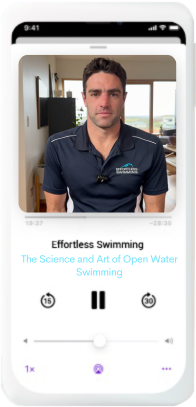
In this episode, I sit down with Grant to share what I’ve learned over nearly two decades of coaching and racing in both pool and open water environments, including qualifying for Open Water Nationals as an adult.
We explore the gap between pool-perfect technique and what actually works in real race conditions like chop, fatigue, and contact. I break down why swimmers often struggle when they try to carry over overly rigid pool habits into open water, and how that leads to overthinking and breakdown under pressure.
We also get into how I now approach stroke rate, breathing, sighting, and recovery in a more adaptable way, depending on conditions.
A key theme is simplicity, learning to stay relaxed, trust feel, and avoid constantly chasing technical changes. We also cover what truly transfers from pool to open water, and why consistency and mindset matter more than constant technique overhauls.
03:51 – Why pool technique doesn’t always translate to open water
07:40 – Stroke rate, sighting, breathing patterns, and adapting to rough conditions
12:19 – Common mistakes swimmers make with technique and body awareness
16:55 – How Brenton simplifies coaching and decides what not to change
21:49 – Why some swimmers improve long term while others stay stuck
28:29 – Overthinking technique and finding the “feel” for swimming
32:40 – Qualifying for Open Water Nationals and improving later in life
37:20 – Strength, mobility, VO₂ sets, and training after 40
41:50 – Drafting tactics, “effortless swimming,” favorite swim sets, and final advice
https://rephonic.com/podcasts/the-science-and-art-of-open-water-swimming
Transform your freestyle to be effortless and smooth with online video analysis:
https://effortlessswimming.com/courses-membership/
Try the new Nanoclear Anti-fog Goggles: https://bit.ly/nanocleargoggles
Transcript
Read the full transcript
Welcome to the Effortless Swimming Podcast to show that help swimmers and triathletes love the water, become a better swimmer and live a better life. Here’s your host, Brenton Ford. I was recently a guest on the science and art of open water swimming hosted by Grant Landers. And on this episode, he really asked some good in depth questions about what you can do to become a more proficient and open water swimmer. And we also get into some of the principles that help you transition from the pool to the open water, as well as some of the things that are a little bit less tangible. Some of the philosophies of why people are attracted to open water swimming and swimming itself. So this is a really fun episode to do. Let’s get into it.
So welcome to the science and art of open water swimming. My guest today is Brenton Ford, a swim coach, entrepreneur and the founder of Effortless Swimming, which has become one of the most influential swimming coaching platforms in the world. Through clinics, camps, online coaching and his own podcast, Brenton has helped thousands of swimmers, particularly adult swimmers and triathletes think differently about technique, efficiency and performance. As a swimmer, Brenton came through the pool system, reaching the pointy end of national level competition as a teenager, for stepping away and later finding his way back into competitive swimming as an adult. What’s particularly interesting is that many years later, nearly two decades ago, he qualified for open water nationals, a very different challenge both physically and psychologically.
Brenton also came relatively late to marathon swimming, completing his first long-distance swim, the Roto Channel Swim, in 2018, an event that resonates strongly with many in the open water community. Across coaching, content creation and his own podcast, Brenton has become known for his ability to simplify complexity, helping swimmers understand not just what to change, but what actually matters and when. Today’s conversation is less about drills or stroke detail, and more about how technique holds up in the real world of open water, under fatigue, uncertainty and across the long arc of swimming life. Brenton, welcome to the podcast. Hey, thanks Grant. I need to update my bio, I think, and replace it with that introduction that you sum that up perfectly. So thanks for that. It’s great to be on it. So, I’d like to sort of start with, you’ve spent years refining what an efficient stroke looks like in the pool.
When swimmers take that stroke into open water, what parts are the hardest to maintain? My first open water swim was when I was about 13 or 14 years of age, and it was me and another guy I used to train with, and I would beat him in the pool every single time. And then in this open water race, he beat me by a couple of minutes and I was flabbergasted why that was, like how on earth did this guy beat me? And I think that put me off open water for a while. And it wasn’t until my early 20s that I started to get actually into it and learn and try to understand and figure out this open water thing, because I’d always been a pool swimmer, just used to flat water. And I think when I first started coaching, I was very much used to coaching people for the pool with more refined, more perfect technique, and without much allowances for, I guess, some variances in the stroke and some things that may actually help you in the
open water, even if they’re not ideal for the pool. So what I’ve come to learn from working with a lot of triathletes and open water swimmers is that how good you look, how perfect and symmetrical your stroke is, isn’t something that’s necessarily that important when it comes to open water racing. And so some of those things that we want to be working towards in open water, it’s quite often a slightly faster stroke rate, especially if you’ve got the buoyancy of a wetsuit or saltwater to support you, you can get away with a faster stroke rate and you’ll be sitting high, so it’s a little bit easier to do. The way that you recover over the water as well, so my motto there is higher, wider, faster. A lot of times you just don’t need to recover with that traditional high elbow recovery that you might picture in a pool with the hand kind of close to the water, you might need to be a little bit higher over the water to not hit any chop or any waves.
You might need to be a little bit wider, particularly if you’ve got a wetsuit on where it’s restricting the range of motion. And so there’s certainly parts of it as well as the skills like the siding. So a lot of times if a pool swimmer comes into the ocean, they’re not used to siding because the last thing you want to do in the pool is look forwards. And so integrating that as part of your stroke is a skill into itself where you don’t lose your rhythm, your hips don’t drop, and obviously making sure that you follow a straight line. So when I see pools from us go to the open water and the ones that haven’t translated into the open water, typically they’re trying to be too perfect and too correct. So I like the thought of being a little bit scrappy when it gets to open water. And scrappy doesn’t mean just throw everything out the window, but scrappy means that allow your technique and your stroke to adjust to the conditions that you’re working on.
So I think the swimmers that do struggle to make that transition are ones that are trying to stick to the box of perfect conditions and they don’t allow themselves to perhaps experiment with a scrappier stroke that might be more asymmetrical, that might go against some of the things that they would have perhaps worked on in the pool. So you indicated a number of things that might be a little bit different moving from the pool to the open water, but what aspects of good pool technique tend to translate well into the open water?
So I think the fundamentals generally of good head position, body position, and an effective kick, they certainly translate. With the kick though, particularly with most swimmers, aside from say those really at the pointy end, you will find that you hardly have to kick at all. So sometimes people will just have their legs floating behind them, especially with a wetsuit on, so that maybe not quite as much. And then with the catch and pull, so it’s absolutely it’s important, but you will usually start your catch a bit sooner, especially as you’re racing, and with a wetsuit on you won’t typically have as good as catch position. So yeah, those things do transfer across, but not exactly. With the rotation, rotation is still definitely important, but again a lot of swimmers will tend to prefer an asymmetrical stroke where they might turn a little bit further on their breathing side. They might not rotate quite as far on
their non-breathing side, and they might tend to favor like a one-sided breathing, which can lead them into a bit more of a sort of galloping stroke. So yeah, the other things that I see is translating from the pool to the open water. Obviously like swimming is swimming, and if the open water, if it’s calm, if it’s flat, like it’s going to be fairly similar, but as soon as conditions get ugly that is when we need to adapt.
Yeah, so typically with the galloping type stroke we’re breathing on one side of the body only. If the conditions are not ideal and we need to be able to breathe effectively to the other side, how easy is that to change the stroke? So my rule of thumb is whenever you’re training 20-30% of your sessions should be breathing to the opposite side, whether you swap sides on the way back, whether you breathe every three or you just mix it up somehow in your session. So it is like you should be able to breathe both sides if you are racing open water, and really we don’t want to see a difference in the speed, whichever side that you breathe. So if there’s waves and chop coming into the side that you’re breathing, that’s one cause for perhaps breathing to the other side. If there’s sun and it’s hard to see that’s another reason why you might need to turn to the other side to breathe. So there are reasons why you might not
be able to breathe to your dominant side. So I think it’s a skill that’s worth developing and I often get asked at clinics or just people I coach is I just breathe to the one side. I don’t like the other side, I’m slower but I do say to them like yeah it’s gonna suck for now like you just haven’t done it but you will get to that point where it does become a bit easier and then I’d go through some of the reasons with them why they might be finding their non-dominant side to be hard to breathe to. And quite often those things are it’s like can be the timing, sometimes people will just turn the head too late, sometimes it will be that they’re not exhaling enough. They go to breathe in but they’ve still got eight percent of the air left in their lungs and so they just not used to exhaling properly and then it can be things like where they look when they breathe. They look too high, look behind them or they’re just throwing their head
around that can throw their stroke out. But a very common one is if the swimmer goes to breathe and they don’t keep their arm in front long enough to give them support for balance that can make it very difficult to be comfortable with breathing to their non-dominant side. So that’s one of the first things we’ll often work on with them to help them get more comfortable with it.
Now you’ve seen thousands of adoximers on video as well as face to face but what’s the most common gap between what the swimmers think they’re doing and what’s actually happening?
Yeah I mean if you’ve seen yourself swim it’s so surprising and even as I get filmed every couple of months I’m still surprised at how it looks compared to how it feels but it’s often so eye-opening for people. We always start with head position when I’m coaching people and a lot of times people think they’re looking in the right range straight down to about 45 and a lot of them are looking too far forwards and they just don’t know it and so even something as simple as head position and where you’re looking can be quite surprising for people and they don’t have that awareness or proprioception around that so head position is a big one.
People are generally pretty good at knowing how high they feel they’re sitting in the water or how low so when people are sitting low at their hips and legs quite often they feel it they just feel like they’re heavy and low and not horizontal but I think certainly anything above the water with the arms and in front of the head with the arms that is usually where the proprioception is the worst. So if they’re crossing over the center line as they go to enter most people think they’re on the train tracks entering in line with the shoulders but they’re crossing over and then with what the arms are doing in the catch and pull they might feel like they’ve got a great catch but they look at it and it’s the complete opposite so yeah it’s typically just around anything to do above the water and above the head they’re the ones that lack the proprioception so obviously there’s other things too but they’re definitely the main ones.
When you’re observing a swimmer how do you decide not to change?
In my head I go through a bit of a process I guess a bit of a checklist of all right what’s the order of things we would typically need to work on something and so I go through that checklist and
I always want to start with the first thing on that list for them so let’s say that they’ve got great head body leg position in the water all right we don’t we don’t need to touch that the next thing I would typically go to is rotation and so maybe that’s the thing that they need to work on first so I might mention the catch but I might not go into a lot of detail on that right now because that’s probably going to change if we make sure they’re rotating the right amount so I won’t work on things usually further down the list until we’ve worked on the things above it and then also around that too if it’s going to give them a 1% change instead of like a 90% change then I might not mention it at all so there are things that maybe to the naked eye it’s like oh that’s that’s not right but if it’s not really going to impact their speed or their efficiency much at all there’s no point mentioning it because I think people often have
too much to think about when they swim so I always want to try and keep it as simple as possible and have them like leave a session with me with like absolute maximum like three things to go away with ideally less if we can but I want to keep it as simple as possible so quite often I won’t mention things that maybe even they can see maybe they can’t say it but yeah things that are not going to move the needle much at all I sometimes get the impression that I’ve coached someone or I’ve worked with someone and it feels like I’ve kept it almost too simple for them like they maybe they feel like there’s not enough to work on in the analysis but when you actually look at the stroke like it if you have great fundamentals and you know you tick the boxes with body position rotation breathing like if you get those right from there you can really develop a good stroke and then start working on your catch and your pull and things like that
so even though it might seem like it’s okay one thing or two things it’s like well yeah if you don’t adjust that one the other things are going to be very hard to change anyway so I’ve got to be mindful to keep it simple but try to show them the impact the change in those things will have down the track
and then going through and looking at changes what separates them as who successfully adapt compared to those who just sort of keep cycling through these fixes so I’ve coached so many swimmers over the last 18 years that I’ve been coaching and the main thing that we have done to say for in person is our clinics and quite often I people come back and do either like a follow-up filming or they’ll do another clinic and I get to see whether they’ve progressed or stayed the same or maybe even regressed perhaps now the swimmers that typically improve over the long term are the ones that firstly come with an open mind most people do yeah if they come into a clinic if they come to get coached usually they’re coming with an open mind but I do find some swimmers they feel like this is the way I’ve been for 10 years and so I just can’t change it’s a small percentage but certainly there’s some people who are just like no this is something
that I can’t change it’s just the way it is so I think that’s the first thing they’ve got an open mind secondly they stick to the plan that we come up with and that plan is two three specific drills to work on a particular part of the stroke for several weeks or maybe several months at a time and they’re not chasing results straight away they’ve got the patience to go look I don’t care what my times do over the next two months I’m just going to work on this particular area of my stroke I’m going to keep training but I’m going to as part of my warm-up I’m going to do some drills I’m going to think about this thing for the next two months three months and not worry about the times they’re the ones that we tend to see the improvements with whereas the swimmers who are chasing faster times straight away when they’re trying to force their speed and force their stroke it just doesn’t work well with swimming so when we swim often when we’re
swimming the best we feel like we are floating through the water we move well when we’re relaxed we tend to apply the right amount of force and pressure when we’re not forcing things so that’s a really common one that makes people just that they get stuck they get stuck when they try and force it so it’s usually the swimmers that are thinking more long-term about their stroke they know how long it can take to change a habit which is often several months of just constantly thinking about it so that’s what I say has been the biggest difference for people and it is easy to go back to what you were doing if you don’t think about it and I’ve done that myself with many changes in the stroke and I’ll catch myself going back to what I used to do an example of that was probably 80 months ago I was working on my breathing it was a little bit late I probably wasn’t exhaling enough and so I worked on it for probably two months feeling good and then I’ve
sort of moved on to something else but every now and then I just catch myself going I hang on like this breathing is just a bit out of sync and so when I catch it and I change it but it’s just one of those things that happened and kind of on that note like I’ve worked with a lot of beginners, intermediate swimmers, a lot of pro triathletes as well and I think sometimes the beginners and the intermediates think that are the guys at the top have it all worked out but they doubt themselves just as much as you do like they doubt their stroke they doubt their ability they have sessions that are absolutely crap and they’re like oh my god I just can’t I’ve forgotten how to swim and sometimes even more so because they’re often more critical on themselves so I think no matter where you’re at you’re going to be going through the same things as someone who’s been doing the sport for 20 years
so just exploring that a little bit further how should swimmers approach and making a technique change in the middle of a long training block
you don’t want to I don’t want to break anyone’s stroke if they’re leading into an important race so if someone’s a month out maybe two months out from their A race and the thing that they need to work on is
maybe going to to slow them down for the next like two months and it’s a bit of a revamp on their stroke that’s probably not a smart idea especially if racing is important to them if it’s their career it’s not something I’d be looking to do but I think that for most people where it’s a hobby they enjoy it yes they like to be competitive but it’s not make or break whether they’re winning prize money or whatever it is I think for most people as long as it’s more than probably six weeks out from their main race if they’re competing you find a work on it now obviously it depends on what it is but with the majority of things that people do have to work on it doesn’t hurt to start at any point now if we had to think right what would be the ideal point it would probably be in off season or just as you’re just starting to build up and the more time until you’ve got to your main competitions the better but we’ve certainly had swimmers
who have been two months out three months out from their main triathlon or open water race and we give them some things to focus on and they will see those results over time it’s something that comes to mind I did a session with a guy from the UK who came over for the Geelong Half Ironman and he had hardly swam because he’d been traveling and he just didn’t feel good with his swimming and I think because he didn’t feel good with his stroke like it was just hard work he didn’t want to train he wasn’t excited to train or get in the water so we worked on a couple things and one of those was just getting better body position and part of that for him was point the toes like his toes were pointing straight down to the bottom of the pool and so we just worked on that plus just being a little bit more streamlined through the start of his stroke he was sort of coming in was drifting up and crossing over and it was training a lot of drag
so we worked on entering in line with the shoulder reaching forwards making sure the fingers don’t drift up and making sure he was rotating the right amount and that was about two months ago three months ago and he sent me two or three emails since then saying oh I got a new PB I’m really enjoying it and it’s because I think when people see that little bit of improvement whether that’s in a race or just they’re feeling better it’s just so much more motivating to to get to the pool and then they get those little wins and that compounds and that’s how I think someone can go from say like a 220 per hundred down to like a 140 per hundred when they start to see those little wins and they start to enjoy it more and it doesn’t become this tedious task that they have to do so yeah what are the warning signs that assume is overthinking their stroke
when I’m running clinics like we go through the stroke I keep it as simple as possible but still if we’ve gone through five parts of the stroke they’re usually trying to think about five different things at once and I see I can see when someone is overthinking it because they get very mechanical in their stroke as in they lose their rhythm they’re quite stiff intense over the water and they sometimes not just like reaching and rotating and they lose that rhythm and that glide so that’s usually a sign that someone has that they’re thinking about too much so one of the things I try and emphasise to the people I’m coaching is that we have to think about our stroke obviously if we’re making changes you’ve got to think about it to some degree but swimming is so much about feel and so much about being in tune with the water how it feels over your hands your arm your shoulders, your body how it sounds like all these sort of sensory things
and we really want to be in tune with that and so as soon as you can try and step out of that thinking side of your brain get to that feeling side of your brain and that is how you’re going to improve your swimming and you look at a lot of like kids who have swum since they’re young particularly in those early years they are just having fun they’re playing in the water they’re really allowing those sort of senses to I guess be used and so as adults especially adults who are learning to swim I think they do get stuck in there in their head they overthink it and that is sometimes just where we find that improvement is harder to do and we don’t swim as well so yeah that’s always what we want to work towards is that feeling side of the brain not the thinking side of the brain and I know you’re it’s the art and science of swimming I’m very much the art side of things like scientifically Cam McAvoy is probably really good at the science
I probably lack in that area but I think you’ve got to go with your strength so that’s why I like to try and come up with analogies or cues or maybe different ways to think about it because swimming I think for a lot of people is something that they do tend to overthink so how can we get out of that side of the brain
now moving towards your swimming career when you qualified for nationals later in that swimming career
what had changed internally compared to younger self?
yeah so when I was an age grouper like 18 year old
up until I was 21 22 I’d tried to qualify for open nationals again open national qualifying time now I was never going to make the Australian team but I think to prove it to myself that I was a good swimmer I thought that’s what I had to do was get an open national qualifying time I mean open nationals is just like the elite the elite guys and I’d missed out by I was like 0.02 I think it was 0.03 and I missed out a couple of times and so that was at 21 I think and then when I was 38 qualified for 5k open water nationals within an open national time and I did it reasonably comfortably in terms of like getting under that qualifying time and I think what had changed in that time was I kept training and I kept fit like obviously that’s a part of it but then also I just I kept learning and I had a camp with the Olympic gold medalist in the 10k from Tokyo Shane and Rivendell and one of the things she mentioned in on that camp
and she focused a lot on and we did a lot of work on with some stuff out of the water was how to use the right muscles through your catch and pull in freestyle and for me I think I
have a tendency to muscle my stroke and probably not use my lats as well as I could through the power phase of the stroke and so for me that was the thing that I needed to get to that next level of speed and so the things that I learnt from that camp from that trip with her was I then did that as part of my training routine I did the Theriband routine before training I focused on having my shoulder in the right position as I was training and I found that by the time I got to the race that it all came together and that was two maybe three months of practice with that and I just found that I could hold like this really good pace maybe 115 without having my heart rate up that high and I just felt like I could sit there all day and then in the last couple hundred I could bring it home really strong where previously my heart rate I feel like would be probably another 10-15 beats above to hold that same pace but because I was using the stronger muscles
from my power phase I didn’t have to work that hard to hold it so for me that’s what changed and I think in my like for my own coaching and what I do it was nice to see that the things I was teaching and the things that I had learned along the way that I could actually implement them into my own stroke because I think the further you get up the pointy end of the field the harder it is to make changes because they’re much more minute and so I hadn’t really I’d made a few breakthroughs here and there through my coaching career with my own swimming but that was the biggest one and to tick that box in proving a point that I could actually compete with the bigger guys or at least qualify in my late 30s I was like I know there was just something that I was personally really proud of so yeah I don’t I don’t often share much about my own swimming on like our effortless swimming channels because I try and make it about the people who are watching
but when I did share that the response was it was really cool to get that positive feedback from people and so yeah I learned that it’s actually okay to talk a bit about myself but it’s always been about other people so I think I might do a little bit bit more of that but I certainly I’m not here to big note myself because I was like no one really really cares I think like how can I help the person watching that’s the main thing
so what do older or long-term swimmers tend to misunderstand about improvement?
I think as you get older
you’ve got to start looking more at the strength and the mobility side of things because they’re the two things that will tend to slip away if you don’t work on them so particularly for master swimmers oh yeah just generally getting older it’s worth considering that and a story always sticks with me that there was a lady that I used to coach when I was coaching masters and she listened to a podcast I did with a yoga instructor and so from that she started doing yoga as part of her routine maybe two three times a week and within about
12 months or so she was beating the time she did like 10 years ago and she contributes most of that to the yoga that she added into her swimming routine and so whether that’s yoga or gym work or strength like I think that pays big dividends for people who are getting older with their swimming the other one is I think just the mindset that goes with it so knowing that it is possible to actually improve even if you’ve done the same thing for 40 years yeah obviously it’s going to be a bit harder than a 15 year old or a 10 year old trying to change their stroke those neural pathways are deeply ingrained but it doesn’t mean that you can’t get better and I had a guy come to our Witsundays camp he I think it was like 85 at the time the attitude that he came with was the best I’ve seen like he had this zest for life really open to coaching and he improved in that time he’s like his body position wasn’t great so he worked on a few things there
and he was up there with the whole group on this trip who are half his age and then we went out on the final night he was straight to the night club to the karaoke bar picking up the microphone so there was a lesson in that as well
so just finishing off with that what habits do you see in swimmers who are still improving after 40?
I think the habits are
usually they’ve got a group or some friends that they swim with because it’s so much easier to train when you’ve got someone else there doesn’t mean you can’t do it solo but I think if you’re going to do something long-term it helps if you’ve got just got that habit of having other people that are relying on you to be at the pool they’re always interested in learning whether that’s listening to podcasts whether that’s like videos they’ve got this curiosity about swimming and about how they can get quicker and they’re also looking at other ways to get better whether that is not just training harder which is you still got to work hard it doesn’t come easy but whether that is strength or mobility or technique they’re always looking for different avenues there so it’s pretty consistent with the athletes I’ve seen who have gotten better as they’ve gotten older and I’ve had guys in masters who have been in their mid 50s hitting lifetime PBs
which you’d think how the hell can a 55 year old be to an 18 year old but it can happen especially if you just keep on swimming and you keep looking for ways to get better
if you strip it back to basics not drills but more principles what actually matters most for open water swimmers
so in terms of principles again probably not super scientific but I think just working with the water rather than trying to fight it is a big one quite often when it gets choppy or difficult people do start to panic and trying to bash their sails through the water but if you can keep this sense of calmness about the way that you’re moving and you’re holding yourself and you’re breathing it can be crazy conditions out there but just internally like you’re very calm and you’re able to cut through the water better that way so that’s one I always like to think of is just making sure that you’re working with it you’re not fighting it what do you think tends to be overemphasized
one that can be overemphasized is certainly kicking hard it’s a really big one that I think particularly beginners swimmers they get taught you’ve got it obviously got to kick your legs and that’s going to keep your bum up and your hips up but kick is more this role of stability and balance and we need to keep it light because we’ve got big muscles there they’re very strong but the movement of the kicks is not an efficient way to use those muscles so it’s the thing that’s going to first cause our heart rate to raise so not using the kick for propulsion but more just for balance and timing so it doesn’t have to be hard other things that get overemphasized for open water swimming I think is really trying to like rip from the start so the catch to me I think that’s the setup phase of the stroke so when your hand’s extended in front to when it goes down to sort of set up your high elbow
you might be like a four or a five maybe a six out of ten in terms of effort but if you are muscling and forcing that then you’re not going to be that effective with it so we want to go slow to fast with our stroke and I guess in terms of principles this is a good one to think of for freestyle is in swimming your movements are slow to fast so that is out in front as you enter and you extend and you catch that’s going to be a little bit slower and you should be more patient through there because you’re going to have to accelerate through in order to really get that propulsion so slow to fast is a good way to think of how to swim another one another principle that I think is helpful to remind yourself of is swim from the inside out and that is core and hips that’s your inside that’s the center and everything is then sent out from there out to your extremities and so a good sort of mental reminder I guess is if you’re thinking about your hand
or your wrist if you go before that if you go closer to the center so your elbow your shoulder maybe your core there might be something happening there that is causing your wrist to do something funny so always thinking inside out which kind of lends itself to we want to look at what’s the cause not the effect and I think sometimes it’s easy to look at the effect or the result at the end and not necessarily looking at the cause and so for example someone I’m going back to technique here rather than open water swimming but someone who’s say crossing over well it might be because they’re not rotating enough and they’re having a hard time getting their arm over the water and so they’re swinging across so rather than thinking all right just be wider we’ve got to go back to the center and look at all right they’re not actually rotating the right amount and so that’s why their arm can’t get over the water very well so there’s some I guess general principles
maybe not so much open water but just general principles that have helped me with my swimming and coaching as well
and what about maybe something that’s under-trained or under-appreciated
one thing that’s helped me a lot lately and I think also helped me get in that qualifying time for nationals and I’m really starting to see this with some of the swimmers that I’ve worked with as well is just not like VO2 sets we just call them best average sets where you are kind of going you’re going as hard as you can hold for the entire set and you give yourself quite a bit of rest so an example of that we like to build up to doing 2100s on two minutes in the lead up to our main open water swims and you’re trying to hold as fast as you can for all of those hundreds and you want to be consistent across them so you don’t start at 120 and finish at 130 all of them should be around that 120 that is a hard set to do but if you can get really good at that I think just in terms of your fitness your cardiovascular fitness your ability to go fast and be comfortable in that zone I’ve seen that help so many swimmers lately
just be able to hold that faster pace so and when I’ve interviewed Olympians for like a YouTube videos and stuff like Nick Sloman, Kim Elvinton they’ve all mentioned sets like that that they find most beneficial so we’ve really tried to incorporate that with some of the athletes that I’ve worked with so I think that’s probably sometimes under-trained with a lot of swimmers
an example there so I live sort of an hour and a half from Melbourne I went into Melbourne the other day and I just joined one of the local tri-clubs there and part of the main set was 10-100s on two it was supposed to be sort of 85-90% so I would say like the VO2 sort of sessions like that yeah you might classify as like above 90% but anyway I jumped in with them and they said we normally hold like 125s for this set and I jumped in and I’d normally for that kind of set I’d normally try and hold about a 107 and I was I was holding maybe 109s but they are all like well I don’t want to get left behind so a couple of them are holding 113s instead of 125 so I think sometimes people get a bit complacent and they’re going ah yeah I’ll just sort of I’ll tick it over but particularly with those sorts of sets I reckon if you can get used to going hard you can really improve so yeah I’m not sure what you’ve seen with your squads but yeah
what you feel works best but for me that’s been like a a staple in the last 80 months we game a fight so we play golf we have the 21-100s on two we have a handicap score which is the best average which then allows every swimmer in the pool to actually be competitive across that set so the winner could be someone who’s holding 140s or someone who’s holding 115s that’s such a good way to do it because like people love to compete like yes they compete against themselves but they love to compete with with others so that’s a good way to I guess even the playing field between the faster and slower swimmers and give everyone a chance to yeah yeah to win or be the best there so that’s yeah I like that
so just coming towards the end what does effortless mean to you now compared to when you started
originally when I first sort of named effortless swimming the thought there was that when you’re swimming well it feels it feels effortless and I think that’s certainly the case when you’re swimming well it just it feels like you’re floating it’s effortless it probably hasn’t changed a lot since then but I think the way that I approach how I coach has probably changed more in seeing that like so many swimmers particularly newer ones to the sport it just feels hard and it feels like a slog and they want to get to that feeling of it being effortless where you actually get to enjoy swimming and I think if once you get to that point where you have really nice timing and you’re kind of gliding through the water each stroke and it feels like you’re just skating from one side to the next when you’re at that point swimming can be just one of the best sort of feelings in the world because you’re using your own body to propel yourself forwards
it’s very meditative as well especially if you’re just swimming for half an hour like the head space that you get from that from 30 minutes or 60 minutes of it there’s not much like it and so I think effortless now to me is probably more of a like a goal or a point that we want to get to where else like swimming’s more than just like a sport it’s kind of a the way that you want to move through life and you want things to feel like like it just that’s how it should be and so with what we do it’s like I’m not really like high pressure high intensity like rah rah sort of coaching and so my philosophy has always been just a bit more laid back you know kind of do what you want to do and so I think that’s what it encompasses I feel like I’ve gone off on a bit of a yeah a tangent there but I think I got lucky with calling the business that at 19 years ago because I feel like people hear that and they go actually that sounds pretty good
like I’d like to swim effortlessly so yeah a little bit of luck was involved there
just a few quick ones that I usually ask most guests what’s your favorite swim set and why
yeah it would probably be it would be I think the 2100s it’s uncomfortable so I wouldn’t want to do that every week but it’s like yeah when I’m doing that well I feel like I am ready to go like yeah I’ll get in competition and I can’t and like I can push as hard as I want and I’m not going to get tired so 2100s yeah off off too
your favorite place to swim especially given you have a number of training camps around the world well that’s a hard one
I do love the Maldives we’ve been there for a couple of years in a row and yeah the amount of sea life there the water temperature that’s probably up there is one of my favorites it’s very hard though because like Galapagos was incredible it’s just so different and we yeah we’ve had trips there as well yeah I’m going to Tahiti this year so it might change we’ll see but yeah I think for me like Maldives is right up there
when you’re swimming are you a singer or a counter?
definitely singing definitely singing I catch myself whatever’s been on like there on my Spotify in the car I’m singing like five seconds of that course every single time so that’s yeah I never thought about it definitely a singer and is there anything we haven’t covered today that you think would be helpful for open water swimmers?
the only thing would just be like don’t be afraid to use if you’re if you’re racing don’t be afraid to use your open water skills to your advantage and get really good at those and use them to get better results and I say it because I think a lot of people are afraid to draft off someone or like just kind of that sometimes that is victim mentality into the open water so if if you can get really good at drafting and using those skills whereas someone might pay the price for that in their races in like the thing that comes to mind that we have Peter Papier in Melbourne that’s our main event and I raced the age group this year so 30 to 39 and I drafted behind a guy Reese Maidstone for the entire swim and I beat him up the beach and I felt like a real jerk doing it but that was the only way that I could win because he’s a faster swimmer he’s like he’s an amazing swimmer but I just had to do that to win and yeah I felt bad but like
sometimes you’ve got to do it and so if you are into competition like just use what you’ve got there because that’s what the best ones in the world do and Sharon Van Ruvendale like she mentioned that so much on her camp like if you sit right on someone’s hip you will slow them down massively like they have to drag you along but sometimes in racing like that’s what’s going to help you win so yeah get out there and be assertive with how you race
last one if you’d like to sort of maybe give a plug sort of give us a bit of background on your coaching and your podcast
yeah so we I mean I’ve got a lot of content out there so if you’re looking for any swim coaching tips probably our YouTube’s the best resource there so just look up Effortless Swimming if you’re in Australia we run clinics in most of the capital cities so effortless swimming.com we’ve got all of our clinics we do underwater filming analysis and basically just working solely on improving your technique and then we have some overseas camps as well yeah and we’ve just kind of brought out our own range of goggles with the new type of anti fog too so that’s really taken off and yeah helping people see clearly in the open water but yeah doing a few different things but yeah YouTube’s probably a good one for people if they’re looking for any sort of swim coaching tips
Brenton thank you so much for taking the time to speak with me today I’ve really appreciated your perspective on a lot of different topics and I’m sure the listeners have gained a lot of knowledge as well yeah thanks for having me I always love chatting swimming can do it all day you know like in our flyers doesn’t it when you’re talking swimming that’s when I’m at a party with my wife and there’s swimmers around she’s like oh my god here we go again they’re talking about swimming so hey this is uh at least I don’t get in trouble for this one so
wonderful thank you thanks great one of the key ideas that came through in this conversation is that swimming well in open water isn’t about holding on to perfect technique it’s about adapting making decisions and understanding what actually matters when conditions change if you found this episode useful please share it with your squad or training group and follow the podcast for future episodes thanks for listening and I’ll see you in the water thanks for listening to the effortless swimming podcast if you’d like us to help you become a faster more efficient swimmer go to www.effortlesswimming.com