








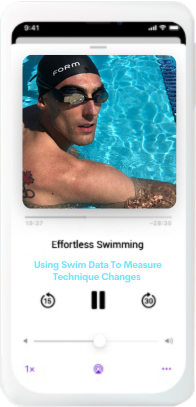
My guest today is Scott Dickens, a two-time Olympian. And now director of Business Development at Form, who is one of our sponsors of the podcast. We will talk about the 8-Week Faster Freestyle course, how you can ensure you’re making progress and the improvement you would want to see. Tune in now!
48.34 The Optimum Goal Is To Be Able To Relax
In this episode
- 01:02 Technique Change
- 09:51 Change Doesn’t Feel Good
- 12:18 Long Dog Paddle Drill
- 16:15 The Kick
- 21:05 8-Week Course Is now in Form Goggles
- 22:02 Week: 2 Posture, Head Position, And Kick
- 25:10 The Base Position In Freestyle
- 27:12 Using A Kickboard?
- 30:16 Wearing Fins
- 32:57 Week 8 – Stroke Rate
- 35:03 Hold Your Rating
- 41:24 What’s The Biggest Benefit of Using Form
- 46:10 Small Incremental Change In Pool Can Be Very Impactful
- 47:18 What Happens When You’re Learning A New Skill
- 49:58 What’s Coming Out Next?
Links from this episode
- 8-Week Faster Freestyle Course
- Change your technique and swim smoother, easier freestyle in the Effortless Swimming membership
- View our freestyle clinic schedule around Australia
This podcast is brought to you by NanoClear — our own range of anti-fog swim goggles, designed by Effortless Swimming with the anti-fog treatment bonded into the lens itself (not sprayed on, so it doesn’t wear off after a few swims). Check out the NanoClear range here and use code PODCAST15 for 15% off.
Transcript
Read the full transcript
Welcome to the Effortless Swimming podcast to show that help swimmers and triathletes love the water, become a better swimmer and live a better life. Here’s your host, Brenton Ford.
Welcome to the Effortless Swimming podcast. My guest today is Scott Dickens, two-time Olympian and now Director of Business Development at Form, who is one of our sponsors of the podcast. And today, we are going to be talking about how you can make the most of the eight week course that we’ve got. And there’s been thousands of swimmers who have gone through that and how you can make the most of that course to make sure you’re making the progression and the improvement that you want to see. And this is going to be relevant, even if you haven’t got the course or done the course, what we talk about here is going to be relevant for you. And make sure that you get something out of the podcast. So Scott, welcome to the podcast. First of all, thanks for having me, really excited to be on it. Well, before we decided this call, you’re actually just talking about your last Olympics in 2012 and something that you technique change that you went through and what
you experienced. And I thought, that’s, that’s really interesting. Someone at your level, an Olympian working on their technique and having some changes feel like they weren’t the right changes to make, but you just had to trust yourself and they eventually turned out to be the right thing to do. Do you want to talk a little bit about that? Because I thought that was an interesting conversation. Yeah, I mean, swimming is such a technical sport. And you know, you look at the best swimmers in the world and whether you think they have the best technique or not, they’ll never master it because there’s always going to be someone to break that next world record. So it’s a matter of fine balance and finding the right kind of technique that works for you and your body because everyone’s different. You know, I started swimming and made my first Olympic team at 19 and, you know, young and silly and dumb thought I was just going to keep getting
better. And, you know, technique was always that thing that was my driver of my success. I was never the biggest or strongest breaststroker, only enough from a six foot five breaststroker built like a butterfly. But the stroke chooses you. But, you know, as the sport progressed, and, you know, I could see others kind of moving faster and a faster rate than me. And my world ranking kind of just almost stagnant or even going down, but yet I’m actually doing best times and improving. It leads you to question what’s going on and why am I not, why am I getting left behind and why am I not keeping up? So, you know, going into the 2012 year, I knew that was probably going to be my last, you know, run at Olympic Games, give him not maybe not age is not really a factor, but just I kind of made that decision with my family. And I looked at my coach after the World Championships in 2011 and Shanghai and I came, you know, 18th, I came 19th
at the 2004 Olympic Games. And it’s like, it’s been seven years kind of just doing the same thing. And that’s kind of the definition of insanity. If you look it up, doing the same thing over and over and expecting different results. So I think something can be a pitfall where we, we think and wonder why we’re not improving. And, you know, you work harder, you know, you find maybe a new coach, you try a new plan, but if you’re technique and there isn’t like those minor adjustments, you might not ever see those incremental improvements or that leap that you’re expecting. So I looked at my coach and I said like, you know, we’re starting back up in a couple of weeks. I don’t want to go into this year saying what if and don’t want to leave any stones unturned. So I said, I’m willing to fail, but I’m willing to try something new to fail. So I’ve accepted whether we’re going to make the team or not make the team because I’ve made a team in 2004. I missed
the team in 2008 by a tenth of a second in the finals of the trials. Got wrenching, but you learn a lot about yourself and you move on. It makes you the person you are today. So going in, we decided like, you know, he talked to some of the best, you know, coaches in the world, like, how is Ken Benenberg’s coach training him for, you know, a hundred meter breaststroke and some of my other key competitors. You look at them, they’re big. They’re like, their breaststroke had turned into a very power oriented stroke. And, you know, look at Adam Pease, like built like a CrossFit athlete, athlete, right? So I had, you know, great technique, but still wasn’t a technique that was a power technique. So very much generating high power with my pull and kick. So we essentially looked at what can we do to one, increase your power and that one, what adjustments can we do in your stroke to help you utilize that power? So we started in September
and first we started with the power and we went from something nine times, 10 times in the water week to down to six and really focus swimming. No more than about 4K. So I went from doing tons of yardage to just really specific, meaningful work in the pool, whether it was technical work or just working on my 50 pace, 100 pace, 200 pace. But it was very much to the point and the rest of the time I was powerlifting, doing explosive work on the track, just doing other cross training elements to really develop my body and try and put on weight as well as develop that, you know, explosive power. And then there came the technique where I, you know, we did a couple of video analysis workouts with some technicians, but also analyzing some key, you know, brushstrokers in the world and how they were doing their technique. And based on my size and my wingspan, actually it was me looking at kind of Bremen Hansen stroke and identifying that, like, she
almost does his full pull before he comes out of the water. We’ve seen a couple of recent female brushstrokers do that. It kind of almost reminds you of 217 that was broken just last week. You look at that stroke, she’s got such a powerful pull, comes out of the water and then rides that, you know, glide with a kick. So we essentially started to incorporate that. And, you know, with the adaptation of more power and trying to gain mass and changing my technique, I kind of like started the season here. And we had a goal in mind of like going like 59 three and 100 meter brushstroke. Best time was without a suit 007. So it’s a big drop. So the target was be able to come back in 30.8. And how do you do that? You have to, well, be out in 27.8 and then incorporate the, let’s say full second for a turn for a full six foot five individual and then that equates to 30.8 through a push. Long course. And the goal was like, how do we do that at 18 strokes
at 95 percent effort? So that was like, OK, what can we do day one like after a couple of weeks of, you know, base training? What can I do at 18 strokes at 95 percent effort? Like 33 high, 30, maybe 33 low. And then it was like 34, 35. It just got worse and worse and worse because I would change my stroke. It felt awful. My brain was telling me, saying, like, why are you swimming like this? You swim one way for since you were six years old and you did really well doing that. Go back. And my body’s also hurting because, you know, it’s just fatigued from all the weight lifting. And it’s mental battle. You see the time of the clock where you’re trying over and over, doing drill work over and over again, getting slower, getting more tired, eating like 10,000 calories a day. And it wasn’t until about December that I finally saw like a little, little squeak of light in the tunnel and I was at like a development that could just to meet me had
in our own pool in December before the Christmas break. And I dove off and went like a one on one six. And I was like, you know what, like, at this time of the year for how I’m feeling, I’ll take that. And then it kind of went on a training camp after the Christmas break. And it was just like, I started to believe in it. So it was one, it was about like, my body doesn’t want to do it. My mind doesn’t want to do it. And yet I started to see that time drop and consistently just get better and better and better. And then I started to find like new limits of in terms of what I thought was like pain threshold and what I was capable of mentally. And I realized I didn’t have any limits. And once I realized that and like I could push through the pain threshold of like when your fingers are cramping, your forearms tighten up and you just have nothing left. And yet you find a you find a way to push off again and go faster and do it again.
And that was a bit of an aha moment I had in January. And then all of a sudden they became an addiction. And I was just like, I know this is working. And I’m just going to stick to it. No matter how bad it feels even technically and still going faster. I’m just going to stick to this. So even when I was racing, I had to work so hard mentally at doing this new stroke because still you can go full back into habits, but it’s your mind that forces you to do a new formation that your body maybe doesn’t want to do. Eventually it became like natural. But it still felt awkward because of like 20 plus years of doing a stroke one way and then just changing it. Anyways, I ended up making the team and then getting to the Olympics and you know, making final in the relay, breaking the Canadian records in 100 and 200 going 59.8 didn’t quite get my 59.3 but full second drop that year is pretty substantial in 100 meter sprint. But it was all because of like
looking and evaluating and deciding to make this change like you want to go best time and running want to go best time swimming. It requires you to go to the drawing board and almost be willing to sacrifice and the hardest part will be the mental part. Like can I do what this plan or this coach is asking me to do and because it’s not going to feel good. Change doesn’t feel good, especially in like sport. When you change a technique, all of a sudden you have to go through adaptation and most people don’t want to deal with that adaptation because it takes too long. So it’s a matter of how can you stick it out and how can you look forward to what’s on the other side but accept from day one that’s going to be hard. That was the thing that stood out most to me is you consciously made the decision to sacrifice potentially making the team for this change because you’d got to that point in your career where you were I guess fed up with not making any
improvements and doing the same thing again and again and you just wanted to you thought I’ve got to try something new here. And that’s a big decision to come to for a lot of people and I’ve spoken with them and worked with a few pro triathletes and for a lot of them I think they’re at that point where they’re not willing to make that sacrifice because the payoff time they might see as being too long and they don’t want to sacrifice the next maybe six months of results. But those that do and are willing to potentially go a little bit slower for the first few months they’re the ones that can improve. So yeah, I think that’s a huge part of it is that that decision and knowing what to to expect. And yeah, it does not feel good. No it doesn’t. And I think the other thing like when you look at it like if you do make those sacrifices but you do come out on the other side what you’ve also done is increase your efficiency which in the intern
will increase your speed because that’s what it relates to. Your stroke length DPS is your ability to hold and do technique. The rating is your how well you can sustain that and that’s going to equate to how fast you’re going. And at the end of the day going like 32 long course at 14 strokes felt easy. And that’s like because I just got maximum efficiency in my stroke as it related to the power I was being able to generate through the stroke because of the work I was doing out of the pool. And that was like kind of that also all home was like I can’t believe this is happening like I can consistently do you know 50 on 50 going such a low stroke count but going this fast. Yeah, it’s because I see a lot of swimmers in like they’re limited their speed is limited by their technique. That’s what’s holding them up and and something that comes to mind there is working with a swimmer at the moment and we’re really having trouble making some changes
to his to his technique. And I said I want you to do this one drill and it’s long dog paddle drill because I see there’s a lot of correlation from doing that drill well to swimming well at least for some of the changes that we want to make to his stroke. And so we’re spending like a couple of weeks he’s sending videos back and forth to get really good at this drill because I can see that if he can do this drill well with the right timing making sure he’s finishing his stroke at the back making sure he’s keeping his fingers pointing down and not like coming in and coming underneath him if he can just do that right with the drill which is the easier way to do it then that’s going to help him do it in the swim straight because there’s been other things that we’ve tried that just haven’t haven’t worked. So yeah it’s just just willing to persist with it. And initially when I said I want you to do this drill and we want to get really good at it
and he’s just like oh yeah I’m trying but it’s just not I just can’t see the relevancy of it like what’s the point so that’s what I think in coaches where all can be is like you’ve got to let them know this is why we’re doing it this is the point of the drill and this is what we want to get to in the next couple of weeks time or couple of months time was it a conversation that you had with your coach at the time or is this something that you just come to on your own and then you spoke to your coach? I think it was that like kind of mutual like understanding where we had such a great year in preparation leading into the Shanghai World Championships 2011 and like the times I was doing like in season so in season being like in work not rested not shaved not tapered we’re set like we’re like you know I’m going to do something good here it’s finally like you know the year before I like went one 007 did well kind of bronze in the 50 at the Pampax
so you know the training quality was much better in 2011 and it was just like we looked at each other he’s like I’m sorry like it was like that to hear that from a coach and him say that you know I feel like I’ve let you down like what what can we do better and he’s like I don’t know what that is right now but let’s come back to the drawing board and figure that out so that’s what we did and that was that’s where our relationship I think also took off because it was now based on communication and so every workout was almost like he wrote the workout and I was like here’s your section it was in the spring group and he’s like here’s your section like I was only brushed over in the group so he became very focused on like making sure there was an adaptation of the workout for me because I can’t train like a sprint freestyler because I’m a breaststroke there’s totally different and it took a while to learn that so it was very much like
look at the workout tell me what you think I came very involved in that process and there was a lot of drill work and a lot of things that we were doing a lot of isolated pull a lot of isolated kick and then a lot of kick, pull, swim component build sets and then there was like those couple of times a week we were strictly full stroke focusing on particular race paces but the isolated drill work is you’re breaking down the stroke and forcing yourself to focus on one thing at a time but when you do that in high repetition it becomes very much forced and natural and that’s where like I think a lot of people don’t understand the importance of doing kick and isolation, doing drill and isolation or doing like different forms of pull and isolation without pullboys and without paddles and those enhancements to really like develop the muscles and the muscle memory of the part of the stroke that you need to develop on.
Yeah, I wanna go to that for a bit is the kick because and I think probably six, seven years ago I was like like triathlete don’t worry about your kick however, I’ve gotten a bit smarter in the last seven years I think and just seeing that the kick is letting a lot of triathletes down not that you need to kick hard like we know that but it needs to be effective and often there’s things that people are doing that their kick is slowing them down and if they were to just isolate the kick and do a little bit of kick work and some of their workouts they’re gonna start to waken up the legs they’re gonna help make this kick much more effective and whether that’s doing some vertical kick kick on the side even just like over kick like fast legs, slow arms just start to wake up the legs and do that as part of your warmup I’ve seen really good results with a lot of the swimmers that I’ve coached and it takes time like typically two to three months
of just doing that consistently but boy does it make a difference like I’ve seen times come down fairly significantly primarily as getting the kick to be rather than a passenger to the rest of their stroke it’s becoming a part of it and they’re able to work it in with the rest of their stroke this episode of the podcast is proudly brought to you by our sponsor Form Smart Swim Goggles they’re more than a pair of goggles meet the world’s most powerful swim platform see yourself improve with Form Smart Swim Goggles including a free one-year membership when you purchase your goggles for only 249 US dollars they’ve currently changed up their offer where you can now get the goggles and you have one year membership included for free and if you’d like to continue with the membership going forwards it’s only 15 US dollars a month where you get access to the workouts, training plans and custom workout builder but you’ll always have access to the real-time data
in the goggles so you never lose access to that my favorite thing about the Form Goggles is having the instant feedback of what times you’re doing, what stroke rate you’re doing and also the ability to see what your heart rate is because never before have we been able to have these immediate feedback heads up display where it’s actually telling you what your intervals are so when I wear the goggles in training I like that I know my split for the first 50 and the 100 and the 150 so every single lap I’m getting that feedback on what my pace is and I find it’s such an important tool for being able to not only have different gears where you can switch between the different speeds that you wanna swim but it helps you develop those gears and it helps you intuitively know how fast you need to go to before you’re going to blow up or before you’re going to go a little bit too hard so it helps you just get really good at judging your pace
for when you do go to a race and even if you’re not wearing the goggles in a race it’s that intuition and that ability to develop your pacing that these goggles can really help with to get your pair of Form Goggles and save 15% off use our link formswim.com forward slash effortless or use the coupon effortless at checkout and that will get you 15% off your pair of goggles using our special link formswim.com forward slash effortless or the code effortless at checkout You make a great point because like you think about the triathlon stroke rate it’s probably much needs to be much higher because you’re up in open water and you need to hold a specific rhythm if you’re not able to attach the right kick to that stroke rate, you’re at a rhythm so you got half your body trying to do one thing and half your body trying to do another thing so unless you condition the legs the same way you’re gonna be kind of fighting your own body
and I think that’s really important like you said not only does it help develop that strategic leg strength
but how much does that correlate to their biking and running because when you’re kicking you’re using every muscle in your leg and you’re fighting resistance at the same time so whenever I kick freestyle I know it gasses me way more than if those brush stroke kicks. Yeah, that’s right and if you do it incorrectly as well it is a lot harder. I remember doing some, we were just doing some filming for just I think what it was for for our beginner freestyle course that we did last year and I had to swim 50 meters where I was kicking like someone who’s doing it incorrectly so I was kicking like someone riding a bike bending the knees, doing these really big kicks all from the knee and I was toast at the end of that 50 I was so exhausted kicking that way and I thought it was no, yeah I was so no wonder that people get tired like kicking that way and then when you change it to just a smaller kick slightly straighter legs
it’s much more efficient so there’s things you can do to help make the kick a lot easier to do so I think it’s good to isolate it. I wanna jump into a couple of things to do with the eight week course because two weeks ago we just added the form workouts for the eight week course so those are listening if you’ve been through the course you know what we’re talking about if you haven’t been through it this is our eight week faster freestyle course where best to go through each element of the freestyle stroke and have specific drills to do as part of your warm up each week and there’s a video that goes along with it and then there’s three main sets three different workouts and we’ve just added the ability to download them to your form goggles and follow those sessions just along with on your form goggles there so if you are listening you’ve got the course well that’s now in there and what I wanna sort of cover here is a couple, a few of the different weeks
I wanna talk about some of the technical aspects there and what you can focus on and what you can look for either on your form goggles or if you’re using just a watch like a Garmin you can track that as well just to how to correlate the technique and the data that comes along with it so the first one that I wanted to touch on was week two which is posture, head position and kick and when we think about improving the stroke it’s reduced drag, increased propulsion whether that’s breast stroke whether that’s freestyle you can boil it down to those two things and the first thing we wanna make sure we do is reduce drag especially in breast stroke as you know like that’s such a high drag stroke that anything you can do to reduce that drag is highly important I mean thinking of your technique what was the sort of focus there in terms of reducing drag with breast stroke what were you looking at? Yeah that’s a really good question
because you know you look at freestyle and backstroke even butterfly predominantly they’re very consistent in terms of the acceleration points in stroke it’s very much based on like a flow pattern whereas like breast stroke you really have pauses in the stroke and you have to one get back to that most minimal resistance part of the stroke which is the glide and so your pull and your kick need to be narrow and snappy so that you’re getting back to that position so one of the things I had to do was work on the smooth slow catch and then establish the pull of the stroke with the high elbow catch the catch in butterfly breast stroke and freestyle is the same it’s just how far you’re pulling back really but then it was like a nice strong established pull and then once you’re only pulling like a quarter of the amount of a butterfly stroke or even a freestyle stroke but then it’s like you gotta bring the elbows in struggle shoulders and get your body up and out
and ready to be in that glide position so from here once you’re done I was really focused on like that sheer acceleration of getting my arms in and out into the glide phase so that I could essentially surf on top of the water not because you wanna look at a lot of brush strokes they dive under the water they come back out and then they glide the surface so you have to learn how to lay out on the water that comes with a fast recovery so that when you kick you just to keep extending on top of the water so that was really one of the things I had to focus on was the acceleration of the recovery but also the acceleration of my heels to my essentially the recovery of my kick to accelerate the kick so because if you pull your legs up gradually you can only get your heels so high but if you accelerate them and use that elasticity you can like essentially kick yourself in the butt and then it forces your legs back and that’s where I think brush stroke
kind of differs from the other stroke is that mindful acceleration of those two elements to get back to, I would say, the most efficient part of brush stroke which is that body position with your heads down your head, hips and heels are in line and you’re in that glide phase. Yeah, that’s, and that reminds me of the what I call the base position in freestyle is when you’re on your side your arms extended, your other arms just near your hip because you finished your stroke that to me is the position that we kind of wanna return to or get really good at just holding and being in because that’s when you’re creating the least amount of drag that’s when you’re ready to set up the catch and that’s when you’re ready to rotate back to the other side as well and with that start point or base position and just dialing that in it gets you really good at feeling for that strain line position because the comparison there would be someone
who’s not really good in that base position is their arms typically crossing over maybe their fingertips are rising up but the head might be too high and they’re either over rotated so their legs are spying or they’re under rotated and they’re too flat and just yeah, so if you can get really good at that position and that’s sort of covered in like weak kind of a little bit of weak too because we talk about like head position posture and the kick but then also in week three when we go into balance alignment and hand position it’s just getting good at that position there and quite often when I’m running clinics we spend the first half of the pool session working on that position and just getting them to return to that position and being quite specific about making sure that they are in that position and giving them lots of feedback and changing these little 1% is because if they do that then they can reduce their drag
and they can swim faster and over the course of 2000, 3000 strokes in a race or in training that really starts to add up so what you may look for there is if you, let’s say you do like a 400 meter swim and it’s just like a 60% effort so pretty comfortable and you have that as your baseline before you do the course and that way you can get your stroke rate your distance per stroke and you’ll see all your stroke counts and stuff like that now you might do that at 60% but it’s also not bad to do that at like a 400 meter time trial as well if you just wanna see where your pace is but then as you go through say week two and week three what you might start to look at is all right, when I’m actually getting good at dialing these couple of things in you should see your stroke count come down for that same sort of effort and your distance per stroke same thing going up
Yeah, that totally makes sense and one of the ways I looked at how do I improve those positions is I stopped actually using a kickboard and did all my kick brushstroke in a full streamline position almost underwater I would do three kicks fully arms out extended head down in perfect position three or four kicks underwater come up, quick breath and just keep going down and I do all my kick repetitions that way whether it was 50 meters, 100 meters, 200 meters one it increases your lung capacity like crazy and especially when you’re kicking fast and load but it forces you to develop that position and have it formation like you said that side position of kick like if you did all your kicking or half your kicking on your side in that position it would start to be ingrained of knowing what that feels like because you’re overdoing it but in a sense that is like sometimes what it takes.
You wanna try and correlate the drills that you’re doing or the kick that you’re doing into your normal swim stroke and I was the same when I was doing a lot of breaststroke as a teenager so I much prefer to have my hands in the water same getting what I’d do if I was swimming because I felt that that had a much better relevancy to my actual swim stroke. Yeah and I did a lot of that with just even wearing a snorkel and like using my arms as a kickboard and also you don’t realize how much like stability muscle generation you need to do like holding a tight streamline can be tiring especially at the end of the race so you have to develop that muscle fatigue and stamina and I think that’s really comes down to again like what kind of what are you willing to put in even if like you know it is more comfortable to train on a kickboard or you know throwing your fins or just swim with a pool boy. Yeah, yeah that’s right. I come across a lot of swimmers
more triathletes I’d say is they’ve had a huge reliance on wearing the pool boy in their sessions and they’re weaning themselves off it and sometimes they need to go cold turkey or sometimes they’ll only allow themselves 300 meters at the end of the session and like I mean kind of in two minds about it like I think there’s nothing wrong with using a pool boy when you train however it does become a crutch for a lot of people and if they can, yeah if you can just swim well without it then it does help develop your kick which I think can help a lot of swimmers so I know I see both arguments and it really depends on the individual. Yeah, I mean I was very much the breast choker that wore fins a lot of the time because I didn’t know how to make my arms and legs like I didn’t know how to kick freestyle most of them like I either had a two beat kick or full of sprint for freestyle but doing that have a consistent kick I could just never pick it up
coming from the breast stroke background but when I wore fins it was much more natural because I could feel that like increased resistance of the fins and I used it as a way to condition my legs. Yeah I think that’s a good point as well just in terms of wearing the fins so if a lot of people that do come to clinics sometimes when they put the fins on they maybe haven’t worn them much and it’s a different sort of movement there and if you’ve got really heavy fins I think it can actually make the kicking a bit harder so get yourself a good set of fins and I really like the DMC elite fins or I think arena power fins or arena power fins fairly similar but I love the DMC brand if you get yourself a good pair of fins it is night and day from a crappy pair and that way you’re actually going to strengthen the legs in the downbeat and the upbeat and usually when people are doing some of these kick drills initially there are a lot of swimmers
who are just like doing this half ass kick because they’re not used to using their legs and so they’re hardly moving anywhere and so we try and just get them to have this steady and consistent kick and then it starts to wake up that motor pattern and then they can start to utilise their legs much better when they swim but it does take a while but if you can recognise that if you’re doing just like a front kick drill hands in front face down and if your legs are just doing like one kick per second then you need to wake in the legs up and have a more consistent and steady kick and just start with that and you will eventually become a lot more effective with your kick. Yeah I mean it’s a great point and I think about like you know I’ve been doing a lot more running and biking lately and in my warm-ups of those workouts where they’re running or biking I do specific parts of the warm-up where I wake up my legs where if I’m on my bike
I’m doing like three or four rounds of 30 to 40 seconds of trying to get my RPM close to 100, 115 so it’s like over doing it but it’s waking up that neuromuscular connection and if I’m on a treadmill I’m doing short bursts of like cranking it up to like nine miles per hour speed or nine and a half just like force like body to like wake up and you know like it reminds me of like swimming warm-ups where near the end of the warm-up we would have multiple like 20 meter bursts whether it was kick or you know float like swim or doing it with fins it was like that okay like you know wake up the body your bodies are still tired from the day before the weeks before so like it’s exactly what you’re saying if you’re not used to it like you need to do it more often. We used to do 15 meter over speed if it’s in a lot of our warm-ups where it’s like you’re gonna be slipping through the water your stroke rate is gonna be up above 100
and you’re just gonna be spinning the wheels but we wanna do that because then when you come back to like 70, 80 strokes a minute it’s gonna feel easy it’s gonna feel much easier and in week eight of the eight week faster freestyle course we look at stroke rate and we’ve got this seven by 100s kind of like a ramp test where we just increased the stroke rate by four strokes a minute and so you end up I think it’s on maybe 80 strokes a minute for the last one now a lot of people may not have been above 60 65 strokes per minute so as you get to those higher stroke rates in the high 60s, low 70s you might be spinning the wheels but we wanna start to wake up the body a bit and just get used to changing out our stroke rate and you can use either a tempo trainer or if you’ve got form goggles you can use that live stroke rate data bear here you can use that official yeah cause like it’s just you just don’t know what you’re doing otherwise
and if you follow that seven by 100s where you’re just ramping it up you’ll be able to track whether or not like where’s your sweet spot with stroke rate where do you start to slip where does your perceived effort go way up but your speed doesn’t go any quicker I mean as a former late swimmer like that’s something that you really get quite attuned to is your limit of where you’re starting to slip and when your stroke rate goes too high like that’s something that you just get dialed in like a race car yeah it’s true and it’s through max repetition and also like your coach with their eye your technique and being able to identify like I saw it, it happened here and it’s like thinking back it’s like that’s you know I felt like I was just like spinning my wheels to the water I wasn’t pulling anything it’s like yeah that’s where you since you lost hold of the water and one of the things that I had to learn over and over again
and I think a lot of swimmers do a lot of athletes is that swimming at the end of the day at the end of the race it’s who can slow down the least you’re gonna slow down and the best swimmers in the world essentially stay in the course better than everyone else like Michael Phelps you look at you know that’s their ever been and what they do is they don’t try and up their rating it’s hold the rating and when you it’s like you look at if you tried to pick up your you know speed by increasing your stroke rate you might actually slow down because you’ve broken a rhythm of your body and now you’re just chopping the water and I used to do that in that last 25 or brush stroke and I would actually start to slow down that’s where my coach is like if you just hold what you’re doing finish your stroke and just one at a time it will feel like not going in there but you are probably holding more water and going faster than trying to pick up your rating
because all you’re gonna do is you know especially in breaststroke like you said you’re fighting so much more resistance you’re just pushing water at this point so push less water and you’ll go faster it was I was looking at the splits of the women’s tone of breaststroke world record that just got broken and it was something like I can’t remember the times exactly but you got the first 50 obviously that’s the fastest with the dive but the next 355 within like 0.1 or 0.2 of a second all of those last three fifties almost exactly the same it was amazing yeah and if you look at her second 50 which I thought was I felt like I was like amazed she went 15 strokes on the second 50 and like I’m not sure how many people are listening for a female breaststroker to go 35 in a race all going 15 strokes and then the next thing I think was 16 or 17 is just out of this world high glide super efficient she was so far ahead of the field as well
was that was amazing I just want to come back on a point you mentioned just about perhaps not looking to increase the stroke rate to go faster at the end of the race they’re only like the main exception there would be in like a 1500 where you see the guys bringing it home that last 50 or perhaps the last 100 but something like a 200 freestyle it’s who can slow down the least because you just ride on that edge that rev limiter for a whole 200 so I just want to make that clarification and for a lot of people listening they are more sort of distance swimmers all of you doing triathlon look you probably don’t need to probably don’t want to bring up the stroke rate too much towards the end of the race because you want to just keep that heart rate down but yeah there are obviously exceptions there and I think that’s a big part of it is the nuance to technique and to advice for different people as well and I’m sure that’s something that you’ve seen
as your four years at form where you’ve probably become a lot more accustomed to the type of training and the type of swimming that triathletes do compared to pool swimmers because when I first came from a pool background to coaching triathletes and even open water swimmers for that matter it was quite, it was very different than what I had originally been taught and I really had to get my head around it and start to change the way I was teaching Yeah, it’s 100% and you know it’s even if I was like even myself preparing for a triathlon I struggle because you know I have good freestyle but I’m a six foot five and I have a really long freestyle stroke so I tend to like really ride and glide on my side in my arms but like in the open water that like I find I can’t go the pace I want to unless I swim a bit this requires stroke rate but I don’t train that stroke rate enough so I can’t hold and sustain it so I get stuck in that like comfortable
you know probably easy speed I’m still going probably fast but in relation to what I could do it’s very challenging for me because I need to learn how to train that stroke rate
Yeah, I went through a period when when was it, it was probably sort of mid 20s where I’d come from the pool background and then I just started doing mostly open water swimming and I remember I swam at a competition in the pool and I did the 400 freestyle my time was okay but I remember a friend of mine saying she’s your stroke look rubbish there and I was quite offended because I was coaching I’m swimming a lot and getting good results in the open water but I hadn’t done much pool swimming and I knew it was right as well and I could sort of feel it too but I just I’d really changed my stroke to be good at open water where I was coming over quite high with my left arm and just like quite quick and good at getting my stroke rate up to be like in the mid 80s and if I was normally if I was like in the pool doing like a 400 free I don’t know exactly what it would be but it would probably be like maybe low 70s I would imagine even like maybe
yeah, probably around 70 so it’s just this very different stroke that I developed for the open water and I took offense to that comment but it got me thinking look you’re right and the reason I’m offended is because I know he’s right so when I do swim in the pool or if I’m training for pool competitions I’m gonna have to change the way I train and the way I approach it because I was doing a lot of sessions in the pool where I was getting my rating up really high towards the when I was working that sort of higher threshold because I was doing this set of I did a set of 10 month 50s and I did it with there’s a guy Daniel Kowalski who was an Australian Olympian distance freestyle and he was training at the same pool that I was at so I did this set with him because he was swimming after I’d finished coaching and when he was going faster because we’d build one to three he would just go like rating he’d go from like low 60s to 70 something
and then to like high 80s when he was doing the faster one and I thought, all right, I’m gonna try and match that and I got pretty good results with it but it made my stroke very scrappy and he could do it and just still look really good but yeah, I just got into this habit of just rating up and the technique kind of falling away a bit and now I’ve sort of come back from that focusing a bit more on better technique and not just going for writing after that. Yeah, I have a challenge just even getting over 60 strokes per minute right now how long and big my body is but that’s the tell guy problems but it’s still fine away but yeah, I mean, when you think about like the amazing eight week course you have to get faster, you know one of the biggest benefits of like, you know utilizing a platform like form and relation to the effortless eight week courses you only get that data in real time to see whether, you know or you’re doing these target stroke rates
or these increases in your stroke counter decreases in your stroke ground as it relates to your time and your pace you’re able to track all that data through the app as well and really focus in on like, okay, week one that’s like my base but then you can see all this like every swim you do is recorded and you have that ability review so it’s a way to kind of like hold yourself accountable if you’re being instructed to do different drills or adhere to a new technique change and that’s the benefit, right? Yeah, that’s right you can look back at it and go through the data and the numbers there and quite often we’ve had people do like week three like up to week three, week four like, oh, this feels great my times are improving and then it might be like week five where they’re like, oh, it all fell apart this week and it doesn’t feel great and that’s going to happen I can guarantee it’s going to happen as you go through the eight week course
that it’s not going to be this upward trajectory that everything’s just wonderful and it feels great you will have some times where you’re asked to make a change or do something different where it will be different than what you’ve done in the past and it’s something that doesn’t immediately improve you so expect that to happen but you can look at your data and see, all right, what actually happened there? Was I taking five more strokes per lap? Was this change not the right one I need to make? So that’s certainly a benefit of being able to track that and see what the difference is and even just with the pacing like we do quite a bit of build work in some of these main sets like for example, like nine 100s, build one to three and if you’re looking to and buy build one to three it’s like the first one’s easy second one’s medium, third one’s fast and if you’re going in a 50 meter pool let’s say your first lap is 45 seconds
and then when you do the medium one if it’s still 45 seconds and then the fast one, the first lap still 45 seconds, well, you’re not really building so you need to make sure that on that first lap at least you need to be going out the second faster second lap, another second faster just to have that gauge because you can get really good at gauging your pace and using the goggles to actually see if you are getting faster on the way out then you can start to get a better idea of if you’re doing what’s required there. Yeah, and you talked on two of the most simple things that our goggles do with two of my favorite like I love seeing my splits of the turn just because it is a way to track your pace in a very finite way pace for hundreds of amazing metric but it’s an average whereas your splits of your turn down to the hundredth of a second are a true correlation to what you’re doing and how you’re executing and if you have real time stroke rate
as a metric you’re seeing while you swim it’s like you can kind of understand like to what splits or pace is my optimal stroke rate. So if you’re doing that build set and you start at 60 strokes per minute if you’re still at 60 strokes per minute like you said on the third well you’re probably going the same speed but if you gradually increase your stroke rate in the optimal way you’ll see the splits come down too but you’re like we talked about sweet spot it’s like what’s your sweet spot for your easy speeding what’s your sweet spot for your 80% speed or 70% speed every kind of different effort range requires a different combination of the metrics to optimize your swimming performance. And it’s a lot less than what people expect I think in terms of like stroke rate like for me if I’m going like a build set I’ll normally start off at like 60 strokes per minute and then when I’m going at like sort of threshold it’s like 65 strokes per minute 66
like it doesn’t increase that much when I’m just having this gradual build but I think people expect it to be like start off at 50 and get up to 70 it’s like it’s no you’re just turning the dial up a little bit like increasing that rev that rev you know the revs from like 3000 to three and a half thousand to 4000 like it’s very minor changes now obviously it takes time to get used to it but it yeah it’s a lot less than what you might expect. Yeah, I agree you’re just slightly tight in the book just a little bit more and that’s the key is like you’re not looking for these huge income like massive changes it’s a small incremental change but small incremental change in pool can be very impactful but can also come with a lot of different sensation and how that feels because you’re pushing more water like it’s interesting like add an element of resistance at all points of time when you’re in the pool changes your perception
and if you don’t come from that swimming background it’s like I’ll compare it I’m like I took out skiing as an adult and it’s very technical to me I think it’s a very technical sport and my brain at the end of the day is just exhausted because I’m so focused on the technique I’m learning from like instructor and trying to keep doing that technique when I’m skiing on my own and like swimming I hear the same thing if you don’t come from the swimming background I’m like I feel exhausted mentally and physically at the end of the day because if you are interested in getting better you have to focus so hard on what is that thing I’m supposed to be doing you know Brunton told me like you know roll on my side establish my high elbow catch and pull straight back through the body like it requires a lot of thought process I had someone attend a clinic a few weeks back and he is a mountain bike coach and also a doctor and he’s looked into what happens
when you’re learning a new skill or a new movement and he was saying that you end up incorporating a lot of the unnecessary muscles so the muscles that you wouldn’t use at the end once you get good at this movement but you end up using a lot more muscles so you’re burning a lot more calories that way plus you’ve got the mental load as well burning a lot of calories so that’s why it’s exhausting making these changes for those two reasons so I knew about the mental load because I think they you measure someone’s like how much energy they’re burning someone playing chess it’s like they’re using a lot of calories just thinking things out so you’ve got that side of it but then also just the unnecessary muscles that when you do get efficient at that movement they then switch off and you’re using only what’s required but not at the start and I’m guessing that’s probably what you experienced when you were changing your breaststroke
100% like that tension, those yeah, everything it’s like it was mental and physical exhaustion to the extreme and I think once I hit that like aha moment like I started to be relaxed in the new technique and I think that’s the key is like swimming does have a form of like tension when you’re learning it but once you get to that like flow state and that rhythm that it’s like I hear a lot, you probably hear this too it’s like I have to focus on when to breathe when I swim when it does become that like you don’t even realize you’re doing it that the tension has gone down and like that amount of energy you use to do that has gone down yeah it’s exactly right I do see when people are doing some drills at clinics and there’s a lot of thought going into it they’re trying to make the positions right and one of the things I think of is our YMCA drill where it’s like you hold your arms in those four sort of key positions for freestyle
initially there’s like there’s a lot of tension there they’re just like really holding it hard and then as they after they do it a little bit I just ask them just all right now just relax in those positions and if they can or when they can relax there it’s like okay I can actually hold my arms here and it’s quite easy I don’t need to muscle this position but it’s just the initial reaction to when you’re concentrating on something a lot so that’s the optimum goal is to be able to relax through the movements but it is unlikely to happen straight away no it takes time and effort and patience I would say a lot of patience and dedication I think that’s a good place to end at Scott well thank you very much for being on the podcast is there anything that comes to mind in terms of what you’re sort of looking forward to with form what you’ve got in the works of what’s been released as well because you guys have been a sponsor of the show
for quite a few years now which I really appreciate and I mean one of the things that I may not have mentioned is just like the custom workout builder there’s been a lot of development going on behind the scenes you want to talk a bit about what’s coming up what’s just been released because I don’t think I’ve mentioned a lot of that lately yeah so I would say over the last year and a half our really big focus is going from just a pair of goggles that gives you a heads up display and you can track all your data in real time to being a full blown swim platform so now we have you know some platform that’s powered by our goggles in the heads up display so now we have you know over a thousand guide workouts in the app 30 plus training plans whether you’re looking to some longer increase your endurance some faster increase your technique or training for sprints you know Olympic half iron or full iron we have all those but then we also have
now got the custom workout builder where you can put those coach workouts that you have or if you’re following an eight week plan you can load those using the custom workout builder in the app it’s very fast for the efficient but having that guiding workout especially when you’re not something to squad it holds you accountable because when you have something telling you what to do you’re more likely to do it versus kind of like maybe you’ll just do one last or I don’t feel like trying at 70% when something’s in your face saying something 70% more than likely you’re going to do it and then some of the future iterations and feature releases that we have coming up this year can’t go too much into it because there are going to be some big launches but what I can say is we’re going to be great enhancements to the overall swim form experience and we’re really excited about that sounds great well thanks again Scott appreciate you being on the podcast
and I just I love the fact that I love to hear the story of someone who at your level has been able to actually make a change there technique and take two steps back to go three steps forward I think it’s a it’s really great to hear that from someone at your level because I think there’s people out there who are they might be swimming three times a week and doing triathlon or doing open water swimming and go I just can’t I can’t afford to to make a big change to my stroke but if you can sure they can as well so yeah thanks again for being on the podcast it’s worth the effort of the time but thanks again for having me and have a great rest of your day thanks for listening to the effortless swimming podcast if you’d like us to help you become a faster more efficient swimmer go to www.effortlesswimming.com