








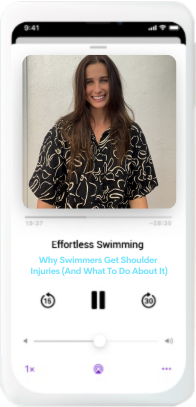
Hollie Buerckner, an osteopath and swimmer, shares tips on preventing and rehabilitating shoulder injuries in a podcast episode. She suggests specific exercises to address shoulder issues and emphasizes the importance of maintaining a balance between strength and mobility. Tune in to learn more.
00:00 Introduction
02:38 Understanding Shoulder Injuries in Swimmers
03:25 Four Causes of Shoulder Pain in Swimmers
05:13 Relationship Between Shoulder Pain and Range of Motion
09:51 Effective Shoulder Exercises for Swimmers
14:36 Common Mistakes Leading to Shoulder Pain in Swimmers
18:02 YTA Exercise for Scapular Strength
20:06 High Intensity vs. High Volume Training
22;34 Importance of Addressing Shoulder Pain Early
24:32 Balancing Mobility and Strength Training for Busy Athletes
27:42 The Stubbornness of Swimmers in Dealing with Pain
29:44 Motivation to Take Care of the Body
35:11 Get in touch with Hollie!
Follow Hollie on Instagram
Osteos on Sunshine
Change your technique and swim a smoother, easier freestyle with the Effortless Swimming membership:
https://effortlessswimming.com/training-and-membership-plans/?el=blog
Do you want to work with me personally to improve your technique? Join my swim technique coaching here:
https://effortlessswimming.com/stroke-analysis-membership/?el=blog
Get 15% off our 8-week Faster Freestyle course by using the code 8week15
https://effortlessswimming.com/8-week-faster-freestyle-course/
Watch the episode on YouTube:
Transcript
Read the full transcript
So there was four kind of main topics. So it was a bit of like overuse, misuse, abuse, and then disuse. So you can kind of dive into all four of those and everyone kind of can fit into one category if they’ve got shoulder pain. And then that’s when a lot of injuries can start to occur because you start to compromise instead of using your muscles, you kind of start to use the joint. Welcome to the Effortless Swimming Podcast to show that help swimmers and triathletes love the water, become a better swimmer and live a better life. Here’s your host, Brenton Ford.
Holly Birkner is a swimmer and qualified osteopath who recently completed her master’s degree on shoulder injuries in swimmers. On today’s episode, I wanted to ask Holly about what surprised her in her research, what are some of the leading causes of injuries in swimmers and how do we go about either preventing or rehabbing and fixing shoulder injuries that we might be experiencing at the moment. We also talk about what you can do if you’re a time poor swimmer or triathlete and you don’t have a lot of additional time within your week to be able to include any strength or mobility work. What’s an easy way to include this in your normal routine? I also asked her about the balance between strength and mobility and how important is each aspect and which one should we really focus on. And she also mentioned some specific exercises that everyone can do to help overcome any sort of niggles that they’re having within their shoulders.
Now, Holly was recently featured on the podcast a few years ago on episode number 174. After I brought her on to talk about her 100 kilometer swim in five days in the Bay in Melbourne. So we’ve got a slightly different topic today. Let’s get into it. This is Holly Björkner talking about her research into shoulder injuries in swimmers.
Welcome to the Effortless Swimming Podcast. My guest today is someone who I had on the podcast a couple of years ago because Holly, you completed a 100 kilometer swim across five days. You swam pretty much around the Bay in Melbourne or along one side of it anyway. So I had you on to chat about that swim which was an amazing effort. And we’ve got you on to talk about something a little bit different today because you’ve recently completed your masters and you looked into what causes shoulder injuries in swimmers and how can people avoid it and what can we do to preemptively get ourselves in a position where we can swim a lot without experiencing some of those shoulder pains that a lot of swimmers tend to get. So I’ve brought you on to the podcast today to talk about that because when you’re talking about a few things that you found in your research I found it quite interesting that it was different to what I expected.
And I’m always open to new ideas and to see how people can improve these things because I come across a lot of swimmers who experience shoulder pain. Even if they’re swimming twice a week it can be a real issue for people. So that’s what we’re gonna dig into on today’s episode. So firstly, welcome to the podcast. I don’t think so of having me. So tell me about this masters that you did and why you chose that topic. Yeah, so I started my osteo studies in 2019 and in my last two years I was swimming quite full-time about six, seven sessions a week and I started getting a lot of shoulder pain kind of myself and it was in like a period of time when we can kind of start choosing what we wanted to research at uni. And I just thought it was a perfect time to kind of look into why swimmers end up with so much shoulder pain, why there’s a lot of swimmers who when they retire need shoulder reconstructions why people have to miss training sessions,
time out of the pool just to put their shoulders in the wingman and it ranged from yeah, everyone’s from just the recreational swimmers all the way through to the elite. So I just wanted to kind of figure out what exactly was causing that. And in terms of what was causing it, did it come across as was it more overload? Was it that particular movements that they were doing? Were they just not strong enough or flexible? What were some of the themes that came out in your research? Yeah, so there was four kind of main topics. There was a bit of like overuse, misuse, abuse and then disuse. So you can kind of dive into all four of those and everyone kind of can fit into one category if they’ve got shoulder pain. So overuse was looking at those people who are just performing a really high frequency and then not giving themselves enough time to recover after they’ve done start exercise. Misuse is using faulty swimming mechanics.
So if you’ve got that excessive body roll through your stroke, then you’ve kind of got that more adduction to the shoulder just pinching into that shoulder kind of joint and then looking at abuse. So people who swim excessively with paddles, they kind of got more pressure going through that shoulder because there’s more surface area in the hand. Or even if you do a lot of kick sets, your shoulders sitting at that kind of elevation and internal rotation for a very long time and you’re not kind of using it as much. And then also looking at disuse. So swimmers who have maybe been out of the pool for a little while and then have gone back into it and come to get back to that 5K set when they haven’t done it for a little while. And then the muscles, the tendons, everything in that shoulder is just not used to that excessive kind of high elevation in the shoulder, internal rotation and different things like that. I think I’ve been guilty of all of those
at some point in my personal career, especially coming back and going too hard without enough buildup. And we were just talking about that prior to the call, right? It’s like you want to go back to what you used to be able to do, but you have to have that patience to be able to just like, hang on, let’s slowly build this thing up. Yeah, absolutely. Kills you as well. Yeah, absolutely. In terms of the lead causes, what were some of the most common causes of shoulder injuries that you found? Yeah, so one of the most common, I think 70% of it kind of made up was tendon properties. So that’s just when there’s like the damage to the tendon. So if we’re looking at the shoulder joint itself at that ball and socket joint, however, the ball’s too big for the socket so that all the tendons around it have to make up to stabilize the joint. So when you’re going through a lot of that movement. So that can cause a lot of impingements
through the shoulder and a lot of wear and tear on those tendons. If there’s not enough stability to support the joint, not enough kind of strength for surrounding muscles to help support it as you’re swimming. And then that tendonopathy also can occur if there’s not enough kind of scapula movement. So the shoulder blades, if they’re not contributing to the super stroke, then the shoulders kind of doing all the work. So it’s amazing. Swimmers have got a really great range of motion through their shoulder joints. You just look at like all the top swimmers before they start their race and they do these incredible movements with their shoulders and it just shows how well that they’ve got, how much movement they got through their shoulders. So yeah, looking at that, I was like, okay, so they’ve got all this range of motion in their shoulders. What is it causing their pain or is it helping them not have injuries? What kind of thing goes to that?
And it kind of goes hand in hand. They need that really high range of motion in the shoulders but they need their scapula to make sure that it’s getting involved as well. So a lot of shoulder injuries start to happen when the shoulder blades are contracting and rotating forward and then the space within the shoulder stops being able to keep the space. So then the shoulder starts to enclose on itself because the shoulder blades are not rotating around but you still want that high internal rotation. So either like a coach or yourself, you’ll push yourself into that increased range of motion in the shoulder but because your scapulas won’t help you, you just start pinching and tearing up those tendons over and over again.
So in order to get that movement through the shoulder, because the swimmers that you will have worked with primarily at like reasonably high level swimmers in the squad you were swimming with, the ones that I tend to work with often, they’ve learned since as an adult, they’re very stiff through the shoulders. So how could athletes like that start to improve that range that they’ve got through the shoulders and start to get the shoulder blades moving a little bit better because I said just years of built up, being on the bike and running and just stiffness through there. So they don’t move much at all. So how do we start to improve on that? Yeah, so like it’s like you said, there’s a lot of built up stiffness. So it can kind of come from, and this is what osteo does, we look at so many different areas of where the pain could become from and why it’s led to that shoulder impingement. So it might not have been coming from the shoulder,
it can come from the shoulder blade or even the thoracic. So a lot of people are sitting at this all day, they’re riding, their body’s very straight, there’s not a lot of rotation through the thoracic anymore, or they’ve got that kind of curved over posture like that kind of lazy teenagers that slump forward and their head’s coming forward. And they’ve got all these tight muscles at the front, weak muscles at the back, and then they can’t bring themselves back up into that right position. So it’s looking at, do they not have them right amount, like right range of motion through the shoulder blades and the thoracic or are they lacking the strength that they’ve got? So if it’s a range of motion, you wanna look at just kind of stretching and increasing mobility through that area. If it’s lack of strength that they’ve got, then you wanna look at strengthening exercises to bring it back. So then there’s all these different,
because that’s kind of what you wanna figure out with all these swimmers, and then you wanna figure out the best kind of routine for them to be able to kind of improve both sides of it.
And I’d assume that there’s probably an element of both required, right? Like you need to have obviously the strength and the mobility, but often having, sometimes having the strength can help with that mobility bit too, right? Like they go hand in hand a bit. They do, they go hand in hand, but then they sometimes also counteract each other. So someone can be really strong and have no mobility. And then someone can be have heaps of mobility, but no strength to keep the shoulder joint and the scapulas in the place. It’s just moving around kind of freelance and it’s not really, doesn’t have any muscles to hold in place. And then it goes the opposite way. People have the strength to hold in place, but it can’t now move in and out of the position it needs to. So whenever anybody gets kind of given an exercise routine, you wanna make sure that it’s got strength and mobility kind of put together in one. You don’t wanna do one without the other
because then you end up with an imbalance again and then more injuries occur from that. Let’s talk about some specific exercises that you’ve found to be generally good for the general sort of athlete in the summer. And perhaps some that, cause I know you’ve had some shoulder pain in the past as well. And maybe some that have worked well for you and anything that you figured out through your own personal experience as well. Yeah, so there’s so many different types of kind of range, like things that you can do with the shoulder and there’s a lot that you can find online and all are very helpful. There’s two main ones that I kind of used to really help me push further into no shoulder pain cause I was doing all the resistance bands and stretches and all the peck stretches, everything like that. And nothing was kind of pushing me away from the shoulder pain, it was still in there. So we had a look at kind of the swimming environment
and when you swim, you’re in a very unstable environment compared to running and riding. You’ve got contact with the ground every time you take a step. So that’s a very stable environment whereas in water you’ve got forces coming from all directions and it can kind of throw you off balance and you need extra stabilizers in your joints and to be able to kind of counteract that. So it went into looking then, okay, what’s a way that we can bring stability into like an unstable environment into like a kind of controlled environment. So when you’re swimming and you’re kind of trying to get the times, you’ve got someone yelling at you cause you’re not going fast enough or you think you’re not going fast enough, you’re out of breath, you can’t concentrate on that mind-muscle connection as easily, you’re constantly thinking about other stuff. So you want to bring that unstable environment to train those muscles when you’re in a kind of calm state.
So we looked at like using a swiss ball, it’s very unstable. If you’ve ever tried to balance someone, it’s near impossible. So we used that, we tried to balance on the swiss balls. So four point kneeling on your hands and then on your knees and then that’s kind of what you work up to. Sometimes you can only just hold your hands on the swiss ball, but eventually you go into all fours. And during that, you can see a lot of swimmers bring their shoulders up to their ears, they round forward, all their hands and arms are shaking. They can’t, they don’t really have the stability through their back and shoulders to hold them. And the people that have that are the ones that have got the injuries. Whereas when you’ve got more stability through there, they’re the ones who don’t have the injuries. So they could kind of keep the shoulders away from the ears, scapulas together, arms straight, and they didn’t fall off the ball as easily.
Yeah, so I was one of them. I kept moving to the side and it was really cool because like the side that I kept falling towards was my bad side. I didn’t have the strength to hold myself up. So I’d kind of collapse into that shoulder and collapse into that elbow and fall towards the right. So yeah, we looked at doing that every day to increase the, we looked at it, it was proprioception in the tendons that I needed to increase. So it’s that the tendons awareness of where it is in space when you’re swimming, controlling the movements. And then when you control movement, you enhance the stability. And then this leads to kind of the proper load distribution throughout the shoulder. So I’m not gonna distribute into my other shoulder or into the back or different things like that. It really helps you, yeah, kind of get that my muscle connection that the next time I’m in the pool, I’m like, okay, this is a familiar kind of feeling.
And I’m stable and the force is coming from the left from the right from the front and everything like that. I know kind of how to hold that shoulder in a steady position. Yeah, it’s really, it’s interesting to hear that because I, when I used to coach at Melbourne Sports and Aquatic Center, they’d be Mac Horton would train there with, with Vic Center and usually as part of their warmup, they do like a, almost like a prone hold, but they’ve got their knees on the ground, got their hands there. And then they’re just raising like left arm, right leg. So just alternating and trying to keep the body still like a tabletop. So they’re not arching through their back and they’re not, when they’re not bringing their shoulders forwards, just trying to keep everything still when they extend their arms and their legs out in front and behind them. And it seems like a pretty basic exercise. It’s very slow. It’s not working on a lot of strength,
but it’s the control. And if you can control your body in the water, which is that unstable environment, like those types of exercises can have a huge impact on the technique that you can have when you swim. And even I can feel like you’re not doing much when you’re on that Swiss ball, when you’re on the ground doing the same exercises Mac. It’s like, it actually helps a lot when it comes to swim form and swim technique, which is one of the main things that’s going to help you be a better swimmer. So it’s not necessarily just about getting stronger with it, but just that control and stability like you talked about. So how long would you do that exercise for each day? So I’d probably do it. I ended up doing it kind of a couple of minutes before swim training until I kind of got a bit too frustrated that I just kept falling off it. So I just got it until I could balance for a few seconds, maybe 30 seconds to a minute.
If I could hold that nice and controlled after I fell off a couple of times, sometimes I would get a bit annoyed and walk out the door and just head off to swim training. But yeah, you want to hold it for at least 30 seconds to a minute to just kind of wake up those muscles and get them firing ready to hop in the pool. And yeah, like it’s interesting you said about like that kind of lifting up the opposite arm and leg. If you look at swimmer’s now like Olympic swimmer’s they’re ripped, like their core is incredible. And it’s because they’ve got that stability through the water, like the rotation through their thoracic but their hips kind of going with them. And it’s cause they can hold that stability when they’re swimming and everything like that. So yeah, that was an huge thing as well just like looking at core strength. And if you don’t have core strength you start to compromise. You’ve got that excessive body roll.
And then as soon as you have that your shoulder comes into more adduction. It comes across the body trying to get that force through. And then that’s pinching all those tendons that are running through that area. So yeah, a lot of the time it looks way back to like even before you fix the shoulder how it’s swimming or fixing how kind of giving cause it’s like always like if you treat the person to get their shoulder feeling better but then they hop back in the water and they’re doing the exact same technique over and over again. You’re kind of just playing like catch up with them. You’re never gonna get ahead of it. You’re just trying to treat them constantly. So you wanna go back all the way to okay what’s the thing that’s causing the pain the most? Is it because you’re adducting your arm a lot? Is it cause you’ve got like a very low kind of recovery that you’re pinching the shoulder as you come over the water?
Do you have a huge internal rotation but then the scapula is not working? So you’re kind of always trying to think about what do you have to strengthen out of the pool so that when you get back in the water you’re kind of good to go.
Yeah, it’s always like what comes first is chicken or egg for each person. And I’ve had a lot of people come to our swim clinics who have said my left shoulder’s been giving me grief for the last six months. Is there anything you can see in the video? And when we film it a lot of times I’d say like four out of five times it’s very obvious what is causing their shoulder pain. They’re doing 3,000 repetitions of coming over maybe crossing the centerline a lot and then they’ve got their hand way above their head. Like yeah, just a really sort of awkward entry where they just up with their hand and then they’re trying to push down on the water really hard. It’s like it’s no wonder that you’re having shoulder pain because of that movement. Or like you said that recovery which might be coming through almost like thumb first and very low and just like that again can just cause a lot of shoulder pain. And then sometimes with the catch.
So when someone’s going from not having a very good catch to then trying to work on that high elbow position it’s very common to see them just let that shoulder roll too far forwards. Like almost too much internal rotation and they just load up through the front. They’re trying to get the catch but they haven’t got the shoulder in that strong and stable position. And like pretty quickly they go, oh, this does not feel good. And I don’t know if I can hold that for the next six weeks. So we just have to go right, hang on. You’re probably just rounding that shoulder a little bit too much. What other kinds of exercises would you often prescribe people just to develop that control through those different shoulder movements? Yeah, so we’ve got another one and it’s called like the YTA. So you’re laying in a prone position. So laying straight down, face like face and ground. And then you’ve got your thumbs like this and you’re gonna go up until Y like that
and you lift. So it’s kind of squeezing the scapulas together and you’re lifting your arms up into the air about 10 reps. And you go into the same thing with your thumbs out and you go into a T position and you lift up and you’re squeezing your scapulas together. And then you go down into an A. So your arms are beside you maybe this far away from or about this far away from like the middle of you and you’re doing that same kind of pulse and you do it 10 times. So you’re gonna go in and out. Yeah, a fair few times just to really strengthen those scaps and they get them kind of moving in the right position. So that’s another gray one that you can do before you then hop in the pool so that you’ve got that kind of my muscle connection to those scapulas. Cause a lot of the time we’re swimming it’s when you become a lazy swimmer that your shoulder starts to hurt. You kind of stop thinking about how your arms moving stop thinking about if you’re pulling your scapulas together
maybe you’re hunching over in the water or you’re just throwing the arms into the water instead of kind of placing them in the water. And then that’s where a lot of injuries can start to occur cause you start to compromise instead of using your muscles and you kind of start to use the joints.
And with that exercise, is it like chin on the ground? Is it chin off the ground? How would you normally do it? Forehead on the ground, yeah. Yeah, so you’re laying like your forehead on the ground you’ve got a long neck you don’t wanna kind of have yourself picking up. You wanna be like in that nice swimmer’s position. So you head down, got a tight like you always kind of suck your belly button into your spine just to activate that core. The legs are nice and long and then it’s really, yeah concentrating on lifting those shoulders up and keeping again like you don’t wanna hunt yourself into your shoulders you wanna keep the shoulders long, neck long and yeah, do about 10 reps of each.
Excellent. And in terms of your research what were some things that surprised you? So you probably had a bit of an idea going into it and going, okay I think this is probably, you know some of the main causes and so on but when you look into things often there’s some surprises there and you go, okay that’s actually the opposite of what I thought. So did you come across anything like that? Yeah, it was funny because when I was doing the research and I was swimming so much I’d be then swimming and being like, is this the best thing for my shoulder right now? Like my research is saying something else and I was like, no I can’t mention that though but yeah, I looked at kind of the recovery and intensity of shoulders because I definitely think I fell into the overuse category and a lot of the swimmer’s where we’re falling into more of the overuse category than the other ones. So there was a study I came across and I was looking at high intensity
versus high volume training and it found that after a high intensity some session it takes a tendon about 24 hours to recover so to decrease in thickness because the supraspinatus tendon which is a major one that’s connecting into our rotator cuff which is most of the time what being damaged in shoulder pain so shoulder injuries and swimmers so that tendon would increase in thickness and then it would take about 24 hours for it to come back down whereas with the high volume training it takes six hours for the tendon to return to normal size so then it was looking at okay with kind of how you structure sessions should you be doing high intensity floor by high volume and a lace waiting another 24 hours until you go back into a high intensity session? Sharon Van Rivendale was on the podcast a few episodes back and she said her shoulder injury which I think was maybe 2015 or 16 that was caused primarily by just doing a heap of volume
at high intensity like the intensity was just too much so now she’s doing same similar sort of volume but a larger portion of that is at a lower intensity more just sort of a aerobic effort that sort of zone two and she’s able to get through it no shoulder pain and she feels like she was just going just that too hard for too long and that was one of the main causes of it and like it makes a lot of sense especially if you’re doing 60 to 80 and that’s 100 kilometers a week like you just cannot do that at that sort of upper range there and that’s yeah it’s interesting to hear that it’s the intensity that causes the yeah it takes longer to recover for the tendons there what would you have someone like consider or maybe change let’s say someone sort of training through training through a little bit of shoulder pain what’s that level where you go okay I might need to rest I might need to go and see someone what sort of threshold
should we put up with in terms of shoulder pain because I know like I have niggles here and there but usually they’re gone after that session sometimes they’ll go two or three sessions but like what would a trigger point be for someone to go okay let’s look at this a bit more seriously yeah so there’s a lot of different kind of categories someone who’s a really high irritability they’re looking at they’re at about a seven out of 10 pain when they’re holding their arm like a 90 degrees of abduction or elevation if they’re holding it there and it’s kind of that seven out of 10 pain that means that you kind of need to really seek some treatment you may even need to take time out of the pool you don’t want to get to that higher or to like the high level you want to at least get treated and looked at at a medium level so that you don’t have to take time out of the pool so it’s better even if you’re in low if you’ve got like a two out of 10 pain
holding your arm up you want to start you know looking at some treatment or some ways to stop it from progressing because as soon as it starts to progress that’s when you’ll seek treatment and then they go okay you kind of gonna need to take you know maybe a week or two out of the pool just to let it kind of calm down a bit and that’s kind of the worst thing you don’t want to take time out of the pool especially you know we were even talking about how as soon as you take two weeks out of the pool your time’s dropped so much like it’s just so hard to get back to that level so yeah we kind of as soon as it gets to that seven out of 10 you’re in that high range and it’s also if you’re hopped out of the pool and you’ve got shoulder pain that’s lasting the rest of the day like if you’ve got a morning session and you’re still feeling shoulder pain like at nighttime and you’re laying on your side at night with your shoulder kind of compressed
and it’s hurting that means you kind of got to yeah seek that treatment Now a lot of the athletes like coach quite busy in terms of they’ve got jobs they’ve got family they’re training for other sports so they look at anything to do with mobility or strength and they go I haven’t got that much time how can I either do this easily and just make it a part of my routine or I’m just not going to do it so what I try and do if I’m working with someone one-on-one is I’ll try and get them to include some like drill workers part of their warm-up so they’re not having to do additional stuff outside of their normal swimming or if it is anything to do with mobility or strength it’s like all right can we tie this in for five, 10 minutes before the start of the session maybe if you’re sitting down recovering and watching TV at night can we include it there how many times a week and how long should someone do some some things that will help them
either not get injured or to help reduce the pain that they’re experiencing so what’s a good sort of weekly schedule look like in terms of this kind of strength and mobility work
yeah so I would always turn up to the pool at least five to 10 minutes early to activate you want to again do those activations like what my court is doing when you kind of create instability and a stable environment just to wake up those muscles get them and you never want to just throw yourself into the pool start a warm-up and then start some drills and then go on to a main set you want to get them awake when you’re still on land same goes for core activation lay down on the pool deck lay a towel out kind of get some activation even if you’re at the house you wake up five minutes earlier than what you’d normally it’s only about a five minute activation that’s all you kind of need even just to start that happening and then same with the opposite side the recovery of what you need to do it’s sometimes stretching and even for me stretching is the most annoying thing like I need all distraction while I’m stretching because I’m so bored during it
so I often do it in front of the TV if we’ve got TV on or got some TV show that I’ve been wanting to watch I’ll lay down in front of the TV and do it and like even growing up in our house like TV was on Dad would always be down on the floor with the foam roller doing his stretches doing all these recovery and then he’d come up and hop on the couch like it was always just a kind of a thing that he’d have his floor time just to make sure that everything would keep progressing in the same way and he was the same he’d do maybe three sessions a week of swimming but at least if it’s the night before each session he’d do it if he’s a bit sore after that session he’d also do it and then yeah that just keeps that kind of kind of keeps you a bit safe with the shoulders and I was the same I would do it every night I think I just got it from my parents just watching them do it every night lay down on the ground while everyone else is watching TV
and that’s when I stretch but yeah even if you can just activate before you head into the pool that’s always like a big plus
Yeah definitely it’s and that’s usually the most down time people have in the day and it’s just an easy way to include that that sort of stuff because yeah I’m like you I need all distraction I need like I need to be watching something on my phone while I’m stretching I just can’t do it in silence but yeah that’s just how it is and yeah so after going through this through the study and working with people who are having issues with their shoulders whether they’re swimmers or surfers or just general population what have been some like key learnings that you’ve taken out of it that you feel like may not be general knowledge for a lot of people like what are some of those standout things that you’ve that have come out of what you’ve focused on for the last couple of years? Yeah so main thing especially with swimmers I don’t know if it was maybe just because of the squad I was in is that people are very stubborn when they get in pain
they don’t want to seek treatment they don’t want to be told that they have to stop swimming they’re very used to swimming through pain and just kind of working through it and being like a signel they’ll work itself out in a couple of weeks and then that couple of weeks goes by and then it turns into a couple of months and then that’s when they seek treatment and then that’s when they come to training and they’re like oh physios told me I have to be out of the pool for two three weeks or I can only do kick sets or only be on the black and then that’s kind of gets disheartening and there’s even a fair few swimmers and stuff like that that especially when they’re in that younger age group when they get at the shoulder injury lower back pain, different things like that like we all hear the famous thing like oh I would have made the AFL but I didn’t do my knee like it’s literally like that with swimming as well like you either kind of push through the pain
or you’re just 18 and you’re like it’s not really worth it anymore I’m just gonna count my losses here I’ve had a bad shoulder I’m gonna get out of swimming so instead of getting to that point you really wanna kind of take care of your body take care of your shoulders and then same goes for when you’re older like you just don’t wanna if you’re doing this three days a week and it’s causing you pain you start to lose the joy and the love for it there’s never any pain there’s never any fun when you’re in a bit of kind of shoulder pain some sessions just become a bit annoying irritable you have to sit out, sit, sit out you have to maybe not use paddles or different things like that and you’re just not gonna get that quality session that you wanna
So yeah, and we’ve all been guilty of it right like we’ve all pushed through the pain when we shouldn’t have and it’s just good to be aware of what’s the psychology around this sort of stuff and if we can see I know that I’m starting to push more than I should through it then yeah, it’s a good sign to do something about it. There’s where I surf, there’s a guy who I see out occasionally and he hasn’t been surfing for a couple of months and I saw him the other day and he asked I asked why I hadn’t sent him out because I had shoulder injury and like if you wait till you’re my age like you’ll get exactly the same thing and that to me is like motivation that’s like, all right I don’t wanna be like this cranky old guy just like, and he’s a pretty negative guy like he’s just someone I see out in the water I’m like, all right, that’s good motivation for me to just like keep my shoulders my body healthy, mobile, yeah so sometimes I want something to like
motivate you by moving away from it you know, not something that’s like driving you towards it but something to move away from and to me like this cranky guy is good motivation to go, yeah I don’t wanna be like that when I’m at that point so yeah, and it’s nothing worse than being out of the water for several weeks when I came off the mountain bike probably a couple of years ago I couldn’t swim, couldn’t surf it was maybe five or six weeks and it was horrible I couldn’t do much at all and it’s like, if I can’t get in the water then it’s really hard to, yeah it’s like two of the things I enjoy the most is swimming and surfing so just do whatever it takes now to be able to do those things rather than maybe trying to excel at them it’s like, no, just be able to do it is my number one priority so I’m always like usually willing to take that step back and just not push through the pain now because of that but in my earlier years
like for sure I was, yeah wasn’t gonna stop, you know so yeah, it changes a bit when you get out of that teenage mindset I think yeah, and you can really see it like it was, I think that’s why I found it so interesting is that people were not being stopped in sessions because they’re exhausted and they can’t keep up it was that their body was literally failing like their shoulders were failing them and yeah, it’s just so interesting to see that it causes so much frustration and annoyance in them and then as soon as you start to employ those recovery strategies it’s like, oh, I can keep up oh, there goes five seconds on my time oh, there goes this and everything just becomes that bit more enjoyable and you kind of see the fire come back in and you’re like, oh, this is so much more fun now like I’m not in pain when I’m swimming and like that goes for everything but yeah, I think with swimming because everything kind of hurts
it’s that full body sport sometimes it does take maybe a week or two to kind of be like, oh, this is not a good pain in my shoulder, this is kind of a bad pain because you’re focusing on breathing properly you can’t get air into your lungs, you know, yeah legs start to hurt, everything’s hurting and then you’re like, oh, I’ve been swimming for three weeks with this bad shoulder pain so instead of going, oh, I’ll just let it wait it’s just, there’s never any harm in seeking treatment straight away just so you can even professional look at it and be like, oh, okay, we need to strengthen this area it’s pretty hard when you don’t have a coach when you have a coach, it’s easy they’re watching you the whole time they’re looking at your stroke they can tell when you’ve got a lazy arm competitor, good arm they can tell if you’re kind of cheating stroke and pulling out of the water early whereas when you’re by yourself
it is quite difficult because no one’s watching that and it kind of, you know you’ve been swimming like that for a little while and then you’ve got that shoulder injury and you’re like, okay this is what’s been happening like I’ve been compromising my stroke for a fair few weeks yeah, yeah, and you just that speed comes back when you’ve got the strength and this ability there it’s yeah, those times just happen a lot a lot easier and you’re based up in the Sunshine Coast in Queensland so for anyone listening how can they either get in touch with you see you for treatment or assessments if they’re up in Queensland anyway so what’s the best way to get in contact yeah, I work at Osteos on Sunshine so that’s based in Majimba so it’s pretty good halfway in between the coast so I’ve always happened to travel to pools either north or south so you can find that just by googling Osteos on Sunshine or we also have an Instagram
which is just Osteos on Sunshine as well so yeah, looking at being able to get into pools with people so that I can kind of have a look to see like why their shoulders pinching or what point and then have a feel through that joint itself and why it’s kind of causing that bit of pain, yeah so if there’s any sort of squads in whether it be tri-squads or swim squads or anything like that just being able to work with those sort of groups up there yeah, definitely, yeah, yeah, yeah I wanna reach out to a couple of squads for kind of that teenage age group at the moment just to kind of make sure that they’re not gonna again quit swimming just because they’re in all this pain and give them kind of strategies to recover but then again, yeah, I wanna like every couple of weeks I’ll talk to Doug about his shoulders give him some advice just to help him as well so yeah, I love working with triathletes as well
yeah, yeah, fantastic well, I appreciate you talking on the podcast again, second time round and it’s been great getting a download from you on what you’ve been researching because for me as a coach just knowing what those additional things are outside the technique because the technique stuff I know I think understand really well but there’s a lot more that goes into it and so it’s great to get someone like yourself on so we’ll put all those links to how to get in contact with you in our show notes and I appreciate you being on the podcast again I think thanks so much for that Thanks for listening to the Effortless Swimming podcast If you’d like us to help you become a faster more efficient swimmer go to www.effortlesswimming.com