








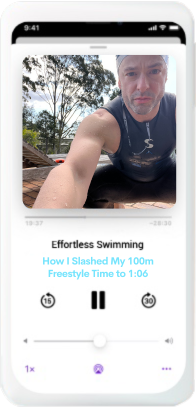
In this podcast episode, we hear from Jay Mueller, an emergency doctor who started swimming 16 months ago after injuries led him to take up the sport, as he could no longer run or ride. When Jay first started, he was averaging 2:15-2:30/100m and finding he was exhausted after a few hundred meters. Fast forward to today, where he is consistently swimming between 1:20-1:30 in training, with a personal best of 1:06 in the 100m freestyle. Tune in to learn about his transformation and the lessons he has learned along the way.
In this episode
- 00:00 Introduction and Background
- 4:21 Initial Pace and Improvement
- 7:21 From Fast Swims to Sustainable Laps
- 9:38 The Science Behind Shoulder Pain Relief through Static Hangs
- 15:27 Improving Rotation and Reach
- 18:22 Strategies for Maintaining Buoyancy and Momentum in the Water
- 23:15 The Challenges of Learning a New Skill
- 28:28 Importance of Body Awareness in Swimming Technique
- 34:09 Drills for Technique Improvement
- 37:47 Impressive Swimming Progress in a Short Time
- 38:34 Being Patient and Kind to Yourself
Links from this episode
- Change your technique and swim a smoother, easier freestyle with the Effortless Swimming membership
- Do you want to work with me personally to improve your technique? Join my swim technique coaching here
- Get 15% off our 8-week Faster Freestyle course by using the code 8week15
This podcast is brought to you by NanoClear — our own range of anti-fog swim goggles, designed by Effortless Swimming with the anti-fog treatment bonded into the lens itself (not sprayed on, so it doesn’t wear off after a few swims). Check out the NanoClear range here and use code PODCAST15 for 15% off.
Transcript
Read the full transcript
And as soon as I stopped doing that stuff, both in the pool, the technique stuff that you showed me and the stuff outside of the pool, you regress. So it was 100% worth it because it all worked out correctly.
And that I thought was good advice because when you’re in there, you’re like, I’m not rotating my head far enough. I’m not rotating my head far enough. But if you just visualize what you want to do and stop thinking verbally, then you have to feel it instead of think it with words. Welcome to the Effortless Swimming Podcast, the show that helps swimmers and triathletes love the water, become a better swimmer and live a better life. Here’s your host, Brenton Ford. When Jay Muehler started swimming 16 months ago, he came from a running and cycling background, but had no swimming background. So he learned as an adult. He came to one of our clinics 12 months ago. And prior to that, he was around 215 to 230 per 100. And when he came and saw us, he was just under that two minute mark. Now, fast forward to today. Jay is now able to swim consistently in the 120s. His fastest 50 is a sub 30 and his fastest 100 is a 106.
We don’t often see this kind of improvement this quickly. So I wanted to get Jay on the podcast to talk about how he was able to see such a big improvement in a short space of time. What drills and exercises did he do in the water to develop his stroke? And what sort of strength training has he been doing to avoid shoulder injuries and to develop the strength that’s needed to be a good swimmer? So let’s get into today’s episode with Jay Muehler. My guest today is Jay Muehler. Jay, you attended a clinic about a year ago now and you sent through a message just about how much you’ve improved since then. So I want to really get you on the podcast to talk about how you went from where you were to where you are now and what it took to get there. Because I love having just average swimmers on the podcast, not your Olympic swimmers to see how they’ve made big jumps in their speed, in their efficiency and technique.
Because I think that makes it a lot more real for people and it feels a lot more achievable as opposed to hearing it from Olympic or world-class athletes. So welcome to the podcast. Yeah, thanks for having me. Nice to see you again. Yeah, so yeah, I’m relatively new to swimming. Like I started swimming for my fitness initially in December, just December a year ago. So, you know, a year and some months and then a bunch of months off actually when I made a trip back to the States in Australian winter, but U.S. summer. So I’ve got just about a year of swimming under my belt now. And I started swimming because I’m a little circuitous. I’ve been exercising my whole life and I’ve raced bicycles since I was a kid. I was never a professional, but I was, you know, a reasonably good amateur in the U.S. and raised at a reasonably high level. And that’s my sort of my first love. But then the pandemic with my job, I’m a doctor.
I’ve made things tight for time. And then I started running and got sick running and got tendinopathy. And then I couldn’t run, then I couldn’t ride. And someone said, you might as well swim. And I was like, I don’t want to go swimming. I just want to get on my bike, but I couldn’t do it and I had to do something. So I started swimming and yeah, fell in love with it. And also because it’s such a tough nut to crack. So when I started off, it was just like anybody else, even though I had a big aerobic background. I was, you know, I diluted myself because I could swim back and forth in my backyard pool. I was like, I’m naturally talented. And then of course I went to a 50 meter pool and like was tough at 100 meters. And the first thing that happened was my partner had a friend in her yoga class who was a swim coach. And she said, you should meet with her. And I did. And she’s a great swim coach and she was lovely.
And she saw me swim and I thought I was God’s gift to the world. And she went like this and she said, come back to me later when you’ve dealt with some posture and other stuff. And that’s when I realized that it’s just totally different to any other sport. And I like to teach myself things, but I’m also well aware that once you get into the social media, YouTube realm, you can get overwhelmed with what’s out there. But I saw your videos and they made sense to me intuitively because I have sort of a background in anatomy and interest sort of in sports medicine and it related best to your stuff and started following them and trying to practice some of it and started to improve with that. And then met with you at a swim clinic in Brisbane and it’s just been continuous improvement since then. And when you first started, once you could swim more than 100 meters without stopping, where were you at in terms of your pace?
And where are you now for those that are listening? Yeah. So my pace when I first started, I think if I was once I started swimming continuously comfortably was in like the 230 to 215 range. And that was like if I was swimming continuously, I could probably get under two minutes if I was going hard. But one of the big things that happened was I came, I was here at work and I went to do a swim before work and I did a very easy 500 meter warm up. And then I was at like two minutes per 100 and I’m like, now I’m going to do a really hard 500 and I did and I went really hard and was still at two minutes per 100. And so that was before I saw you. I actually started to get a little quicker, but I started to have big time shoulder issues too. So I just finally I was like, man, I just got to see Britain in person and help sort it out. So I got to the end of last year and did NUSA as my first triathlon and I did a minute 40 per 100 by that point for the 1500 meters.
And I actually think my straight line speeds a bit better. But like, just like you have to make all the mistakes in the pool, I had to make all the mistakes in the open water too. And that was not, not being good at sighting at all and swimming way off course. So there was tons of like stopping, looking around for 25 seconds, finding the buoys and stuff. So it was a bit of a mess, but still quick enough to make me happy. I did that same speed in another triathlon and then things started to click in the pool. And yeah, now I think my fastest 100 I did was sort of this and it’s not with a diving start. It’s just with an easy push off off the wall and a tumble turn. It got down to 106 and then I can blast out a 50 free pretty well now. I’ve gotten below 30 seconds, which is good for me. That’s flying, especially in the 250 to 230 when you first started. Yeah, so I mean, I’m a sugar burner. I like to in bike racing, you know, you have all of these very, each of them love the VM2 efforts and effects.
But that’s, you know, that’s not my focus. My focus is to do some triathlon. So big, big, big change. But then just the like, if I go and do a swim that has a bunch of sculling and drills now. And then add back the stuff that’s at sort of a moderate pace, because, you know, when you’re sculling, you don’t carry a lot of stuff like that. I still end up, you know, pretty frequently under a buck 40 for the, for the entirety of the swim and pretty often in the 130s. And I’m starting to put together like, you know, continuous pieces in the in the 120s. It’s cool. Yeah. Huge improvement. So yeah, it’s like you’re making early on once you could swim continuously. What did what did you see in the in the clinic when we did the filming? It’s funny because I think I’d improved from your videos a fair bit by the time I saw you. And, and so the things that you, you changed at the time, I was like, these are very minor changes, but they were really big in the pool for my comfort.
So the biggest problem I had is this is a rebuilt shoulder here because it was a chronic dislocator. And this one should be rebuilt, but it’s held together with metal and all sorts of other stuff. And I was on my return because I was under rotating and under reaching. I was not giving myself enough room when I would come out on my return. And so I was just essentially impinging for the first part of the return, my recovery. So getting up on my side and letting the elbow open it up rather than trying to pull pull everything up and into my shoulder and decreasing the amount of space. That, that made a huge difference to the sort of sustainability of it. So it immediately like my best laps, which at that point were, I’d actually slowed down when I saw you because I had done some really fast swims, but it destroyed my shoulders. So then I had to rebuild my stroke. And my best laps then were like, you know, I started to just knock them down like I was continuously in the 150s, then 145, then 140.
And then it just, and that made those same laps, sustainable lap after lap after lap. Instead of just doing 100, having to rest 30 seconds, you can do the 500 at that speed before your shoulders tire out. And then adding a lot of the out of the pool stuff that we talk about. And some of which you told me about and some of which I found on my own has also made a massive difference. And as soon as I stopped doing that stuff, both in the pool, the technique stuff that you showed me and the stuff outside of the pool, you regress. So it’s, it was 100% worth it because it all worked out correctly. And what’s that look like out of the pool for you? What are you doing on a regular basis? Yeah, so the thing that made a big difference right away was doing static hangs. And so just it, and you know, it doesn’t sound like much. And I, I thought, you know, how can it make that much of a difference, but just a pull up bar and initially not even using my body weight.
And it’s amazing how little I could tolerate at first. I had to work up to using my full body weight for the static hanging by doing like five times 15 seconds with support underneath. And now I’ll do like five times three minutes of my body weight just hanging. Wow, that’s huge. Yeah, yeah, yeah. And that just, that opens, that opens up the shoulder space. And there’s a bit of research that, you know, shows that your supraspinatus tendon pulls on that coricoclavicular ligament. And so what that is, that’s sort of the boundary of the space you have for your rotator cuff to move around underneath there. And it opens that up maybe the same way that braces change the way that your teeth are, it changes, changes the structure. And so that gave me a little bit of space. And then cuff exercises, particularly external rotation on this side, because swimming is a very front, you know, anterior front activity.
You know, you’re pulling down with your lats and your pecs and you’re down there. And if you don’t, if you don’t work this stuff on the backside, your scapula doesn’t stick and glide to your back. And, and then you get the extra, your internal rotation ends up fairly strong from the swimming. And people still like to do that too. But then they forget to do appropriate and dynamic external rotation in the same position that you would do your swimming stroke. And if I do those things, the shoulder pain just goes away. But like anyone, you know, like I’m pressed for kids in a job and stuff like that. Yeah. Stay on top of it. The, the static hangs is an interesting one. I’ve, I’ve started doing those for the last couple of months. And like it’s, I can do probably a minute, I could do about a minute 30. Yes. Holding on. And it’s like, it’s really the grip strength that, that gives out the quickest, but I’ve built up to, to that.
And I can do like two, two by one minute, yeah, in a row with about 30 seconds rest. So five by three minutes is, is massive, but you’re, are you just doing it with one arm? No, not both. Oh, okay. Both arms. Yeah. Yeah. I mean, I think I have almost unlimited ability to just hang there. No, but it took a while to work up to it. It, you know, it took, it took a few months, months and months. But yeah, it’s, I, when I first went to do it, I mean, I couldn’t, I couldn’t hold my own body weight like at all. And I’m not, you know, not, it wasn’t a big strong guy, but I was not, you know, totally deconditioned, but it was just too painful, you know. And, and are you letting your, like you haven’t been in the shoulders come up just hanging like completely there? What’s the, or are you, are you keeping a little bit of sort of keeping it switched on a little bit or just letting it hang completely? No, I just, I, I get, I sink into it as much as I can and let the, and let the soft tissues and not the muscles stretch out as much as I can to just get, it’s, you know,
essentially you’re, you’re pulling up on that quark ocular ligament and that’s what’s causing a bit of the bone to remodel and stretching it out a bit. So yeah, I just, I, I really relax into it and literally hang out, you know, have a whatever’s on Netflix with the pull-up bar in my house here at work. What I, what I noticed as I started to, to do it is that at the point where I intern, I was reaching forwards and then rolling into that first part of the, the catch. That just felt so much stronger and more controlled compared to previously before I was doing it. Like it was a very noticeable difference between like the before and after with it. So for anyone listening, it’s like start slowly build up to it because you can, like if you just go too hard and you don’t, you know, you just try and overdo it. You, you might injure yourself even though you’re not moving much, but I know at the start, like I just, I was probably sinking into it a little bit too much.
And then I’d sort of come off a little bit sore. So like, yeah, start slow and build up. But yeah, yeah, yeah, simple exercise that can make, make a world of difference. I found, I found that super, super helpful. And I, like you said, it’s get it like, I find it super helpful on the recovery, but also just, you know, in getting, and you know, the catch is such a, like a conceptually fascinating thing. Like I didn’t understand what it was probably not until the last couple of months to really understand like kind of what it should feel like and what it is. But that idea that you’re get trying to get over the water. Like you’re not, it’s like you’re trying to get your arm around and over like a mass that you can feel. And it’s like you’re, you’re holding the whole thing from under your shoulder all the way out to that forearm that should be straight down. Then you want to get that mass behind you and getting the, getting the out in front, you know, elevating the pectoral girdle up right there is easier once you’ve done the hang.
That’s, that’s really interesting. So it was a matter of the recovery just being more what I’d consider open with it rather than trying to keep that hands to be close to the body. So that, that just frees things up a lot. Some, some strength work as well, especially for, as you said, external rotation, those static hangs. And then was there anything else that you’d worked on as well? Yeah. So the things that you had mentioned when I saw you were that I was under rotating. And I know that when I started and I first, I first, I was over rotating. She said, you’re rotating way too much. I was going to 90 degrees. They almost passed it. And then I had gone to basically being flat. So I corrected it way too much. And so just keeping, keeping that, you know, rotation in the upper body and deciding how much of it, like you said, to transmit to the hips, because the hips should probably be rotating a little less than the shoulders.
But you have to be careful because otherwise you start thinking too much in there. And so the thing that I worked on with you was how much I was rotating and how far I was reaching. And I’m like, initially, I thought, well, that’s two things to work on. But in fact, it’s, in fact, it’s just one because your rotation is your reach. Like you can, you effectively do both of them at the same time. And then you get up over the top of that catch with it. And the other thing that you worked on with me was how that’s transmitted and, you know, sort of through the core. And I will say that I, there are a couple of people here where I work who I met with and had a couple of light bulb moments. And you had talked to me about doing sort of fiddle faddle to make that connection. And so I would do that. I would do, you know, like one, one paddle and then the opposite flipper, opposite fin to sort of connect that core.
And I was like, great, that trains my core. And then I would just go back to swimming the way I did before. And, and I was swimming with one of those physiotherapists here and she’s like, so how much do you engage your core when you’re swimming? I’m like, oh, well, I do this drill. She’s like, right, but after you do the drill, do you keep doing it? And I was like, I guess not. And so then just connect, you know, you’re really sending the effort across your body with a connection in your core. And once I realized that, I actually realized that thing that swimming seems the most like to me and you’re going to say I’m crazy is actually Nordic skiing. And the reason for that is you’re constantly pushing yourself back into a glide because you want to maximize the amount of time you’re in that low drag position. And so you also went through with me increasing the amount of front quadrant time I have.
And so I’m really cognizant of keeping the arms in that front quadrant. So when I begin my catch here, I’m pushing myself into streamline, pushing myself into streamline. So you’re constantly pushing yourself into the lowest drag position. And once you start to feel the water, you can feel where you’re creating drag. And it all comes together with time and strength. And is there any mistakes that you made along the way where you look back and go, okay, I can see where I maybe went wrong here or focus on something I didn’t need to focus on? Or anything that you look back at and go, like in hindsight, this was the wrong thing to do or something I could have done better? That’s a good question. Actually, I have to think about it like any sort of like rabbit holes I went down that I probably didn’t need to. Yeah. Yeah. I think you said to me when I met with you, I was asking about breathing. I was definitely overthinking the breathing and you’re like, first of all, make sure you’re getting enough air because otherwise you can’t swim.
And I was like, no, that’s true. But then I, and then, and then I went back and I was thinking about it. And I’m like, actually, you know, I’m a doctor and thinking about respiratory physiology. Actually, what you’re doing is making sure you’re getting rid of enough air because what you’re really doing is, you know, your reserve of oxygen is pretty much always going to be okay. It’s very hard for people to drop their blood oxygen level, but you’re blowing off the CO2. And so the way I make sure I get enough air is by blowing enough off before I take the breath. And that’s the big thing was that I felt like I wasn’t, you do, you feel like you’re not getting enough air, but you can’t get enough air if you’re not emptying enough out to take, to take it back in. What I do is try to maintain that buoyancy and maybe just let a little out of the nose. And when it’s time for it to go, I’m still breathing from the top of my lung capacity.
I’m not breathing from halfway down. I haven’t let half of it out when it’s time to let it out before I breathe it, you know, and then back in. And in that way, I don’t oscillate in the water. I maintain the same buoyancy and momentum. That’s a good one. That’s interesting because the way I, the way I would, you know, often explain it. And I can’t think, I can’t remember that conversation, conversation precisely, but, you know, people always, people often are thinking, well, I need to breathe every three or every four because that way like maybe they feel better when they’re swimming and they can maintain a better stroke. And like bilateral breathing is certainly a good skill to have. But yeah, they’re doing it to the detriment of like, they just, they just can’t get enough enough air in. Especially if they’re going hard, they might need to breathe every, every two. But the point, the point you made there is, is a really good one that you’ve got to make sure that you are exhaling enough.
Otherwise, it’s just like, yeah, you just kind of topping up and topping up. And then you just never really get that, you know, that sort of clear that full, full, a lungful of air that’s this fresh air. So yeah, I haven’t sort of thought too much about it. But we, like what we want to try and do is make sure we have that little bit of exhalation from the start. And then just as you’re turning your head to breathe, have that bigger exhalation where you, you don’t completely clear the lungs, but you get rid of most of it at that point. So that’s the, that’s the way to do it. And I think it’s easy to overthink all these different parts of the stroke. But if you can have that very gradual exhalation with a bigger exhale just before you get your next breath, that’s, that’s the way to go about it. Before we dive into the rest of today’s podcast episode, this episode is proudly brought to you by Form Smart Swim Goggles.
They’ve been a long time sponsor of the podcast and they are my go-to goggles when it comes to tracking my training sessions and being able to see what’s happening in real time through the goggles. And we know swimming is a highly technical sport, but without the guidance of a coach on deck, identifying and addressing technique flaws can be a challenge. They’ve recently added a new feature to the goggles, Head Coach. And this addresses that problem head on. It gives swimmers improved access to their technique awareness, focused skill development and in-app education and analysis. Head Coach provides real-time visual coaching via the Form Smart Swim Goggles augmented reality display. During and after a swim, Head Coach provides swimmers with technique feedback using two types of metrics, Form Score and Head Coach Skills. Form Score is a measurement of overall swim efficiency ranging from 0 to 100, defined by your pace and your stroke length.
Head Coach Skills encompasses five key areas that will help you identify where to focus on improving with your efficiency. Head Roll, Head Pitch, Set Pacing, Interval Pacing and Breathing Time to Neutral. And after completing a session, you can check back in on the Form App to track your progress. And Head Coach provides swimmers from beginner to expert with an unprecedented level of data-driven guidance and understanding, enabling you to boost your performance and your speed. Get your pair of Form Smart Swim Goggles today. Click the link in our podcast description or use the code Effortless on Checkout to get 15% off your Form Smart Swim Goggles. Now, one of the things you mentioned at the clinic, because you’ve come from a riding background, and I think you’ve done a little bit of sort of teaching and coaching with it. And with your background as a doctor, you mentioned something about what happens when you’re learning a new skill.
I’d love for you to share that with those that are listening because I’ve actually said this at quite a few clinics because I found it really interesting and a great way to describe what people go through as they’re changing their technique. Yeah, so it kind of transcends each sport. Anything that is requires significant technique and neuromuscular coordination, which is a lot of different sports that you’re doing repetitively. So, like, gate retraining for running, changing the geometry on your bicycle, and especially with swimming because swimming is so much different. You can’t hide mistakes in swimming like you can with the other two. Initially, the best, the most efficient you will be is whatever you’ve been doing for a long time, even if it’s wrong. So, if I go, like when I started running, I ran cross country in high school, but mostly to stay in shape for riding bikes. And I didn’t, you never know anything about running. You run the way you run as a kid.
And then I did some work on technique and absolutely when I first started doing it, I felt less efficient and weird and wrong. Like, and the hard part is, is putting your faith in the person in front of you and trusting the process that you’ll arrive at a better place. And the reason that’s hard and it is because you feel strange and less efficient and you are. So, if you were to, you know, take a swimmer or a runner and, you know, measure their, their oxygen uptake and then have them change their technique fundamentally. Initially, their efficiency will drop and they’ll take, they’ll require more oxygen to do what they’ve been doing. And that’s because you’re using all sorts of accessory muscles just to make that little tweak because it’s not, it’s not like set it and forget it in your muscle memory. So with running, you know, when, when you start to shorten up your stride, increase your cadence and make sure that the contact point is underneath your center of mass.
Initially, that requires a lot of concentration, brain power, you’re moving your pelvis all over the place. You’re trying to keep your core straight so that the contact point is just underneath there and then you’re pulling too hard with your hip flexors and your efficiency initially drops. But if you, if you keep in mind that the goal is to dispense with all the extra motion ultimately and just stick with that one technique and do it slowly over time, you do, you do retrain. And then when that becomes your new way of doing it, if the technique is better, you will be more efficient. And with swimming, you’re always in the marginal gains part compared to the other two. So when I ride, you know, I’ve been riding time trials on a bicycle since I was a kid. And you get really comfortable feeling the wind and knowing you, you know, if you get really, if you’re really comfortable doing it, you can feel like, you know, being down like this and tweak things and feel where the wind is sticking to you and going over you.
But you have to be going really fast to feel it. And in running, you know, yeah, running doesn’t have a lot of that because you’re going slower the whole time. But when you get going fast enough, aerodynamics do come into it. Then you get into the water and the water is, you know, it’s viscous and dense. So you’re always in the marginal gains point in swimming. So there is almost no instance in which you’ll make a bigger gain by applying more power if your technique’s not there. Because you’re always in the drag limited portion of the sport from the second you get in the water. So, you know, you can ride your bike, you can ride at five, you know, five k an hour, you can ride at 10 k an hour, you can ride 15 k an hour. And you don’t have to think too much about what you’re doing with the winds. You can just ride for fitness. And if you’re riding uphill, you’ll get, you know, you’ll get some resistance and you’ll get fitter.
And then when you start going out, you know, with a group on a group ride and you hit the front with a bunch of people, your position has to be good. And you have to know, you know, where your actuation is and everything like that. And you have to be low in fairness. And that’s the, that’s the marginal gains part where the aerodynamics matter at 45 kilometers an hour. With swimming, whether you’re swimming at two 30, two minutes, one 30, one 15 or your, or your, you know, Michael Phelps, you’re in the drag limited part of it the whole time. And, and that’s the big difference with swimming. So that’s why, you know, you can do whatever you want with swimming. But if the technique is bad, you will never realize the gains and strengths you have. You’ll just, you’ll just work harder and, and make minimal changes in speed. That is a great point. And something that I’ve tried to instill in the athletes that I’m coaching, especially recently is just that body awareness, feeling like feeling where your hips are, where your legs, where’s your head when you’re turning to breathe, just building that body awareness and always keeping in mind that we want to first and foremost have good body position.
Because your fitness and strength does not really matter too much if you’re swimming like this. So we’ve got to, we’ve just got to work towards having great, great body position. Yeah. First of all, it’s so much different to, like as, you know, your proprioceptive system is a system that gives you feedback on position. And we’re so used to gravity doing that for us when we run or we ride a bike or you hit a jump on a mountain bike. And with swimming, the proprioceptive system isn’t getting gravity to do it the same way. It’s interacting with itself, right? Like, are my hips higher than my shoulders? Are they too low? But it’s not, you’re not getting it through your skeleton and up and traveling vertically upwards. It’s, it’s much different. You’re horizontal and there’s no ground underneath you. And so it’s, it’s much more subtle and a lot of it’s just time. Like it just takes time to build that awareness.
And I thought, I will say that there is one thing I’m going to say it. It’s from another YouTube channel. But where the guy said, it’s all out. Yeah. Where the, where the, where the guy said, stopped thinking with words and think with your body. And that I thought was good advice because when you’re in there, you’re like, I’m not rotating my head far enough. I’m not rotating my head far enough. But if you just visualize what you want to do and stop thinking verbally, then you have to feel it instead of think it with words. And that, that connects your neuromuscular system much better than thinking with words. You can think words all day long. But in the end, you’re going to, you’re trying to get into that flow state where you don’t have words and, and you’re sort of doing it automatically. And that, that’s the goal. So start by just feeling, you know, where you are in the water and can you feel the differences?
I do planks, but in the water. So, you know, we all, people do planks from their core and stuff like that. But I all go in my backyard pool and sometimes I’ll even take a picture of it to make sure like, you know, stick the iPhone there or stick the GoPro in the water to see if I’m doing it well. And I just float, hold a big breath in, make myself as buoyant as I can with my arms out and streamline and my feet out and see how close I can keep my feet to breaking the surface of the water and high without causing anything up front to sink. And when you practice it, you like over time, you get that posture correct and pretty soon your bones out of the water and your heels are out of the water too. And then you’re really using your back muscles to do that. And then you go to swim and you just stay really high and, you know, everything’s in one line and you go faster. Yeah. It’s like just going back to the like basics of like floating, right?
It goes a very long, long way. Yeah. Like that’s, that’s a great quote about thinking with your, with your body. It reminds me of is. So if you think of like music, for example. If you think of the, like the lyrics to like your favorite song, you could recite it word for word. Now, if you had just a written, if you just read that without any rhythm to it, without any beat to it, if you just read that, it’s unlikely you could remember like several hundred, hundred words. Yeah, that’s right. But if you put the rhythm and the beat and the tune to it, you’re going, you can remember it quite easily. And you can do that with like dozens, if not hundreds of songs, at least like part of it. And so I find it’s the same thing with, with swimming is if we can get out of like that, that overthinking brain where we’re thinking about all these like, yeah, okay, my rotation was my head. It’s like, okay, yeah, keep that in the back of mind, but really feel for it.
Can you feel for those, those things? And what does it feel like when you get it right? Because we can, we can do those things so much better if we are feeling for them rather than just thinking to try it. It’s, it’s, it’s huge. And, you know, when you were telling me, you know, when do you feel the water and where are you, where are you beginning to apply pressure? When I met you at the clinic, I was like, I don’t know. You tell me, I have no idea. And then, you know, with time and just sort of turning down that internal dialogue, you do feel it like you feel, you know, you start to feel the catch and you get your arm over that massive water. And you understand, you start, you start to understand why it’s called the catch. And it’s because you really, it almost feels like, you know, it feels like you’re almost like sliding your hand into the sleeve of a jacket, you know, like you can feel the massive water that you want to get around.
And then as you put pressure on it, if you put too much pressure, you’ll create turbulent flow and slip. But if you don’t create enough, you don’t maintain momentum. And so it’s, it’s a very fine line and more subtle and controlled than it is, you know, with bikes. Bikes are easy. Have a little harder. They go faster. Yeah. With swimming, swimming, you pull too hard. You slip in the water and create turbulent flow. And then you’re not moving that massive water anymore. You’ve actually pulled through the mass that you’re trying to move back. And that’s the problem. Were there any particular drills that you did over your time that you found were helpful for changing some of those things? Oh, yeah. Tons. You know, you had a podcast with Joe Freel on, right? And he’s like a hero. And he said, I think he was saying, like, you know, you could just do drills for your first year or something like that. And you’ve probably, and you might improve the same amount.
And I don’t know if I would only do drills and not swim, but I do tons and tons and tons of them. Lots of long dog when I was starting out, lots of long dog. And, you know, the stuff on the side and YMCA, tons and tons and tons of it for after I met you. Just to get the position in and also to make sure my entry was wide enough and that I wasn’t crossing over. I and really tried to get that down. And now I still do some of that, but sculling is huge. I find sculling really helps. And I think if I like what I this morning I was swimming with a friend and I was like, you can change the way your freestyle feels in 200 meters. And you do good. Do the fist drill going up for 50 meters skull coming back. Do the a okay drill going down and then swim your freestyle. So do 200 freestyle now and then 200 freestyle that way. And it feels totally different. You feel the entire catch. You feel the mass of the water.
You get a hold of it. You know where you want your hand, how far to keep the fingers apart and you shove that water behind you. And you, you drop, you know, six seconds off your previous lap. Yeah. As I said, it doesn’t take much at all. Just some, yeah, just just a good drill progression goes a very long way. And one of the drill progressions I’ve given a number of summers that I that I coach is I’ll give them. Just scaling to start with some front scale. Yeah. Then we’ll go into doggy scoop, then into long dog and then maybe into some single arm drill as well. Like that kind of covers all your, all your bases. And yeah, you can just get you feeling the water and feel that propulsion when you set yourself up well with it. So like it doesn’t, it doesn’t matter too much what the drills are. If it progresses and it builds on something that you need to improve on, that’s going to go a long way. And within 200 meters, a couple of minutes of swimming, you’re probably set up pretty well for the rest of the.
Yeah. So it’s worth doing each session, something along those lines. I mean, I think you have to. And to be honest, the best sessions I have are the ones where the percentage of the, of the swim is a bit more on, you know, focused on drills. And, and then, you know, drills into the piece back into drills into the piece. And, you know, it’s, I think there’s a video you said, if you don’t know what part the drill is emphasizing and what the result is, like, you know, the result you’re trying to achieve with it. The drill doesn’t do a whole lot for you. And so I think that’s part of the reason, like, you know, you go to the pool and there are some people that aren’t progressing. They’re like, I’ve done long dog a okay, and I’ve done this. And I don’t feel like I’m progressing. And it’s like, but when you do, when you do that fist drill, are you feeling the mass of water and then catching that mass of water behind the forearm?
You should start to feel like you’re, you know, sliding it over a ball and you can feel the ball. And then you have to decide how hard you want to push the ball, not too hard, not too easy, enough to keep momentum. And, you know, and it’s fascinating. It’s like, it’s, it’s been really a fascinating thing to start swimming because it’s just been so different than anything I’ve ever done. Yeah, that’s, I mean, to see you, to the fact that you’ve gone sub 30 and a 106 for 100 coming from just over 12 months of swimming is pretty ridiculous too. And it’s like, that’s, that’s a huge, like a huge improvement in a very short space of time, which I have rarely seen. So I think you’re, you’ve done a lot there where just probably really focusing on the technique and doing it the right way. And it sounds like the, your background as a doctor and knowing what to expect when it comes to those changes in the stroke and how long it can take and those sorts of things.
I feel like that’s probably helped you in fast track that, but the thing is like that’s, that’s knowledge that everyone can have and they can have that same approach. So yeah, it’s, it’s, it’s out there for, for everyone. Is there any advice that you’d give to someone who was, you know, maybe three to six months into their swimming and maybe around that two minutes to 230 mark where you were, what advice would you give to them? Yeah, a couple of things and that it’s, it’s not like technical stuff. It’s just the approaches. I think a lot of people, if you’re worried about your pace at all, it means you’ve got a little bit of that sort of type a in you. Cause some people are swimming and you ask, what pace do you do? I don’t know. I just swim. Fantastic. I mean, and good for them, they’re enjoying it. But if you’re worried about your pace at all, it means that you’re probably someone who’s invested a bit in their own performance.
And that’s the kind of person that often runs the risk of not being kind to themselves and patient with themselves. And I’ve probably, I’ve probably been that person to my own self a lot in my life. And it’s not helpful with swimming because when you get frustrated, you, you move out of the flow state and into your own head and then your performance will decline. And remember that you’re, you know, you’re doing it because it’s an enjoyable thing to, you know, we come from water to connect with the water is actually really an enjoyable thing. And your speed is a byproduct of the time you spend in the water acquiring that feeling and strength. And so, you know, my, my best swims, to be honest, where I are, where I start to swim and I don’t use the watch or the form goggles for the first part of it. I just let myself connect to the water and relax so that I’m not like goal oriented from the second I’m in there.
And just feel what I’m doing and then just relax and be, you know, be kind to yourself. And then it’s much easier to not overdo the things that make you less efficient. You end up faster that way. And all of it takes time. There’s no other sport where you basically are pulling, pulling things down from overhead hard. And so if you don’t have that strength from something else you’ve done, it, you know, that takes a long time. And I’m built way differently now actually than I was, you know, a year ago. I was racing, when I race bicycles, I’d be racing at 66 kilos and I’m like a 180 centimeter guy. So I was real light, you know, the widest part of my arm was the elbow. And now, you know, I’m fueling the efforts and eating an adequate dose of protein three times a day, especially on either side of my swim so that I can soak that up afterwards. And I’m almost 80 kilos now. Yeah. Yeah. So it’s like, it’s a, it’s a very big difference if you look at pictures of me doing stage races on the mountain like a few years ago.
And then what, what I’m like swimming now, it’s, it’s two different physique. And but that, you know, that takes time and food and effort in the pool. And maybe I did it a little quicker than some people, but that’s just cause I, I think it’s, I had a little extra knowledge base and some nutrition that I stuff that I transferred over from other sports. And I don’t take no for an answer maybe, but I think you’ll get there eventually it just might take a while. And in the interim, you know, you feel great. You get like, once you get over the, I can get enough air, you get out of the pool. Like I just went swimming with a doctor buddy of mine, who by the way is probably on track to make faster progress than me watching your videos, FYI. And we both came into work and he’s like, don’t you feel so he’s Brazilian? Don’t you feel so great that we swam this morning? I said, yes, I do. So it’s fun, you know, make sure you’re having fun.
That’s love. That is great, great advice for anyone who’s, who’s in that early phase, no matter where you are really, but in that early phase of your, your swimming journey. And I think if you’ve got that willingness just to be, to be patient and not worry about what the times are, just, just be diligent with what you do, then the, the results are going to come. So yeah, it happens. Yeah, it does happen. So Jay, this has been fantastic. I really appreciate you sharing how you got to the point where you are and just being willing to stick to the process and it’s fantastic. So thanks so much for sharing that and I can’t wait to see where you’re at in the next. Yeah, thanks Brenton. I’m sure we’ll be in touch. Yeah, it’s been fun and I really appreciate everything you’ve done. My pleasure. Thanks, Jay. All right, dude. Be good. Take care. Thank you.