








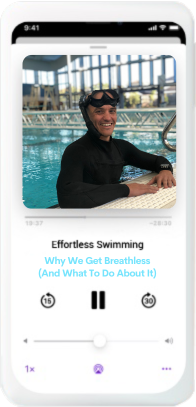
In this episode, we sit down with Jarrod Briffa, an Australian freediving athlete, instructor, and online coach trained in the Oxygen Advantage. Jarrod’s expertise lies in the power of breath and how it can enhance performance, reduce stress, and aid in recovery. As the founder of Drifters Freediving, he offers courses and private coaching to help individuals improve their breathing techniques. He has been the Australian Men’s Champion at The Pool Freediving National Championships and has represented Australia in pool freediving at international competitions. Join us as we explore the importance of proper breathing in sports and everyday life.
00:00 Introduction
02:37 The Importance of CO2 Tolerance in Breathing
04:57 Understanding CO2 Tolerance and Breathing Patterns
08:12 Assessments and Exercises for CO2 Tolerance
9:52 Diaphragmatic Awareness for Swimmers: Techniques and Benefits
16:57 Building CO2 Tolerance
20:28 Benefits of Nasal Breathing for Swimmers
23:00 The Science of Breath Holding: Understanding Your Body’s Responses and Limits
30:15 Breathing Easy in the Water: Effective Exercises and Techniques for Swimmers
38:40 Mental Strategies for Increasing Breath Length
39:43 Race Day Breathing Strategies for Swimmers
42:29 The Relationship Between CO2 Tolerance and Lactic Tolerance
47:37 The Impact of Proper Breathing on Recovery and Performance
51:09 Get In Touch with Jarod for Coaching!
Visit Drifters Freediving on their Website and Instagram
Follow Jarrod on Instagram
Change your technique and swim a smoother, easier freestyle with the Effortless Swimming membership:
https://effortlessswimming.com/training-and-membership-plans/?el=blog
Do you want to work with me personally to improve your technique? Join my swim technique coaching here:
https://effortlessswimming.com/stroke-analysis-membership/?el=blog
Get 15% off our 8-week Faster Freestyle course by using the code 8week15
https://effortlessswimming.com/8-week-faster-freestyle-course/
Watch the episode on YouTube:
Transcript
Read the full transcript
doing things like this really helped to increase my CO2 tolerance and improve my scores in those basic assessments. How you breathe during a 24 hour period dictates how you breathe for the next 24 hour period. So if I was hyperventilating all night during sleep, I’ll probably breathe more and be more breathless during the day. Welcome to the Effortless Swimming Podcast to show that help swimmers and triathletes love the water, become a better swimmer and live a better life. Here’s your host, Brenton Ford. Beyond poor technique and general fatigue, what causes breathlessness in swimmers? And what is the main driver of fear and panic when it comes to swimming in the pool or open water? Could it be as simple as the way that we breathe? On today’s podcast episode, I’m joined by Jared Briffer, who is a free diver, an instructor and a coach. And Jared’s professional and sporting life is based around the way that
people breathe. And on this episode, we’re exploring how you can improve the way that you breathe so that you can keep calm in high pressure situations so that you can improve the results that you’re getting in the pool and in the open water and so that you can recover faster. Jared has studied in the oxygen advantage method and he’s put his knowledge to the test, having represented Australia in multiple international competitions in pool free diving, as well as holding the Australian record for dynamic apnea, having swum 235 meters underwater on a single breath using a monofin. So let’s get into today’s episode with Jared Briffer. Welcome to the Effortless Swimming Podcast. I guess today is Jared Briffer and Jared, we go back a very long way now. I think we go back probably 18 years. And it’s funny how our paths have crossed recently. So we’ve sort of met at the pool swimming at the squad with a mutual friend, Jenny. And then I know over the last couple of years, you’ve been doing a lot
of free diving. And today, I want to get you on the podcast to talk about how we can use our breathing better, how we can breathe better, because I had a guest on the podcast a few weeks back, Frank Sol, and he talked about oxygen advantage and he talked about how he was taking some of his swimmers through a few exercises just to help them relax more, to breathe more effectively. And I had a lot of emails and Instagram messages just where I piqued their curiosity. People are really interested in this stuff. So I thought it’d be great to get you on to talk about something that you’re an expert in, because I know a little bit about it, but not much at all. So I’m really excited to chat to you today to dig into this topic. Yeah, awesome. Brent, there’s a massive passion of mine. So I love sharing and talking about it. So let’s jump into it just in terms of the relationship between CO2 tolerance and why CO2 gets a bad rap. And I think in my early coaching days, before I started to
learn more about how to breathe properly, I had an idea that CO2 is this necessary thing that we need to breathe effectively, you know? Yeah, well, I think like it often gets a bad rap, you know, like CO2, like people talk about it as a waste product. But it’s really an essential gas for oxygen exchange in the body. So I suppose it’s important to understand first like what’s happening when we’re breathing. So when we breathe, we breathe air in, it’s a mixture of gases, but the important one for us is oxygen. Inflates our lungs. And in inflates our lungs, we have different parts of the airway. So it goes down in a trachea, branches off into the bronchi, bronchi oils, which are more like the branches. If you think of the lungs as like an upside down tree, trachea would be the trunk, the bronchi oils would be the branches. And then at the end of them, we have the LBOLite, which are these little air sacs that inflate when we breathe. So every time they inflate, they’re full of oxygen, that
oxygen can be diffused in our blood. And then it gets transported around our body bonded to hemoglobin, which is a protein in our red blood cells. The reason why carbon dioxide is important in this relationship is that we have the oxygen traveling around our blood, but the strength of the bond between the oxygen and the hemoglobin is determined by the presence of carbon dioxide. So if we don’t have much carbon dioxide, the bond between the oxygen and the hemoglobin becomes really strong. And the hemoglobin wants to hold on to the oxygen. So we can have heaps of oxygen in our system, but we can’t use it. So we generally want to have like a higher or like a neutral or higher level of carbon dioxide so that the bond becomes weaker. And then we can use the the oxygen that our body is transporting around. And then like just to finish out that system, so we have the oxygen traveling around in our red blood cells. When oxygen is
delivered to the cells, then often CO2 is delivered back to the blood plasma, which comes back to our lungs. And then we exhale the CO2. And so our bodies are throughout the day, managing what they consider to be a neutral level of CO2. So we’re always sort of managing a neutral level and we do that through our breath. So how would someone not have a low level of CO2? Like what are some of those causes where yeah, where that wouldn’t be where we want it to be? Yeah, well, it’s actually like it’s probably more common than not these days. Like most people have some sort of dysfunctional poor breathing patterns. When we’re breathing more than our body’s metabolic needs, we will breathe off too much carbon dioxide. And so any mouth breathing is generally unless you’re at like 100% intensity is generally over breathing. And so we will be breathing off too much carbon dioxide, which is like changing that relationship between the
oxygen hemoglobin, but also generally will make us feel breathless quicker. So we should be breathing through our nose all the time. When we’re not in the water, it’s a bit hard when we’re swimming. And like understanding like or being aware of how we are breathing is something that’s quite challenging to do. So we spend a lot of our day like not really aware of how we’re taking those breaths. So in order to improve your CO2 tolerance, you really want to start by first building up a big awareness of how you breathe. Personally, like I had, when I started, I did oxygen advantage training, like probably five or six years ago now. And when I first started, I was already a freediver, I could already hold my breath for over five minutes. I thought, cool, my CO2 tolerance is going to be really good. And then I did some of the basic assessments for oxygen advantage. And I realized that I had what would be considered signs of
dysfunctional breathing. And that was like a bit of a shock for me because like breathing is like so important in everything that I do. So to like be like, you know, thinking that I’ve got dysfunction, it was I really wanted to know how to change it. And so the big thing that I noticed first was like how I was breathing during sleep. And I was often waking up with like a dry mouth, maybe a bit of drool on the pillow and I snored occasionally. And so this would indicate that I was breathing through my mouth during sleep. So that eight hours a day that I’m in bed, I’m always breathing too much. And I’m over breathing, so hyperventilating during sleep. And then what what happens with the breath is how you breathe during a 24 hour period dictates how you breathe for the next 24 hour period. So if I was hyperventilating all night during sleep, I’ll probably breathe more and be more breathless during the day. So like
even like doing something like climbing a flight of stairs, I would transition from nose breathing to mouth breathing. So yeah, like in terms of improving my journey, I’ve started with building the awareness. So first it was about how I would breathe during sleep. And, you know, probably many of the viewers as well probably seem like we’re taping their mouths like it’s been like something that’s become like very popular. So that’s something that I started doing a lot of. It’s like, it’s a simple thing like it’s just some like 3M micropore tape, just fold both ends and then just a little bit over you. And it’s just it just enough to while you’re sleeping. Yeah, while I sleep. So yeah. And so like that was a big one for me, I changed that first. And then after that, it was just getting aware of like the breathing throughout the day and trying to keep it nasal as much as possible. Most of us have these habits where we transition to poor breathing or we have like poor breathing habits throughout
the day. One of them like could be for instance, like even like you just like cleared your throat, right? Okay. So like anything like this, like clearing your throat, sighing, yawning, it was the one that I used to do a lot as well. We’re taking like we’re blowing off a lot of CO2 when we have these breathes. And so if we just go back to normal breathing after that, what happens is we have the neutral level of CO2, we do the big yawn, we drop the CO2 down. And if we continue normal breathing at this point, we start to establish a new baseline of what is normal. Okay. So if we’re like yawning all the way through the day or sighing throughout the day, and we’re not recalibrating after that, we basically set a new normal. And so our body gets used to having less CO2. And as soon as CO2 increases from there, we start to feel breathless and like we need to breathe more. So one of the things that I would do would be
after that big exhale, I would just hold the breath until I felt like the urge to breathe start to come. And then I would try to manage the breathing again at that upper level. And doing things like this really helped to increase my CO2 tolerance and improve my scores in those basic assessments. What are those assessments? So how did you, how did you realize that you weren’t as good as you thought with it? Yeah. So with the opposite advantage, the main assessment that we do with everyone when they start, it’s called a bolt score. And what it is, is basically breathing like you are now. So you’ve just got your tidal breathing where you’re inhaling and exhaling just softly through the nose. And it’s not a full inhale, because you know, you could breathe a lot more in and you could exhale a lot more out as well. It’s just this tidal breathing in this middle range here. And then when you get to the bottom of an exhale
in that tidal range, you hold the breath. And you see how long you can hold the breath for before you get a distinct urge to breathe. Now a distinct urge to breathe, it could be like an involuntary movement of the breathing muscles, it could be tightness in the throat, could be a need to swallow, something like this. When you get a distinct urge to, I need to breathe now, not just the, I’ve remembered that I’m holding my breath, but like, I’ve actually, I’ve got a distinct urge to breathe now. And then we would record what that time is. And so generally anything under 25 seconds would indicate that there is probably some dysfunction in the breathing. Over 25 seconds, we start to be in like more healthy breathing patterns. And then 40 seconds plus is optimal. So with athletes, especially, we try to get them like to 40 seconds plus with this bolt score.
Where were you when you started and where are you now with that score? So I was at like, I think like between 18 and 21 seconds when I started. And now I’d be like, well over a minute, I think. So yeah, and like, so much of that is through that awareness training and like just being really familiar with how I’m breathing. And like, when I do slip up, because we all will, like, there’s certain habits that like, you know, I’ve been doing for a lifetime, I can’t just like, switch them off overnight. But I’m trying to correct the breathing once I do make those habits. And for someone listening, so a really common thing that I hear in my coaching is that I’m like, I’m really fatigued in the pool. I get really tired. Now, outside of just the typical technical things that someone might be doing to cause them to, to, you know, to run out of breath pretty quickly in terms of like, their legs are sinking. They’re not breathing regularly enough. And just just those sorts of things outside of
that. To you, what do you think would be some of the causes of someone feeling more fatigued than they really, really should be? Yeah, one or two things, it’s going to be like beyond poor technique which you talked about, it’s going to be the poor breathing mechanics or it’s going to be poor CO2 tolerance. So we could probably talk about the mechanics first. So I’m going to just step back a bit so you can see. So when we breathe, our most efficient muscle for breathing is our diaphragm. So a diaphragm is like a parachute shaped muscle sits underneath our rib cage here. And when it contracts, it pushes the lower two ribs out. So we’ll inflate low into lower lobes of the lungs. We have a lateral expansion of these lower two ribs. And then when we exit, when we exhale, the diaphragm comes back into its resting position here. A lot of people don’t have good coordination of their breathing muscles. And especially with swimming, we see like a lot of
new swimmers, they sort of gasp when they take their breath. And what happens with that, they’re not using the diaphragm. They end up using the chest and the intercostal muscles. And so generally, when they take a breath like that, they’re only putting air in the top third of their lungs. Now they’re still getting air in. But I think it’s important to understand this concept that we have of dead space, right? So we have with each breath, we have about 150 mils of what we call dead space. So the air in your mouth, the air in your trachea and the air in your bronchies, that’s dead space. That’s not involved in ventilation. So that’s 150 mils of air that comes in and goes out and does nothing. So if you’re taking like short, shallow breaths, like you would when you gasping, let’s say someone’s like maybe getting 500 mils of air in, 50 mils of that air is in dead space. So there’s only really 350 mils of air that
is involved in ventilation at that point. And if they’re breathing like every two strokes or something like that, there’s not much time for that air to actually be diffused, like the oxygen from that air to be diffused into the blood or for CO2 to be diffused into the lungs to come out again. And so they’re going to feel breathless very quickly. Whereas someone who’s breathing well with their diaphragm, they’re going to have like, they’re going to pull air low to the lower lobes of lungs. They’re probably going to get a deeper breath as well. So they might like breathe in a liter. But there’s not the difference between those two breaths of air, the one breathing through the chest and the one breathing through their diaphragm. It’s not 500 mils versus one liter. It’s actually like 350 mils versus 850 mils, because the dead space is the same whether you take in a liter or you’re taking 500 mils. So the person breathing in the diaphragm is
actually going to get a lot more air to the lower lobes of the lungs. They’re going to have a lot more oxygen that’s involved in ventilation and being diffused into the bloodstream. And then they’re also going to get more CO2 out. Generally, when they’re taking those deeper breaths, there’s going to be more time between the breath. So there’s more time for diffusion as well. We would have like, when we’re training people, we have like a basic measurement that we sort of use to like see that people have good movement of the diaphragm. So what we would do is we put a ruler around the lower two ribs and we’re like there. So for me, I’m at about like 88 centimetres on that. And so you’d exhale first and then take a full inhale. And we want to get at least a 5% change in the measurement. Okay, it should increase by at least five centimetres. So yeah, went from 88 to 96 on this one. So like that would be more than sufficient.
And so when we say that like people are not getting such a big measurement, like they’re not getting the five centimetres, there’s usually coordination issues with the breathing. And these are generally pretty easy to fix. You see a lot of people that like breathe with the chest during the day. So you shouldn’t ever see movement of the chest just through your normal breathing. So usually what we can do is we can start to like assess like how people are breathing, training some like diaphragmatic awareness with the breath. And then that will improve that. And then we can take this into the water. Once people are more familiar with how the breath, how the diaphragm works, they can, they can bring it into their swimming as well.
Yeah, so training it, training it outside the pool, just getting those muscles working and just learning how to breathe that way. And then it’s much easier to breathe that way in the pool. Kind of like with some of the things that we like to teach in terms of the catch, for example, it’s like, if you can’t get it right out of the pool, you’re probably not going to get it right in the pool. It’s a harder environment to learn it. So yeah, learning it outside is the best way to begin. And you can obviously, like once you do have the awareness, you can start to, you can feel this on your stroke. Like when you take your, take your breath, you can feel that you’re feeling into lower lobes of your lungs. And you’re getting a full breath as opposed to that chest breathing. But then so yeah, the second, the second one would be around CO2 tolerance. So there’s like a few different ways that we sort of look at this. Like the
first one is sort of as I talked about, like, you know, it always starts with awareness with CO2 tolerance. Your CO2 tolerance is determined by how you breathe during a 24 hour period. So just doing like an hour of training at the pool where you’re doing like high CO2 stuff, that’s not necessarily going to improve your overall CO2 tolerance. And that’s sort of where I was at. You know, I was doing a lot of really hard freedive training and I had a good breath hold, but I was breathing poorly during the other 23 hours of the day. And so that was offsetting all that work. So like improving the CO2 tolerance is going to start with building that awareness first. And then we have like a couple of like assessments that we would work with. One is the bolt score, which we’ve talked about. So we assess where the bolt score is at. And then as people build up the awareness, we will see improvements in that bolt score. So if that’s
something that you like measure regularly, like you might do it like it’s good to do the same time each day, right? Maybe like first thing when you wake up in the morning, you could do it just before you go to bed at night, but do it at a similar time each day because you might notice differences throughout the day. And so you’d be trying to improve that. I like to do like with my freediving background as well, like do a maximum breath hold test with the people that I train because often with that, we can change people’s confidence with their breath. Like a lot of like extending the breath with the swimming or like holding the breath longer. Often it’s very foreign for people, right? Immediately you’re breaking a habit, right? Your body gives you signals that you’d normally breathe now. Why not breathe? Okay. And this can be really stressful. So on all our basic freediving courses, we work through like the physiology
and understanding like what’s happening in the body when we hold our breath and teaching the body that it’s safe to do this. Like the body is giving you signals that carbon dioxide has risen. Carbon dioxide is a primary trigger to breathe. We’re not getting signals that we’re low on oxygen. They generally don’t come until we’re like at like a saturation of like 50%, which is a long way away. Like most people couldn’t get there. So yeah, we want to like build the confidence of what we’re doing safe. And then the body will trust us. So yeah, for most of the people I work, we will do those tests. And it’s often quite profound experience for a lot of people. Like I had a woman the other week, she came to the course and she said, I can only hold my breath for eight seconds. And then she said, I’ve tried so many times I can’t get past eight seconds. And like, right, because I was like, okay, this is definitely
got a winner. Yeah, yeah, we can definitely help you. And so then on the course, I’m pretty sure she held her breath for like two minutes. And that was in the course of like, you know, a couple of hours of like understanding like physiology and then some basic exercises that did in the water. And having that experience, right of going from eight seconds to two minutes in such a short amount of time, it just really opens up your potential of what might be possible with this. So then like doing these exercises that you might do to like improve your, you know, number of strokes that you do between breaths in swimming or whatever else, you know that you’ve held your breath for two minutes now. So the confidence is there that you can start to explore these things and it is safe. Yeah, so they’re like, they’re probably the like the main things that I would start with with someone. And but then also like with swimmers,
one thing that I find is really important is their ability to recover with nasal breathing at the end of a swim. So when they’re at the ends of the pool, can they recover with nasal breathing and how quickly are they able to do that? So they might need like one or two, like big breaths to offload some CO2, but can they revert to nasal breathing quickly? And yeah, these are some of the assessments that I would do with people to sort of see what level they’re at and then how we can work on improving it from there. And the reason that they’d be better to recover with nasal breathing is in terms of those CO2 levels, is that right? Like can you explain that? It’s going to work on a few things, right? So recovering nasal is going to, it’s going to help to build your CO2 tolerance, right? Because you obviously, you’ve built up a lot of CO2 during the swim. And then the nasal is a smaller airway than the mouth. So you’re going to be able to breathe about a third of the volume of air in the same
manner of times through the nose as you can through the mouth. So you’re not going to be able to offload the CO2 from the swim as quickly. So that’s going to, you’re going to, you’re going to feel that and you’re going to have like a bit more urge to breathe at the start. But you will probably notice that your oxygen delivery is much better if you can manage that nasal breathing. And so you will recover quicker. I’ve been doing some counterintuitive in a way, right? Like it’s very counterintuitive until you feel it. And then you go, okay, this actually works, right? We’ve been doing a lot of stuff at the gym that I train at with the clients there. And it’s funny, like the first couple of weeks, they’re like, oh, this is terrible. I hate it. I can’t do it. Like, but within a month, everyone’s noticing that they’re recovering from really high intensity stuff much quicker with nasal breathing than they were when they were mouth breathing. And yeah, a lot of it’s just about changing
like those neural pathways in the brain that like, you know, this is the best way for me to cover, recover, and then, then they’re recovering quite quickly. So yeah, I love that. The the thing that that clicked for me there was that the the oxygen delivery was a lot is a lot better with the nasal breathing. Like to me, okay, that that kind of makes makes sense. Now, why, why it’s a preferred method to, to breathe. And I’ve been trying to do this for the last couple of years, ever since I became aware of it nasal breathing is better. That’s kind of all I knew, right? Like, but it’s, but yeah, I’ve been trying to do that. I never sort of knew knew why. So that’s, that’s a great way of explaining it. And to me, that makes it really clear on what the benefits of it are. I just want to dig into a couple of things you mentioned earlier. In terms of a maximum breath hold, how, how do you perform that test? Is there a certain way that you should breathe in the lead up to it? Are you doing
it sitting down? How do you normally perform it? Yeah, so it’s like, with any of this stuff, don’t do it in the water unless you’re with like a trained plate coach or anything like that. So like, if people are doing like a free diving course or something like that, that’s a really good way to do it if you want to do it in the water. But otherwise, you just do a try. The breathing that you do before the maximum breath hold should just be your normal tidal breathing. You’re not manipulating the breath at all. Okay. So you breathe as if you’re going to sleep at night. And the reason for that is like, like we talked about before, we want to have that neutral level of CO2 when we start the breath hold so that we’ve got that the bond between the oxygen and the hemoglobin is neutral, right? That’s they’ll release the oxygen, right? If we hyperventilate before, we will, we will delay the urge to breathe, right? Because if we hyperventilate, we’re going to drop our CO2
levels down. And CO2 is the primary trigger to breathe, not low oxygen, right? So then during the breath hold, it’s going to take some time before the CO2 gets back up to neutral levels. We don’t get any triggers to breathe that neutral. We’re not going to get triggers until it gets above neutral. So hyperventilating or breathing more than our metabolic needs will delay the urge to breathe. But it’s also going to mean that the oxygen and the hemoglobin are going to hold on to each other. So they got less oxygen. And so we are at risk of like blacking out if we hyperventilate before a breath hold. So we want to avoid hyperventilation at all costs. So any breath holding that you do, it should just be normal tidal breathing. You breathe as if you’re going to sleep, and then you take your full inhale in. It’s good to do a two-part breath, right? So use your diaphragm first, fill up, like it feels like you’re feeling the belly, fill up the belly first,
then you fill up the chest with the intercostal muscles. That’ll be your full breath, and then hold the breath. And then you’re just trying to relax as much as possible, right? So notice if you’ve formed any tension in the body, can relax it down, relax the shoulders, relax the neck, make sure that the front of the body is nice and soft. And then with any of the breath holding, it becomes very much a mind game. So it’s about finding some sort of process that works for you to stay in that mind game. And people are different. Some people are very analytical. They like to have like a task to do. Some people are really creative. They like to just go off, you know, imagine themselves flying through space or wherever they want to go. So yeah, about finding the right thing for you to stay in that situation. And then, yeah, obviously taking a breath down when you need to. I remember hearing Ross Clark-Jones talk, Big Wave Surfer, he said when he gets wiped out and you know he’s
going to be under for a while, he imagines that he’s in his disco underneath the water. He’s just enjoying the, enjoying the ride there. But I think I went to a course with Nam Baldwin. Do you know who Nam is? And I think it was there that I heard him mention that like if you are held underwater, you know, you feel like you’re running out of air and you need to breathe. But you at that point, you’re only about 50% of the way there. It’s when you start to get that, you know, that need to sort of gulp or that’s, that’s the trigger of when you’re starting to get low on oxygen. Is it like that’s the, that’s the point at when your body’s long enough to do it? Yeah. So it’s like, it’s different for like different people. And cause like I’ve obviously like I’ve trained a lot of people in this over the years. And so I’ve seen like a lot of different bodily responses that people get. Some people are not as sensitive to carbon dioxide as others. So some people are really sensitive to carbon
dioxide. I probably would have put myself in that category when I started free diving. And I would have got, I would get a physical urge to breathe quite early and it would be noticeable. You would see it in my body. Whereas now it’s like much softer and it’s later, but it’s still strong. Whereas like there’s some freedivers that I’ve trained and on a first course, they barely get any, you don’t know noticeable sign to take a breath and they’ve held the breath for like four or five minutes. So it can differ from person to person. But like a general rule that you could sort of say is like for a lot of people when they get that first distinct urge to breathe, which could be like movement of the breathing muscles, real tightness in the chest that need to swallow and stuff like that. Yeah, you’re generally at about like a third to one half of your maximum potential for that breath hold. I like at the world championships
a couple of years ago, I did my static breath hold and the guy that won was in like the heat before me. So I got to see, got to see him. And after my breath hold, I had a chat with him. And because I had for me on that day, got my first urge to breathe, what was pretty early for me around two and a half minutes. And I managed to hold my breath a bit over six minutes. And then he held his breath for nearly nine minutes. And I had a chat to him after and I said, you know, how was the breath hold for you? And he said, Oh, I got my first urge to breathe at about two and a half minutes. And then like his experience was basically exactly the same as mine. But then he managed to stay in that zone of like real urge to breathe for a lot longer. So yeah, it does differ from person to person. And I think it’s going to be careful with like breath holding and like just having like rules like this, where it’s like halfway when you get that like, because you do
want the body to feel safe. So like, CO2 has this like profound driver to induce panic. Have you, have you been with James Nester’s book, breaths at all? I’ve heard of it, but I haven’t read it yet. Okay, there’s a, there’s a great like part at the back of it, where he’s talking about this, this girl, and there’s a couple other people that they’ve found as well that they, they’ve got some disorder where they basically they’re amygdala doesn’t work, right? So they don’t have any fear response. And they tried like all these things to induce fear in them, and they couldn’t, they couldn’t induce a fear response. And then the scientists were like, well, let’s just try this one thing, we don’t think it’s going to work, but we’ll give them a mouthful of pure CO2. So they inhale a mouthful of pure CO2. And this, this woman, like there was like countless stories of things they’ve done to her to try to induce fear, nothing
worked. One mouthful of pure CO2. And within moments, she’s like grasping at the table, her eyes are like this, and she’s like terrified. And CO2 does can induce like quite a primal response in people. And it goes beyond just that like rational, rational response of like, okay, I need to take a breath. There’s something deeper happening that we probably don’t really understand yet. For that reason, it’s important that like with any breath holding work that you take it slowly, and at a pace that feels comfortable, you might feel challenged, but you still feel safe. Okay, so you’re not getting to a point where you feel like, you know, that something bad could happen or anything like that, you don’t want to be like pushing for results. You want to be like just comfortably exploring into what I what I like to call comfortable discomfort. Okay, so there will be a stage with like any hard CO2 training, or any long breath holding where it becomes uncomfortable, but you want it to be comfortable
discomfort. So we talked about a couple of things just in terms of like your daily breathing, how you’re breathing at night. And, and that’s those 23 hours outside of the hour that we’ve got in the pool, probably more important than anything else right in terms of just our yeah, how we our relationship with breathing in the in the water. Now, what about some exercises either on dry land or exercises in the pool that would help swimmers feel like they can breathe more more effectively, whether that’s not needing to breathe as as much or just feeling like they’re more relaxed and more comfortable in the water. What are some of those things that that we can do as swimmers? Yeah, I think I think at first like it depends on your level, right? So like if you’re starting at a level like, let’s say like that beginner level with CO2 tolerance, where maybe the bolt score is like 15 seconds or less. Okay, so do the bolt test. What did you get? Okay, 15 seconds
or less. Someone in this range, they’re going to become breathless very quickly. So I would start off with like awareness of the breath. So trying to make sure that when they are breathing, they’re getting a full breath in and also they’re getting a full breath out. And just being aware of how often they’re breathing. Okay, so trying to like make it more rhythmic and getting more familiar with like, you know, are they breathing every two strokes, are they breathing every three strokes, that sort of stuff. And then definitely like trying to focus on nasal breathing when they’re at the wall. So whenever they come to the wall, trying to focus on nasal breathing for the recovery is a really good one for beginners and people that are having trouble with this stuff. This is going to like during the swim, you will have increased the CO2. And if you breathe through your nose at the wall, you’re going to maintain that higher level of CO2 for longer. And this is going to help to
build up your tolerance to it. And then like any sort of kicking drills that they do, do that with your face in the water. So have a face in the water, you’ll be on breath of for a bit and then take breaths when you need to take breaths. But try not to do your kicking drills with the face out of the water. So that would be a really good way to incorporate those into beginners. Then as you start to become like more that intermediate level, that would be as people where like the bolt score is probably between like 15 to 30 seconds. Okay, so they’ve got generally a little bit better tolerance to carbon dioxide. You still would be doing like the nasal breathing at the wall. One exercise that I love that is quite challenging. So on dry land, and you might have seen this sort of thing before, like the I’ve nearly done do it because it’s a bit tight. Yeah, these training mask.
So these are really great like on dry land, but obviously can’t wear something like that in the water. But in the pool, what I do with my center snorkel is a tape at the end of it. So it’s got a small hole. I wouldn’t have two thirds of that tape. Yeah, there’s not much of a gap there. Yeah, I wouldn’t recommend people starting as small as I’ve got it here by like just even say if you did like half of the half of the snorkel to start with, what are you going to do with that? You’re going to create a lot more resistance for the breathing muscles. So the breathing muscles are going to have to work like a lot. It’s like doing weights for the breathing muscles. And you’ve also got a lot more dead space, right? You can’t get rid of as much CO2 because there’s so much resistance. And you’ve got the snorkel, which is an extension of this 150 mils already. Okay. So then you’ve got your 150 mils here. I don’t know. You’ve probably got
another 100 or so 150 mils in the snorkel as well. So you’re going to need to do longer, deeper breaths to get that gas exchange. So yeah, this is definitely one I recommend for that. So that’s going to train both the breathing mechanics and also the CO2 tolerance because you end up with like inhaling a lot of your exhaled CO2 basically. So it’s very good CO2 training like that. With those sort of exercises though, like I think it’s important to do them in a way like I wouldn’t go into doing like sprints or something with that. For me, like I generally do that sort of stuff at like maybe the end of a training session. So say I’ve just done a couple of K swim session and then I’m going to like have like 500 meters of like cool down. I’ll do that with the center snorkel in and I’ll just like try to manage like nice slow inhale and exhale for the whole 500 meters. And then like beyond that hypercapnic swimming. So high CO2 swimming is something that
is a really good way to do that to improve CO2 tolerance. So that’s just basically like increasing stroke count and you can continue increasing the stroke count as you get more advanced with the exercises. So like someone breathing every three strokes normally, they might increase the stroke count up to like five strokes and see if they can manage that. As they get more advanced, they might even go up to seven, nine or 11 strokes. You’ll, you generally find that at some point as you’re increasing the stroke count, you will need to slow down the swim a bit. Like you won’t be able to maintain the same intensity with that high stroke count. You will feel lactic as well. You’ll get because you’re not exhaling as much, you’ll get a bigger lactic build up. But this as well can be like good training to help improve your lactic buffering systems and so that you can manage lactic acid better. And is that something you do within a session or at the start or at the end like you
do with the snorkel? Or does it matter? Yeah, I think like if I was like, if I was training with like swimmers who were like focused on sprinting, I would probably do the snorkel stuff at like the end of the session. You could do it at the start of the session, but a lot of people find that if they’re not warmed up properly, it can be, can be quite hard on the breathing muscles to start with that tape snorkel breathing. So it’s generally better once the lungs are nice and warmed up. The hypercapnic stuff you can do at the start of a session, like it’s quite good to do at the start of the session. It sort of starts to prime you for like prime your breathing muscles, prime your CO2 for like just not needing to breathe as much. So like I generally find if I’ll start the session, maybe with like, you know, like 400 meters, 500 meters, 600 meters of like warm up where I might be breathing every like, you know, between seven to 11 breaths
per stroke. Once I start the actual like the meaty part of the main set, I’m not feeling like that urge to breathe as quickly, right? Because I’ve trained, I’ve warmed that up and I’ve trained that during that warm up period. So yeah, that’s what we on our one on Wednesday, we do sprint sessions. And usually at the end of the warm up or at the start of the main set, we’ll have some breath control, usually something like eight fifties off a minute or a 105 going starting with every three, then we go five, seven, nine. And then we go back down and start again. And it’s, I like as well, even like the mental aspect of it, where it’s, it’s counterintuitive, you know, you think that in order to get you some people want to get through those strokes faster so they can take their next breath sooner. But then you actually, you start to panic more and you start to get more fatigue, because you’re using more energy, you’ve got to be able to
keep yourself calm, cool and collected to do that. What in terms of the going through that sort of breath control work mentally, how could some, how can someone improve their ability to increase the length between breaths there? Because I know people have that, there’s that panic and that thought like a crap, I’ve really got to breathe here. And I’m not comfortable. So mentally, what can people do there? Yeah, well, I think like a lot of like the mental part is about building up that confidence prior. But I think you can do a lot of stuff with your breathing during that that’s going to help a lot, right? So for instance, like making sure that you’re getting a full exhale. So like when I do those long hypocatonic swims, I would be making sure that maybe like, you know, say if you were doing like nine, maybe at like the end of the fifth stroke, I’ll start exhaling a little bit through my nose. And then as I get to like seven or eight, I’ll dump the rest of it through my mouth, right?
And so making sure that like when I am at the end of that exhale, that I’ve fully exhaled and there’s room for another full breath in. Now, this is going to help you to offload more CO2 and make sure you’re getting all the CO2 out. But it’s also going to give you the confidence that you like, you’ve had that full exchange of gas, right? You’ve got rid of as much CO2 as you could, and you’ve got a full breath of oxygen in again. And so once you can create like a rhythm with that, so maybe you know that like every fifth breath, or you know, if people are less like every third breath, I’m going to start exhaling through my nose for a bit, and then by the seventh breath, I’ve exhaled everything. Once you’ve got a rhythm with that, your body just follows the rhythm. So like a lot of your success of being able to do that is about getting into rhythm with it. So yeah, like really trying to work on like having that rhythm
of you take your breath. There’s a few strokes where you’re just holding it. And then it starts to release slowly through the nose. This can like, you know, help with a bit more parasympathetic activation. That sort of nasal exhale is like more linked to parasympathetic, that slow exhale, more linked to parasympathetic. I think on a lot of swimming though, like, you know, that you’re never going to be in full parasympathetic, you’re working hard. So but it will help to keep the heart rate low. Breathing like that. And you’re just going to make sure that you get the full air out so you can get more every so.
And in terms of, I want to jump into breathing during a race because the mistake that I’ve made when I’ve explained breathing in the past is that people think that like they have to breathe every three strokes because then you’re breathing to both sides. And that’s the right thing to do, which is it’s a great skill to have. And it’s, I think it’s an important thing for most of us to develop. But sometimes people just need more air and they prefer and they’re better off breathing every two within a race. So can you talk a little bit about what to do on a race day in terms of the the breathing? Because I don’t want something to listen to this and go, yeah, I need it. I’m going to breathe every seven in my 400 freestyle. You’re going to be toast.
Yeah. So I think like it’s important like in terms of using the breath like this for swimming, like improving your CO2 tolerance, you’re trying to build up a good base, right? So you’re trying to create like more effectiveness and efficiency with the breathing muscle. So you can take that big breath and you can exhale properly, but also building up your CO2 tolerance. So you’re not feeling breathless during your swims. That’s going to help your lactic tolerance as well, right? Like as you, as you build up more CO2 tolerance, you naturally are building up better lactic tolerance as well. And those buffer systems work really well together. But once you get to race day, you don’t want to be thinking about the breath, right? So once you get to race day, you want to do that, you want to, you know, focus on your stroke, your form, like doing, doing all the things that are going to help you to feel as strong as you can in the water.
If you’ve been doing this training prior, you won’t feel as breathless on race day. But if you need to take that extra breath off the turn or whatever it is on race day, you take the breath, right? Whatever you need to do to swim at your fastest for the swim. The idea with this training is that if you’ve done it, if you’ve trained it regularly, um, your breath won’t be one of the things that’s holding you back on race day. Okay. Maybe your body or your technique or your form is, but your breath won’t be. And that’s what you’re trying to do with it. Yeah. That’s how I sort of like to approach your technique as well. It’s like, do the things in training to set yourself up and develop those, those habits. So by the time it comes to, to your race, it’s like, yeah, okay, have it in the back of your mind. You don’t want to, you want to make sure things don’t fall apart in the race. But the, the work’s been done or it should have been done.
And it’s really just about managing your, your effort and executing good skills and that sort of thing. It’s like, yeah, you got to do the work in, in the training, which is 99% of your time spent. And it’s that 1% that you spend racing where you just want to be able to forget those things because you’ve, you’ve made them automatic. You’ve made them a habit. Now in terms of lactic tolerance. So, um, you were talking prior to the podcast, you hold the national record for the eight fifties at me. Can you talk a bit about what that, what that is? And then just what you experienced throughout that and, and that relationship between the CO2 tolerance and, and lactic tolerance, because firstly, like this, this eight fifties at me is, it’s, it’s a crazy event. And that, that scares the hell out of me thinking about doing that. So I’d love for you to just talk a bit to that if you could. Yeah. Okay. Cool. Yeah. It’s pretty random event. So it’s eight 50 meter swims.
I do it in a mono fin. So I’ve got like the mermaid tail sort of thing. The, the 50 meters has to be underwater on breath hold. And then you’re basically trying to get the minimal time that you can for the eight fifties. So your, your recoveries are as, as small as you can. I think the last few times I’ve done it, and I’ve done my best times have been around sort of eight to 10 seconds recovery at the end of the pool. And then go on up here again. Yeah. I think like we were sort of talking about before the podcast, like the interesting thing I’ve noticed with that sort of training is that I usually, my years usually are broken up into two parts. So I have sort of half the year where I’m doing pool training. And then half the year I’m sort of doing depth training or I’m on holiday overseas sort of thing. And during that depth training period, I usually lose quite a lot of my CO2 conditioning because I’m not doing as hard CO2 training during that time.
And when I come back, when I start doing these drills, usually I get very lactic very quickly, like within a few laps, I can start to feel the lactic acid building up and I can feel it like it’s very hard to finish the laps without the legs starting to deteriorate. But as I train it throughout the season, and I’m doing like lots of, lots of hard CO2 training, lots of, lots of lactic training as well, lots of sprints and stuff like that. As I get to the competition part end of the season, the, the lactic is barely noticeable. Like I feel like in that sort of eight seconds or 10 seconds that I’m recovering at the end of the pool, I can start to sort of recalibrate the system and I’m ready to go for another 50 meters sprint again. So yeah, I don’t know, like obviously I’ve like learnt lots about that stuff through the oxygen advantage training, but it’s great to see like, you know, when you, you’re the guinea pig, and that
you can see the difference that it’s making because of the training that you’re doing. And yeah, the, the, the difference has been quite profound for me in the training. And so to be able to train that lactic tolerance for you, it’s just been, been just doing more, more training where your body’s
producing that lactate and then it gets, it has the ability to just clear it, clear it faster. Is that, that kind of where you’re heading with it? Yeah. And so, and on breath hold as well. So like by training, especially like we do some exercises dry. So one of the exercises that I do with people dry is it’s similar to the bolt test that we talked about, but we call it like paces and you’re walking when you do it. And so we do this like, so you’ll, you do a passive exhale, you hold the breath and then you start walking. And we generally aim for like people to get up to like 80 plus paces. But like with the freedivers that I train, they can get to a lot more than that. They might get to 160 paces or more. What’s really interesting, when people go like beyond that sort of 80 paces mark, they generally notice that at some point it’s like the legs just get like concrete, like it’s so heavy. And all they’re doing is walking, right? So they haven’t done
anything strenuous. They’re literally having a stroll in the park, but they’re, they’re on that passive exhale and they’ve disrupted the blood acid base. And so the lactic builds up very strong. And when they stop, like, you know, one of my coach, my gym coach, you know, she’s been on Ninja Warrior and stuff like she’s insanely fit. When we started doing this sort of training together, I don’t think her legs had ever been as heavy as they had been after this training. And quite the sound to be added have that response just from like going for a walk. So yeah, so you can do similar stuff in the pool with like, like short sprints, like 25s on breath hold or kick only like 25s or 15 to 25 on breath hold, where yeah, you build up this, you build up that lactic very quickly and very strong. So doing sort of repeat work like that. But again, it’s got to be in a safe way. Gotta make sure you’ve got people that can rescue and stuff. If you’re doing it, you will build up lactic
tolerance very quickly. That’s cool. So typically they’re breathing out and they’re walking and then breathing out, holding the breath from there. And the aim is initially to get up to around that 80 paces is a pretty good marker for people in the beginning. Yeah, 80 paces would indicate it’s like similar to getting like a score of like 40 on the bolt score, right? Your breathing is probably optimal. You’ve got pretty good CO2 tolerance. And then beyond that, yeah, obviously, there’s levels of, you know, beyond optimal. But then it becomes more of a sort of like athletic thing. Like once you start to go beyond that, you start to train other systems and you definitely train lactic training with that as well. Yeah, we’ve been through quite a few things here, which I’ve found so interesting. And it’s the way you’ve explained it has been really clear just on why certain things happen. So I think that like for me, that’s helped a lot. And I’m sure for the people listening,
that’s going to help a lot as well. Is there anything we haven’t covered that you think we should talk about or anything over your years of free diving and coaching that you think would be helpful for the general population to know? Obviously, the sleep thing is a major one in the nose breathing. Is there anything else that comes to mind for you there? Yeah, I think like what I try to encourage everyone that I talk to about breath is just to become more aware of how you’re breathing. So like understanding a bit better like the muscles that you’re using to breathe. And like we should always be like at rest or unless we’re at like very high intensity, we should just be using the diaphragm to breathe. We shouldn’t have much movement in the upper chest and the breath should be light, slow and deep. So I think like once you start to build up a bit of awareness around your breath, you can you see like countless impacts throughout your life. Like once I
started breathing better during sleep, like I couldn’t believe how well I was recovering from like hard exercise. Like I used to because I used to sleep poorly, like I’d train hard, but I was sleeping poorly. And like I would feel tired for days after hard exercise. And then yeah, once you started doing the mouth taping, like the recovery is just so much better. I’m ready to go again the next day. And so it just allows you to do so much more with life. And like not getting as breathless. You know, like I used to get breathless. I used to work on the third floor and I’d always take the stairs. And I would always be huffing and puffing when I go up. And you’re the guy too. Like you’re not tired. Yeah. And I was like, what’s going on here? Hey, so to get to a point where you can walk up those stairs and you’re not feeling like that, you can still breathe through your nose. You can have a conversation with someone
without feeling like you have to constantly catch your breath. It’s quite empowering. And yeah,
for me, it’s been life-changing. So yeah, like I encourage everyone just to get familiar with your breath. And like the breath, this does amazing stuff like in terms of like regulating your nervous system. So once you are familiar with it, you can use the breath as this anchor point that can help you to like calm down, to rest, digest like all that sort of stuff. So I definitely like we talked about like some hard sort of CO2 training and stuff like that. At the end of all my sessions, I try to encourage people to have some nice relaxed breathing where they’re not thinking about the breath as much. They’re just like, it’s nice, soft breath that’s just like in and out with diaphragm. It’s not meant to be like hard or challenging. Just some time for the breath to reset and for your nervous system to settle down again. And yeah, just doing some nice slow breathing at the end of a session is a great way to have
that reset so that you don’t take the stress of the session into your day with you. Yeah, so don’t get out before the cooldown like I sometimes do after a max effort 50 and rush off to, yeah, rush off somewhere. So I know you run courses kind of similar to what we do in terms of we run our half day clinics. You do a similar sort of thing in terms of like freediving and breathing. Would they be like suitable for swimmers to come along to learn more about their breathing or is it more specific to freediving? Yeah, definitely. I run individual coaching as well that can be specific for swimmers or surfers or anything else that people are sort of, you know, whether we’re using the breath in their activity, even just people that are wanting to get gains in the gym with their breath. Like I do some of that as well. But the introductory freediving course, whilst it is a freediving course, I think it’s great for like anyone who’s wanting to explore
more about the breath. Like freedivers obviously have like a very intimate relationship with the breath because we spend so much time like breathing and holding our breath. It’s a great way to learn like the foundational knowledge that you need to do it in a safe way. And then also progress your confidence so that you’re more confident to do the stuff that you might want to do in the pool with your swimming. So yeah, the introductory freediving course is a great way or just finding a breath work coach. Yeah, like myself or someone else that you can work with individually to explore more specific to your situation. Yeah, fantastic. Well, Jared, we’ll put all the links to where people can get in touch with you and find out about the coaching and the courses, Drifter’s freediving. So this has been fantastic. I really appreciate you sharing this stuff with me. And we plan to hopefully get together and go through some of this stuff in person because I’d like to
put together like a YouTube video to sort of show people some of this stuff and to try it out myself. It’s more of a selfish thing than anything else. But yeah, that’d be really cool. So hopefully we can we can see that up soon. Jared, anything else you want to add before we wrap up here? No, it’s been great chatting to you, mate. And yeah, I really love all the stuff that you’re doing and wish you all the best with it in the future as well. Yeah, no, thank you. I appreciate that. And this has made me really, really want to just be more conscious of my breath again, because it’s looked into it quite a bit a couple of years ago, started to become a lot more aware. And then, you know what, what it’s like, you just get, you know, sidetracked by other things. But this has given me a lot to try in the pool. So I’m excited to do that. So thanks again. I’ll catch up with you soon. And thanks for being on the podcast.
Cool, man. I can’t wait to hear how it all goes. Thanks for listening to the Effortless Swimming Podcast. If you’d like us to help you become a faster, more efficient swimmer, go to www.effortlesswimming.com.