








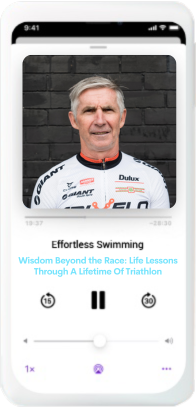
Joining me today is Gerard Donnelly from Trivelo Coaching, an Australian champion and podcast host. His podcast is a go-to for triathletes seeking insights from his seasoned journey in the sport. We’ll dive into life lessons from triathlon, smart training with technology, race focus, and the balance between short intense sessions and longer technique-focused ones. And, of course, get advice for those training for half or full Ironman events.
Check out TriVelo Coaching on Instagram!
Visit TriVelo Coaching Website
Related Content:
How To Fix Your Swim Stroke
In this episode
- 01:29 How the sport has changed in the past 30 to 40 years due to various evolutions
- 05:00 Getting ahead in technology helps coaches train athletes better
- 12:55 We’ve plenty of technology to test and train smartly, aiming for peak performance in races
- 15:44 Athletes should understand their body’s feelings along with data for better decisions during races and training.
- 22:01 What does perceived exertion look like for most athletes?
- 27:15 Form goggles provide solo training feedback, crucial for refining swimming technique
- 29:54 Avoid drifting and losing concentration during races
- 37:55 Key habits for faster triathlon swim times
- 41:57 The fitness component is the key to holding the form
- 49:20 Shorter intense sessions VS Longer technique-focused ones
- 53:10 What advice would you have for someone training for a half or full ironman?
- 58:10 A focused race plan lead to a positive experience and a more fulfilling life journey
Links from this episode
- Change your technique and swim smoother, easier freestyle in the Effortless Swimming membership
- Want to work with me personally to improve your technique? Join my swim technique coaching here
This podcast is brought to you by NanoClear — our own range of anti-fog swim goggles, designed by Effortless Swimming with the anti-fog treatment bonded into the lens itself (not sprayed on, so it doesn’t wear off after a few swims). Check out the NanoClear range here and use code PODCAST15 for 15% off.
Transcript
Read the full transcript
Welcome to the Effortless Swimming Podcast to show that help swimmers and triathletes love the water, become a better swimmer and live a better life. Here’s your host, Brenton Ford. Hi and welcome to the Effortless Swimming Podcast. My guest today is someone who I’ve had the pleasure of being a guest on their podcast a couple of times. But the first time you’ve been on our podcast, I’d like to welcome Gerard Donnelly from TriVallo coaching. How are you? Great, Brenton. I’m really happy to be here and privileged to be on your podcast and it is funny sitting on the other side not asking the question. So forgive me if I don’t answer the way that you expect, but I’m not, you’re really used to being interviewed, so I’m really a wrap to be on your program. We’ve known each other for you and your son, Jordan, who run TriVallo, who have both been to clinics, but I’ve been lucky enough to have a lot of your athletes that you
coach through TriVallo come to the clinics and work with them and help me improve their stroke, which we’ll talk a little bit about later in the podcast. But you have a very popular, very successful podcast where you have a lot of triathletes listening to you, looking for advice and tips and sharing your knowledge because you’ve been in the game for a very long time. You were an Australian Joathlon champion in 1988, the Australian Ironman runner-up in 1989, as well as being on the Commonwealth Games team as well. So you’ve had a lot of success as a pro in your career and now transitioning to coaching and working with a lot of different people, a lot of different abilities and things like that, so you’ve sort of very well versed in all different levels of triathlon. And one of the things I’d like to get stuck into to start with is how’s the sport changed over that time because there’s no way in 30 odd years that you’ve been
in the sport that it’s stayed the same. What are some of the evolutions that you’ve seen over the last 30 to 40 years? That’s a great question to start with. The sport has changed incredibly. And I think technology is the main reason, knowledge, people’s ability to understand a bit more about training and racing through technological advances of heart rate meters, power meters, bike computers, indoor trainers, medical testing with VO2 testing and seeing where your numbers are actually at for your ability and being able to train to those numbers. Bike technology, you would laugh at the bikes we rode back in the 80s compared to what we’re riding now. They’re just incredibly different. Shoe technology, skill and stroke analysis of swimming has really gone way ahead of, and you’re a great example of that. So I think in every facet of triathlon, it is just not recognizable. And I look at some of the great athletes of the 80s and 90s when I
competed and they would do very well these days if they had the same technological advances because they were still performing some outstanding times in the run, for example, that the running time really hasn’t come down a great deal, although it has in the last two or three years, which is amazing. But before that, the guys in the 80s are running similar times to what they were running in the 2010, 2015 period. But the bike is where the biggest change and the faster speeds have evolved from because the time trial bike is just such a game changer. And it also allows you to get off the bike and run better because you’re not as fatigued from riding a road bike with clip-on bars as we did in the 80s. So it’s come a long way. It’s unrecognizable in my opinion. And the times are reflecting that, you know, a time that I competed in when I won the Australian Ironman would rarely win my age group, let alone win the race outright.
So and I put that down to, you know, so many advances in so many different areas and the bike is probably the biggest thing. I think the bike I rode was a road bike that steel frame probably weighed twice as much as what the bike I ride now. And I think I could ride the same speed now as a 64 year old as I could as a pro when I was when I was 30 because of the bike. And that’s a big statement, I know, but to be able to, you know, I think I rode four hours, 40 or something, four hours, 50 at my best in Kona on a road bike, I could ride probably that time now on a time trial bike. It’s not because I’m a better athlete’s because I’ve got a better piece of equipment underneath me. It reminds me so much of competitive pools. I mean, with the blocks that you’ve got now there, you’ve got the kick step. You’ve they used to just die off the end of the pool a while ago. They’ve obviously got they’ve got the grip there.
And then they’ve got the the suits as well. Sometimes the walls are grippier with the touch pads. Like there’s technological advancements with a lot of those things where we have seen times come down. But in swimming there, well, they’re now being the supersuit times in nearly every event, which is amazing. The supersuits from 2009. So I think similar sort of thing where it’s like better training methods because we’ve got the data and we’re able to use it where we understand a lot more, but also the the technique side of things. I’d be curious to hear about your the change in the way that you’ve had to coach over that time. Has there been things come up, let’s say like VO2 max testing or using the Garmin watch to record your sessions? Have any of these things come up and you went like, I’m just going to sit back and see how this this plays out before I start incorporating this into my coaching or do you feel like you’ve been at the forefront of these these new technologies?
Where do you sort of sit in that in that timeline? Another really good question and look, if I put my coaching hat on, I would want to be known as a person who is really at the front of the queue for lining up to whatever is going to help our athletes. That’s that’s what I’m I’m invested in. And and I don’t mind if I don’t know anything about it, such as obviously my background is exercise physiology. So, you know, I was in a lab back in nineteen seventy seven when I left uni, left school to go to uni. So I’ve already always had that interest in in like the human guinea pig and what things could we do to make that person as a runner, improve or as a swimmer or as a bike rider or or gymnast or whatever sport they chose. And I just think that that interest in in my wanting people to improve has been the thing that’s driven me as a coach is is I will embrace any new technology as long as I see it’s got value
and and works for the athlete to get them to be faster in some capacity to to be a PB as an age group or a pointy end of the races to get on the top podium. But but that’s a key aspect of what I really embrace is if someone knows something that I could be doing in my program, I want to know about it. Yeah, I’d love to hear that. And just saying what you have put out in your podcast with yourself and Jordan, you are at the forefront there. You’re looking at recent races or recent technology training methods really diving deep into it, which I think is is really interesting. And I’d also love to know with with some of this stuff is there. Well, how do you rank them? What should people be doing? And what more secondary things that they could be using? If they’re a triathlete, let’s say they’ve been training for one, two years, then they’re not brand new, but they’ve been in the sport for a little while. What do you see as some of those key things
that can actually make a difference with someone’s results over time, whether it’s testing, technology, better bike, those sorts of things? Yeah, I definitely think there are lots of whenever someone asks me a question, I say there is never one answer to give as the reply. So there could be 15 things that could be ranked in order of what would be the most important. And and I can’t shy away from the fact that if you’ve got a really decent program, yeah, definitely ranking the priority of the importance of what people should be concentrating on is is I’m a big believer in. And I just think getting your getting your training program right first, I think is what people should be really concentrating on. People often ask me, can I do extra this? Can I do extra that? And I’m forever saying, look, just do the program to start with. And then as you get a customer and adapted to the program and your body’s coping with the training load, then we can add
some some other important aspects to the actual program. And at the end of the day, that that I think is is going to get you more bang for your buck if that’s what you’re after. And at the end, I suppose the technological side of things is really important. But if we just get the training right, then we can add the technical things to that program. And what do I mean by that? Probably the testing side of things in your program is key. We really are firm believers in if you don’t know where you are in a given month or week or or block of training, then it’s hard to train accurately in the right zones. And that that is a little bit less significant in swimming because the margins are so small. We’re talking seconds per hundred. Whereas on a bike, you could have 10 or 15 or 20 watts difference, which means you will be training too low. If you don’t adjust your power up as you’re improving or you’re training to too hard and failing all the sessions
if you have had a period of three or four weeks of sickness and you haven’t trained well on the bike and you resume trying to push the power that you were pushing literally four weeks ago, but you can’t do now because you haven’t been training and you will fail all of those sessions because you haven’t adjusted your power number in in your in your settings. And that has a catastrophic effect on people’s mental health almost because you start to feel like a failure and it’s actually got nothing to do with that. It’s you’re actually training to the wrong numbers according to the current level of fitness that you’ve got right now. And I think once people understand that there will be periods where you need to keep adjusting your your zones because you are having periods of improvement and you need to train to those better, better speeds, better power, better pace. And then you’ll have periods where you’re maybe in a
downtime where you’re just trying to maintain fitness and you’re not trying to improve. You’re just trying to keep your fitness going. So, you know, don’t oh, we have example of that would be someone’s got their A race. So they went to the Australian 70.3 titles and they had a four week period afterwards where they wanted to recover and reset for the next day race. They would go into that A race with the peak pace on the pool, power on the bike and running pace as a runner. And then four weeks later, for some reason, their expectation would be that that’s where they their fitness is still at. And in my opinion, in my experience, that’s just not true. You need to actually retest yourself after a two or three week period to find out is your power number down 15 watts or is it down two watts? And if it’s down to what’s great, we can resume training. If your running pace is down from four minute K pace to four, four twenty,
then we have to adjust the running pace. If your swimming pace is lost two seconds, we need to adjust it back a bit. So so you’re always going to be training at the level you’re at. And I think once people understand that aspect of their training and that’s something we didn’t do and had no capabilities of doing in the 80s and 90s, because the technology wasn’t there. So we’re at such a great advantage now, not only understanding how to train better, but but to actually test ourselves over periods, whereas we used to use racing as our testing to say, you know, well, I ran the half marathon in one eleven or one thirty or two hours. And next race, I did it in two minutes slower or two minutes faster. Then I get perspective. Same in the in the water, even though, you know, a swimming race in a triathlon, the distances could be two or three hundred meters out or a kilometer out. Sometimes in, you know, if you’re swimming downstream in a river
or something like that, you can’t really compare times that well. So so so really trying to do a science lab type of testing where you’re doing a pool swim over a thousand metres in a pool is really great to to re-measure time and time and time again. The swimming pool doesn’t change its length. There’s no wind. There’s it is you’re comparing apples with apples as a runner, 10 K, 5 K. They’re really great ways to measure your improvement or or loss of performance. And same on the bike, we do an FTP test over 20 minutes. We should be doing 60, but it’s hard work convincing people to do a 60 minute or one hour P test. So we do 20 minutes and take 95 percent of that. And and that gives us our training zones so that we are really training accurately at the current level where we’re where we’re at, whether it’s in the, as I said, in the phase where you’re recovering from a race or whether you’re in a building race period
or you’re in the middle of winter, where you’re trying to, you know, in a base period or whether you’re at the pointy end of the race ready phase. We have so much technology that will allow us to test ourselves so that we are training in the right zones and be improving so that we get to the race at our peak performance. And and they’re the things that I think the most important things that if people get right, they will continually put layer and layer upon layer of fitness to get themselves to continually improve. And whether that’s a really sharp curve or whether it’s a long, slow drawn out one is dependent on how consistent you are. And it’s also dependent on the amount of time you have to put into the sport. And and we have so many variations of that. We have people who can put six hours a week in and we have people who can put 20 hours a week in. So the rate of improvement is very reflective of the hours
you can spend in in preparation. And that doesn’t mean just doing throwing thousands of hours at something. It has to be doing the hours the right way. And I suppose that’s really the number one thing that I’ll be pushing to any athlete, whether they’re new elite or someone who’s been doing for two or three seasons. There’s a lot of great points there. The first one being it’s hard to steer a parked car. If you’re not doing the training, well, yeah, there’s nothing that we should really add in. It’s like, all right, let’s just see how you’re going. When you’re doing the training, OK, let’s get that sorted first. Get the foundation there. Then we can look to add or or remove things. So you’ve got to be be going, first of all. The other point that you made there is you’ve got to know where you’re at and you’ve got to know where you want to get to. So that that regular testing is key. And, you know, for training zones, for example,
with with swimming, I did an episode recently on on CSS pace, which is a similar thing to like the thousand meter swim test. It’s essentially going to give you a very similar number there. And that can allow you to set those those training zones that that we want to use to build that that aerobic base and that that fitness there. And if you know roughly where you should be, then you can make sure you stick to that in those in those key sessions. And I know with with swimming, in particular, we have some average sessions. We have some great sessions. So that does fluctuate and it might change if it’s a really hot pool as well. I was training in a indoor 25 the other day when I’d normally be an outdoor 50, which is same temperature, clean air. And I go to this indoor 25 and my pace was right. I know it’s probably four seconds slower per 100 in a short course pool compared to a long course because it was just so hot and I just couldn’t push above about 75 percent.
So you sometimes got the variables there with with pool temp and air quality and that sort of thing. You’ve got how you’re feeling that day. But we just need to get those those numbers to be able to to use them. One question I’ve got is how have you seen things change from having that perceived effort? You know, when we didn’t have watches, we couldn’t track that stuff.
There’s a lot more perceived effort, you know, how you’re feeling and being in tune with that. Do you think that that’s gone away with now people are just so involved with the technology or do you try and encourage them to to find the happy balance between the two? What are your thoughts around that? And how do you like to coach your athletes when it comes to perceived effort and keeping in mind you’ve got the garment as well? I love that question because it’s it’s one of the things that we’re really adamant in trying to get across in our podcast is we are very driven by data. There is, you know, we are known as people who are just, you know, entrenched in in understanding the data. But but the thing that people forget is we are also trying to get the athlete to understand what the data feels like so that if for some reason your swimming watch isn’t working and you’re using form goggles or whatever the, you know, you’ve got some some data coming into your eye on your bike.
You’ve got your power meter and your heart rate and your cadence and your average speed as a running. You’ve got your running pace, your heart rate. So all of these pieces of data coming back at you as you’re competing, helping you make really good decisions about what you should be doing at any given time during that actual race and in training, of course. But but what about how you feel and and that is so it’s almost 50 percent of of the answer. So you need to be really thinking about what does one 30 pace feel like without me looking at my watch? What does four minute pace as a runner look feel like without looking at my watch? What does 200 watts feel like without looking at the power meter? And, you know, I’ve done this to myself plenty of times. I’ve an example would be if I did five by five minute efforts at 200 watts. I would cover my garment over with a towel and try and ride one of the five minutes, not looking at it and just trying to to get as close
to 200 watts as I can. And then the next effort, opening it up and having a look. And and really, that’s a way to to to get your body to to think about what that feeling is, because you have to force it, train it to understand what is the feeling of this? Of course, there will be days where the temperature in the room or outside changes. And the example I give, I’ve done so many zone two bike sessions and you’ve just given one with the with the pool temperature indoor temperature outdoor and on a bike. The same thing happens riding your bike in Melbourne in zone two. My heart rate for 200 watts might be 125 beats. Doing the same session in the Sunshine Coast or cans. My heart rate could be 525 beats. It could be to 200 watts down in Melbourne. It would be probably 160 watts in cans. So I would lose 40 watts for the same heart rate just because the body is responding differently to the conditions of the day.
So they’re really important things that will affect
the actual race. If you’re in a race in a hot climate, you haven’t been like a classic example is going from Melbourne winter to Kona World Championships. So we trained all basically major in July, August, September. And then we arrived at Kona in October and having not spent one day and a temperature of pretty much above 15 degrees and we get to Kona and it’s and it’s 30 plus degrees with humidity at 90 percent. And there’s the lava fields are reflecting the sun back in your face. So you’re now experiencing a heart rate response that’s different to what you’ve been training in. And so 200 watts in Melbourne, 200 watts in Kona will give a completely different outcome physiologically to your body. And therefore, if you don’t recognise that and adapt to it, if you try to ride to the same power, you will probably end up having a horrible day. So you’ve got to adjust or climatize before you get there. So there are examples of understanding how important racing and training
to feel is a part of your training learned process. And and you should be trying everything you can to make sure that you are continually checking or how does this feel? And some days you’re going to feel like if you’re in a three week block and you’re in the third week and you’ve got a massive amount of fatigue building up, you’re going to you’re going to feel like 200 watts. It was like 400 on week three. So you should adjust down and don’t just follow blindly that you should be doing 200 watts adjusted down to 180 if you have to so that you get the same feeling of the outcome of the session. And and people are really scared to do that because the session says do this and and we’re one of the things we do is we give people a range all the time in swim, bike and run a range of time in the pool. If you’re if you’re trying to swim some threshold stuff and your threshold pace is 135, we would give you between
133 and 138 pace or 140 pace just so that you’ve got a top and a bottom. And you can you can go by how you feel on that day. And if you woken up tired and didn’t sleep all night and the kids were keeping you awake or or you didn’t eat well or whatever the reason you can adjust according to how you feel. And so that’s where that feel comes in in training. And and on race day, if you arrive on race day, you want to be at the peak of your performance. That’s you’ve tapered for this main race and you don’t feel it for some reason. You’ve got something wrong. You can’t blindly follow the plan that you’re supposed to do because you will end up going worse on the day. But if you’re in tune with 200, I keep using the one example of 200 watts. 200 watts is what I’m supposed to be racing at. I can’t do that today. So don’t spend the next 90 K trying to get to that number. Spend five minutes saying, well, that’s too high for me today.
I need to reassess and I need to actually drop my power by five or 10 watts and see how I go with that. And keep reassessing how I feel throughout that experience. And you you will still get some good training and racing results because you’re in tune with how your body’s coping with the task that you’re setting it. And do you have any athletes racing that don’t use any data when they’re racing, they prefer to just go by feel. What’s what’s that look like for for most of your athletes? Yeah, look, a lot of the athletes who come to us have actually been racing like that. And and it’s my job to to to bring them around to to use the technology to their advantage. And if I can’t convince them to do that, then I’m not actually coaching them very well. I would try to point out that that’s great what you’re doing. It’s actually fantastic. You can actually be that close to what your current level of racing should be at.
But let’s just check it. There’s no harm in checking to see, you know, what power or what pace or what pace per hundred you’re able to swim at. Let’s just check to see because I would I would hazard a guess. And I’ve actually done this many times where I’ve said to people and Jordan’s done this in many of his sessions where we’ve experimented on just making him try to do two minute. He’ll repeats where he’s not allowed to look at his watch and and he’s he’s tried to run at a pace like 310 pace up the hill and then do that for the whole session. And, you know, he’s felt like he’s done every session, every effort the same. And when he’s gone and downloaded the session, it’s gone 310 pace, 311, 315, 317, 320 because he felt like he was pushing as hard as he could. But had he been able to check after the end of that one one effort, he would know that, well, that’s my pace is dropping. I need to actually reassess and try and put more into it,
even though it feels like I’m giving the same effort as the first effort. But of course, you’re fresh on your first effort and you’re not as fresh as you are on the sixth effort as you are on the first effort. So that’s where the perceived exertion formula has some flaws because you feel like you’re putting the same effort in. And the power meter on the bike is great for showing that you bust in your guts for five minutes times five efforts. And you could look back at your data if you just use perceived effort and the power numbers would be just dropping the whole way. But every time you keep glancing down, you see that it’s dropping and you put more effort in and you feel like, boy, this is getting harder. But that’s what the power meter is telling me that I’m dropping. So they’re the things that the technology can really help us with. And once athletes hear that and see it in their own experience, when we show them a session where they’ve they’ve actually faded
and they think they they didn’t fade because of the perceived exertion experience was I did my best over the five efforts that you’re asking me to. And I’ll show them while you fade it. And then that’s kind of a moment of, well, I thought I knew what I was doing. But the technology is actually proving that I’m a little bit off. So we do have that experience. Yes, definitely.
When I did a half wine, man, what I spoke to friends, they said in the run you’ll you’ll probably feel like you’re going really easy, but you’ll be going way too too fast. So just be be mindful of that. And I remember coming off the bike, you know, legs are feeling good. I’m like, oh, this is really easy. And I look at and the first K comes up on the watch and I can’t I can’t remember exactly what time it was either three thirty or four minute pace. And I was trying to run either either four or four thirty pace. I can’t remember exactly. But thirty seconds faster than what it should have been. And I was just like, oh, my God, I’m glad I looked at my watch here because I just pushed way too hard. And I couldn’t have kept that up if I if I’d just gone by gone by feel. So it’s it’s great to be able to marry the two together. It’s just such an advantage that makes makes a lot of sense. And the other thing I really like with.
Using data to especially in swimming is using the form goggles to be able to make a change to your stroke and see if that’s made a difference to your times. An example of that was I did a set on Friday last week. It was twenty fifties on the minute and it was best average. It was kind of as fast as I could hold across all all twenty because I didn’t have long and I thought I just want to get a good session in. But I’ve only got twenty five minutes. So it was warm up and then twenty fifties on the minute. And for the first twelve of those, I was holding about thirty three roughly. And then I made one change to my stroke for the next eight where I was working on going a little bit deeper with my cats because I have a tendency to just to not go deep enough through the first part of my catch. And it just means that I’m just sort of pulling pulling a bit short, not getting as much power as I could and not holding the water as well as I could.
So by going that little bit deeper with my catch, it came down a second and a half as like thirty one mids for the for the rest of them. And that was a massive change over the course of just a fifty for me. And so I was like, OK, this is this is really good. I’ll keep working on it and to have that that immediate feedback when the the number pops up in your eyes. It’s like, wow, OK, this is so tangible and it’s a direct cause of the change that I’ve made. So that’s one of the real benefits I think you’ve got with with the form goggles. When you’re working by yourself, you haven’t got a coach on deck giving you times and giving you splits. So you can use that to your advantage as well. And I mean, you can use it to if you’re just looking at it on your your watch. It’s not quite as accurate sometimes because you’re having to stop the watch and all that sort of stuff. But you can use that for your for feedback.
Have you sort of you have you experienced that sort of thing with yourself or with your athletes where you can make a change and see the result there?
Absolutely, mate. And the swimming example is a great one. And I’m forever trying to do that, having grown up as a squad swimmer, as a five year old, six year old, you know, in the local country club down in Warrigal, just up the road from where you grew up. And and, you know, certainly I had some sort of technique that I had in those days and I don’t even know how it evolved. But but now as a swimmer, you know, 60 years later, I have felt like I don’t have a stroke that’s resembling what I used to do. And so I’m forever looking at my form goggles, even in the middle of a swim where we’re in an actual so I’m doing four 100s. I’m I’m absolutely trying to adjust my stroke to see whether I can do something better in that hundred. So I’m I’m absolutely looking at that the whole time. And on the bike, I’m forever telling people they’re just so determined to push the power. And when that happens, they forget about pedaling in 360 degree circles.
They just push down harder. So we’ve got three muscle groups. We’ve got the glutes, the hamstrings and the quads, the major muscle groups that drive the pedals. And if you’re just pushing down for that half a stroke, instead of actually engaging your glutes and your hamstrings for the up pull, instantly the power goes from what it was five or six watts within two pedal strokes. The power goes up and they’re great examples of minor adjustments. And I’m forever telling people if I’m actually watching them on a hill climb or I’m saying, you know, don’t forget to engage, engage your glutes, you know, pull up, pull up on the stroke. And and you’re assisting your push down by pulling up. So you’re recruiting, recruiting all the three major muscle groups to help you improve your, your power number, which is going to make you ride faster. And that’s a classic example. As a runner, you would, you know, people, I know Tom, Tom runs with a very upright action.
And, and we know from biomechanics that, that if you actually lean forward slightly, you’re going to land your foot underneath the view from if you look down and run a string line from your forehead to the ground, that’s where your foot should strike the ground. And the further back you lean, your foot’s going to be, you know, half a foot in front of your eye. And so therefore you’re breaking every time you land with your foot and putting more force through your body. And a little tip of just lean forward a little bit more is going to actually accelerate the pace and make the running action easier and less load on your body. So there, there are things that you should be thinking about as you are competing as a swimmer and as a bike rider and as a runner, when it counts the most in a race. And, and I’m always asking people, what are they thinking about when they’re racing? And, and when I, you know, when I ask them that they’re sometimes they’re just drifting along
and, and not until they come to a corner, they have to actually concentrate again. And I’m in my, my chats to my athletes before a race, I will talk to them about what should you be doing in the swim? What key things should you be concentrating on when you get in the water? And I ask that question to them. And some people are great. They fire back at me with, yep, I’ve got to actually try and get some feet. I should be looking for the, the marker boys. And I should be really concentrating on my technique. And I’m going brilliant. That’s fantastic. That’s exactly what should be happening. And if you’re not thinking about that over and over and repeating that, then you will be have periods of drift where it’s a, not a pun intended there, but you will drift off to sleep almost if you’re not concentrating on what you should be doing and your times will drop off. If you’re, you know, on the bike, the classic example is what power am I pushing?
What cadence am I on? What’s my heart rate? What’s my average speed? And you should be asking those questions every four or five minutes. How’s my power? Am I on a hilly section of the course? Is it a headwind? Is it a tailwind? And you’re making these micro adjustments as you ride that ride. If it’s a 90 K or a 40 K or 180 K, you should be doing that the whole time. And the same with the run. You should actually be asking yourself, what pace am I running? How does it feel? What’s my heart rate doing? Am I coping with this pace? Do I need to slow down? Can I, can I start to speed up? And, and by the end of that event, after you’ve concentrated on the swim, the bike and the run for those things that I just mentioned, you should be extremely tired mentally as you are going to be tired very physically, of course. But, but your mental fatigue should be right up there because you’ve concentrated on not, not letting things just drift along.
And, and those micro adjustments you can make so many advanced, so much advantage into your overall result. I just think that’s, that’s an area where people aren’t really utilizing enough. And, and if I was going to give some advice on how to improve your racing strategies, and if you, if people looked at the example of the Tour de France recently, and if you, if you haven’t seen the time trial where Vinegar beat Pogachar by the biggest margin for two guys who are both very close in ability. And he was doing a lot of the little things well, such as cornering well. And, and people say, well, so what? You know, you’re cornering better than someone else. How much advantage is that going to give you? But if you get around 10 or 20 corners, one second faster, that’s 10 or 20 seconds ahead of the, your opposition. And sometimes in time trialing, that’s the difference between winning and losing. And that’s how, that’s how important these micro adjustments should be,
be happening, not only in training, but, but when you’re racing more importantly. This episode of the podcast is proudly brought to you by our sponsor, Form Smart Swim Goggles. They’re more than a pair of goggles. Meet the world’s most powerful swim platform. See yourself improve with Form Smart Swim Goggles, including a free one year membership when you purchase your goggles for only 249 US dollars. They’ve currently changed up their offer where you can now get the goggles and you have one year membership included for free. And if you’d like to continue with the membership going forwards, it’s only 15 US dollars a month where you get access to the workouts, training plans and custom workout builder. But you’ll always have access to the real time data in the goggles. So you never lose access to that. My favorite thing about the Form Goggles is having the instant feedback of what times you’re doing, what stroke rate you’re doing,
and also the ability to see what your heart rate is. Because never before have we been able to have these immediate feedback heads up display where it’s actually telling you what your intervals are. So when I wear the goggles in training, I like that I know my split for the first 50 and the 100 and the 150. So every single lap I’m getting that feedback on what my pace is. And I find it’s such an important tool for being able to not only have different gears where you can switch between the different speeds that you want to swim, but it helps you develop those gears and it helps you intuitively know how fast you need to go before you’re going to blow up or before you’re going to go a little bit too hard. So it helps you just get really good at judging your pace for when you do go to a race. And even if you’re not wearing the goggles in a race, it’s that intuition and that ability to develop your pacing that these goggles can really help with.
To get your pair of form goggles and say 15% off, use our link formswim.com forward slash effortless or use the coupon effortless at checkout. And that will get you 15% off your pair of goggles using our special link formswim.com forward slash effortless or the code effortless at checkout. But the swimming world champs run at the moment. And one of the things that Thorpey, Ian Thorpey is commentating, he keeps talking about in the 1500 or the 800, but specifically the 1500 is they often break it up into three, five hundreds. And it’s that middle 500 where the swimmers that drift off mentally, their time slowed down just a little bit and then they can’t get back. So it’s about staying switched on that entire time. And in the course of a 15 minute race, it’s a five minute window there where that’s where people tend to tend to lose it. So it happens there. And it reminds me of this one race I had. So there’s a swim called the Lorne Peter pub,
which is the biggest open water swim here in Victoria or near Melbourne. And I did it this one year where I drifted off mentally for about 10 seconds. I just wasn’t paying attention. I don’t know what I was thinking about, but mentally I just lost it for 10 seconds. And in that 10 seconds, I ended up drifting left and the currents is sort of pushing you left in towards the rocks and the boys there. And that’s all it took was 10 seconds of not concentrating where I lost the pack. I was too far in and you can’t really sort of swim wider and get back with the pack because the current sort of pushing you into the left. And that was it. That was the end of my race where it’s just like, all right, I’ve just got to sort of stay on the right side of the boys because on the left of that is the rocks and I just can’t make the pack anymore. And my race was done because it’s a short race. It’s over in about 12 minutes,
but it can happen so quickly in that situation. And then with an Iron Man, you’ve got all these little opportunities to be able to just switch back on and be aware of it. And it’s a lot of concentration. Yeah, it might be 10 hours, 15 hours of concentrating, but all those little micro decisions to be aware of what’s happening could make you several minutes and perhaps, and how fast it can really make a difference over the course of a race that’s that long. I couldn’t agree more. And there are examples of people who really are in tune with what’s happening around them. And I’ve seen examples of passing people who are in a zone of almost a zombie-like zone where if they’re swimming, they just got their head down. They’re just rolling their arms over. If they’re riding, they’re not even, you could say something to them and they would almost like you’ve woken them up out of a sleep. And that’s a state you don’t want to get into.
And it happens a lot more on the run in the Iron Man as an example because people are just, they are past concentrating and wanting all they’re thinking about is the next step. And it’s a long walk when you’re like that. And had you concentrated a bit more and not maybe pushed yourself so hard too earlier in the race, you may not be in this position. So not only is it going to help you improve your time, it’s actually going to help you from stopping from executing your plan poorly and going too hard too soon. I want to shift to swimming technique. And as we mentioned at the start of the podcast, I’ve had a lot of your athletes come to our clinics, which has been fantastic. And enjoyed working with them and working with a few athletes on a fairly regular basis who have seen great improvements with their swimming. I’d love to get your perspective on that. And what you see would be the key things that someone could do to take 5, 10,
20 seconds off their swimming pace for a triathlon. What are some of those key habits that they’ve gotten into? What are some of the things that you’ve noticed with those athletes who have improved? Because I sort of get to see it on the technical side where I’ll video them or analyze them and that sort of thing. But from your perspective where you’re setting the programs, I think at the start of your sessions, you might say do 400 meters of effortless swimming drills or branching drills. I’d just sort of, I’d love to get your perspective on that because, yeah, what do you see as being the consistencies among those that are getting those improvements? I definitely think for swimming, the two areas that the triathletes need the most help in, and that’s just not triathletes, I suppose in general swimmers, if you can get your fitness to a point, that’s your number one goal, bring your fitness up so that you can actually hold the technique that the effortless swimming
course is asking you to hold. And if you don’t have fitness, everybody knows when they jump in the pool, their first 25 or 50 meters without even trying is their fastest. Because you’re holding really good form because you’ve got no fatigue. And so we really want to get our athletes fit first. And at the same time, we want them to be concentrating on, this is why we send our athletes to you. So you do a great job of identifying probably the three biggest weaknesses that they might have at the moment. And you’re asking them to concentrate on improving one of those each time they swim. And it might be a four week period where you’re saying, look, these are the three things that will enable you to swim faster. Can you work on those three things over this next four week period? And so we’re really drumming that into our athletes is, and that’s why we actually put it in our program, Brent and Ford effortless swimming drills.
You know, do your research, check the actual drill that you’ve made a video of the night before you swim, understand exactly how that drill is done, and execute that drill in that section of your swimming program so that you can actually concentrate on that. And then when you’re doing your swim session after that, you can think about one of those things and try to concentrate on that. But the rest of the session is really thinking about you really working hard on your fitness. So the two things go together in my opinion, and I’d love to hear your expert advice on this as well. But I definitely think from my example, where I’ve got no swimming fitness whatsoever, because I’m only swimming once a week. And at times, there might be four or five weeks where I’m not swimming at all. So I’m probably swimming, you know, in six months, I’m not even getting 30 or 40 swims in, which is a really small amount of swimming.
And here I am entering half Ironman Aquabike races, where it’s a 2K swim nearly. And I can clearly see my fitness fade as I’m swimming in these races. And luckily, I’ve got good technique from your effortless swimming analysis and from my history of being a swimmer for, you know, 50 years, even though I’ve had a 40 year break from swimming. So I can feel myself getting tired in these races. And when I analyze it post-event, I’m starting at 132 pace and I’m finishing at 145 pace. And that’s totally down to fitness. And I know the answer to that is train more. Don’t do one swim every fourth week, or but time doesn’t allow me to do that for whatever the reason is. But the fitness component is the key to holding the form. And if you aren’t fit enough, you can’t hold the technique you want to. And so we’re drumming into the people, you know, because triathlon is such an enduring sport with three sports and swimming, you know, not downgrading the swim part of the actual race,
but it is the least time involved in the event. And it is got the, for the work you put into it, you get the least reward back. And what do I mean by that? If I had a swimmer who swam once or twice a week and they were able to swim 30 minutes for 1900 meters, which is a pretty adequate result for the everyday swimmer, if they swam three or four times, they would improve incredibly. And that might look like two minutes over a year of training, double the training sessions, that would be a possibility. And if we looked at a cyclist who spent another session instead of swimming, he could possibly improve 10 minutes by adding one more bike session. And then as a runner, if he added another run session, he could possibly improve five minutes. So I look at the breakdown of times for the effort put in, and then we push the bikers to be the one where they should be doing more time because you’ll get more value back for your efforts.
So, you know, we’re not downgrading this swim, we’re just saying that you need to get fit first, then concentrate on your stroke and how do you get fitter? Well, you swim more, but it’s got to be a point where you can’t swim too much because it’s going to affect the other part of your race, which is the run and the bike. So there’s a fine line between what we’re advising to our athletes, and I’m wanting them to do a minimum of two. And that’s really under your guidance from the podcast we’ve done with you to say, well, two’s the minimum. If you can do three, that would be brilliant. If you can do four, great. And then we would come in and say, well, is four going to affect dramatically your ability to improve 10 minutes on the bike? And if it does, then we have to drop that fourth swim to make it three swims. And in those three swims, if they can only do two, we really want to concentrate on getting your fitness up
in all those swims that we’re doing and having a small period for your stroke because that’s what’s going to make your swim faster. Improve your technique, you’ll swim faster. Improve your fitness, you’ll swim faster to a point. And when you get to a maximum fitness level and then unless your technique changes, you’re going to swim the same. And we’ve got examples of that. We’ve got examples of people swimming 20K in the pool where they’ve got to a level where they’re not improving and they could probably get that same speed if they swam 10K. So we’re really adamant that that person needs to improve that technique so that they can actually take the next step. So there’s a good example of someone who’s doing a lot of volume is as fit as you could possibly get in the water but just needs to work on their technique more now. So build the fitness up to a point and then really work on the technique so when you feel your fitness is where you can hold the form.
And I’m the example of not that person. That’s not what’s happening in mine. And I know that but the one thing that I would love to do is spend more time doing that so I could improve my fitness so I could hold the form better. And it’s such a great feeling when you’re swimming on top of the water and everything feels good and it’s effortless to use your title. But yeah, it is important that we push the fitness for two minimum swims. And if they can do a third, we’re really trying to do that third one with a bit more technique. So we do two blocks in that session where there’s Brenton’s drills. So we might do four warm-up drills, a main set, then some more drills, then a cool down. Whereas the other two sessions, we would have one session for drills and the rest of it’s building that fitness. So that’s how we would, and I would be interested in your opinion on whether that’s the way you would do it, knowing what triathlon’s requirements are.
And I’m talking only triathlon. I’m not talking open water swimming races here. So yeah, what’s your thoughts on that? Yeah, I very much agree. And I think it comes back to you can’t steer a parked car. Like you have to have some sort of fitness to be able to change a stroke really because they’re also going to be lasting 25 or 50 meters at a time. So you want to get that fitness first of all. And sometimes I find people are afraid to train the wrong habits. But it’s like you’re so early in your swimming journey that just get that fitness up. Get that blood flow to your upper body, to your arms, build those swimming muscles because they’re very different than any other muscles that you’re probably using. So you’ve just got to get moving first of all. And then we’ll start to tweak and adjust your stroke as you go. And I also find people are sometimes afraid to go too fast in swimming. So when they’re heavily focused on their technique,
they’re just thinking, I just want to have long and beautiful strokes and I’m just going to swim at 40% effort. Just very slow and very perfect. And then over time I’ll build up from there. But yeah, I think you’re missing a big part of it. You don’t need to go at 90% for your whole session and nor should you. But it’s okay to swim that little bit quicker. Maybe do some sprints as well. Maybe some, you know, 25s and 50s. Fire things up a little bit. And you’ll feel what’s slowing you down when you’re going at a fast 25 pace. You’ll feel what’s happening. Those faults in your stroke will be exacerbated at the speed. And so, yeah, we don’t want to just do everything slow and perfect. We need to change the pace. You need to not be afraid to, yeah, to go at slightly faster efforts. And you generally develop, I find you sort of develop your technique a little bit faster. Your fitness has got to increase a lot quicker as well when you do that.
So, yeah, we don’t want to hold back. Hold back too much. The story comes to mind of the guy we just had on the podcast recently. His name’s Josh and he was quite new to swimming. So he originally had a lot of time in his hands and he had a pool close to him. So he was doing in the early days once he sort of got his fitness up there. He was doing four or five sessions a week but they were only 20 or 30 minutes. It’s because he had a pool at his apartment complex. So it was really easy. And he just worked on his stroke, built up his fitness that way. And then as he got better and more proficient in the water, he got better feel for the water, he’s now dialed back his swimming to be able to focus on his bike and his run. And so now I think he might be doing two sessions a week, maybe three, but he’s able to swim at a really good pace now that he’s got his swimming to a certain point. But yeah, if he just kept swimming five times a week
and not focusing on the bike and the run, he’s missing out on the biggest portion of where that extra speed could come from in his races. So you’ve got to be smart about how often you’re swimming. And I know we spoke about this on your podcast recently where when I was training for Ironman, I was swimming four to five times a week because I enjoyed it and I loved it. And I was doing maybe three bikes a week and it just was not enough. I could have found, I’d say an extra half an hour in my bike had I just done two swims and five bike sessions or just really ramped up the bike. And I sort of knew it at the time, but I enjoyed swimming. So that’s what it was. That’s a great story. And it reminds me of the question that I actually would love your answer on. And when you can only do two swims and you’re training for either 70.3 or Ironman as a 1,900 meter or 3.8K event, would you be doing those, if you were only doing two swims,
would your goal to be staying in the water longer, even though you may not be swimming? So you’re doing your main set. And I asked this question because we use this philosophy in our bike and running. The main set, we don’t adjust at all on the bike. So if someone wants to do extra work on the bike and they’ve got say the sessions an hour 10 and they’ve got an hour 50, I would say to them, yeah, go for it. You can do whatever you like in the warm up and the cool down, but don’t extend the main set because the main set is the hard section of the session. And that will give you your zone two aerobic fitness component and that will give you a head start on everybody else. Would you be doing the same thing in the water in those two sessions a week if I’ve set down a 30 to 40 minute swim and you’ve got time to do 50 to 60 minutes or an hour 10, would be that something that’s going to help them, even though they’re only swimming twice a week?
Do you think that would be a better than swimming four times 30 minutes a week as compared to two times an hour? What’s your thoughts on that? Yeah, I think it depends on the person. So the frequency certainly helps, but you’ve got the time that it takes to get to the pool to get changed. Like it adds a lot of extra time. So if you’re doing two one hour sessions a week and time wise, that’s going to be a better thing for you to do. I’d probably go with that. And it depends on the session. So I like to have certainly want like a pretty reasonable workout that’s like a threshold session, a key main set there that I know, let’s say it’s two kilometers or two and a half K, whatever it might be for that, that main set. And you’ve probably only got a certain amount of quality in you for that session as well. And I think to like personally, with some of the threshold sessions that we do, it’s like if this was longer,
I wouldn’t be hitting my times. I wouldn’t be hitting my paces. Like I’ve kind of just got that limit of what I can do. Where I think you can do the longer sessions is if it’s more like that pure aerobic, that sort of zone two stuff where you can stretch it out a little bit, you’re not going as hard and you’re just building up that swim fitness and strength. I think that you can push a bit longer. But if you’ve got say a 30 or 40 minute main set and you’ve got additional time at the starter at the end, I’d probably just a bit like you could do perhaps a bit more technique, focus, swimming where it might be, say you add 20, 50s onto the back of it where it might just be 15 seconds rest and you’re just looking to swim strong. So you’re looking to hold good technique, swim strong and maybe just hit a certain stroke count for each 50 that you’re doing. So still technically focus and you’ve got to switch on but it’s not physically, it’s not hard.
It’s just mentally you’ve got to switch on and hold good form and just do that by hitting the same amount of stroke count or you could do some breath control as well or maybe some more skills. You may be doing a bit of kicking or a bit of pull. So yeah, I think that’s how I’d probably look to add additional stuff on that’s still beneficial for you rather than spreading it out across four, 30 minutes, swims a week. Awesome. And so just to wrap things up because we’ve been running for an hour here. We can chat all day and I know with the knowledge that you’ve got in triathlon and doing the amount of podcasts that you guys have done, you’ve had a lot of different guests, talked about a lot of different topics. So we could draw from that well for a very long time. But just to wrap things up, what advice would you have for someone who’s training for half or full distance Ironman? They want to improve their times overall.
What are some of the key things that you’ve seen with all the athletes that you’ve coached? What are some of those key habits or things that you’ve noticed from a coaching perspective on what can help those athletes going forwards? Yeah, good way to finish. Preparation I think is a really undervalued aspect of any athlete’s toolbox, I think. And you want to fill your toolbox up with as many tools as you can. And preparation is one of those things. And whether that’s knowing the course, so you’re going to your local half Ironman and you haven’t seen the swim course, you don’t know that it’s two laps, you don’t know that it’s one lap, you don’t know that it goes left or right. Preparation about understanding the course, the tides, preparation in practicing open water swimming, preparation and swimming with other people around you. All those things, understanding what pace you’re planning to do, that’s part of preparation, your race strategy,
preparation for the morning of the night before your equipment, getting everything box tick so that you don’t land at the race without your goggles. So, so many things that you could be doing that’s not part of training, but it is an essential part of training, that you prepare properly for a training session and erase the same way. And the people who are flippant with their training, they are going to be found out on race day because you just can’t switch on and off. As an athlete, you need to be the same in training and the same as a race. And it doesn’t mean you have to be serious. That’s not what I’m really advocating. I want you to have fun on race day and I want you to have fun on training and make it enjoyable, make it something you’re looking forward to. And part of the preparation is knowing what is the session that I’m going to do? Is it a high intensity session? Is it a zone two session? Is it an hour and a half?
Is it 50 minutes? I have examples of people getting to the pool, not having any clue about what the session is until it comes up on their watch. And they don’t even know what’s next. And on the bike, the same thing. They’re just waiting for their bike computer to tell them what the next set is. And I find that is a really poor way to train. And you will do that on race day. You won’t think about what your race strategy is and be prepared. And we really drum that into everybody we coach is being prepared both physically and mentally for the task at hand. Get practiced in that. Get practiced in that in training. And that will run over into your… You always hear the elite sports of the world just take the footballers. What are the things you think are good about this footballer? Oh, his attention to detail and his preparation is second to none. He’s the first at the training track. He knows what he’s doing. He’s practicing his skills.
And we have an example in our squad of an Olympian. He won’t mind me naming his name. But Julian Painter is… He epitomizes professionalism and that preparedness as an Olympian, he still does as an age group. And he is great at that. And he has shown a lot of our other athletes when they go to races what preparedness is. And it’s great that they see him rocking up, going over to the bike course before the race, doing extra warm-up, getting there really and setting up his trainer so that he can warm up before… I’m using the example as a time trial. Understanding what the time trial course requirements are and having done it many times and looked at the course and written the course and understanding where the hard parts are. And he knows all that. And all of our athletes want to emulate what he does. And of course, our standards going up because they’re all copying the best. And so that preparation, I think, is a really undervalued aspect of anybody’s athletic pursuits.
And if you can really improve that, you will be amazed how much you will start to improve without training any harder, just by being better prepared and understanding what the goal and emphasis of the session that you’re going to do or the race you’re going to about to attack. And I think obviously consistency in your training is a key to anybody’s improvement. You can have the best program in the world and if you do two or three sessions a week really well and miss the others, the person who just trains day in, day out will probably get a better outcome after 12 weeks than the person who’s haphazard in their approach. So consistency in training and consistency in actually understanding that you have a race plan and you want to actually race to that plan consistently all the time. Understanding the field we did talk about, how do I feel on any given day? It will determine how I perform. So getting in tune with your body,
I think that would be a third thing that I would definitely be pushing people to think more about that is undersold and undervalued. I think the recommended perceived exertion, RPE, is something we only ever had in the olden days and I think that’s something that that should still be a part of your program, erasing and training. And of course the key and the one that we talked about already is, you know, you need to do the work. It’s great to say at the coffee table with all your mates that I’m going to do the next Ironman that’s coming up and everybody’s on board but understand what that statement entails. It entails a lot of work, a lot of preparation, a lot of consistency, a lot of determination, a lot of sacrifice. So don’t make these decisions flippantly. If you want to do well, you need to be able to understand that it takes effort and organization to get to these Ironman races. You and I talked a bit about our fare,
about, you know, the cost involved to go and do one of these big races is the entry fee, the airfare, the accommodation, the training, the equipment purchases. You know, you don’t want to do all those things and then spoil the day, you know. It’s like getting ready for a party and turning up drunk. You know, you’re just going to not enjoy the day because you’ve missed it. You want to actually get to race day and enjoy the fact that you’ve prepared well, you’ve got the right equipment, your mind is totally in tune with the race plan and you actually have a great day and a great outcome and can’t wait for the next one. And they’re the things that are, that are going to keep you in the sport and, you know, at the end of the day, we do this because we love doing it but at the, you know, I’m sure and everybody in the back of everybody’s mind, is we want to be as healthy and as fit for as long as we can in our life journey.
There’s going to be a point, I’m looking after my mum at the moment and she’s 90 and she’s frustrated with her body at the moment because it’s not functioning but she’s mentally totally in tune with the world and what’s happening. And, you know, you want to live that 40 to 70 to 80 years of age where you’re still functioning really well and I think, you know, using the sport that we do to keep ourselves healthy, both in mind and body, will make us have a better journey in our life. So I think that aspect of, if people can think about that and when they’re waking up and saying, oh, I’ve got to train again, it’s going to be a hard day. You know, it’s all on this journey to get you to be as healthy and as fit as you can and we know that people are more alert because they’re fitter. We know that they function better and have clearer thinking minds when they’ve actually got their body and mind to a really good level of fitness.
Sure, you’re tired and you’ve got fatigue, but you’ve got such clarity because your body is actually thriving on the level of fitness that you’ve got it at. So I think they’re probably the four things that I would be, in summary, really advocating. You know, we are all about trying to get each person to be the best version of themselves and whether that’s a beginner getting to the end, I was just talking to one of our guys who’s put himself down for NusaTry 10 minutes before the podcast and this is a big thing for him. He’s done sprint races, but to do an Olympic race is really stretching him and I love that he’s challenging himself and he’s now got an absolute determination to get himself to be able to run 10K. He hasn’t run over 30, 40 minutes for 20 years. So for him, 10K is probably going to take him an hour 20. So we’ve got a really big task ahead of ourselves to get him to that finish line where he can smile and say, I did that.
And he, you know, it’s going to take some work for him but that’s what this is all about is setting challenges and achieving them and he’s just all in for this and I love that when people ring up with a new challenge and it’s one that’s really going to test them. So there are the summaries that I would try to get everybody to really think about when they’re on this journey whether it’s as an open water swimmer or a triathlete or a marathon runner or a bike rider you’ve just really got to think about those things that are going to help you be the best version that you can be and if you’re spending all this time and energy and money why wouldn’t you do all the things well and not just do one of those five things well? What a great way to end the podcast there and the sport emulates life and if you can change yourself in your sporting life or career and whatever that challenge is to you whether it’s to go from a sprint distance to an Olympic distance
and run a 10k that’s probably the same as someone going from a half iron man to a full iron man it’s just whatever that challenge is for you just keep pushing it, keep pushing it and that will have flow and effects to the other parts of your life with work, with family, mentally how you’re feeling the confidence that you’ve got and when you’re at that point with your fitness when you’re not training you’re going I don’t feel good here like I need to get back out there and get back in the pool I need to get back on the bike when you’re really uncomfortable with the fact that you’re not training or you’re losing fitness that’s a great place to be rather than someone who’s been on the catch for the last five years and they’re going oh I can’t believe I have to go for a walk or I have to go for a run no we want to get to that point where we miss the training and we can’t live without it and I mean so many triathletes, swimmers there at that point
where they just don’t want to take a day away from it they don’t want to take a week off which is great to get to that point and I just think sometimes we don’t understand that on the other side of that there’s people who think it’s an effort to actually have to go out and train they don’t seek after it like we do so that’s what I love being around swimmers and triathletes is it’s that sort of mentality they’re the people I want to be around because they want to push themselves they want to grow they want to get better and that is so much better than those people who are just sitting on the sidelines not doing anything or pulling other people down so it’s just a great culture that is around sport and that’s why I think swimming is a big part of my life is because you’re surrounded by great people who love to push themselves Yeah look the one thing I probably didn’t mention was the balance and you reminded me when you were just speaking there about
if you’re feeling bad about missing a session and you’ve been training your backside off for a good year and all of a sudden you miss a session or two you know that’s not the end of the world and sometimes we are too extreme and I always say anything that is extreme that’s unsustainable and we know the examples of that if you wanted to lose 10 kilo when you managed to do that but the only way you got there was because you didn’t eat for two weeks well that’s an unsustainable way to lose weight you know it needs to be a balanced way where it would take maybe 16 weeks or 25 weeks to lose that weight so that you can keep doing that for the rest of your life and so as an athlete you know there are small percentage of us at the elite level the rest of us are all trying to be the best version of ourselves and wanting to improve even at my age at 64 I can’t wait to improve my swim times and my bike times even at this age it drives me to train
so you want to have that balance so that you’ve got it in check in terms of perspective of everything else and the example I give you know injury is a classic and you asked me off air how’s my training going well basically I’ve had eight weeks of no training from a back injury and I missed the sport that badly I could not wait to get back on to do some sort of exercise it was it was just foreign to me to have this much time away from exercise and it was almost get to a point where you’re a little bit depressed so you get good perspective when something’s taken away from you but you still need to have balance that in the scheme of things and if I look back at this this phase of my life in this period of May, June, July next May, June, July this will be insignificant period and in the scheme of five years of training or 10 years of training those six weeks are very insignificant and you have to have that balance to understand that
and don’t get too down on yourself when things aren’t going your way just keep coming back to the person who’s more even and not high and then way low is going to succeed just like training hard and training soft so I think one of the key things I missed was the balance and you know whether it’s balance with your family balance with work or balance with training they are all things that if you don’t get right you will come a cropper and it will be to the detriment of your health and well-being fantastic. Well thanks so much for being on the podcast go check out the Trivallo podcast go check out the Trivallo website as well if you’re looking for triathlon coaching and Jad, thank you so much for being on and thanks for having me on your podcast as well and I look forward to working with you and your athletes in the future because as I mentioned on your podcast like it’s a great group of athletes that come in really like working with them
because they’ve got the right mindset and the patience to be able to do what they need to do to see those improvements thank you very much and this has been a great podcast we’ve gone on here because we love it and hopefully that comes through in the podcast so I appreciate your time cheers mate I’m very appreciative of you having me on so thanks very much thanks for listening to the Effortless Swimming podcast if you’d like us to help you become a faster more efficient swimmer go to www.effortlessswimming.com