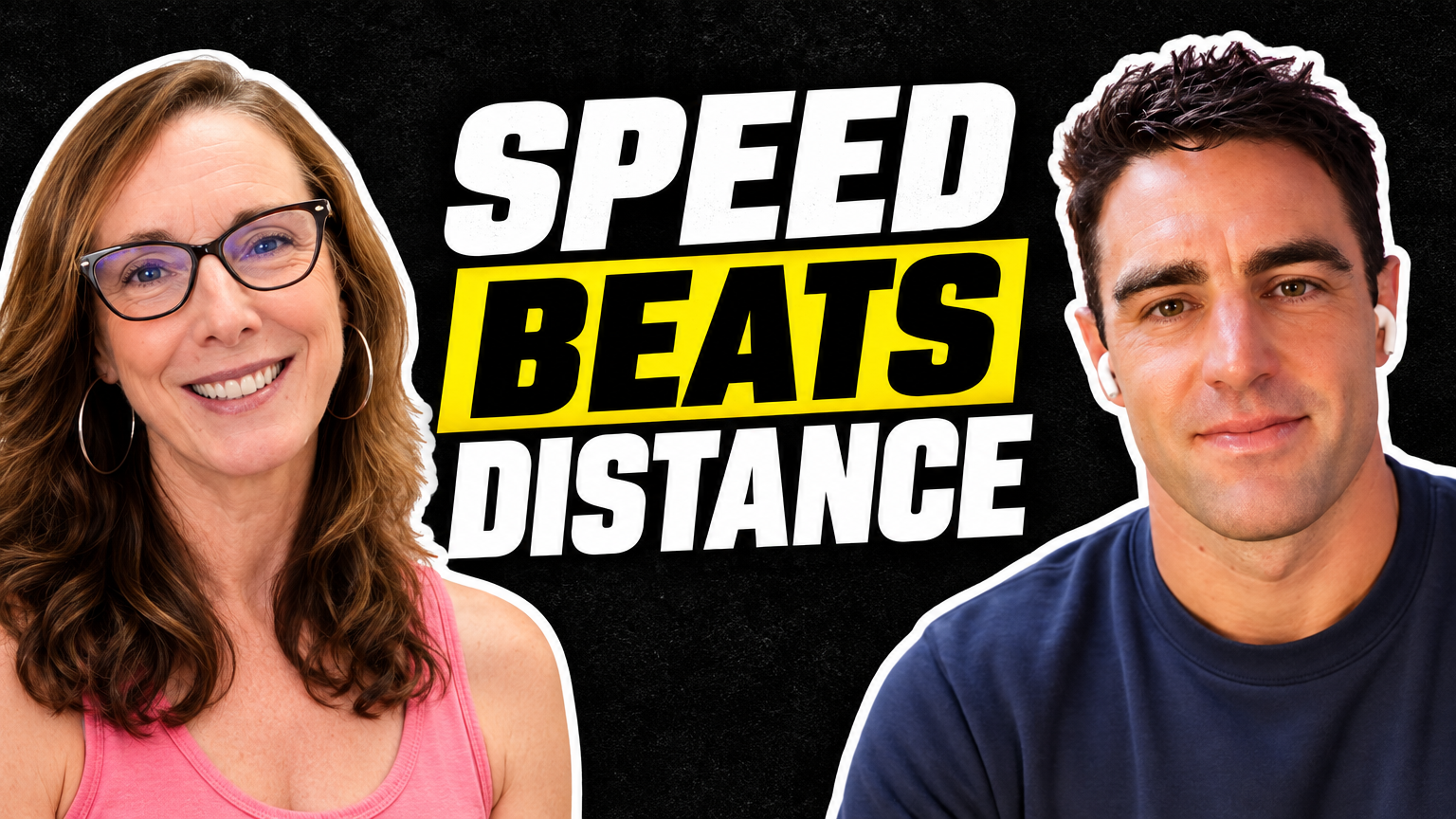









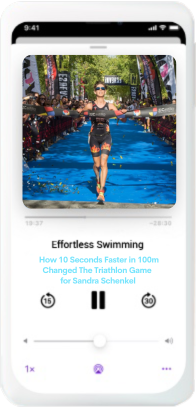
Join me in this engaging episode as I chat with Sandra Schenkel, an elite duathlete from Spain who overcame swimming frustrations during the pandemic. We’ll dive into her journey of making incredible progress through focused training and coaching. Discover how Sandra regained her swimming skills and achieved her best level ever. We’ll also explore the significance of relaxation, breathing exercises, and technique in swimming. Get ready for valuable tips on mobility work, rest intervals, and maintaining a healthy diet.
01:56 Overcoming swim frustrations and developing skills
03:32 The Impact of breathing exercises on stroke improvement
04:18 Breathing exercises can help improve relaxation and body position in the water
08:05 Focusing more on the process than the result
11:49 Improving technique through the catch, breathing, leg posture, and head position
13:19 The importance of mobility and flexibility in swimming and how to improve them
19:07 Advice for those who are frustrated by their swimming
21:45 What’s the next goal?
22:58 Interval Rest is Vital for Athletes
30:20 Work on technique, breathing, and the things you can control, and do not always train at maximum intensity
8-Week Faster Freestyle Course:
https://effortlessswimming.com/8-week-faster-freestyle-course/
Links from this episode
- 5-Day Catch Challenge Course
- Change your technique and swim smoother, easier freestyle in the Effortless Swimming membership
- Want to work with me personally to improve your technique? Join my swim technique coaching here
This podcast is brought to you by NanoClear — our own range of anti-fog swim goggles, designed by Effortless Swimming with the anti-fog treatment bonded into the lens itself (not sprayed on, so it doesn’t wear off after a few swims). Check out the NanoClear range here and use code PODCAST15 for 15% off.
Transcript
Read the full transcript
Welcome to the Effortless Swimming podcast to show that help swimmers and triathletes love the water, become a better swimmer and live a better life. Here’s your host, Brenton Ford.
Welcome to the Effortless Swimming podcast. I’d like to welcome my guest today, Sandra Schenkel. Welcome to the podcast. Hi, thanks for having me. So Sandra, we’ve been working together over the last 12 months or so. And I was just looking back at what you wrote when you first joined our membership and it was something along the lines of you’re basically frustrated with your swimming because it was letting you down in your races. And you needed to take only a little bit of time off to really make it with the pack to be able to be competitive on the bike and run because that’s really your strength. And so you just need to be able to take a little bit of time off. And in those 12 months, what you’ve achieved is you’ve gone from struggling to really get under that 130 pace per hundred to now pretty comfortably getting getting under that and being in the low to mid 120s. And that’s just been a game changer for
your races. Is that right? Have I missed anything there so far? No, yeah, that’s what it is. So I used to get out of the water like with 10 lost girls at elite level. So I had basically no race. I was just alone on the bike and alone running. And it was no fun for me. So I wanted to improve a little bit so I could in fact play with the other girls and have a nice race. And now I achieved it. I get out of the pack with the other girls. Not in front but that actually doesn’t matter because once you once you are out of the water with a lot of girls, you can really play your game on the bike. That’s what I did this year was nice. Yeah, I loved hearing the results that you were getting in your races because you sound so you sounded so excited that it’s like I finally I’ve made this breakthrough with my my swimming and you’re enjoying it a lot more by the sounds of it. Talk to me a bit about the frustration you’re experiencing a couple of years ago because in our
communications, you said you stopped doing triathlons because you’re a bit fed up with the swim and then you just decided to get back into it and and just work on your swimming. So what was the frustration that you’re experiencing over the last couple of years with your swimming? Yeah, so I started I started triathlon five years ago. And of course, at the beginning, you improve a lot. But then I got stuck at 130 135. And I just didn’t improve. I was getting to the pool five times a week and there was no improvement, nothing. And I I got to the triathlons at the league level. And yeah, I had no race. So I was putting all this effort into the swimming and showing up at the pool and I wasn’t getting better. And I was seeing that other girls who I thought were less fit than I was, were swimming so much faster. And then at a certain point, I think after three years, I just said, you know what, I love cycling and running a lot more than I love
swimming. So let’s go and do some do it one. And then I will do some triathlons during the summer because there are no do it once during summer. But then yeah, the triathlons, I just picked some little triathlons out where I still could have a race. But then I started again, because my team asked me to do some triathlons. And then I started working with you. And actually, over the last couple of months, I made finally the improvements I was waiting for five years ago. And I know you’ve gone through the eight week course and the catch challenge. And you’ve also sent through video for the monthly members calls. Is there anything in particular that stands out for you that you changed in your stroke that actually that made the biggest difference? Was there any anything there? Yes, the breeding exercises that was like the most important part of everything. Once I started doing breeding exercises, and implementing them in each
workout I did, I feel more relaxed in the water. And I was starting not to fight with the water but to actually flow flow with it. And it went a lot better. And then I moved on on working on my catch. And I still have to work a lot on my catch because I’m not so flexible. And that made there I made a big improvement too. But that the catch is still for me working progress. I’m especially due to the lack of flexibility in my shoulders. And what what braiding exercises in particular helped you? Yes, like all these kind of exercises where you breathe every three, every five, every seven. It really teach me to relax into the water because if you’re if you have too much tension in the water, you just can’t breathe every five. So instead of focusing on my times and on swimming fast, I was more focusing on swimming relaxed. Yeah, as simple as that sounds, it can make a huge difference because one of the very first thing we
want to work on is being able to relax in the water. And I’ve coached a lot of people who think they’re relaxed and they’re okay. But they’re holding their breath too much. And they’re taking these shallower breaths. And that they’re holding their head quite high in the water, not necessarily looking forwards. But they’re holding their head up. So it’s just their face in. And they’ve got about two thirds of their head just sitting up in the water, which really drops their their body position. You weren’t you weren’t like that based on your video, but people are carrying this this tension that they sometimes don’t think that they’re carrying. So by doing those exercises to encourage you to just be able to relax and just it’s kind of switch off a little bit in the water and also exercises like the sink down drills where take a breath and just slowly exhale. And some people think some people don’t depending on their their buoyancy
profile. But just that just being comfortable having say no air while you’re in the water. It makes a huge difference if you’re carrying that unnecessary tension. So it sounds like by going through those those exercises, you had to learn how to relax in order to be able to breathe every seven strokes. Yes, and it’s indeed what you said because I thought, yeah, I’m relaxed in the water. I have no tension. But then when I started to do these exercises, I thought, yeah, I think I can relax a lot more. Because otherwise I just don’t get there to the five or the seven strokes. And yeah, this is really these exercises helped help me a lot to to yeah, at the end swim faster. I think I used to be that my focus was too much on swimming fast and having nice, yes, swimming yeah, swimming fast intervals. But when I changed my focus from swimming fast to swimming relaxed, I had the results I actually was waiting for five years ago. So
yeah, that that was a discovery effect. I really like what you said there because swimming is so many things in life are actually like that. The more you try and force it, the less it comes. But if you just let go of the results a little bit, things come to you and swimming so much like that where yeah, where if you just just relax into it, you generally can keep your heart rate down, you can keep your ethic down and you hold the water and you feel the water a whole lot better when you just just relax into it. And the world championships are on at the moment of swimming. And I was watching some of the races, the races last night. And I know even those elite level sprinters who are doing 50 and 100 freestyle, their focus is trying to relax as much as possible in those events because as soon as they get overly tense, they slip in the water. So even for those high powered, high speed, high turnover events, they’re trying to to relax. And
I think it’s even more so for those those faster events. And it doesn’t mean you just it doesn’t mean you just switch off. But yeah, because you got to keep your tempo up, but it’s just being able to have that nice balance of relaxation and tension in the body and finding that that sweet spot. As your mindset changed with you’re swimming now in training and in racing. Is that different now that you’ve seen those results? Yes, it’s very different. So yeah, during training, I’m really focused on what I said, swimming relaxed, and also my technique. And during the races, I start swimming like I have to go straight on. I have to relax. I have to focus on my breathing. I’m not thinking about the place or the result of my swimming. I’m just focused. I really have to be able to breathe every three strokes. I have to focus on looking forward and so on. I think the focus is now more on the process than it is on on the result.
And while I’m focusing on the process, I feel more comfortable in open water too. And I just don’t get beaten that often as other girls, I think, because I’m really focused on my line where I’m swimming and where I am going to breathe. So I think that that’s really important to get more comfortable also out of the water. Yeah, on our last podcast episode, I had another swimmer who been working with Josh. And he was saying a very similar thing where as soon as he just went, I’m going to control what I can control. And I’m going to focus on my stroke, my pacing, my siting and my race strategy. Then he wasn’t overwhelmed when it came to racing. So he was able to relax a lot more. Whereas in a race where he was worried about what place am I going to get? What are all the other swimmers doing? He actually found himself getting quite worked up and quite tense and almost panicked in a way. So I think by being able to just focus on what
you’re doing, then you can control what you can control. And you’re going to have much, much better results as well there. This episode of the podcast is proudly brought to you by our sponsor, Form Smart Swim Goggles. They’re more than a pair of goggles. Meet the world’s most powerful swim platform. See yourself improve with Form Smart Swim Goggles, including a free one year membership when you purchase your goggles for only $249 US dollars. They’ve currently changed up their offer where you can now get the goggles and you have one year membership included for free. And if you’d like to continue with the membership going forwards, it’s only $15 a month, where you get access to their workouts, training plans and custom workout builder. But you’ll always have access to the real-time data in the goggles. So you never lose access to that. My favorite thing about the Form Goggles is having the instant feedback of what times you’re doing, what stroke rate
you’re doing, and also the ability to see what your heart rate is. Because never before have we been able to have these immediate feedback heads up display where it’s actually telling you what your intervals are. So when I wear the goggles in training, I like that I know my split for the first 50 and the 100 and the 150. So every single lap I’m getting that feedback on what my pace is. And I find it’s such an important tool for being able to not only have different gears where you can switch between the different speeds that you want to swim, but it helps you develop those gears and it helps you intuitively know how fast you need to go before you’re going to blow up or before you’re going to go a little bit too hard. So it helps you just get really good at judging your pace for when you do go to a race. And even if you’re not wearing the goggles in a race, it’s that intuition and that ability to develop your pacing that these goggles can really
help with. To get your pair of form goggles and say 15% off, use our link form swim dot com forward slash effortless or use the coupon effortless at checkout and that will get you 15% off your pair of goggles using our special link form swim dot com forward slash effortless or the code effortless at checkout. Is there anything else in terms of technically that you’ve worked on that you felt or noticed a difference with? Technically, well, no, actually those two things like the catch and the breeding, there were these two things were crucial. And then the other little things were like putting my legs together so I don’t get a gap in between my legs. That was one of the last things you told me to work on. So that’s something I focus on. And then also my head position was a bit too high and I corrected it. So I’m looking a bit more downwards in like the 45 degree, how do you call it? Yeah, the 45 degree angle. Yeah. Yeah. So these were like
a little tin. These were the little things I was working on. And now I’m still focusing on the lack of gap. Yeah, gotcha. Because I looked back at the very first video you sent for the the member’s call. And I saw your head position was, I think maybe the first thing where the chin and the eyes are a long way forward. So your hips and legs were dropping a bit dropping. And that’s that’s an easy fix which is always always great. Just got to remember to do it. And then often people their legs are out too wide just trying to keep themselves balanced and feeling more stable but it creates more more drag. So we want to try and just bring everything into the middle to make you more streamlined. And you can overall get much better connection through the through the stroke. And you mentioned the catch. That’s obviously a more long term thing. But over time, you can certainly make some good good improvements to it. In terms of your range of
motion and mobility, how can you feel that impacting your ability to get those positions? Just because if you feel tight through them or is it harder to do some drills? Where’s that awareness of your mobility come in? Well, I feel it when I when I do the catch like it’s hurting already like here. So and really hurts in my shoulders. I of course my boyfriend is also very flexible so I can compare with what he’s able to do in his catch and what I’m able to do in my catch. And that’s so different. I have also I really have to stretch every day my shoulders to to to make the movements I want to make in my stroke. No, but I really feel it because I think now I’m really I’m swimming for five times a week over the last year. I have like a chronic shoulder pain that’s there. It’s not that hard. But yeah, it’s there. It’s there. I always feel my shoulders effect. So I have to continue working on my flexibility and and stretch every day.
But it’s under control. So no panic, no panic. Yeah, yeah, that’s good. I mean, it can make such a huge difference over time. And what I’ve encouraged a lot of the swimmers that I’ve that I’ve coached recently and in the past as well is just doing five to ten minutes of some sort of mobility work each each day or most days because in the long term that is going to help you become a much better swimmer and in the other triathlon course inside the membership there, we’ve got there’s a mobility test. So we go through these seven tests where you can basically compare your range of motion through some different areas to what they want the elites swimmers to achieve. Now, if you’re doing triathlon, you don’t have to be in those ranges necessarily because you’ll be tighter from the bike in the running. However, it’s good just to see what are the elites swimmers able to do in terms of their thoracic rotation, their overhead range,
ankle flexibility and then just kind of compare yourself to that. And in that course, there’s also some some ways to just improve improve upon it. And I think for most people, the best one to improve your range of motion for your catch is typically if you get a foam roller and just put it behind you on your back, go in streamline position and just sort of rolling back and forth through there to start with. So you’re almost in a streamline and just just working on that. And then what I’ve been doing a little bit myself as well is with an exercise bench, I’ll get a weight. I can’t remember how heavy it is. Let’s say it’s like let’s say it’s six kilos for now. So I’ll get I’ll go on an exercise bench. I’ll have the exercise bench across my back and I’ll have the weight above my head and I’ll do these overhead like raises. So basically the same movement as the stretch, but with a weight. So I’m just slowly moving moving through that.
And so I think if you can build strength through range of motion with something like that, and I wouldn’t start with six kilos, especially if you’re tight, you might start with one kilo and just building that strength through range of motion can really help open up through the movement that’s required to get that catch. Because it’s directly directly related and that have you seen the test the test the overhead test? We did a test. Oh, did you? OK. Yeah, how’d you go? Horrible.
Not many people do well with that one. No, no, no, I didn’t. It wasn’t really good. It’s like this is my my big handicap in swimming, my lack of flexibility. And it’s it’s something that I work on every day to improve. I really think if I would get like five percent more flexible. Yeah, I would swim a lot faster. But what your range was in that overhead I don’t know. I don’t know anymore. I did it. Yeah, a lot of months ago, I think often, yeah, time ago. So I don’t know anymore. I just remember that I was comparing myself with these two elite athletes. I think there were two triathletes, weren’t they, a girl and a boy and was like, no, no, this is really not good. But I don’t remember what I exactly what my results were. They were not good. Yeah. Also, so for those that are listening, the the test is if you lie on your front, have your arms out in front of your head, have your chin on the ground and have your arms straight
and you link your thumbs together. And so in that position, while keeping your chin on the ground, lift your arms up as high as you can above your head. Now, the range that we’re looking for, the optimum range is more than 20 degrees above zero. Not many people get there. Only elites, elites from Israel get there are really flexible people and not many people are in there. I’d say like 5% of people I’ve seen are in that range. And then I’d say majority of people can’t get above zero. So if you can’t get your arms off the ground and you might listen to this and go, of course I’m going to get my arms off the ground, do the test and find out because it’s people are pretty tight. So that we call that minus five and then zero is directly in line and then anything above that obviously. And it’s a great way just to check your range of motion. And if you’re, I say for triathletes, anything less than 10, we want to try and improve upon it.
So I don’t think you need to go to 20, but 10 is kind of an ideal, ideal number to strive for. And I’ve seen a direct correlation with that test and your ability to comfortably get a good catch. And you don’t need to get extreme positions with your catch, especially if you’re doing triathlon, but we want to try and make it as easy as possible and having decent range of motion through the shoulders is a big one that can help. So yeah, that’s what we want to work towards. And as you said, it’s long-term and if you just keep on top of it each day, it can really start to improve. And for those that are listening or if you’ve had friends who’ve gone, wow, I can’t believe you’ve had such good improvements with your swimming. What advice have you given to those people? What have you suggested they personally do to be able to improve their swimming? I think it’s very important to not get too frustrated. Well, if you run and you cycle,
you put in the work and you get the results, but I think in swimming, it’s a bit different. You have to be really, really, really patient and focus, yes, really focus on a process and don’t focus too much on the results because I did one of my best swims in a triathlon in a week where I thought, yeah, now I didn’t improve, but I even got worse swimming. And then at the weekend, I did my best swim ever and I got out of the water with girls who were one minute and a half before me last year. So just keep showing up, do your drills, do your work, and you will get there eventually. Yeah, that’s like the biggest step I can give. Just show up. Yeah, it’s such great advice because I had a swimmer last week who I’ve been working with in the stroke analysis coaching with for a while and he sent me a message last week and he said, he’s basically like, oh, I did, I’ve been swimming and my times have been a lot slower and I’m not feeling good.
And so I’m like, I’m quite frustrated. And then I didn’t get to see that message until like the next day or two days after. And he said, sorry, don’t need to panic. I just had my best workout ever. I was hitting these times and it’s like his best one ever and it happens so much. And even for me, two weeks ago, I was swimming, on the last week, I was swimming so poorly and then today came back and have had my best session in a couple of months. Like it just ebbs and flows like that and just expect it and just keep showing up. Keep going to the pool, keep training. It’s just, it’s one of those things where you just, you’re not going to avoid those days. And I even think of Ariane Titmus who’s the Australian 400 meter freestyle. She just broke the world record in the 400 free last night and she had an average world championship trials. She qualified but wasn’t happy with it. She’d had a pretty average year from what she’d said
but she was able to keep showing up, keep working on it and she just broke the world record last night. So it doesn’t matter what level of athlete you are, you’re going to go through those ups and downs and so if you just keep turning up, then the results will come. Yeah, indeed. You just don’t know one. So be patient, be patient. Exactly. And before the call, you’re saying your next target, what you’d love to be able to do is be able to consistently get under 120 essentially. What do you see being the things that will help you get there? I really have to improve my speed, my maximum speed is just not that fast. So I can swim at 123, 124 easily. But getting under 120 is like a super big step for me and I think that the biggest problem is that I’m not capable of not able to swim really fast 50 meters.
I can’t get under 37 seconds, I’m just not able to do it. So I think I should work on my speed. I should do more speed work and that’s something I haven’t done too much because what my goal was showing up five times a week, swimming my two to two and a half K every time, focusing on my technique, focusing on my endurance. So the next step is focusing a little bit more on my speed.
Yeah, that’s a real K one. And what I’ve seen a lot of swimmers, a lot of athletes in general, not being comfortable doing is taking enough time between intervals to get sufficient rest to be able to swim fast. So let’s say they’re doing 25s or 50s fast and they’re resting for 20 seconds or even 30 seconds and then they’re going again. So sometimes they just don’t give themselves enough, enough rest to be able to really hit that top end speed. So what I’ve really tried to encourage a few of my swimmers to do is just, if you’re doing speed work, make sure it’s all out 25 or 50 and have sufficient rest. So you might end up doing, you might do a set of say 10, 50s maximum effort on one minute, 30. And if you’re coming in at say 37 seconds or 35 seconds, most people would go, I’m wasting my time at the pool. I’m sitting at the wall for a minute each time. Like I’m just not getting a proper workout in. But if you actually give yourself that rest,
you’re going to hit those top speeds. You’re going to be working at that maximum capacity. And it’s actually going to be much more beneficial than doing 10, 50s on one minute where you might be getting 20 seconds rest, but you’re never really sort of going fast enough. So that’s what I, that’s a mistake I see made quite often is people just not comfortable resting a lot when they’re doing those high intensity, high intensity workouts. And same thing for like on a Friday morning in the squad that I coach and swim with, we do, we call it a heart rate set, but it’s kind of like VO2 max. So we’ll often do repeat hundreds at what we call best average. So as fast as we can sustain across the whole set. And those fast hundreds typically on two minutes. So I might be getting 50 seconds rest, which is a decent amount. And that’s like, it’s really hard. And it is a fair bit of rest, but it allows us to just get the heart rate back down
and go again. And for the swimmers in that squad, I’ve seen really good results with them over summer as we’ve got racing because that’s been a part of their training sessions. So I think that’s a real key thing just to get comfortable with. And doing triathlon, if you’re doing hard bike workouts or running sprints, like you kind of get used to just taking that rest. But I think swimming people just think they’re wasting their time by sitting at the wall. So it takes a bit to get your head around that. Yeah, just because it gets cold in the water Brandon. Yeah, it’s really, yeah, it does. It does, it gets cold in the water. So, but yeah, that’s really a really good suggestion about getting enough rest. I will certainly do that. And would you start with 50 meters or with 25? Sets of 25 or sets of 50? I mean, you could mix it up, you could do both. I think maybe to start with just go some fast 25s. So you could go an example set that you may do
is like 425s on, that’s like where you come in. So 425s on 40 seconds, and then you go 100 easy. And you could do that, do the sets 200, depending on your session. Like you might do that five times, six times. So again, it’s not a huge set, might be a thousand meters, 1200 meters, but just maybe starting with something like that and making sure those 25s are fast. And you might even find towards the end of that workout, the 25s are starting to feel it. You haven’t quite got the energy there to swim as well as you did at the start. But yeah, just something along those lines is what I do. Or even if it was just a 1050 set on the one minute 30,
you’ll probably find that that’s more than enough to just really get your firing. Because yeah, 1050s max effort is actually quite hard. I remember Brett Hawke, when he was coaching some college swimmers, they had this set called the, what was it, the Auburn spew set or something like that. And they’d be doing maximum effort 100s with about five minutes rest or seven minutes rest or something, a lot of rest. Now in between that is going a bottle of Gatorade. So it was basically like, you gotta keep swimming until you throw up. I wouldn’t recommend doing that. But some of the elite guys will do these maximum effort 100s with five, six, seven minutes rest. And they’ll do, I don’t know, four of those, five of those, six of those. And even though it’s not far, the amount of lactic acid that you build up with those sorts of things is a lot and it is hard. So you can still get a great work adding. Yeah, that’s really hard because I compare it
at that level with running for 400 meters. It’s like the same time. Yeah, yeah. So that’s just. Not fun. That’s no fun. No, no. No, that’s right. So I think for now I’d start with 25s and some 50s. And yeah, as best you can, just try and hold your form and hold your technique at speed and use the rate of your kick to set your arms speed. So you gotta kick. And I want you to kick reasonably hard as well. And so I’ve had a swim that I’ve been coaching for a while and it’s taken a long time. It’s taken probably a year plus of working on it, but her kick was just a bit too inactive in her sprints. And for longer distance, she had a, I think a four-beck kick and that works really well. But for a sprint, I wanted her to develop this six-beat constant kick. And it’s finally clicked for her where it’s just become automatic in her sprints. But I think it’s a really good thing to develop in case you need to use it. If you need to make a break
or at the start you need to get out there. So use that, use a strong six-beat kick to set your stroke rate for those sprints because sometimes people are just, they might still be doing their two-beck kick in their sprints, which is fine, but. Yeah, that’s me. I do a two-beat kick. I do a two-beat kick for everything because I’ve already timed the difference and I lose speed when I am using the six-beat kick. So I’m doing something wrong there. So I really have to work on that. So I sprint with a two-beat kick. Yeah, gotcha. See how you go with this six-beat and it’ll probably be more tiring initially. But it really just, it gives you that extra gear when you need it and you probably, you don’t wanna have to pull it out in a race, but it’s good just to have it and it’s good just to work your legs and work yourself that little bit harder in the sprints and training. So yeah, be good to see how you go with that. Yeah, okay, I will certainly do that.
That’d be great. Yeah, and I think like next time when you get a chance to cord yourself again, it’d be great just to see where the stroke’s at and just see what to work on next as well, because yeah, to come from, can’t get under 130 to now mid to low 120 is a big jump and it’s just major competitive. So yeah, I’d love to see you get under that 120 mark. And if you could do that in the next 12 months, that’d be a huge achievement. And there’s no reason why you can’t, there’s, you’re doing the training, you fit, you eat well, you’re doing all those things. And so it’s probably more coming from technique and maybe a slight change to some of those sessions so you can get the sprint times down. So I’m looking forward to seeing what the next 12 months holds for you. Yeah, it would be great. I’m really looking forward to it. So any advice for someone listening to this who is maybe frustrated with their swing and that they’re going through those thoughts
and those feelings that you had over the last couple of years, what advice would you have for them? Get rid of your watch, keep showing up, do the trainings, focus on your technique, on your breathing, on the things you can control because when you’re frustrated, I think you also have the impression you can’t control your speed and the times you’re swimming. So get rid of all that and go back to your basics. And focus on those things you can control, that’s it. And then it will go better, but you have to be really patient. And another thing is I see a lot of triathletes that work out like too hard on swimming. Like every session is a hard session and I don’t think that’s necessary to improve. I think that the recovery sessions and the light endurance sessions are also key to seeing improvements. To get faster, you don’t have to suffer each workout. Yeah, yeah, just to be able to go at that general aerobic pace is beneficial, isn’t it?
And do you think it’s because, do you think it’s because they’re like, all right, I’ve got two swims or three swims a week? That’s all I can do, so I’m just gonna hammer it. Is that why you think they might be doing that? Yeah, maybe, but I also see triathletes who train six times a week on their swimming and I have the impression that every session they do is hard, it’s really hard. Yeah, I understand that people who have only time for two or three sessions a week feel that it’s necessary to go very, very hard. But if you’re a triathlete, you also have the running and the cycling and you just can’t go all out every training you do. The aerobic basis is the most important part of your workout. I work with 80-20 principle, or how is it called? Where you work 80% of your workouts on your aerobic basis and then 20% of what’s left over, you put in the more specific effort. Like the intervals and speed work and those stuff.
Yeah, and I think that’s a really good way to approach it. I know when I was a teenager, I was guilty and I didn’t know I was doing this at the time, but looking back, I trained all of my sessions way too hard. So I was never, I was definitely in the aerobic zone, but not enough when it needed to be. So I was just sitting above it and just not getting that aerobic benefit from the sessions that should have had that aerobic benefit because I just thought the harder I train, the better I’m gonna get. Yeah, we all made that mistake. Well, I did exactly the same when I was young. We all did that and when you get over, you see, yeah, well, actually I’m getting better if I do less or not as hard as I used to and I’m improving, so. Hindsight’s wonderful, isn’t it? And look, I probably wouldn’t have listened either when I was that age. It’s just like, no, no, I know what I’m doing. Like I’ll just train hard and I’m gonna
bet the people next to me. But yeah, that’s one of the beauties of getting older. You get hopefully a little bit wiser and you adapt for the knowledge that you take on. So Sandra, I appreciate you being on the podcast and sharing your story of how you’ve made a really great improvement with your swimming. And I just, I love getting those Instagram messages where saying I had a great race and I had this result, I love to hear that. So thanks so much for trusting in, I guess, in the process and being willing to commit to it. And yeah, looking forward to continuing with you. Thank you for inviting me, Brandon. Thanks for listening to the Effortless Swimming Podcast. If you’d like us to help you become a faster, more efficient swimmer, go to www.effortlesswimming.com.