







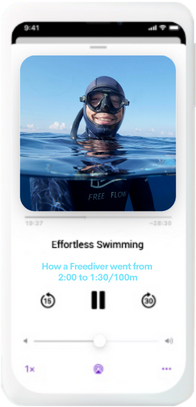
I’ve got Ioannis Aliazis on today’s podcast episode. He has recently been through the 8 Week Faster Freestyle course and is here to share his improvements over the last couple of months. Ioannis is also a freediving instructor, and we will talk a little bit about some of the crossovers from freediving to swimming.
01:01 Swimming Background
01:23 The Best Exercise For Freediving
02:03 I Found Your Channel
02:25 Going Through The 8th Week Freestyle Course
03:39 Kick Timing
06:16 2-Beat Kick In Open Water Swimming
06:53 Following A Structure
07:40 Getting Your Questions Answered
09:34 Swimmers To Freedivers
13:31 Keep Calm & Don’t Panic
16:05 Build Your Confidence
19:22 Friendly Competition
20:58 Practice More And Get A Good Coach
22:00 Find The Reason To Enjoy Swimming
23:10 Listen To Your Body
23:58 Swimming Is A Feeling Activity
THE 8-WEEK FASTER Freestyle Course
Form Goggles
Watch the episode on YouTube:
Transcript
Read the full transcript
Welcome to the Effortless Swimming podcast to show that help swimmers and triathletes love the water, become a better swimmer and live a better life. Here’s your host, Brenton Ford.
Welcome to the Effortless Swimming podcast. I’ve got a guest on today who’s recently been through the Eight Week Faster Freestyle course, which I know many of the listeners to this podcast have. And Yanni, you were in the comments you were commenting every week about your progress. And I thought this is excellent to hear how well you’re going. And you’re also a freediving instructor. And I want to talk a little bit about some of the crossover from freediving to swimming as well, but also just talk about your improvement over the last couple of weeks and last couple of months, because it’s been great to see that happen in that Eight Week Faster Freestyle course. So welcome to the podcast to start with. Thank you. Thank you. So you’re, how did you come across Effortless Swimming and what we do? Because obviously you’ve got a big background in freediving and was swimming something that you started to do a bit of cross training or how did that all
come about? I found you on YouTube, basically, like I saw some videos because I started, I’m not a swimmer like I don’t have a swimming background. I’m a sea person. So I live in Greece and we’ve always been in or near the water. But I did, I don’t know, like three months of swimming, I guess when I was a kid in a pool and that was it. So after I started freediving, I realized that swimming is the best exercise you can do for freediving because you’re just in the water, get a good feel for the water and like it improves your stamina, your CO2 tolerance and all these things. And I started to get more into it. And I was looking for videos like every once in a while, I would go on YouTube and look for a technique. For example, I like nothing diving, freediving without things. So you just swim down and swim up. So for that, I was looking into like the breaststroke kick, for example, like technique for that. So over over the years, I
guess I was I have a playlist like a freediving playlist on YouTube. And I’ve been adding videos and since I found your channel, I’ve been subscribed and watching everything like I said, and like listening to everything just absorbing and sending to people. I’m a huge fan. That’s that’s awesome. I appreciate that. And with your swimming when you first started the eight week course, where were you at in terms of pace and how comfortable you were in the water? I think, like, I was doing some training in open water, my goal was open water, it wasn’t really so much like to compete or do something in the pool. But with open water, it was very difficult to go under the two minutes for 100. And we were tracking that with the Garmin watch or I have a watch. Yeah, cool. It’s not I know the Garmin is a little bit more moral, let’s say statistics oriented, you get more feedback, more information. But this is just fine. I had a goal to swim to a smaller
island that we have here, which is 2.3, 2.4 kilometers. So I was just swimming along the coast. And it was very difficult, even the two minutes was like really hard for me. And I knew it wasn’t so much in terms of the pool, it wasn’t so much strength. But I was doing something wrong, it wasn’t lagging in the water enough. Like my feet, my leg was sinking, I was just I was struggling. So I needed help. And as you went through the course and you picked up some of these things, is that what primarily changed for you? Do you feel like your body position improved, you’re able to lengthen out a bit more? What were some of those things that sort of struck you as I didn’t know that before, or something that maybe clicked when you were So a bunch of your videos before. So I was trying to apply some things from your videos to what I was doing. But I think in the program, it’s structured much better. So you start from like completely basics, which some things I was
okay with, but it was good to start from foundations again, and start building up the huge difference for me was I think like week seven, which was where you liked all the timing with the kick. That made a huge impact. But it’s only because I had the foundation before, like I worked on the whole thing before. And of course, you are training two times a week, three times a week. And you build up the strength and the stomach. But at the same time, I think it’s also really nice that you have exercises that are fun. It’s not just punishment. We just there are things that you can do. And you have fun with it. For me, like intellectually as well, there were things there were times like I mentioned, the one comment, I think that there’s four different things that have to keep track in my head to swim correctly with talking and squeezing and stretching and all these things. But that’s what keeps it interesting. And I think the kick timing was the game
changer for me, because I am having the water in general, like even with freediving, I sink like a stone. So it was difficult for me to stay on the surface, especially in the pool where you have less buoyancy. So that was like a big difference for me. Yeah. Can you talk about the kick timing? What did what do you think you were doing before? And what did you change before? I think I was kicking the wrong way. So I was instead of doing the catch and the kick and the same movement, the same timing, I was doing the opposite. So my legs were like playing a little bit more. And they were dragging behind me basically, I was it was more like an anchor than to push me alone. So with that, I was I’m doing the two bit to beat that seems comfortable. And with the two beats, I can do pretty not 100% tired. I can do like a 130 per 100. So right, I like an old if you’re going for an old at 100. If I’m going for a no out, I would probably do better. Yeah. But
yeah, do less than 30. I’m sure. But that’s a proven improvement from two minutes. Yeah, yeah, it’s a huge I’m super happy when I’m ecstatic for this. And it doesn’t feel like I can do the 130 ish and doesn’t feel difficult doesn’t feel like I’m gas completely at the end, you know? Yeah, yeah, that’s awesome. Yeah, a couple of things that with the two bit kick if you’re primarily in the ocean, which has the extra buoyancy because of the salt water, it’s almost like wearing a wetsuit in a way because you sit up higher and you often need less of a kick, especially for what your primarily training for is that swim across the island or yeah, like that for that sort of stuff, I think a two bit kick is really good. And it’s very efficient as well. So that’s where a lot of people can just find a really good rhythm and swim for a long time as well with that two bit kick. Obviously four beat and six beat kick are great as well. And it’s
different for each person. But particularly for what your training for, I think that two bit kick is probably the best thing to be doing there. Now also just you mentioned is you’ve watched a lot of videos and listen to some podcasts. And then you eventually did the eight week course and you found it had the structure that helped you improve. And I find if people have watched a lot of the YouTube videos, for example, it’s not always extra information that they need. It’s they need sometimes just the structure to be able to follow and say, I do this now and do this first, then move on to this thing and then this thing and then this thing because if you have got, yeah, if you’ve watched a lot of videos over the last year or two, you’ve probably seen a lot of the stuff that we talk about in many of the courses. But because there’s just so much to think about, you might you probably might not be doing it in the right order, a number of other things. So that’s
why I think these courses are getting the results that they’re getting is it just gives you tells you what to do, basically. Yeah, but it’s also super important that you’re there as well. If anyone has a question, you’re there to help us like in the comments and in each week, people are posting their workouts and their times and then you’re there to help them suggest things and stuff which you don’t get on YouTube. It’s a more personal touch from someone who is like super experienced. So you can help you can identify things more quickly, because you have the experience and you can help us. We need something you’re there 100% to help and then you I as the trainee, let’s say, can see the difference the next training I do. And it’s really helpful. Yeah, and I bad weather or not, I had a comment section where I like I’ll jump in each week and answer them. But I’m glad I did because I’ve picked up a lot of things from some of the
questions that people have asked. And often there’s quite similar questions for each week. And it’s helpful for me as a coach to go, okay, when over I’m teaching this topic, then I’ve got to I think I should make a certain point clear. And one of those with the kick timing is that often people think of the kick timing as they should enter with say the left hand and kick down with their right hand, which is correct. But for many people, the easy way to think of it is especially with the two bit kick is right arm catch, right leg kick down at the same time. And so I think that’s not really taught like that very often. People are thinking, isn’t it the opposite? But no, it’s not. It’s just a different way of explaining it. So there’s things like that. I want to go into some crossover from free diving, which is your area of expertise and swimming. So from what you’ve gone through over the last couple of months, what do you see
those sort of crossovers being amongst the two different sports? I wanted to note as well, like what you said before is really important to get feedback from the students is really good because then that informs your teaching the next time. Like it’s the same with me with free diving. I always ask them why you did this and to give me feedback. And then I can fine tune to the student and to the next students for the crossover. There are lots of if you take a professional swimmer and you try to turn them into a free diver, they’re going to destroy everyone because they have the strength and they have the feel of the water. They have a good technique. They have good CO2 tolerance because of all the swimming that you do. So it just as a form of exercise, it’s perfect. But it also translates, I think for me, 100% because there are different kinds of free diving you can do, right? So you can dive without fins, which means
you’re just swimming up and down. So the kick for that is a breaststroke kick. Right. So you learn how to do a breaststroke because it’s more efficient than a freestyle kick? Or why did I choose that? Yeah, you just kick like this, you’re not going to go anywhere if you’re trying to go down. So the arm stroke for that is like the breaststroke, but the actual movement is the movement of the freestyle mirrored. So if you’re, I can move it back a little bit. So you go up and you try to push the water behind you like this. So it’s basically the movement of freestyle, but with both arms. So once you learn to do a nice, to stretch in a nice way with your freestyle, you can stretch up, you can catch the water, pull it behind you. It’s the same movement. So you get a better feel for the water. You strengthen the muscles that are going to make this movement for the no fins. And then the kick is the breaststroke kick. There is
another style which you go down by down and back up by pulling on a rope that does a dive line. So you just stretch, you pull and again the same. But, and again, I think this translates as well because when you go in, when you’re swimming freestyle and you go in, you have to learn to be comfortable to make a nice stretch, right? You have to be comfortable lengthening your body to have a nice stretch. And for this is called free merger. So for this, you need to be able to stretch comfortably and as far as possible. So you can have a long pull on the rope. So your pull is going to be longer in distance. And then typical, the most usual kind which is with bi fins, usually let these carbon fins. The freestyle kick, again, like it strengthens your legs. And if you want to do other kinds of swimming, it strengthens your core as well. So if you want to dive with a mono thing, like the big thing that you put both feet in, you need to have a
strong core. So again, it translates 100%. And at the end of the day, like, why would you do anything else as an exercise for freediving other than something that involves the water? You get more comfortable. Yeah, I can see why there’s so much cross. Yeah, you get more comfortable with the water. You have a better feel for the water. It makes sense for me 100%. And I tell all my students that they have to swim more. This podcast is brought to you by Form Goggles. Form empowers swimmers at every level to reach their goals. Whether they want to get stronger, faster, swim further would be more efficient. Get lap by lap motivation with real time metrics and workout instructions right in your goggles and forms recently released form plans, which include a progressive series of workouts to help you achieve your fitness skills or triathlon goals. You can follow along with the plan and your weekly swims will be automatically synced to your
goggles. So you’ll swim through your workouts with real time metrics and workout instructions all in your goggles. So it’s like having a coach right there with you. And I’ve had to look through these training plans. And I think they are excellent for people who want to train for certain triathlons or reach certain fitness goals. It will build on each week and a really good way to progress progressively build up your fitness. So if you’d like to follow along with some plans to help you reach your specific swimming goals, then check out form goggles at formswim.com forward slash effortless. And this will give you 15 dollars off your purchase of form goggles. So formswim.com forward slash effortless to get your pair of form goggles. Yeah, I can see why the one experience I had with free diving. So like we went to I did a swim trek in Turkey. It’s probably 10 years ago now. And I can’t remember we’re in cash at the time. And I
don’t know how deep the water was but it reasonably deep in my sister and I were swimming out there and I was comfortable swimming down getting to the bottom and coming back up. And so that wasn’t free diving, but it was, you know, we’re still going down reasonably deep. And I was fine with that. But then when I did a very brief free diving course in the Maldives a couple of years ago, and the instructor, we only got the chance to do one sled with the instructor on the sled going down. That’s fun. And because I was, yeah, it’s fun. But I thought I was gonna be good. I’m fit. I’m a swimmer. But then my panic on my fear set in a lot earlier than I was than I would have thought. And so I got I don’t know how deep I got but it was like half the depth of some of the other guys. And I was just like, yeah, because I wasn’t in control. And it was the first time I did it. I was just like now I’ve got to tap him say that’s enough. And I’m
ready to go up. But yeah, when I’m in control of it, it was like, it’s it really like mentally, it was quite it was a real challenge, which was such a surprise to me. I didn’t think that fear or that panic would sit in because we’re going down so fast. And then you do it. Yeah, this is a very particular like for me, the first couple of times were scary too, because you relinquish control to something else, right? So it’s not just me kicking down and kicking back up. I’m on this thing that something might go wrong. It’s going super fast and stuff. But then once you get used to it, it’s fun. But the mental aspect is very important with freediving, like mental and emotional aspect. It can completely ruin a dive. You tense up. And it’s the same. I think with swimming is the same thing. Like you need to be relaxed in the water. Like yesterday, I went for example for a little swim in the pool. And I thought it was like super comfortable. And like this
time it’s been a few weeks that I haven’t been and I thought I’d be super tired. But I was doing a nice comfortable two beat kick and I was getting around 130. And there was a guy next to me who was moving more, but not swimming as fast. So it’s important to have the technique, but it’s also important to mentally be there and be able to relax. Because if you’re overthinking or if you are stressed or if you’re whatever, you can’t relax in the water, then it’s going to translate, I think 100% to your speed and your comfort and your endurance. Absolutely. Even more so in for many the triathletes and open water swimmers that I coach who are racing. Those that are newer to open water, there is often quite a bit of fear and panic. And one of the athletes that I do some stroke coaching with online, he’s been swimming mostly in a lake recently because he’s got a race coming up. And the first group swim that he did, I think it was 1500 meters
that they did, there was like, there’s only 10 of them. But because it was, yeah, it was like a mock race for them just to get that practice off the bat. He was like, he had to stop, get his breath and then go and then he’s started to panic. And so it took him quite a while to just relax and get into it. And then he found his rhythm, got into his flow when he was, he did really, but it happens pretty often, especially the first time that you do an open water race. And it’s quite, I think it’s really enjoyable to find those challenges, particularly those mental challenges where once you get over them, you’re just like, man, okay, that’s great. I feel like I’ve leveled up and I can push again. And for me, that thing is like surfing big waves. If I’m out there and it’s big, there’s not many people out, might be a dark day. It’s yeah, it’s like mentally, you could easily go, oh my God, I’m in trouble here. What if I get held under? But if you
keep your mind in check, and then you get out of the water, you had a great surface. Wow, that was really, that was really cool. You just feel like you’ve gotten to that next level. And I found that with long distance swimming to training for the 20k swim to Rotnest Island was longest I’ve done was 10k. But then once you do that 20k, that’s possible, can do it. And you just build that confidence. Yeah, for sure. Even when I did the 5k, like I stopped and I was like, okay, I could do more. Yeah, you build the confidence like you do two, I did three and I was like, you know, I just go for five and see what happens. And it was like super comfortable, like I could do it in the sea, I could probably do a little bit more. I don’t know about the 20, you build the confidence over time, I’m sure. And I’m really sure you swam to that island, did you? I did. Yeah, I did. That was a 2.3 kilometers. And I did it in like 156 was the pace. Yeah, cool. Yeah,
did you do that by yourself or did you have others with it? I was by myself, but I had my father with the boat next to me for safety. Yeah, because now it’s in the season now. So there are boats with tourists and so on. So he was next to me, I don’t know, max five meters distance. And I was sighting the whole time. So every, I don’t know, 10 strokes or something, I would just look up and see where I’m going straight. And he was there next to me the whole time. Yeah, that’s cool. And how did it feel when you once you’ve done that swim? Was it a goal that you had for a while? And did you think it was? I did it again last last summer with a group, but there it was, I was like responsible for the group so I couldn’t relax that much. And this time, I was, it was very comfortable, like in a little bit before the halfway mark, I felt tired. But then I relaxed again, and it was super easy. Like I came out. It was a 156. I could have gone faster. I’m sure if I
was going to do just the goal was to go there and swim back. So the idea was to do 5k, but the seed picked up and then we stopped it on the way back. So if I was going to do just a 2.3, I couldn’t go faster. I’m sure I could sustain a 140. Maybe I’m not sure, but I think I could have done faster. And it was comfortable, like the 156 was very nice, like we’re very comfortable. I don’t help you. And with your swimming now, what what are you thinking about? What are you working on at the moment with your swimming? No, I think I have a like a friendly competition with one of my teachers for for 400. So I want to see what kind of time I get. Like the last time I checked the first time I’ve ever done a 400 and I timed it was a seven minutes. So now I have to start slowly chipping away at that. Yeah. And like the open water, I would like to do longer swabs. Like I would like to do like a 5k open water, maybe a little bit more slowly. And overall, I
want to like more comfort, like more speed with more comfort, basically. Yeah. Yeah, getcha. It’s I find when people come to clinics, like that so many people will say like that one of their main motivations is to either beat their friends, the people that they swim with or if it’s like a parent who’s got a kid who’s 10, 11, 12, they’re like, I need a delay then getting fast. I mean, by by another year or two, because the kids start to catch up to him with the speed. So it’s yeah, it’s nothing like just trying to beat a friend is motivation to say that that’s really good. It’s also great for any sorry for like for me, as an instructor, this is super informative because I can help people like because for the courses that I teach, they have to be able to swim a little bit. So depending on the level level one is okay, you can swim level two has to have a little bit better technique level three has to have even better technique for knowledge
that I gained from you and from them from this program, I can help the students even more. Yeah, that’s it’s great that it’s able to help you with that. For anyone listening to this, what advice would you have them if they want to if they want to get faster, if maybe they’re stuck with their swimming? I know we’ve talked about the eight week course, that sort of stuff, but just from someone who’s improved a lot over the last couple of months, what would be your main advice for them? I think practices is important, right? Like you need to put the hours in for sure. So it’s not something like I’m realizing as a non swimmer that it’s not definitely not something that you can get like hugely better at in two trainings, because I know like you and like a lot of other swimmers have swam hundreds if not like thousands of kilometers in the pool. So they need to put in the work. But I think the information is there like you can find
anything on YouTube, right? But you need to have someone that will give you a structure and that can be there for you. That’s why I said like the comments are super important. So it’s good to have someone that will be there to help you and to have good structure in your training. And the most important that for me is to enjoy it. Find the reason to enjoy it. If you’re just doing it because, okay, let’s say you have a goal. I want to do I don’t know 20, 20 seconds less on the hundred or whatever, five seconds less or whatever. If that feels like a chore, it’s not going to be a good thing over like at the end of the day, it’s not going to be a good thing. So it’s good to find a reason to enjoy. And that’s why I said like your the exercises you have are fun, like in the warm up stuff. It’s orange. It’s interesting. And one thing I saw I wanted to mention about the kick timing is that for me, like it took a while to figure it out
because I was doing it the wrong way. So I think you have one exercise where you just do it on one side first, right? So I had me only thinking about all months, but yeah, yeah, so I had the board on one side and I was trying to figure it out only on the one side. And I think the right side clicked first before the left because the one side clicked first, I was like, okay, just do the one side, do like some distance on the one side so that it becomes automatic and then switch to the other side. So it’s good to also you give us like a very good structure, but it’s good to be open to listen to your body and adapt things on the fly to figure it out by yourself because at the end of the day, I will be by myself. I have your training, which is good, but like, I’m by myself in the water. I need to be aware and try to figure things out. So I think like practice and like a good coach and being aware of what’s going on while you’re doing not just
do it mechanically. Yeah, shooting into how things feel in the water because it’s very easy to get caught up in the in your head with so much to think about, especially sometimes during some of these courses is you can overthink things. And then you’re just not aware of what your body is doing. But swimming is such a feeling activity that that we want to almost try and get out of our heads as best we can while maybe just keeping something in the back of our mind. But yeah, just go by feel it’s it’s much more enjoyable that way to rather than trying to cycle through 10 things at once that you’re that you’re trying to do. I think that’s great advice. So just get in the water enough to be able to improve two to three times a week. Three times a week is great if you can. I find that’s sweet spot for many people three times a week or more. And having that consistency over time, that frequency is how you will improve. You mentioned
obviously technique and structure, just yeah, having something to follow. And I look at some of the YouTube comments that I get on some of the videos and I go, oh, geez, I hope people don’t actually listen to what this person said because I feel like that’s completely wrong. So if you’re going by YouTube comments, you might get some good advice there, but it’s very easy to get distracted and go, okay, maybe I’ll try this. Just yeah, keep it simple. And yeah, and then just you said, just go by go by feel just tune into to how your body’s feeling and how you’re feeling, which I think is excellent. So, Yanni, thanks very much for being on the podcast and for being so active in the comments as well on the course because I love to see that feedback from people and especially how well you’ve gone over the last couple of months. It’s awesome to see. Yeah, thank you very much. Thank you. Thanks for listening to the Effortless Swimming podcast. If you’d
like us to help you become a faster, more efficient swimmer, go to www.effortlesswimming.com.