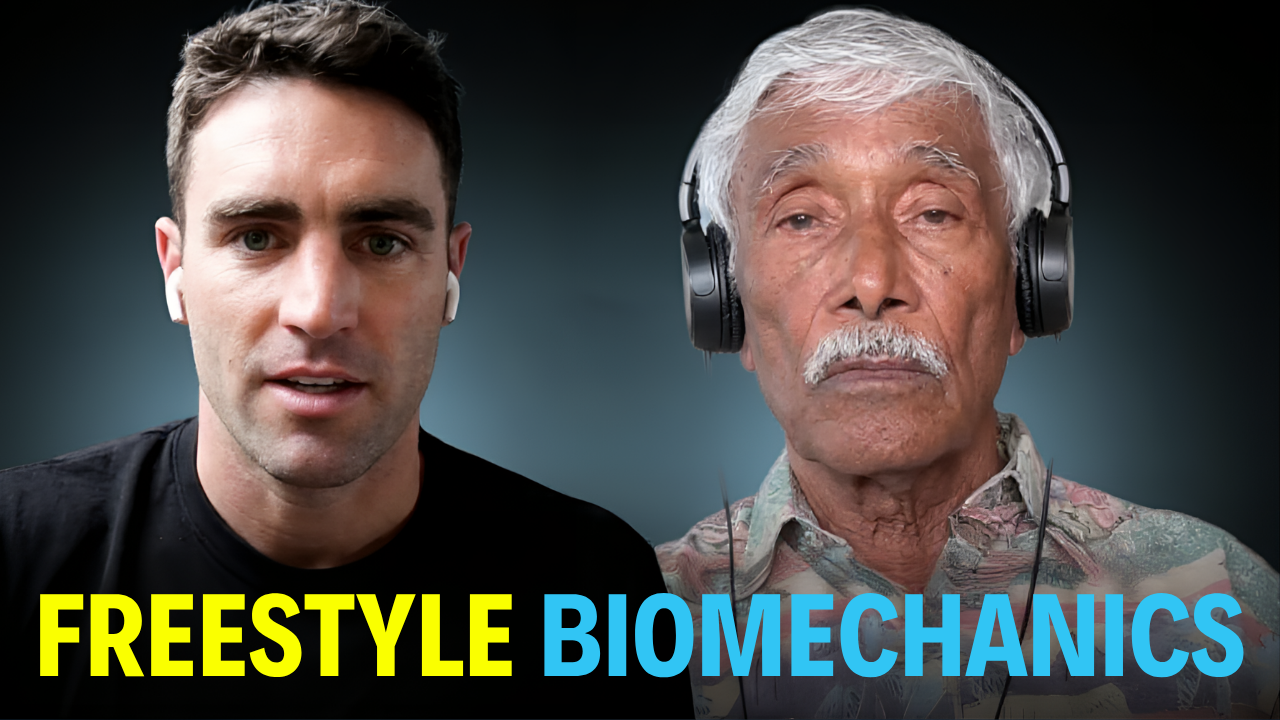








Our guest today is Marc Evans, a former National USA Triathlon team coach. In this episode, we will introduce the M25 Lift Paddle. We will discuss the paddle’s purpose and why it differs from others in the market. Specifically, we will focus on how it helps improve the catch, which is an essential part of the swimming technique.
Triathletes in Motion: a Book By Marc Evans
In this episode
- 00:49 Kickboard Is A Great Tool
- 04:02 Skinny S
- 4:42 Pass or Fail Coaching
- 5:59 Learning Engages Additional Muscle Groups
- 8:19 Learning New Things Takes Time
- 11:17 The Invention Of The M25 Lift Paddle
- 17:55 The Is Purpose Of The Paddle?
- 20:18 Seeking Help To Launch M25
- 23:47 Product Design Is Based On The Fundamental Of Movement
- 28:28 Persistence Is The Key
Links from this episode
- Check out the M25 Lift Paddle
- Change your technique and swim smoother, easier freestyle in the Effortless Swimming membership
- View our freestyle clinic schedule around Australia
This podcast is brought to you by NanoClear — our own range of anti-fog swim goggles, designed by Effortless Swimming with the anti-fog treatment bonded into the lens itself (not sprayed on, so it doesn’t wear off after a few swims). Check out the NanoClear range here and use code PODCAST15 for 15% off.
Transcript
Read the full transcript
Welcome to the Effortless Swimming Podcast to show that help swimmers and triathletes love the water, become a better swimmer and live a better life. Here’s your host, Brenton Ford. Welcome to part two of this two part series with my conversation with Mark Evans. If you didn’t listen to the previous episode, it might be worthwhile going back and listening to it. And if you haven’t heard, we’ve just released a new paddle called the M25 Lift Paddle. It’s on Kickstarter. We are raising funds to get that made into reality. And if you would like to get your own copy, your own pair of the M25 Lift Paddle to help improve your catch and develop your technique even more, then head to effortlessswimming.com.com. forward slash paddle or just follow the links in this podcast. If you take a kickboard, kneel on the deck of the pool, and you take a kickboard in your hands and your fingertips in your hands and you just put an inch or two
of the tip of the kickboard down on the water. You’re just kneeling on the next to the pool and you pull it straight back and you’ll just pull it back and you’ll go, oh, that’s really easy. And so what’s happening is the kickboard is moving the water backwards. It’s like a river just going straight down. If you put that kickboard back in the water, same position depth, and then you change the angle, either left side or right side. You rotate the hand, you will be able to barely move the kickboard.
And we’re talking just minuscule, like an airplane, a wing of an airplane, a little bit of flip, just the smallest amount of deviation of the angle of attack of the air lawns or the smallest amount of deviation of your hand when it’s in the water will cause you to have greater lift. But for me, it’s not so much you’re doing something with the hand. It’s that your slight internal rotation, like when you just did this a moment ago, I watched your shoulder and it’s a subtle motion. It’s not like you’re moving like so, but it’s just a very subtle motion and you get this beautiful high oval catch that causes that slight angle of attack to change in the sweep back and hold water. It’s not back, it’s more holding against the resistance. And the kickboard is a great little tool. I think if people, listeners went out and just sat on the side of the deck, held the kickboard in your hand, put the tip in, pull it straight back,
you go, oh yeah, just pull straight back. Well, that’s a straight arm pull. Your hand just slips right through like an old paddle wheel on a steam engine because those boards on a steam engine, those old things, they just pushed water straight backwards and it took 19 guys shoveling coal into the engine in order to keep the energy up. And then eventually there was a development of a propeller concept and this curved linear, curvier linear propeller, this curved shape. Actually, every time it turns, it turns into clean water or still water actually or air. That’s what you’re doing. If you’re pushing or pulling straight arm, you’re pushing water straight back and you cause any forces you do get are opposite. And so it’s basically these small amount of changes in the angle of attack that are what’s distinguishing the good swimmer from the not so good swimmer. And there is still water. And that’s why you see, if you’re looking at the path of someone’s hand,
it’s like this skinny, yes, it’s very slight curve of the hand. It’s nothing extreme. Yes, skinny, yes, I like that term, a skinny, yes, I’ve never heard that before. That’s really exactly what it is. And but it’s how you get there, I think is teaching it in that front quadrant, those catch up drills, looking at the videos, really helpful, you know, which I know you do a lot. The video is such a cool device, you know. And then making sure that they do enough repetitions of it. And I used to, I had this technique or this way of coaching, I says, pass or fail, you know. I mean, it’s just like there was no middle ground, you know. So like I’d have them swim 50 or something and then we’d film it. And I’d ask them, was each and every stroke, whatever the technique we were working on, because we usually just, and that’s everything, only work on one thing. You can’t multitask, you know, forget it, you know, in my opinion.
But we’d film it and I’d ask them pass or fail. Did you execute each and every motion the way that we were intending? And at a slow, relaxed intensity. And very often they would start to give me a editorial. I, no, no, no, pass or fail. And then we’d look at the video and that was so good, so helpful. And, you know, with all the cameras nowadays, that’s fantastic. I wish we had that years ago. I had this massive 80 pound camera that we used back then, but it’s still work. Not like the gay pros we’ve got today or the iPads made things much easier. Yeah, no, it’s fantastic. I mean, you can do FaceTime video with your coach from the pool if you want. I had an athlete come to a clinic on the weekend and he was a mountain bike coach and a doctor as well. And he was doing some research into learning new skills or new movements, essentially. And one of the things that he found was that when someone’s developing a new skill,
let’s say you’re trying to improve your catch, for example, when you are first learning it, you are going to be using more muscles. So more muscles that are not required, will eventually not be required to do that movement. So you’re using more of your upper traps and your shoulders and your back as you’re learning this. But then as you get better at it and you have more repetition, you’ve got that efficiency of movement. So you’re not using those muscles that aren’t necessary, but in the beginning you are because you’re still working out that pattern. You’re thinking about things a lot. So that’s why it can be very tiring to be doing something new. And I think part of that’s just the mental fatigue as well when you’re concentrating on your stroke, but also the physical fatigue of using, say, twice as many muscles. It’s burning a lot of energy that way. And so that’s why it can be quite exhausting and they can’t hold that for an entire session.
So I found that that was quite interesting. Yeah, I would agree with that. It’s the synapses of learning, not knowing the brain is dictating. The mind is telling thoughts, has thoughts about what you’re trying to do. And then larger muscles are being utilized because there’s this kind of disassociation from it. And that’s really pretty smart because it is more fatiguing at first. Absolutely. But if you’re a six-year-old kid jumping in the water and everybody’s going, I can remember, and you probably too, is they’re just beating you to death basically with volume. And then you go, OK, I’ve got to get better at this. I’ve got to get more smooth. I’ve got to get, and eventually the evolution of being in the water teaches you how to be more efficient. If that’s your goal, if that’s something you want to do and you have the propensity for it. But that was really smart. And that’s a good example of how people go about learning.
It takes time. Difficult things take time. And I’ve always tried to tell people, hey, we’re not going to change your hamstring or quadricep or piriformis or like hip inductors or glute media. All these strength issues have to be done over time. And also there’s underlying issues with each person. Everybody walks, talks, moves a little bit differently. But to my point about having that fundamental, if you’re not achieving that high elbow catch, then you’re kind of not going to probably get too much better. This episode of the podcast is proudly brought to you by our sponsor, Form Smart Swim Goggles. They’re more than a pair of goggles. Meet the world’s most powerful swim platform. CSOLF improve with Form Smart Swim Goggles, including a free one-year membership when you purchase your goggles for only $249 US dollars. They’ve currently changed up their offer where you can now get the goggles and you have one year membership included for free.
And if you’d like to continue with the membership going forwards, it’s only $15 US dollars a month where you get access to their workouts, training plans and custom workout builder. But you’ll always have access to the real-time data in the goggles. So you never lose access to that. My favorite thing about the Form Goggles is having the instant feedback of what times you’re doing, what stroke rate you’re doing, and also the ability to see what your heart rate is. Because never before have we been able to have these immediate feedback heads-up display where it’s actually telling you what your intervals are. So when I wear the goggles in training, I like that I know my split for the first 50 and the 100 and the 150. So every single lap, I’m getting that feedback on what my pace is. And I find it’s such an important tool for being able to not only have different gears where you can switch between the different speeds that you want to swim,
but it helps you develop those gears and it helps you intuitively know how fast you need to go before you’re going to blow up or before you’re going to go a little bit too hard. So it helps you just get really good at judging your pace for when you do go to a race. And even if you’re not wearing the goggles in a race, it’s that intuition and that ability to develop your pacing that these goggles can really help with. To get your pair of form goggles and say 15% off, use our link formswim.com forward slash effortless or use the coupon effortless at checkout. And that will get you 15% off your pair of goggles using our special link formswim.com forward slash effortless or the code effortless at checkout. Yeah, you catch and pull, that is where the majority of your propulsion is going to come from and you’ve got to connect it up with your rotation in your body and the timing of your kick. You’ve got to do that too,
but that is where most your propulsion is. Your kick doesn’t give you much at all. It is more balancing and stability. So you’ve got to get good at your catch. I agree. I want to just briefly talk about the N25 lift paddle that you’ve developed and we’ve worked on for the last couple of years. What’s the purpose of the paddle? Why is it different? We haven’t talked about that yet, but we’ve been talking about the catch and this is really what the paddle is designed to improve. So could you just talk a bit about how you’ve designed it, with the shape, the grooves and anyone who’s listening to this, you’re going, okay, I’m probably curious to see what it looks like. I’ll put some links in the show notes and we’re doing a Kickstarter for this paddle. So I’ll put those links in the show note, but could you talk a bit about the paddle itself and how it can actually help someone improve their catch? Well, I think we’ve really been talking
about how it was developed without talking about how it was developed. And all those years of research and understanding, well, first of all, if I go back into 1996, I developed a curvilinear, patented a curvilinear path with arcuate shaped patented shape of a swim paddle. No one had ever done that before and it was patented and I licensed it to Speedo and they sold, as you mentioned, worldwide all over the place, many, many thousands and thousands, if not over a million of those paddles. Also, it was knocked off by many companies too, but that’s okay. But the patent ran out in 2014 and once the patent’s done, then all of your major swim brands made similar looking paddles. And it was interesting, because I had just started this book and I thought, you know, because I invented that paddle during one of my earlier books because of the research that I was doing.
And I thought, you know what, I’m going to maybe have that opportunity again.
And of course, this last book took over three and a half years and sure enough, some concepts and ideas came to me and that’s what we’ve been talking about, movement. What initiates movement in order to get the high elbow catch? And I’ve mentioned, once you understand what the motions are, then the products are pretty straightforward. So I went about having never done that before. I went around about drawing what I thought the movement should be. If you look at wing shape, I looked at many, many different types of airfoils, what they do and their cause and effect on air and water. And I looked at, oh my gosh, just so many animals, fishes, turtles, seals in particular of their shapes of their bodies and their fins. And so, but it was based on what I knew
got the high elbow catch, which was that slight internal rotation, ad extension by the way, right? It needs to be out front. And it’s just so subtle and it’s that internal rotation. So I said, okay, well that’s what we want the paddle to do. Okay, so then I started looking at current state of art and I thought, well, the current state of art is kind of based on my paddle, the swim foil and the contour training paddle. It’s time and I go, well, they’re all made out of this polycarbonate kind of plastic. So there’s really nothing. And then I started thinking, so I started designing my own paddles and I became an expert at using a Dremel and foaming and I made many, many models, but it was interesting if I look back at my first drawings how similar the end result is to that because of the foundations, the fundamentals I was talking about. I kind of knew what I needed to build even though I hadn’t built it. And so the first prototypes were very close
and I often take to speak of some of the triathletes, I would take neophyte triathletes and put them in the water and watch film them and watch what happens to those straight arm poles, right? Because that’s what they’re doing mainly, I think, in that kind of the thing that they do. And I go, okay, that’s working a little bit because I’m not telling them what I’m doing. You know, I had a great pool in Colorado and Longmont, the director there allowed me to come in and do those things, which is nice. You need that kind of support too, right? I could come in there, take a lane, have all my stuff laying around and not being bothered by anybody. We filmed a lot of triathletes doing that. But the thing was, as I almost knew, I always knew if it worked with less than 25 meters.
I mean, I knew when I had it done. And finally eventually, you know, and I would test all these as well for sure, but I only tested them like 25 meters, that was about it. I knew within a first few strokes if it was making that shoulder internally rotate. Because that’s what I was trying to do. And so then I came up with this concept of, okay, what about materials? What kind of materials can we do, can we utilize that will have, well, one thing I’m not afraid of is telling what we do is because I know competitors will start doing it. But, you know, but we looked at buoyancy. You know, how buoyancy affects curvy, or linear motions and motions of the elbow. So basically this M25 lift paddle, and Brent and I, just for the audience, you know, we were talking about these things when we first started working together many, many years ago now. And I was telling the stories about how I invented the original swimfoil and the contour training paddle,
which were licensed to speedo. And I knew in 25 meters that it was right. And so that’s how we came up. And what it’s doing is lifting. It’s lifting and rotating. But we use a specialized shape, the curvilineature shapes, the leading and trailing edges are all geared to cause that elbow or the shoulder to rotate slightly. And it’s a tool. It’s a tool to help people learn something that’s very often takes years to learn. And we do that by the shape. We do that by the material. It’s unlike any other paddle that’s made. It’s got this very beautiful elastolin material. And it’s gonna feel like your hand and it’s gonna have different buoyancy in different regions of the paddle. And the purpose is so that it helps rotate. So it’s a complex patented design with unique material that came pretty straightforward because I knew what it needed to do.
It’s pretty simple. But the nice thing is, is you and I and our other partner Jane have navigated a very long process of how this was made. And not easy to do something like that. And that’s, we’re so excited to have finally got the prototypes. We’ve got all the manufacturing in order. We’re ready to go. And pretty exciting to do it to create a new standard again in paddle design. And we have not only this product, but we’ve got several others patented right behind it. That the good thing is, is we’ve got the manufacturing sourced here in the United States, by the way, which is fantastic. They’re within a half hour of where my home is. Not an easy thing. It took over five years to find that. And so we’ve got a great team. Isn’t it funny though, like we’re looking in Taiwan and other places. Yeah, we had sources in Taiwan and then COVID hit and then cost of shipping was crazy. And it just scared the heck out of me
to think that our paddle could be on a container ship. And then it gets stuck out there in the Taiwan Straits or the China Seas. And then it gets stuck outside of, I mean, we are so fortunate to have navigated this very lengthy process. But we are totally ready with the materials, with all of the elements that go into making a great product. And, you know, quite frankly, we’re looking for people to help us launch our company M25. And it’s a branded division of sports engineering group, which is my company now. I don’t coach anymore for the, I haven’t for seven or eight years now. So I’m totally into sports engineering group, designing and patenting these products. And we’re like right on the precipice of launching the M25 swim brand. And with people support, with viewer support, we’ll offer them opportunities to get early stages of product. And it’ll be great. And the different levels of support. And the nice thing is,
and basically what we’re asking people to help us with is to launch this company. It’s not an easy thing to do. The, all the patenting costs and design costs and the, you know, what is it, five years? We’ve been working on this, maybe I’ve been on it seven. So it’s, we’re really excited. I mean, we’re very, I’m very excited. And we’re going to have other products right behind this, this first paddle. And I’m super excited about our kickboard and pull boy and those kinds of things. It’s a good time.
And I mean, the reason we’re doing this is a Kickstarter is just the tooling alone for the paddles is more than $100,000. Just to get the tooling to be able to start making the paddles. So we, so we need to, we need to have about 10,000 people join the Kickstarter or 10,000 paddles. So it’s, it’s quite a big ask, but yeah, this is a, it’s a great product. And I’ve, I’ve swum with not the end version of them in terms of what it’s going to be made from, but I’ve swum with the paddles, a 3D printed version. And they feel great. Like it’s, they feel really, really good. So I’m excited to get them when they’re completely made with the, with the right stuff, with the right buoyancy. And yeah, and then we’re not too far from it. So I’m really looking forward to, to get into that point where people are able to use these and they’re able to have a, have a paddle that actually helps them with their, with their stroke. Cause I see a lot of paddles that are making their stroke
worse. There’s not going to mention what kind they are, but there’s a lot of paddles out there that I see people using. And when they come to me, I can actually see that they’ve been using these paddles that, that they have because they have these sort of hitches or things happening in their stroke that these paddles are causing. So there are paddles that can actually make your stroke worse. I want one that I want people to be using things that, that work and make them better. So yeah, these, these paddles are very, very different, very unique and, and there’s a reason why it’s taken so long to get to this point. But we finally got to the point where they can get manufactured now. Yeah, we’re, we’re super ready. And you know, I’m, I’m pretty convinced that this paddle can, can, you know, set a standard for, for a lot of people and, and be a significant help to people learning this high elbow catch. And the, you know, we’re, we’re,
the same thing is going to be with our kickboard. It’s going to change the standards of how kickboards are, are utilized. And now I’m from the shape. We have, I think some beautiful designs in these. And I think you mentioned, you might put up a couple of pictures or something. Is that right? Well, they’ll say the one, the Kickstarter page. Yeah, yeah. So anyway, it’s all good. I mean, I think, I mean, other companies are going to be doing good things too. You know, I just always based my designs on fundamentals of movement. And so if their criteria is, you know, that their product is saying it’s going to help them do something, that’s great. And, but yeah, to your point, you know, like the flat paddles of the old days, you know, is exactly that straight pushback paddle wheel that I was talking about. And that was when I had the aha moment in the mid 90s about making a curved paddle, which is the swim foil or the contour paddle with speedo.
And then just about every paddle that, and I haven’t really looked for a couple of years, but like I said, when our patent ran out, everybody was making a more curved or hand shaped paddle. I mean, if you look at the shape of a hand, it’s curved. It’s not flat. So, but between the, like I said, the buoyancy, the shapes, the leading, the trail edges, the curvy or linear shapes, the arcuate shapes of the paddle combined with the material and the way it will feel on a person’s hand. This is going to feel like you’re touching your own hands, which is really beneficial. And they’re, you know, they’re not heavy. And the buoyancy is something I’m really excited about and always wanted to, you know, be able to develop. And, you know, we found the right type of material for that. And yeah, and it is expensive. Patting is what, 115,000 or the molds are $115,000
in order for make left and right side paddles, left and right side straps. We haven’t even talked about our strap. Nobody has ever seen a strap as functional and streamlined as the one that we have. And it happened because it was a fundamental that I had.
And that’s why I keep going back to those. When you know what you need, then you build it. And that’s, it’s very purposeful. You know, I knew I wanted a strap that had no impact upon the hydrodynamics of the paddle.
I didn’t want it to in fact impact teaching the high elbow catch. And so when people see this and they realize how streamlined it is and how easy it is to use, I think they’ll appreciate that. You know, like, oh, okay. You know, it’s like a, I don’t know, a Jaguar or Mercedes or whatever. You know, it’s pretty nice looking, you know, or a Tesla, you know, whatever. They’re very functional. They’re not perfect, but you know, they’re really working in trying to provide fundamental comfort, safety, and design aerodynamics, all those things that go into it. You know, it’s, it’s, it’ll be great to have the support of your listeners and others to help us launch this company because we have a lot more to offer and it’s an exciting time for us to have made this long journey. You know, it’s a very long journey. And I think it’s merit worthwhile. Yeah, absolutely. Me too. And it’s, you know, we could have very easily just gone,
especially through COVID, when we’re almost sort of ready to get going. It would have been very easy to throw in the towel, but, you know, as long as you don’t quit, then you can still succeed. And we’ve, it’s taken a while to get here, but we’ve, we’ve gotten here. So it’s like training technique, you know, you have to keep after it, you know, you just can’t stop. It takes hours and hours and hours and persistence. And it’s the same thing that we’ve had to do with this project. It’s, it’s quite a story and, and we’re right at the precipice of it. And, but it’s, it’s very similar to, you know, what people need to do with their technique. And they’d be so surprised how focusing on it in a deliberate way is, can be super helpful.
So if you listen to this, it’s now up on Kickstarter. We’re going through the campaign now. And if you’d like to get yourself a pair of these paddles, you can jump on and I’ll put those links in the show note. So Mark, thank you so much for being on the podcast and joining about the catch and your, your philosophies with coaching, product design, and how to approach the, these different things. And it’s been very interesting working, working with you and chatting regularly because you think about things differently to a lot of coaches or probably more deeply than any other coaches that I’ve come across. And, and I think that’s why the things that you design are so, so unique and so different and have had huge success in the past with the paddles that have designed there. But I think these, these new ones that you’ve come up with a step far above from what you have done in the past. And obviously technology evolves
and all those sorts of things. So we’re able to make them now where that may not have been possible back then. So yeah, I’m looking forward to launching these and to getting them into the hands of swimmers and triathletes who just want to swim faster and that’s a big part of their life because when we look at swimming, it’s not just a sport or an activity. For a lot of people, it’s something that they love. It’s something that they want to get better at. They’re doing it regularly. They want to, they want to beat their mates. They want to beat their friends. They want to get higher in the results in their triathlons. So it’s much more than just an activity or a sport. I think it means a lot more to people than they will say. And I think that’s what you’re doing. It’s quite pleasurable to do things right and to feel like you’re making the right motions. And that’s really at the end of the day, it’s pleasure. And oftentimes that results in faster.
And, but I also would say Brenton, it’s been really a pleasure working with you, I guess now somewhere over five or six years. And your contributions to all these products have been at the highest level too. So I really appreciate all of your work. I know we have different roles here with our small company, but your feedback on testing and the performance and the specificity that these products are trying to accomplish was really very helpful and appreciated. Well, thank you, Mark. And we’ll no doubt chat soon. So thanks very much for being on the podcast. All right, thanks so appreciate it. Thanks for listening to the Effortless Swimming podcast. If you’d like us to help you become a faster, more efficient swimmer, go to www.effortlesswimming.com.