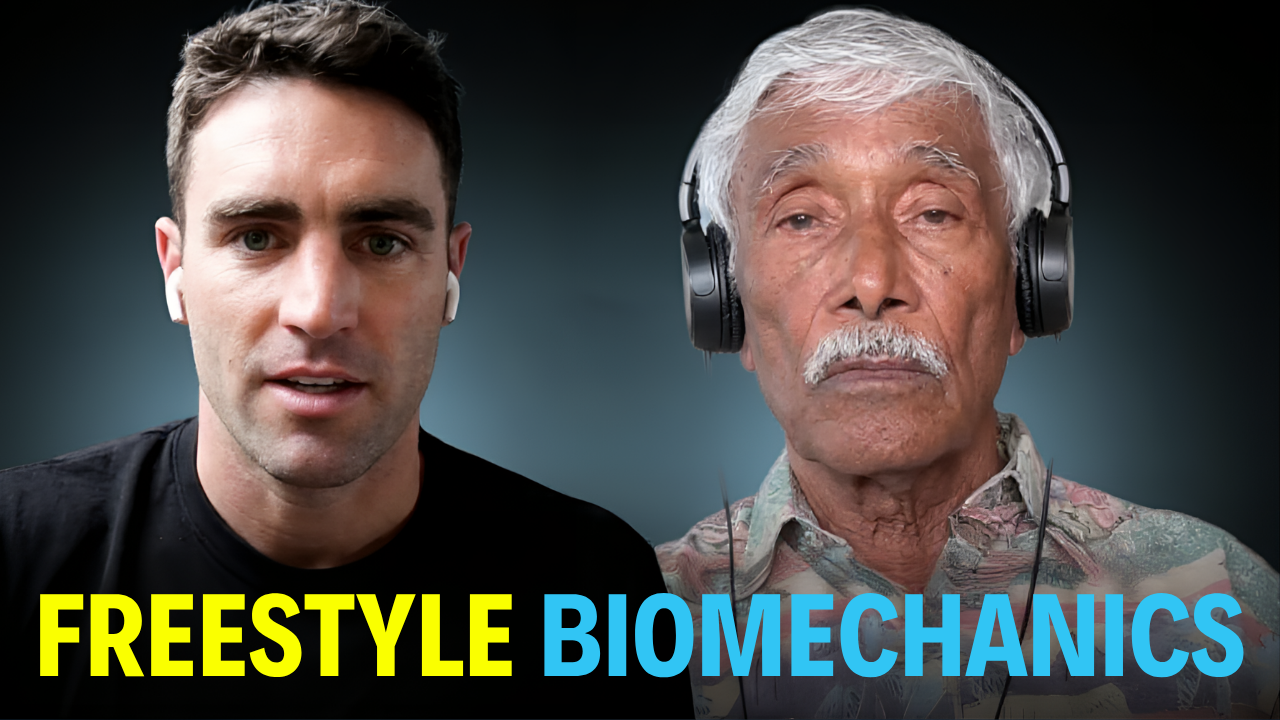








Abe Goldberg has recently been through the 5-Day Catch Challenge. He knocked 7 seconds per hundred of his 1000 yeard time trial. I thought it would be great to get him on so that he can share what he changed about his stroke and about his swimming because I think it’s going to be relevant to a wider audience and I am sure there’s going to be some learning that people can take away from this and will apply it to their own swimming.
2:10 Open Recovery Versus High Elbow Recovery
4:10 Doing It Consistently
5:49 Being Mindful Of Front Quadrant
8:58 Using Bouyancy Shorts
11:46 Swimming Downhill
12:30 It’s Okay To Come Up With Your Way Of Doing Things
14:50 Ongoing Commitment
17:07 Using Numbers
Join the 5 Day Catch Challenge:
Join the Effortless Swimming membership:
Transcript
Read the full transcript
Again, I just come back to how simple you make all this is really the benefit to anybody that’s following you or your content.
If they would consider that five day challenge and just that in and of itself, I think that breaks down everything you need to know. Welcome to the Effortless Swimming Podcast to show that help swimmers and triathletes love the water, become a better swimmer and live a better life. Here’s your host, Brenton Ford. Welcome to the Effortless Swimming Podcast. This is episode number 184. My guest today is Abe Goldberg and you’ve recently been through the five day catch challenge and replied to an email that I sent you with some pretty good results. You’d knock seven seconds per hundred off your thousand yard time trial and I thought it’d be great to get you on, share what you changed about your stroke and about your swimming and because I think it’s gonna be relevant to a wider audience and I’m sure there’ll be some learnings that people can take from this and apply to their own swimming. So welcome to the podcast.
Yeah, well, thank you, Brenton. It’s really exciting to be here and I appreciate all the content you provide to all of us out there who take a little bit of time to search you out and so it’s really been helpful.
Yeah, so I have been comfortable in the water for a long time, I swam as a kid but never competitively but always active and so swimming in general is fairly comfortable for me. You know, I don’t panic in the water in a triathlon or anything like that. I’m pretty comfortable overall
but I have recognized that it really comes down to technique and it’s not a power game in the water. I know you’ve done some analysis on Lionel Sanders and if it was a matter of power, well, he would certainly be the first guy out of the water. So when it comes to some of the subtle changes, so I have seven seconds sounds like a lot and it is a lot but I find that my gains are more incremental that I’ve had when I kind of follow some of your tips. One of the first things that I tried to incorporate was what you refer to as this open recovery versus a high elbow recovery. So I used to find myself coming real close to my body to try to get that arm over into the water and I noticed people either with your content or just watching races online, people’s arms were quite a bit wider when they were coming back into their recovery and I wasn’t sure if that was just sloppy or they were in a hurry or they were open water.
I really didn’t understand why they were so wide and then when I started doing that, I heard that slap in the water, right? That you just sort of drop your hand in and extend it and then all of a sudden you get this little bit of a slap to it and I thought, okay, well, you’ve been talking about that. So I started to incorporate that. That’s definitely made it easier.
I just feel like, I wouldn’t say I’m effortless but that’s certainly one of the things that I have incorporated into the swim is just trying to come a little bit wider with the recovery and stretch that arm out.
So that’s definitely, I guess I should back up and say that all of your instruction or all of the analysis that I followed you now for quite a while really kind of comes down to those five or six things, how you start to catch,
where you put your hand in the water to begin with.
Focus on that power diamond when you’re going through the water. I don’t bilateral breathe, I just breathe to one side. I don’t worry too much about that. I try to make sure that at least one foot breaks the water line when I’m kicking. I know that I’m dragging my feet a little bit. So all of the things you are suggesting, you could kind of break them into these five or six little things. And now it’s just a matter of keeping it in front of mind when you’re in the water and executing it. Yeah, that’s exactly right. When you look at it and then you have it explained you, you can think, all right, it’s really simple and it really comes down to a couple of simple things. And then the challenging part is to be able to do that and do it consistently and then do it at speed. And that’s where all the practice comes in and doing the drills and the warmup and that sort of thing. But I 100% agree with some of those small changes
you talked about the open recovery. Like some of those small changes where people are perhaps told something like have a high elbow recovery and it’s taken is come really close to the body and so you get jammed up with your shoulder. And yeah, teenagers, a lot of those guys will have the range of motion to be able to do it comfortably and it might be an okay thing to do. But being an adult, we just don’t have that same range of motion. And so we’re just gonna do some really funky things that probably aren’t good for your shoulder if we’re having to come over really close to the body. So sometimes those little tweaks can make a difference. I recall some of your feedback was, imagine you had like a string or something like that pulling your elbow forward, right? So I think about that, right? I just think to make sure, because if you don’t, you could very easily just lay your arm down in the water and that’s not good at all.
The other thing that I’ve taken away from the challenge and some of your other content is really the front quadrant, being mindful of that.
I don’t know that it’s natural to, unless you’re doing a catch up drill, I don’t know that it’s automatically natural to, you put one arm in the water, it’s natural to then pull it behind you, but to give a little more thought in concentration to making sure that something is always above my head in the water or in the front quadrant. And then when I watched some of these other swimmers, like we just talked about Dan Smith or something like that, I mean, it’s a whole nother league in what they do with regard to, or I watched your other interview with Sun Yang and the same thing, these guys are, they’re gliding in the water with almost, their second arm is almost in the water while their first arm has barely started to catch. So it’s pretty extraordinary. And for you, what was it those couple of changes that you mentioned that helped you take off that seven seconds per hundred? Or was there, what were you thinking about?
I think so, I mean, I think, so most of my swimming is gonna be,
so if I’m doing a longer distance triathlon, so I’m gonna be, it’s kind of a sustained, I’m not gonna be sprinting, right? Or I may try to be sprinting, but it probably won’t be a sprint, right? So it’s kind of a sustained, swim for 30, 35, 40 minutes, right? And so having that comfort and focus on some of those subtle things, right? Where are my eyes looking? Obviously, in the open water, it’s gonna be a little different, but where are my eyes looking? What is, how is my arm, how am I recovering and reaching? Am I staying on the training tracks?
Am I creating that power diamond in every stroke, right? And then not overthinking it, right? You gotta relax a little bit, right? I mean, in the first 400 yards or meters of any race, nothing is relaxed, but then you try to find your zone and you try to find your lane and then you implement all these little subtle things.
And I’ve been fortunate to have some pretty good swims. And so you’ve done triathlons for around 12 years now? Yeah, about 11 years, yeah. And if you, how often are you able to get into the pool at the moment? How many sessions a week are you doing? No, I swim, I commit to two days a week, right? I know three is better and four is even better than that, but if I get in two days a week, I’m doing, and it’s usually with a swim group, some type of squad or master’s group, a couple of days a week in the winter season, we’re now in our summer season here in the States. So, the master’s program that I would swim with, now I’m kind of on my own. So a couple of days a week, a couple, two times a week for about an hour, hour and 10 minutes. And one of the things that I remember you mentioning in an email was that you were using the neoprene shorts, the buoyancy shorts, and then you took them off, you were a little bit slower,
but I think you started to get back to, yeah, you started to get back to where you were without them. So what caused you to go without them? And then how was it, how was that process of getting back to the same speed? Yeah, I feel it, and that’s a good, that’s a good side comment for where you and I will continue our work together because I’m definitely faster with a pull buoy, right, than without one. So I’ve got to figure out how to correct that so you can make a note to yourself that that’s a follow-up item for you. But yeah, so I just decided that it was a crutch to use those neoprene shorts and heading into the winter season. So we’re now in June, so probably back in November to December of 2020 as swimming was, you know, we were able to go back in the pool and start swimming again with COVID and everything. I decided to lose the shorts and just, you know, not have that crutch. And I was clearly, you know, seven or eight seconds slower for sure, for a hundred.
But I have crept back up to a time close to where I was using those.
Yeah, which is fantastic. And it’d be interesting to see, have you worn them since? Have you? No, no, I’ve been in a wetsuit a couple of times in some open water swimming, but I have not worn those. But if I do a interval set that has a buoy, a swim buoy, a pull buoy, I will be five seconds faster for sure. At least. And it’s not uncommon to be faster with a pull buoy. It’s particularly if perhaps your kick isn’t really effective or your body position has room to move. Like it’s, that’s usually the case where perhaps your hips and your legs will sit a little bit low. And so obviously the extra buoyancy at the back brings that up and it reduces the drag and that speed increases. But there’s obviously some things that you can do to help bring that up. And then there’s a number of things that will cause the hips and legs to drop. There’s like six or seven different things that will help it. And a lot of times I think people just go to
what’s just head position. So they put their head down, they sink it well below the water and they just go to this really bad position in the water where they’re just almost swimming completely underneath it because I think it’s all to do with the head. But the head’s a small component of changing that balance out the back. I think some of the comments that I’ve watched from some of your content about swimming downhill, that’s I think a mistake. I don’t, it doesn’t make sense. And you can have too many drills, right? I thought, again, I just come back to you how simple you make all this is really the benefit to anybody that’s following you or your content.
If they would consider that five day challenge and just that in and of itself, I think that breaks down everything you need to know. Now it’s a question of can you do that, right? But I mean, that’s the content that that is so helpful.
Yeah, thank you for that. I think one thing that I learned probably I started to be comfortable doing about five years ago was it’s okay to come up with your own way of doing things. Obviously, when you start in anything, you’re brand new, so you’re learning from other people and immediately I learned from a lot of different coaches when I first started and I often just repeat something that I’d heard another coach say. And then when you get enough experience and you work with enough people, you start to figure out different ways to explain things or deliver things or maybe different drills and then just being comfortable maybe making some stuff up and just seeing how it works. And so after 13 years of coaching, I feel like I started to get to that point. And yeah, I mean, we’ve worked with so many different people and particularly when we first started running clinics where we had 20 odd drills that we do, now we only do about five.
So there was a lot of complexity in the beginning and I think the best version of something really is often the simplest version of it. So just really try and weed out anything that’s not 100% relevant to you swimming faster. And so as you mentioned, it’s just how simple can you make it? You can have too many drills, too many things to focus on. And I think one of the real keys to the five day catch challenge why so many people are getting good results is it’s one thing each day and that is it. It’s like, it’s pretty much one drill, maybe two, but it’s the one focus point each day. And that is like, again, there aren’t a hundred things to do. There’s a few things you have to do and if you can get them all to line up, you’re gonna have a good swim. You’re gonna improve. And again, I’d like to, I’d love the aha moment, the breakthrough moment where I feel like, oh, that’s it. Like I go from 140 to 130. Well, those pills aren’t available
on this channel apparently. So you gotta take them one second at a time and you make these little incremental stuff like where’s your hand when it’s going underneath your body? And are you rotating it? Are your feet all over the place? And all these little things, and I really do think that 5B Challenge kind of summarizes it.
It’s great. We were talking about the Chuck Ryan podcast and you had a chat to Chuck as well about, you know, like it’s, and we see with him like it’s a process. And as you said, it doesn’t happen overnight. You can certainly make some changes with one particular aspect of the stroke. You might see a few seconds drop, but really it’s just that ongoing commitment to improving your stroke. And over the course of many months, you’ll start to see that gradually come down when you do focus on the right things. And I think when people have that approach, they’re gonna be so much more successful than just wanting to take that magic pill and have it drop 10 seconds and then it’s done forever. And that’s not really how things work. And it’s great to be great if that was the case. And it’s great to pitch it that way, but it’s just not really how things work. And so that’s why I try and be as honest on these podcasts and in the videos as possible.
So that we get the right people coming to clinics who are willing to take that time to invest into their strokiness with me. Yeah, I mean, I think, you know, on a sprint on 25 or 50 yards or even 100, you know, I can have a aha moment, right? I can hit a time that is, you know, seven or eight seconds faster than what I might normally do, but to be able to sustainably swim at a, you know, at a tempo pace at an 80, 85% effort pace.
Yeah, it’s just incrementally, just little tiny tweaks. I did a five by 200 set the other day. And, you know, I was, you know, below 140 and as opposed to 145, right? As opposed to 146, I was swimming, you know, 138, 139. So that to me is, those are the kind of gains I know. Like I said, I’d love for it to have been, you know, 129, but that’s just not the case, right? So you just have to keep working at it.
And again, your analysis and the feedback you’ve shared with me already about my particular swimming as well as the content you provide out there, it’s a huge benefit. Yeah, thank you. And so just before we finish up, you talk, so it sounds like one, you know, going under that 130 is the, that’s the next goal, that’s the big, big target, something that you’d love to achieve. Do you have a sense of what you need to do to get there? Do you have a feeling of what may need to change? Yeah, I’d have to swim with a swim buoy.
So I really do, I really think that there’s, that’s clearly, I mean, if I just,
you know, without analyzing it much more than that, I mean, if I swim 139, you know, I can hold that pace, you know, I just did a five by 200 set, you know, with a little bit of rest and, you know, off I went.
You know, so why is it that I can do, I could probably do that in 134 or 133 with that buoy, right? So that is the question, not for me, but for you. So that’s the work, that’s the magic answer, right? So how do I get that, that, you know, is it rotation? You know, I need to, you know, little subtle changes to my body position to be able to take that three or four seconds or five seconds off. That would be significant, by the way. That would be significant over, you know, a half iron main distance or something like that. Yeah, absolutely. And I mean, the way that you can think of it too is, let’s say, all right, you’re swimming 140, so that’s a hundred seconds. So, yeah, so like you’ve got that as like a hundred seconds to swim, sorry, yeah, a hundred seconds to swim a hundred. So if you were to get down to 130, that’s basically 10% quicker, roughly. And so, you know, where can you find that 10%? And so sometimes you can use them, you know,
use the numbers a little bit. You can look at your stroke rate, so your cadence, and then how far you travel with each stroke. So your stroke count. And so the way, and then it’s really just about manipulating those things and, you know, perhaps looking to increase the cadence a bit and increase how far you travel. And that’s just often reducing drag, which is probably one of the main ones if you’re fast with that pull buoy. And then perhaps some improvements with the catch and alignment and some other things. So when you look at it from that analytical perspective, you can sometimes see where those improvements lie. And then it’s about making that actionable and applicable to what you’re doing. So, yeah, we’ll have a look at that, but I appreciate you coming on and sharing what you’ve improved and what you’re focused on to get such a good result. And as we mentioned before the call, it never stops. There’s always something to work on.
Doesn’t matter where you’re at, but that’s all part of the farm I think goes to me. Yeah, well, I just want to thank you again for all the feedback, all the content you provide. It’s great, you know, public service, although I know you don’t do it for public service, but it’s really helpful. And I would encourage others to, you know, follow you and learn what they can and then reach out to you. You’ve been amazingly engaging and I appreciate it very much. Thanks very much, Chad. Thanks for listening to the Effortless Swimming Podcast. If you’d like us to help you become a faster, more efficient swimmer, go to www.effortlesswimming.com.