








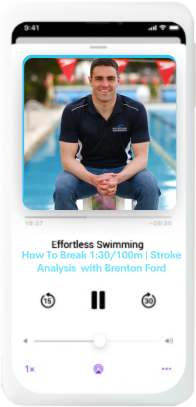
This episode is taken from our latest Feedback Friday video. We have a triathlete from Sydney who holds 1:30/100m on his Ironman swims. Let’s take a look at his strokes and see where he can find additional speed.
Watch on Youtube:
In this episode
- 00:37 — Head Position
- 01:04 — Body Position
- 04:10 — Reach And Extension
- 06:13 — Arm Angle
Links from this episode
- Get your NanoClear swimming goggles here and get 15% off your first purchase with code PODCAST15.
- Grab the freestyle checklist here
- Work with us (stroke analysis coaching)
- Join a camp
Transcript
Read the full transcript
Welcome to the Effortless Swimming Podcast to show that help swimmers and triathletes love the water, become a better swimmer and live a better life. Here's your host, Brenton Ford. Welcome to Feedback Friday. In this video, we've got Gilly from Sydney. He can hold around 130 per hundred in his half Ironman swims. Let's take a look at his stroke and see where he could find some additional speed. Yeah, you'll notice here that he's swimming really well. If you're swimming 130s, it's pretty quick for your triathlon swims. So you've got to be doing a lot well to be swimming at that sort of pace. So we do see here that head position is quite nice. He's looking slightly forwards top of the head's just out of the water, which looks great. And he's timing his breath where he pulls into the breath to initiate the turn of the head gets a breath relatively early and he brings the head back down with this catch here. So the timing of his breath looks really good. Now there's two things that stood out here that I think will help him increase his speed. One of them is body position. One of those is what happens at this moment here. Let's dig into this one first. So what you'll notice at the finish of his stroke is that the back end of it pushes up towards the surface of the water. So from here you'll see the direction that this palm is going upwards and then that hand gets drawn out of the water
in that direction. What we want to do instead is keep the palm of the hand pressing backwards all the way through, come out on the way back and then come over. So to me that indicates it is just not finishing his stroke as well as he possibly could. So he's going to lose a little bit of that propulsion through the back end of the stroke and it also means that his recovery might be impacted as well. So he might be losing 5-10% of his propulsion through the back end of the stroke. Now that might be the symptom of something else that's happening in the stroke. At Effortless Swimming our mission is simple. Make swimming more enjoyable. Whether you're training for your next race, swimming for fitness, or just love being in the water, we're here to help you swim faster, smoother and with more confidence. And one thing that can make or break a swim is your goggles. If you've ever struggled with foggy lenses mid-session you know how frustrating it can be. That's why we created the Effortless Swimming Hydro Clear Anti-Fog Goggles for long-lasting crystal clear vision. I've been using them myself and the difference is night and day. And I'm not the only one. Deborah swam 36 kilometers down the Derwent River and the entire time her vision stayed crystal clear. No fog, no frustration, just an uninterrupted swim. So what makes a hydro clear goggles different? It's all in the technology. Unlike ordinary anti-fog coatings that wear off over time, hydro clear super hydrophilic technology is built into the lens material itself.
Here's how it works. Instead of fog forming as tiny droplets, water spreads evenly across the lens, creating a thin film that prevents fog from even starting. And the result? Consistently clear swim after swim. And the durability? Our lenses are CNAS certified. Tests show that even after 2000 rubs with a wet cloth under a 200 gram load, the lens stays fog-free. No gimmicks, just serious performance that last. Using them is simple. Just wet the lenses before putting them on and you're set for a fog-free swim. Ready to see the difference yourself? Get 15% off your first pair of hydro clear anti-fog goggles with the code podcast at shop.effortlesswimming.com. That's 15% off your first pair of goggles with the code podcast at shop.effortlesswimming.com. We also have a 30-day money back guarantee. So if you're not happy with the goggles for any reason, you can simply return them for a refund. Don't let foggy goggles ruin another swim. Try hydro clear today and experience clear vision from start to finish. And I think it's a symptom of his reach and extension on his left side. So if you look at his right hand, this one enters nicely. He reaches out, gets good rotation, and you can see this link through the body here. This looks good to me. On his left side, he enters there, which is our, and then when he reaches forwards, he doesn't extend out quite as much there. And I think that he could go for a little bit more
reach at the back. And that, sorry, out the front. And if he reaches forwards a little bit more, that will help him rotate the hips slightly more. And that will also help him keep that palm facing back behind him. Because what can often happen there is that if you cut yourself short with the reach, then it's harder to get the hand out. And if the hips are flat, it's harder to get the hand out. So I think he could get a little bit more extension in front before he goes down. And that will help him rotate a little bit more through the hips, which can help him finish that stroke with the palm facing back. So we want to look at the cause, not the symptom. And to me, that's probably the cause. Now he did mention in his note study has been trying to go a little bit deeper, a little bit earlier, with this arm, which isn't necessarily a bad thing. So you can still go a little bit deeper if it feels like it helps. Slightly deeper than the shoulders are extending forwards. But I think he's just missing out on a little bit of that reach and rotation and rotation through the hips, which is stopping him from finishing his stroke on that right side as well as he could. All right. So that's the first thing. Now that kind of can lead into body position as well. So in terms of body position, at least from this side view, there's room to bring the hips up and the legs up ever so slightly. So looking at this here, you can see how the hips and legs are just slightly lower. And what I'm thinking is that that could be from not extending and reaching out
quite enough. Now if we were to get really picky with some things, another thing he could do over the top is on this left side, when he enters the water, his hands at a little bit of a funny angle there. So it's almost at this sort of angle, as you can see, where it's kind of entering like that. And he's sort of pushes forwards with it, eventually gets to a really good position. But what he could do instead would be get that middle finger going in first and extend straights out in front. It will reduce the drag ever so slightly and it can make that proper extension and reach a lot easier to achieve. So it might just be these either trying to relax the hand a little bit too much where you need enough tension in the hand so that you can enter correctly, but he might be keeping it too relaxed where it's coming off to the side there. So that would be one other thing which may help him with that reach and extension. Couple things that I like here, like his catch. This is really good with the catch there and the power diamond underneath. So that's a big part of his propulsion and his speed. He does that so well. Similar thing, like the left side as well, he gets a good catch on this side too, where we see the fingers pointing down, elbows out to the side and it's quite a nice angle with that catch too. So he's very good at those propulsive parts of the stroke and again I think that's why he's able to go that 130 pace. So at this speed, this is typically where we're trying to refine a few parts of it. We're trying to make sure we've got the right rhythm and tempo
and we're looking to work on race strategy as well. So if you want the full breakdown of how to go from 230 down to 115, watch this video above and if you'd like the freestyle technique checklist where I have got dot points of all the things that you need to be doing in your stroke, in what order, click the link below. Thanks for listening to the Effortless Swimming Podcast. If you'd like us to help you become a faster, more efficient swimmer, go to www.effortlesswimming.com.