








In this episode, I’ll show you the 5 key steps to swimming freestyle with ease, so you can save energy, improve your speed, and feel confident every time you dive in.
If you’re an adult swimmer or triathlete who gets tired quickly, this is a must-watch. You’ll discover how to finally relax in the water, connect your stroke together, and build a freestyle that feels natural.
00:42 Good Body Line and Balance
02:05 Good Head Position
03:22 Setting Up the Catch Position
07:30 Recovery Not Working Against You
09:53 Check The Timing Of Your Breathe
11:42 Rhythm and Kick Timing In Place
Join a camp:
https://effortlessswimming.com/camps/
FREE Freestyle Technique Checklist ➡ https://effortlessswimming.com/freestyle-checklist/
A simple 1-page guide to help you spot what’s holding you back in the water.
7-Day Freestyle Fix ➡ https://members.effortlessswimming.com/7-day-beginner
One tip a day for a week to help you swim further without getting tired.
Courses Membership ➡ https://effortlessswimming.com/courses-membership/
Get access to all of our online courses, drills, and training plans.
=== About Effortless Swimming ===
For over 15 years, we’ve helped thousands of swimmers and triathletes improve their technique through clinics, camps, and online coaching. Our goal is simple: to help you swim faster, save energy, and love the water.
=== Follow Us on Social Media ===
IG: / https://www.instagram.com/effortlessswimming/
FB: / https://www.facebook.com/effortlessswimming/
YT: / https://www.youtube.com/user/EffortlessSwimming
Watch on Youtube:
https://www.youtube.com/watch?v=ixCh5YsJVDo
Transcript
Read the full transcript
Welcome to the Effortless Swimming Podcast to show that help swimmers and triathletes love the water, become a better swimmer, and live a better life. Here’s your host, Brenton Ford.
If you’re going swimming is not necessarily speed, but it’s more to swim very comfortably, very relaxed, and moves through the water with beautiful technique. In this video, I’m going to share with you how to achieve effortless freestyle. And the thing about this is it can actually be very fast. If you’ve got great technique, you’re probably very streamlined, you’re probably very graceful, you’ve got good rhythm, and all of those things actually lead to swimming with good speed. So if you work towards these sorts of things that I’m about to cover, you might find that your speed actually increases for less effort. So let’s go through the five things that make up effortless freestyle. Let me know in the comments below which of these five you’re going to work on first. The first thing we need to do to swim with effortless freestyle is make sure we’ve got good body line and balance. Everything comes from being balanced in the water
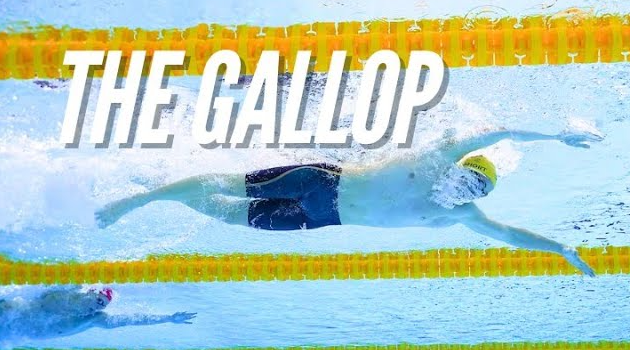
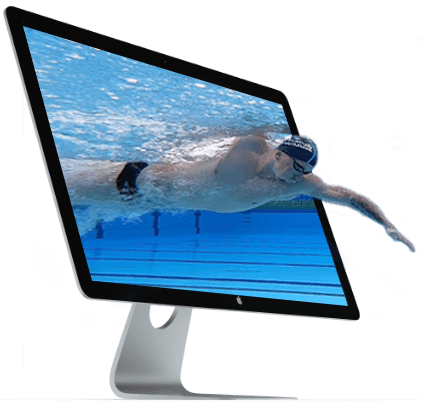
and being streamlined and horizontal. If we don’t have that, it doesn’t matter how fit, how strong we are, we’re always going to be struggling and muscling our way through the water. So step number one is we need to find a good body line which is horizontal. And our aim is to have these three touch points of our head, our hips and our heels at the surface. And even if you feel like you are someone who naturally sinks in the water, it doesn’t mean that you can’t achieve this position. It comes down to how you hold the body. So how we need to set up our frame and build our body is we need to start with good posture. And good posture comes from being tall through the head all the way through to the spine and we’re getting the length through here. And when we do that, we also should suck our tummy in and squeeze our butt cheeks together a little bit. And that tautness through the body allows us to maintain this straight position.
Because if we just switch off when we hunch over like this, our body’s gonna move around a lot. So how we hold the body actually sets us up to have success and have that balance. So we’re tall, we’re proud, we’re sucking our tummy in and squeezing our butt cheeks together lightly. We don’t need to do that in any hard way. The second thing that we need with that as well is good head position. So where you look can determine how high your hips and how high your legs are sitting in the water. Now you don’t need to look directly down. There’s nothing wrong with looking slightly forwards. I like to teach anywhere up to about 45 degrees in front. But think of your head like an iceberg, 10 to 20% above the water, the rest of it below. Because your head weighs four, five, six kilos and if you’re holding the majority of that above the water, you are gonna find that it’s really hard to keep the hips and legs up. So looking slightly forwards,
top of the head just above the water. That way we’ve built our body line. So we’re straight, we’re horizontal and the other important thing to note there is a lot of your buoyancy will come from your lungs which are filled with air. So if you find it hard to keep your hips and legs up you should feel like you’re almost trying to press down slightly with your chest. Imagine you’ve got a set of scales below you that’s here and we’re just trying to add a little bit of weight to that set of scales as we’re leaning into the water. Again, not too much, not trying to be a submarine going underneath, but we need to lean on that somewhat to help keep our hips and legs up. So that’s step one to building our body line. The next thing that we need to be aware of is the setup of our catch position. Now when we talk about the catch, this is the start of it. When we’ve finished reaching forwards out in front. Now when it comes to reaching forwards,
if we feel like this middle finger here is being sent directly out in front, that’s gonna help us initiate some rotation to our body. And when we think of rotation it should be around the spine. That’s around this axis here. So we’re not trying to rotate where we’re going like this. We need to rotate around the spine. So we want to make sure that we’re sending this forward that’s gonna create a little bit of rotation on our side and help us set up our catch in the right position. Now what position is that? Well, we need to get fingers just below wrist, wrist just below elbow, and our fingertips should be about underarm depth as well to set up the catch. Because in that position, it’s very easy to then transition into the next part of the stroke, which is our catch, which is this movement from here to here. And then that’s the part of the stroke we’re actually gonna get a lot of our propulsion from. So if you can set yourself up correctly
to start the catch, what ends up happening is not only are you 10, 15 centimetres longer than if you weren’t rotating, but you’re also very streamlined at that point. And I’d like to think of this as our base position or our streamlined position. And as we swim freestyle, we’re just transitioning from that base position to the next position. Now there’s no pausing, there’s no stopping in that position. But if you can get there, that is actually when you end up traveling the fastest through the stroke. Because if you’re very streamlined, you’re gonna have lots of speed. And you’ve also gone from catching, pressing on one arm, and then you’ve also come from this rotation and the weight of this arm coming over the water into that next part of the stroke. So you actually get a lot of speed from that movement. So you actually traveled the fastest at that point in your stroke. So we wanna make sure that we’re setting ourselves up correctly there.
And it’s a big part of feeling like you can skate from one side to the next if you set yourself up at the beginning of the catch. Now, as we go through that catch position, we wanna make sure that we’re not trying to force it. And the way that we can do that is we need to make sure that we just tip our fingers down, we let our elbow slide out to the side, and our hand and forearm remains as this big paddle. Because then we’ve got all the surface area, plus a bit more up here as well that we can use to then press back and anchor in the water as we slide onto the next side. So if we set ourselves up correctly with the catch, the catch itself starts to become a lot more natural and we don’t have to force it. And in a lot of ways, we don’t have to think too much about it if we set it up in the correct way. Now, if you’d like help with this part of the stroke, if you can get video of your swimming, check out our effortless swimming coaching membership
where you can work with myself and our other coaches inside the membership where we do video analysis. So I’ll put the link in the description below. Now, the next, hey, real quick, in case you didn’t know, we run swimming camps around the world from the Maldives, Thailand, Japan, with Sundays, Galapagos Islands, plus a bunch of new locations for next year. So if you’d like to join us at a future camp and improve your swimming and explore and experience some of the best locations to swim in the world, then go to effortlesswimming.com forward slash camps. We’ve got all the dates and locations listed there. A question I get all the time is, I’m not that quick. Will this camp be suitable for me? We have a wide range of speeds and abilities come to the camps. So as long as you can swim a kilometer, there’s a very good chance that these camps will be suitable for you. And if you’re not sure, just get in touch with us
and we’ll make sure that we do find you a suitable camp. Thanks for listening. Let’s get back into the podcast. Part of swimming effortless freestyle is making sure that our recovery over the water is working for us, not against us. Now, over the water, this is not the propulsive part of the stroke, but it’s important to get it right, because if you do this wrong, then it can impact the propulsive part of the stroke. Now, a mistake I see all the time here with our recovery, which is this overwater part of the stroke, is that a lot of people are trying to do too much of a high elbow recovery. They hear the term high elbow recovery and think it means that elbow needs to be literally very high in the water. They end up coming very close to their body like this. That position is not great for your shoulder. It’s not very comfortable and it can really throw the balance of your body out. So what I’d recommend with this recovery is,
think about keeping a nice open underarm, have the elbow pointing mostly up to the sky and not behind you and we need to relax the wrist, relax the hand as we’re coming through. We don’t wanna be overly tense with it. So the way that I would picture that is, if you imagine you’ve got a piece of fishing line attached to your elbow, someone’s in front of you and they’re pulling that piece of string towards them. That is helping initiate that recovery and bring the arm over the top of the water. And we don’t wanna come too close. We don’t wanna be too wide, but we need to have the arm just out in a comfortable position here. And that way is we bring the arm over, it’s very easy and we’re using that rotation of the shoulder coming out of the water. We’re using that to help bring the arm over the top so that we naturally then just place it in front of a stair. Whereas if anything is really forced or too close to the body,
you’re gonna notice it. But if we can come over that way, then it means that you keep the rhythm of your stroke going and it’s not gonna get thrown out by doing anything weird or awkward over the top of the water. And one small important point there is we wanna enter with our fingers first, elbow up. If you can enter in this position instead of reaching out and landing elbow first, if you can enter here and you have that last little bit of extension happening in the water, then you’re gonna find that the stroke flows a lot better. If you are overreaching and you’re landing like this, then you sometimes feel like you’ve got nowhere else to go except for straight down with your arm. And it makes the catch really difficult to achieve if you do that. The fourth step to effortless freestyle is making sure we breathe in a relaxed way and in time with the stroke. If your breathing is out of sync with the rest of your stroke
or we’re taking these big gasps there and we’re struggling to regulate our breathing in a controlled way, then it’s gonna ruin the rest of your stroke. So we need to make sure firstly, when we breathe, we’re taking a sick of air and then we gradually exhaling as our face is in the water, not too much at any point, but just a gradual exhale, release the rest of the air as you’re about to get your next one. And we wanna time the breath so that it’s in time with our shoulder roll. So we wanna turn the head with the shoulders, back with the shoulders. And a way you can think of that is we wanna pull into the breath. So as this hand is coming past our shoulders, we pull into the breath, we start turning and then as we are finishing the stroke, we wanna start to get our breath in there and we bring it back as that same hand is coming over the top. So it should all go together. So if you feel at any point in your stroke
that when you take a breath, things just lose their rhythm or their connection, check the timing of your breath. And another important thing to note there too, we wanna be looking directly to the side. It’s really common for me to see people lifting up, getting the breath or looking up to the sky as they turn. Look directly to the side, keep part of that bottom goggle in the water and that way it will be almost like you’re breathing on a skewer. So imagine you’ve got a skewer through your head, neck and spine. Wanna turn that skewer to get the breath and then we bring the head back down with it. We don’t wanna break that line of a skewer by lifting up and looking in all sorts of different directions as we turn to breathe. Super common one that I see in probably a quarter of the people that come along to our clinics and our camps. Step number five is making sure we get our rhythm and our kick timing in place. Now if you are fairly new to swimming,
a good way to start can be to use a two beat kick. And a two beat kick is one kick per arm stroke. So as you’re doing the right arm, you’ll kick down. As you’re doing the left arm, you’ll kick down. So it’s one kick per arm stroke. That’s a pretty good way to start. But the important thing there is to make sure that we time the kick correctly. Now there’s a few different ways you can think of timing the kick. And I’m gonna explain two main ways you can think of it. The first one is when your left hand enters, your right foot will be kicking down. And you can think of this as kicking yourself into streamline. So your right foot will kick down and that will kick you into that streamline or that base position to start the catch. So with a two beat kick, it’s a lot easier to think of because you can almost have your legs just going one, two, one, two. And it’s easier to think of the timing that way. As you start to progress and you get a bit more
experienced, you might change the type of kick, a four beat or a six beat. I won’t get into that in this video, but you can click this video here to learn more about those different types of kick. But with our kick timing, it’s important to kick opposite sides hand entry and foot or another way you can think of it as well. And it’s the same thing, but just a different way is in your catch, that is when you’ll kick on the same side. So let’s say we’re coming through in this movement here. This hand is about to enter. So I’m gonna be kicking with my right foot and that’s gonna kick me into streamline. But if we look at this right arm, this right arm will be going through the catch at that same time. And so you can think of right leg, right arm, catch, going together, and it’s the same thing, just a different way of thinking of it. And I find some people prefer the first way, some people prefer the second way, it’s really just up to you.
But it gives you a couple of options to think about the timing of your kick. Now, if you are doing a six-beat kick, which is three kicks per arm stroke or a continuous kick, it can be quite hard to think of the timing of it. So that’s why I think it can be good to start with a two-beat kick, get the timing of that right first and then build up from there. And the reason that’s important is because in the water, we’ve got nothing to ground us. If we’re on land, if we’re throwing a ball, we’ve got that stable surface area that we can generate power from and connect up with. But in the water, we don’t have that. So we need something to ground us and to help us generate that power from and feel connection. And it’s the kick. And I like what Tracer Bownman says about, it’s almost like the press of the legs. The press of the legs is gonna help you rotate your body. And it’s not like we’re trying to kick up and down to move forwards.
We’re gonna be slightly on our side and it’s that press of the legs that’s gonna help you switch sides and feel like you’ve got something to brand yourself from. And that is when you feel like you are much more balanced and stable in the water. So we need to make sure with that kick that we’re not kicking too big and we’re not bending our knees too much but we’re keeping it relatively narrow, relatively long with nice pointed toes as we do that switch. So that’s the last part of effortless freestyle. Now, if that all sounds like a lot to you, I’d recommend going through our eight week faster freestyle course which I’ll link in the description below. It gives you a plan of what to follow for eight weeks to help you develop your freestyle and swim in a way that not only looks good but it gives you speed and allows you to swim for a long time without getting tired. If you enjoyed this video, let me know in the comments
what you’re gonna work on next and you can also check out our 33 minute breakdown of the full freestyle stroke in this video here. Thanks for listening to the effortless swimming podcast. If you’d like us to help you become a faster, more efficient swimmer, go to www.effortlesswimming.com.