







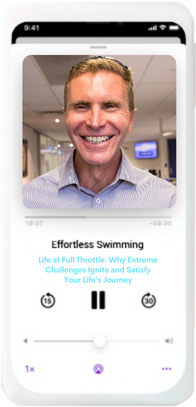
We have an extraordinary guest, Gerrard Gosens, who is a three-time Paralympian and has an impressive list of accomplishments. From competing in running to representing Australia in triathlon at the Commonwealth Games, Gerrard has proven himself as an exceptional athlete. But his achievements don’t stop there. He has climbed Mount Everest, completed a 2000km run from Cairns to Brisbane multiple times, and even appeared on Dancing with the Stars.
However, what makes Gerrard’s story truly remarkable is his current endeavor to become the first blind person to swim across the English Channel. In this episode, Gerrard shares his journey, the training involved, and the importance of teamwork in achieving such a groundbreaking goal. Tune in now!
In this episode
- 02:01 Training to be the First Blind Person to Cross the English Channel
- 05:21 Overcoming Limitations in Different Training Environments
- 06:57 Swimming Long Distances with Guide Swimmers
- 08:48 Swimming with a Tether: The Experience and Benefits
- 12:15 Listening to the Depth of the Water
- 13:23 Meet the Guides Taking on the UK Swim
- 14:55 From Running to Swimming: Embracing Solitude in Training
- 18:44 Focusing on the Journey, Not the Time
- 19:56 Overcoming the Quandaries of Swim Technique
- 24:07 Finding the Balance: Training and Time Management
- 25:36 Using Emotional Carbohydrates
- 31:52 Jellyfish, Sea Lice, and Stingrays: Unexpected Encounters in the Water
- 36:52 Lessons Learned Through Sport
- 39:52 198 Days to Gerrard’s English Channel Swim
Links from this episode
- Instagram”>Follow Gerrard on Change your technique and swim a smoother, easier freestyle with the Effortless Swimming membership
- Do you want to work with me personally to improve your technique? Join my swim technique coaching here
- Get 15% off our 8-week Faster Freestyle course by using the code 8week15
This podcast is brought to you by NanoClear — our own range of anti-fog swim goggles, designed by Effortless Swimming with the anti-fog treatment bonded into the lens itself (not sprayed on, so it doesn’t wear off after a few swims). Check out the NanoClear range here and use code PODCAST15 for 15% off.
Transcript
Read the full transcript
you’re trained to be the first person totally blind person to cross the English channel. So that’s what I want to talk about today, because for me, that brought up a lot of questions like, all right, how does that work? How does the training work? Where comes the swimming technique? Obviously, I can’t watch a person do a stroke and you can’t feel a person do a stroke as they’re doing it and obviously can’t look back at video footage. So, you know, for me, I’ve always sort of had the quandaries of how deep do I go with my stroke? Welcome to the Effortless Swimming Podcast to show that help swimmers and triathletes love the water, become a better swimmer and live a better life. Here’s your host, Brenton Ford.
Hello and welcome to today’s episode of the Effortless Swimming Podcast. I’ve got to say the guest I have on today has probably got the longest list of accomplishments of anyone who’s been on this podcast, and that is saying a lot. We’ve had many gold medalists, Olympic medalists. We’ve had Andy Donson, who’s done the Ocean’s Sevens win in 12 months. We’ve had many, many accomplished athletes on this podcast, but I think Jared probably takes the cake. Now, Jared, he’s a three-time Paralympian and he has competed in running twice and once in goalball, which is kind of like soccer where you use your hands and there’s like bells in the, in the ball. And he’s been on the Australian team for triathlon at the Commonwealth Games. He’s not, he’s also climbed Mount Everest. He’s run from Kansas to Brisbane five times, which is 2,000 kilometers. And that’s just some of the things that he’s accomplished over his lifetime.
Now, the reason I’ve got Jared on the podcast is recently we had some people attend a clinic in Sydney and those people were their guide for Jared’s upcoming swim. So Jared is looking to be the first totally blind athlete to swim across the English Channel in August this year. And when it comes to swimming in the channel, it’s absolutely a team thing where there’s so many people involved in from the pilot to the support to the training buddies, all that sort of stuff. But I think even more so when it comes to being the totally the first totally blind person to cross English Channel. So he’s going to do it with several guides where they’ll have an attachment to the to the thigh and I’ll leave the rest for the podcast. But this was a really interesting episode and I learn a lot from Jared. He’s an incredible person, incredible athlete. So I know you’re going to enjoy this episode with Jared Gossin. So let’s get in the episode.
My guest today is Jared Gossin’s Jared. Welcome to the podcast. Good morning. Thank you. Well, I got to introduce you a couple of months ago now. And the friend of yours, Chris was saying that he attended one of our freestyle clinics and was saying that he’s training for the English Channel, but not in the in the typical sense. He’s training for the English Channel to go along as a as a guide for your crossing and you’re trained to be the first person, totally blind person to cross the English Channel. So that’s what I want to talk about today because for me, that brought up a lot of questions like, all right, how does that work? How does the training work? And then I sort of dug into your background and looked at all the pastings that you’ve done, some crazy athletic and physical accomplishments. It sounds like you just love to set yourself a challenge, something that’s completely out there and then just and work away at it.
And you’ve had a lot of success with that over the last several years. Is there anything that comes to mind? What’s probably the one that you’re most proud of so far? Look, I think for me, it’s it’s never been a bucket list of things I had to tick off. It’s always been about the actual opportunity and throughout my career, where I’ve been from long distance running when my ultimate goal as a as a young kid and back in the days where there used to be the Sydney to Melbourne Westville run, the days of Cliff Young and the Oscar us. For me, it was about preparing both mentally and physically to try and I run and and be potentially have a chance of replacing or if not winning the actual race. So I embarked upon my first ever journey by running from to then I went on to complete that for further times by running from cans to Brisbane. So after I suppose five years, I felt I was both mentally and physically prepared to to do the Sydney to Melbourne run
and had my team, had the equipment, had the resources. I was all ready to go and that year they actually cancelled the Sydney to Melbourne Westville run. And I was sort of somewhat left stranded. And for me, I had to recognise that.
I have a I suppose a very simple philosophy in that is success is a journey. Never ever a destination. It wasn’t going to sort of finish at those five runs from cans to Brisbane. And then that turns to you know, parallel games and very through athletics and triathlon and whole range of other adventures. But for me now more so the the English Channel was about an opportunity. You know, I had I come back from the 2022 Commonwealth Games representing Australia and triathlon and I had a small brunch for about sort of 60 or 70 people just to thank them for their support over the last two or more decades. And someone mentioned to me at the brunch that there’s never been a totally blind person swim the English Channel. And I thought, well, hey, look, let’s let’s give it a go. So it was through the opportunity and the the teamwork, the support of ocean water swimming and has been incredible because they’ve all come together as swim guides, as Chris and Joe
and Jen and Hayden and Phil have all shown that they are all dedicated towards assisting me across the English Channel. Yeah, watching a video from a couple of years ago where the ABC was interviewing your wife, she said that people will mention something and it’ll put an idea in your head and just implant that scene. It sounds like that happened for the English Channel. Well, why do you think that’s what appealed to you in that moment?
I think obviously what I it’s very hard for a person who started to I suppose appreciate that the fullness of this particular answer. But every part of my life, his teamwork, whether it be going to the movies, whether it be going shopping and all the years of training, for example, in athletics and long distance running and triathlon, all my adventures have been even, for example, when I climbed Everest on two occasions, it was it was about teamwork. And I saw this as an opportunity and particular training in the swimming pool where I have the opportunity to train individually. I have the control of how long I train, how hard I train and when I train, whereas in running or cycling or climbing or whatever they look like, I’m actually then somewhat, I suppose, limited to the availability and the ability of my guide. So, for example, if I have a guide who pulls out because they’re sick or injured or they’re not necessarily having a good day or they’re feeling a bit fatigued
and they actually can’t do the speed session, whereas in the pool, I can actually get in there and place my head on the line in the sense of my responsibility as a swimmer to train myself where it be for just a simple long swim through two hard reps. Yeah, it’s interesting. So what’s that for you? Does that then obviously makes it easier to do the training because you’re not relying on someone else to do the training? Has there been any other differences there in terms of just having the option to, well, to just go whenever you’d like or to do as much or as little as you need to? Has there been any other differences that have stood out to you there? I think it’s a very simplistic way of describing. It’s like when your 16-year-old gets the P-plates or the driver’s licenses when they have to sit with mum and dad for, I think, it’s 100 hours in the car. And then when that comes to that day where they’ve got their own license
and they have the freedom and they go, Whoa, this is great. I get to drive out on my own. I have no worries about who’s in the car beside me watching how a driver went on a drive. And the freedom for me has been, I suppose, fantastic as a person who is totally blind. And secondly, though, the biggest thing that has been quite remarkable, not necessarily related to the pool, but has been to open water swimming and the amazing culture that there is amongst open water swimming in the sense that when you’re tethered to a person who is totally blind, the growth, the understanding, the somewhat courage and resilience of the guys who has been quite remarkable because they’ve had to overcome some amazing perceptions as well because their fear would be, oh, my God, how am I going to guide a person who’s totally blind in the ocean? Well, now I’ve got multiple guys, both Gold Coast, Brisbane, Sunshine Coast. Who are all available and prepared to jump out into the open water
and swim 5, 10, 15 kilometers.
Wow. And into the question that I’m sure a lot of people are wondering, and this is what I wondered initially, how do you do your training in the pool and how do you do it in the open water? And you mentioned that the tether there. Do you talk a bit about where the tether is, how it works and what that experience is like swimming with the tether on? Sure. In the swimming pool, first up, I actually, when I’m swimming in the pool, I actually wear a snorkel. And the reason why I wear a snorkel is because I don’t count my strokes because I may wander a tad to the left or a tad to the right and that’s going to change where it be by one stroke or half a stroke where I am in the pool. The reason why I wear a snorkel is because I can listen to the water so I can tell you whether it’s shallow or deep. And actually, as I’m coming into the wall, I can listen to the depth of the water and know where exactly where I am in the actual pool.
I have a very good callus on two of my fingers on my left arm or left hand. So as I’m going up the lane ropes, I just check every and again so my my finger will rub up against the lane ropes. So it’s well worn by the how brutal some of the lane ropes are and some of the swimming pools. And that’s how I can swim independently. And I suppose with somewhat some freedom in the actual ocean. I have a swim tether. So there’s an elastic out of court. It goes from just above my knee to my fellow swim guide has like a small sort of wrap brand harness which goes around the actual thigh. I suppose I’m saying we invented a bit designed it and so I actually now provide these swim tethers to other Paralympic swimmers who are doing open water swimming, more so triathletes. I designed it through when I was competing for Australia in triathlons because there were a number of other Paralympic athletes or triathletes around the world who are using
where it be a cord from a surfing board or a piece of rope. And I thought there must be a way better design that’s going to be more comfortably be lightweight and more resilient. And so I’ve sort of taken the time out of the years to design it. And it’s very comfortable. It’s lightweight. It doesn’t hold any water. Obviously, it’s it’s simply a piece of the resistance bands you might buy at a rebel sports store. And then that’s obviously sewn into a tether which goes around the actual thigh of the swim guide. And the thing about obviously being a swim guide is there’s no actual talking in the water, obviously. But I can actually feel through the tension of the tether where my guide is going. For example, if you’ve ever ridden a force, you can feel the tension through the reins of force where it’s going, how it’s, I suppose, working. And it’s the same when working in the ocean. You become very sensitive to the tension on the actual tether itself.
It’s a shame they don’t make the the old foam lane ropes like they used to back in the 80s and 90s. You’d have much less of a callus on your hands. But I think it’s only just gotten worse. There was Lane ropes at M Sack, which is the main pool in Melbourne. And they bought in these brand new state of the art lane ropes to stop any sort of waves and splash. But they were brutal. They they had sharp edges and they they’re not good. Now, hopefully I imagine that probably got just your standard the lane ropes there at the Rongo Park. But yeah, it’s it’s it’s amazing. I haven’t tried listening to the depth of the the water. I’ve never tried that. It makes me really curious as to what I want to try. I doubt I’d be able to notice a difference there. Have you heard of anyone else being able to tell the difference in depth from just listening to it? I’ve been trying to train a number of young athletes who are blind or have low vision.
Rowan is the young kid and Patrick is actually based in Melbourne. I’ve been trying to train them to to really use the other senses to have a sensitivity to the depth of the actual water. If you go to places like, for example, Chandler, Quattroxen or Brisbane, that’s where it becomes a challenge because it’s the same depth all the way through. You have to use other senses there where it be through the acoustics of the Chandler Quattroxen. But most people was obviously with a shallow and deep. It becomes, you know, very easy. More so places like, you know, University of Queensland. But your Rongo for me is sensational. And only from obviously it’s set up for a person who’s blind and has low vision. But I had the culture of a swimming pool. The people there is quite remarkable. And they’re very inclusive for a person who was totally blind.
Hey, tell me a bit about the team who will be going over to the UK with you to do the swim. I have six swim guides. I have three girls and three guys, both Joe, Rosie and Jen, the female guides, they all are supposed to have very different abilities as to Phil, Chris and Hayden. I suppose this is going to sound a bit funny. But I describe them in some respects. For example, one of the guides I describe as the old sort of holding the Commodore where it’s quite comfortable and we just keep on going. Where one of the other guys I describe as the human speedboat, they have a lot of speed and I really have to put the whole sort of jets on to swim beside them. So each of them had their own set of skills and I will tailor their set of skills, strengths in the actual channel crossing. So there are four quadrants in the actual channel. And I will make sure that they will be sort of put into the water so that we are an hour on hour off.
So obviously, for example, Hayden will be my first swimmer to get up through some of the choc. He’s a very strong swimmer. I’ll utilize his knowledge and his time with me. So Hayden went to the Commonwealth Games with me when I competed for Australia in triathlon. And then you look at people like Phil, who is a stayer and you probably use him into the meal parts of the actual crossing as well. So I will utilize their strengths and skills for each part of the course or the crossing.
What’s been different for you with swimming training compared to your running background?
Before we dive into the rest of today’s podcast episode, this episode is proudly brought to you by Form Smart Swim Goggles. They have been a long time sponsor of the podcast and they are my go to goggles when it comes to tracking my training sessions and being able to see what’s happening in real time through the goggles. And we know swimming is a highly technical sport, but without the guidance of a coach on deck, identifying and addressing technique flaws can be a challenge. They’ve recently added a new feature to the goggles, Head Coach. And this addresses that problem head on. It gives them as improved access to their technique awareness, focus skill development and in app education and analysis. Head Coach provides real time visual coaching via the Form Smart Swim Goggles augmented reality display. During and after a swim, Head Coach provides swimmers with technique feedback using two types of metrics.
Form Score and Head Coach skills. Form Score is a measurement of overall swim efficiency ranging from zero to 100 defined by your pace and your stroke length. Head Coach skills encompasses five key areas that will help you identify where to focus on improving with your efficiency. Head roll, head pitch, set pacing, interval pacing and breathing time to neutral. And after completing a session, you can check back in on the Form App to track your progress. And Head Coach provides swimmers from beginner to expert with an unprecedented level of data driven guidance and understanding, enabling you to boost your performance and your speed. Get your pair of Form Smart Swim Goggles today. Click the link in our podcast description or use the code Effortless on Checkout to get 15% off. Your Form Smart Swim Goggles. I think for me, obviously, it’s that sense of solitude because I used to run when I was trying to run from Kansas to Brisbane
and I was studying at University of Queensland and I was living there at Emmanuel College and I run past the pool and, you know, I was sort of training at sort of four or five in the morning and you could smell the chlorine coming across the university campus. And you think, what a crazy soul would swim at five in the morning? Why would you do that? Why would you stick your head in a bucket of water basin and do that? And here I am, Brinton. I was at the pool at 3 a.m. this morning. What up at 2.15? I was in the pool in the pool by 3.05. So it’s amazing how things change and I have a very strong quote in my life and that is that change is constant growth is optional. So it’s the solitude of the actual pool because there’s a lot of thoughts that go through your head when you’re doing four, five, six, whatever kilometers. But more so for a person who’s totally blind, not just in the pool, but also in the ocean
because a person who’s sighted actually can see whether it be a boy out there in a marker if you’re going around a course or it could be a building in the distance, for example, when we do our swims along the Gold Coast. You know, the team can look at Q1 or the Jewel Hotel or other landmarks along the way. They can sort of unconsciously and consciously so know how well they’re going, whether it’s for me, it’s we could be swimming into a sweep and I’m thinking, gee, we should be there by now, but I’m not aware that the actual sweep is really strong or thinking, oh, we’re almost there, but in actual fact, right off really quickly because we’re with the sweep. So it’s all the time in your brain, you’re having to think, are we there? Are we there? Are we there yet? So you have to have that mental strength to know and trust your guys implicitly. Not in obviously the direction they’re taking you, but in how you’re swimming as well.
And when you do eventually swim the channel, will you be getting updates on the distance that you’ve swam and the time you’ve been in there? What for you works best mentally? I think for me, I’m just gonna not, I don’t need to know my distances. When I did the 20K swim a few weeks ago at NUSA, I sort of set out to just go through my swim guides. So that, for example, Hayden won, Chris too, and on which I went. So I was just working through that hour sort of clock order of each of the swim guides. And it was only within the last sort of maybe two K that I simply asked, how far are we off to the finish? And that wasn’t through exhaustion or fatigue. It was just because I knew that I’ve been through a number of guides and I knew that would must be getting very close towards the actual in the swim. And I’ll use the same sort of philosophy because I just bought off small pieces. It’s not looking at the big pieces.
I suppose a good analogy is, how do you, how do you get elephants? Well, we are one bird at a time. It’s not looking at the massive, I suppose crossing. And I have no, I suppose time that I’m aiming for because for me, I’m based on endurance and I will get there regardless of the actual time. And in terms of swimming technique, for me, when I’m running clinics, we have a big emphasis on the visual side of it, recording video and showing people and that helps them understand what they’re doing a lot. What has it been like for you in terms of the technical side of it and what kind of coaching or if there’s cues or something like that that you have found to be helpful over the last year or so? I think for me, both when I was sort of training for triathlon and now obviously the distance swimming, it’s really hard. And I give an analogy in that respect, is that I have the opportunity to compete on dancing with the stars.
And when I was asked to do things, for example, like the rumba, tango, I suppose the jive, but when it came to things like, for example, the rumba and they said, hey, listen, we really need a sexy look or what does that look like? I’ve never seen a sexy look or we’re doing the tango. So we want a passionate look. Well, what does that look like? I’ve never seen a passionate look.
So where comes the swimming technique? Obviously I can’t watch a person do a stroke and you can’t feel a person do a stroke as they’re doing it and obviously can’t look back at video footage. So for me, I’ve always sort of had the quandaries of deep, do I go with my stroke? Do I keep it sort of more close as a service so there’s less drag, but more speed on the stroke or does it go deep or there’s all these questions I’ve had over time or am I placing my chest in the right position and making up head position? All that sort of stuff becomes a massive challenge not only for me but also for anybody who’s trying to give me advice. And whilst we’re getting there, I don’t claim to be any much of a swimmer as I did a dancer. Well, I made it to the final dancing with the stars purely through the passion, the story that we told. I was never a great dancer. Now it’s the same, I don’t claim to be a good swimmer. I just pray to be a person who is stubborn, persistent
and determined to do what I can.
I think trying to give off a passionate or whatever it is sort of vibe when you’re dancing. That’s hard enough if you can see what it’s meant to look like, I think. So the fact that you can’t see what it’s like is like, man, that’s hard work. So yeah, that’s amazing. For example, when people used to say to me, oh, they’re giving you the evil eye or they’re giving you the come to bed look. Like to me I go, what the hell does that look like? Why the look you get to you with a confused look? Well, what does that mean? I’ve never seen a confused look. So that’s all like, because facial expressions are learned as you’re a baby and as you’re growing up, you learn your facial expressions from your parents. Now they’re looking at you with an angry look, you learn that look, it’s unconsciously learned. Whereas I never got to experience those sort of things. Do you find the equivalent for you would be in, say, tone with like vocal tone?
Yeah, vocal tone, yeah, sure. But I think obviously when you’re doing something like, for example, dance and they say, hey listen, you’re expressing your face on your face has to be a very passionate look. Or if you look back on one of the commentaries, I’ve actually, they reviewed my quick stare. I did pretty well at dance, but Helen, who was one of the judges said, she said, okay, when you’re doing this, I need you to imagine you’re waiting for a bus. Well, I’ve never waited for a bus. So I don’t know what that looks like. What does it, what does it playing for a bus look like? So now there’s all these sort of visual things that people will try and work through, but from a swimming perspective, as I said, it’s the challenge of underwater. Am I actually going too deep? Or am I going too shallow? Or is the elbow in the right position? Or am I going too high with the elbow? Am I dropping the elbow? It was always sort of technical stuff,
but yeah, I suppose the challenge is about for me, it’s about persistence. And as I said, I’ll just keep on taking that advice. And in terms of fitting all this training into your day, how are you, how are you finding that compared to when you were doing the other sports? Oh, look, I think I’ve lucky enough where I don’t require a lot of sleep. And I think that was sort of built into me through all the years of the major long distances. So I trained twice a day, almost every day, where I’d be going for a run on the side or going for a bike ride, but I’m gonna actually cut back. The bike ride’s now purely from a risk analysis perspective because I can’t control other riders. So I ride a tandem bike and my pilots is, as in my front rider, is very, very good. But it’s the cars and other riders who could have an accident. So I’m cutting that back. Whereas running, the Pilates, all that sort of stuff is pretty, I suppose, entrenched in my life,
but I love training. There’s never a day where I don’t sort of say, oh, gee, I wish I couldn’t have a day off. It’s, for me, it’s about the whole enjoyment of, I’d rather turn up at my graves or I suppose, rugged at more an ounce and all this stuff rather means to refresh as a daisy. Totally agree. It’s like, if I don’t exercise in a day, I feel agitated as a result. Just, especially in the morning, I love getting something done in the morning. And in terms of starting at three o’clock, do they open the pool for you? Or is there a pool? Okay, I’m gonna say, I don’t know, any pools that will open at three o’clock in the morning, anywhere else. We actually, our official squad starts at four, four, 15. So the guys that actually opened the pool get there an hour early at three just to give everything set up and they allow me to go through the back. And that’s been a fantastic support from Shelly and the guys that you’re on a swimming pool
because they are aware, obviously. And for me, it also allows me that hour where I don’t have to worry about swimmers coming towards me. You know, if I wander a slightly bit towards a meal, then so be it for the hour, I have that sort of relaxation that’s, for example, Brenna, I often talk about the what we call emotional carbohydrates. For example, when you walk down a corridor, you would use up, let’s say, 1% of emotional carbohydrates of thinking about where you’re walking, how you’re walking. For a person who’s totally blind and this has never been equated, I hypothetically might use up eight or 10 carbohydrates emotionally. And it’s the same in the pool and it’s the same in open water because every stroke I take, both in the pool and also in the open water, emotional carbohydrates that consume far more vigorously because I’m thinking about where I am in the water, what’s the tension on the tether? What am I feeling through that,
not only from a, I suppose, a communication, how does my balance, is my body sitting straight because a person who’s sighted also knows when to breathe. So if it’s really chompy, and when I first started doing open water, it was a massive struggle because I couldn’t see waves. So I’m sort of gobbled falls because a person inside can then think, okay, well, I won’t breathe now, whereas I would be breathing away if it’s me or if it’d be a chop, it’s me. And in the pool though, obviously keeping myself straight up against the lane road. So because I’m not gonna obviously put another person in danger of swimming towards me. So I’ll be consciously using up emotional carbohydrates, carbohydrates far more viciously than a person who’s sighted. And have you noticed that all the way through your career, just in terms of the emotional carbohydrates? Yeah, my emotional carbohydrates, as in what the brain actually consumes.
And for example, if I go to a very loud, even not through sport, if I go to a loud venue where it’d be for, for example, I go, I’m an Australian ambassador. Tomorrow I travel out West. I’ve got straight awards. I was young Australian back in 95. And I’m going out there to present awards and make people strange. There’s a function on Friday morning for 400 people. And I know that my emotional carbohydrates will be used a lot, not only in my surroundings, the people around me, what objects are around me and where I’m actually working, where it’d be with my partner or where it’d be with my God dog. So just even in a loud environment, you’re using up emotional carbohydrates. And that’s where athletes, even sighted, for example, when they go out on the town or where they go to a function, they don’t realize when they get to their train next day, why they’re feeling that bit fatigue. It may not be physically, it’s just emotionally.
Yeah, it certainly adds up. And I think about that, even if I just travel into the city where it’s just, it’s busy, there’s cars, there’s lots of people. It’s like just being in that environment is tiring and compared to being out on the coast where it’s quieter, not many people around. So that makes a lot of sense. I think there are… So I think another way of actually describing it very easy too is like, for example, when you go out on your first date, we’re gonna be with a girl or guy because, for example, you’re thinking about, okay, where am I gonna wear? What am I gonna talk about? Where are we gonna eat? And it’s the same day, for example, same thing when you go for your first day on a brand new job at the work. You’re thinking about your desk, where you’re sitting, the new people around you, what you’re gonna potentially get for lunch, what the worst gonna be like, what the new boss is gonna be like, and you go home after that first day of work
and you’re exhausted emotionally, not physically, just emotionally. Have you found that that’s impacted, like you’re obviously an endurance athlete, has, do you feel like that impacts your racing? Like when you’ve done the long runs, has that, have you noticed that take a toll or have you noticed that in the pool when you have the lane to yourself and the pool to yourself, that you feel like those, say, I mean, 3K goes a lot quicker than the second 3K? Oh yeah, look, most definitely, because obviously you have one last thing to worry about, but I think my body has learned to adapt over the years, but my body also knows when to shut down. For example, Brenton never traveled with me on a plane and the reason why sad is because I’ll step onto a plane and I’ll sit in the seat and I might go to sleep straight away. My body just goes, okay, we’re in a plane, we can’t go anywhere, not moving, bang, and I’m off to sleep.
And say, there’s no talking to me on a plane and it’s my body can just shut down for that few minutes and it’s gone again. And I think from a long run perspective, you have, I suppose the ability, for example, whether it be a Richmond Road or I hate running a footpath, Richmond Road’s a far more controllable environment for me because if you’re running on a footpath, I’m thinking, well, what branches are hanging out of the fence? Is it going to be even pavement or is it going to be uneven pavement? So I will try and control those factors that will influence hammy, emotional carbohydrates I will consume. But then there’s also how your diet is feeling as well because I can’t see their facials. They can be struggling, whether you’re not physically, but also other things happen in their life as well. So I have to be trying sensitive to their own emotional and physical needs as well. What do you do to pass the time,
whether it be running or swimming? How do you get through those long stretches of not necessarily activity? Like just, I’ve talked to quite a few distance swimmers and one of them said that when he was doing, I think it was like Taupo. He said he, in his mind, he goes from, when he was a kid, his house that he lived in and he just tries to follow along the road to like different locations and go around all the different streets just in his mind. Do you have anything that you do to pass the time? I think for me, I will, whilst I’m also focusing on particularly open water, I’m focused obviously, but it’s really flat. For example, it could be Annogua Dam in Brisbane. Okay, so I don’t have to worry about waves or chop or anything like that. So that’s a very meditative sort of swim to swim. I can think about where being, the words that I do, I’m a, I suppose I’ll run a number of different projects for where it be through the Paralympic Committee,
the Olympic Committee for Triathlon Australia, where it feed through my work as a chocolatier. So I have businesses in the Brisbane CBD. So it would be going through, even for example, designing chocolates, obviously then trying to invent new flavours, designs. So my brain is constantly thinking, but then also checking back into, hey, how’s the tether? How’s the tension? Where’s my swim guide? Are they slightly, in front or they slightly behind? How are they feeling? How do I think they’re feeling in the actual water? So there’s a constant roll over of thoughts. If it’s in the ocean, way different. Because I could be then thinking about the chop, okay, when is a safe to breathe? Is it gonna be good here now? What am I going through? And the other thing is from a blind perspective is bloody jellyfish and particularly the small ones. Like you might run into a particularly on the Gold Coast, you run into these small packs of hundreds and hundreds
of tiny little jellyfishing or globular ones. Anything, shit, don’t swallow one, don’t swallow one, don’t swallow one. Like it’s, you know, how long will these jellyfish last? Are they going, are they gonna sting me? Are they not gonna sting me? And there’s all that sort of swimming into the unknown is at times a bit confronting. Oh yeah.
Nothing worse than jellyfish on a, well, there are worse things, but yeah, jellyfish are just not much fine. I’ve in the Bay in Melbourne, occasionally have these really big ones, about 30 to 35 centimetres across and high as well. And I’ve, many times just put my hand straight into one, some swimming with my head down and creeps me out every single time. We like we don’t have too many stinging ones down here, but it’s not, they have a few stinging ones up on the Gold Coast, don’t they? Yeah, we do, but it’s more that they’re really, like they can change, for example, or be, and more so just last week in a break lift, my team did a 10K swim and a lot of my team got, and I was a little, I don’t know why, but I was lucky enough not to be impacted, but by sea lice. And all my team now come up with, you know, welts and rashes and feeling unwell. So there’s all that sort of things you have to deal with, but it was more so for me, the unknown, okay,
when you’re swimming through a large pack of jellyfish, how long will this last? And even for example, when I swim around the Great Kippel Islands, you know, I had a, I had a dugong brush past me. Now that was a bit of a scary moment because I had no idea what that was at that time. Oh, how long did it stick around for? I’ve never heard of someone swimming along with a dugong. Well, it was, it wasn’t there for that long. I was, I don’t remember where it’d be. It just sort of was falling out of a ball of fish or what have you. The other one that really freaked me out, which was, I suppose I never knew there were a few like that. And that was a stingray. I was swimming through Recliffe probably about two months ago now, and there was some shallow waters there. And my hand came down and brushed across the top of a stingray. And I always assumed that a stingray would be sort of, maybe that’s the hard, fleshy bit, but it’s actually, they’re very velvety,
almost like a tiny bit sort of, wouldn’t say furry, but I was going back against the grain of the actual sort of bird dash, whatever they are on the top of a stingray. So that was something that I never knew they would feel like. It’s like, for example, I never knew, it took me 25 years to know that an elephant was hairy because you’ve walked into a store of a shop and you pick up an elephant, there’s not one ounce of hair on them. One day when I went to the circus and I had the chance to have a ride on an elephant, it’s like mounting a made of scrubbing brush. They’re one of the hairiest things I’ve ever come across. So your perceptions and your mind can be very different to what they realistically are. Yeah, that’s amazing. Is there any lessons that come to mind that you’ve had to learn over the years through sport and the physical challenges you’ve set yourself? Are there any lessons that have really stuck
where you have to remind yourself when you’re maybe going through something that’s challenging or you’re in a heavy block of training? What are those key couple of lessons that you keep coming back to? I think I carry two tools with me. I carry something that I will never ever use in my life and that’s a mirror. And the reason why I carry a mirror with me everywhere I go is that when you walk into the bathroom in the morning and you give it a smile, it gives one back. When you walk into the bathroom and you give it a grimace, it gives one back. What you put in is exactly what you give back. And for me, it’s about that understanding that if I’m gonna put in the hard session, obviously I’ll get the results back in the hard session. If I’m putting anything in all, then nothing’s gonna be received. The other thing I carry with me is a piece of Everest. When I climbed Everest in 2003 and five, I bought back a piece of rock from the top
of the summit in Everest. And for me, it was a continual reminder that we’ll be both mentally and physically along the way there’s gonna be crevasses. There’s gonna be those, the times where things can and will go astray. And I’ve learned, I suppose, very importantly that there are what we call the facts of life where things can and do go astray. As in, there’s gonna be a point where my guide owner does call up and we’ll be half an hour before a session and say, listen, Jeremy, I’m stuck at work, I can’t come and try and jump on the bike or go for a run. I could very easily go, well, oh well, reasonable reasons. And that’s where a lot of people, I suppose, fall into the mistake of reasonable reasons where they go, oh well, it’s like, for example, I might say, oh, I had a glass of water so I can actually have that piece of chocolate cake. Or I had that salad so I can have that apple pie. You know, our brain is amazing
how it can justify anything of life to itself. And for me, as a person who’s totally blind, I had to get past those facts of life where, sure, a guy’s gonna call up and say, well, what’s the alternative? What can I then, obviously, move on to as it’s firing the actual opportunity? For me, I suppose, to look at the obstacles, not necessarily the actual opportunities. For example, when dancing with the stars, it should have never seen dance before. Well, the opportunities were, well, how can we tell the story? How can we take people on this journey? And that’s how we got to the final. It wasn’t about the dancing. It was about the story, we’re told. I love it. It’s particularly the first one. It’s like, however you approach something is probably how you’re going to perceive it. And you can see the exact same situation in a positive or a negative light. And it’s really about your decision to see it, however, which way that’s gonna determine
how you feel about it. Jared, when’s your window for the English Channel? For those that are listening? Yeah, I’m looking to the actual windows from August 10th to August 17th. So just on 198 days, but who’s counting? And for me, it’s about the journey now. So we’re looking at the swing and the down river through to that’s next week and then to right next to Ireland. And then we have some, I suppose, cold water camps, both in Sydney and Melbourne at Half Moon Bay. And then obviously move on to the channel, but it’s a very short time now. It’s only a matter of months away. So it’s all about the teamwork now, I think in that next six or so months. And I think I was taught there very aptly by Sir Edmund Hillary, I’ll have the pleasure of having, do you know what’s Edmund Hillary? And what people don’t recognize is that when Hillary climbed Everest back in 1953, his team wasn’t four people. It wasn’t even a hundred people.
The entire team that trekked to Everest Base Camp with Hillary back in 1953, total 2,000 people. It took 2,000 people to get two people to the top of Everest in 1953. And the same with my team. It isn’t Gerard Gossens crossing the English channel. He’s my entire team and the charity of Great Dreams, which we’re looking to obviously raise funds for, that will be crossing the English channel.
That’s awesome. Well, I’m really looking forward to, well, to following that journey. And I think we’re gonna catch up in March in Brisbane. So looking forward to that. So Gerard, thanks so much for sharing your story on the podcast. I know that the people who listen to it are gonna get a real kick out of it. And we’ll take a lot from it. So I appreciate that. And I wish you all the best in your journey over the next couple of months in the lead-up to the channel. Thank you. Thanks for listening to the Effortless Swimming podcast. If you’d like us to help you become a faster, more efficient swimmer, go to www.effortlesswimming.com.