







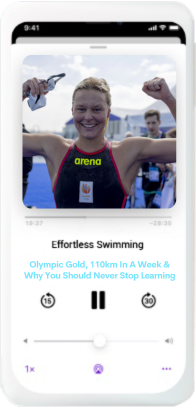
Join us in today’s episode as we interview one of the best open water swimmers in the world, Sharon van Rouwendaal. We will delve into her recent double win at the world championships, her intense training regimen, and the mental fortitude that drives her success. She will be sharing insights on her transition from pool to open water swimming, managing injuries, and the importance of technique and kick in her training. Uncover Sharon’s unwavering commitment to greatness, and her relentless pursuit of improvement. Tune in now!
In this episode
- 01:41 The Double Win
- 05:56 The 110 Kilometer Week
- 08:23 Building Mental Toughness and Confidence
- 11:16 Training Environment and Culture
- 14:10 Understanding Open Water Racing
- 16:35 Transitioning from Pool to Open Water
- 18:35 Overcoming Shoulder Injury
- 22:11 Mastering the 6-beat kick
- 24:54 Learning from a New Coach
- 26:04 Coaching Others and Sharing Knowledge
- 30:46 Effective Communication in Coaching: Simplifying Techniques
- 32:56 5 Different Levels of Speed and Heart Rate Zones
- 37:34 Challenging Sets and Progression in Swim Training
- 41:10 Analyzing Training Sets and Building Confidence
- 44:05 Managing Training Load and Sleep
- 49:07 Challenges of Transitioning from Running to Swimming
- 50:34 Exploring Hobbies Beyond Sports
- 52:52 What’s next for Sharon?
Links from this episode
- Instagram”>Follow Sharon on Open water swimming and clinic with Sharon
- Change your technique and swim a smoother, easier freestyle with the Effortless Swimming membership
- Do you want to work with me personally to improve your technique? Join my swim technique coaching here
- Get 15% off our 8-week Faster Freestyle course by using the code 8week15
This podcast is brought to you by NanoClear — our own range of anti-fog swim goggles, designed by Effortless Swimming with the anti-fog treatment bonded into the lens itself (not sprayed on, so it doesn’t wear off after a few swims). Check out the NanoClear swimming goggles here and use code PODCAST15 for 15% off.
Transcript
Read the full transcript
I want to kind of go back to something that you mentioned earlier because I was going to ask you about this. It’s that 110 kilometer week that you did. Tell me in a bit more detail about that week. How many sessions? How do you recover in between? How do you feel after it? Because I saw that number and I think you had it written on the whiteboard. And I was like, wow, that is insane. Even if I’m world champ or Olympic champ. Yeah, that’s just something I would recommend because I can’t change it. It took me 16 years and still it’s very hard to do it in the race. Welcome to the effortless swimming podcast to show that helps swimmers and triathletes love the water, become a better swimmer and live a better life. Here’s your host, Brenton Ford. In 2016, Sharon Van Roovendale clinched Olympic Gold in the 10 kilometer open water event at Rio. Despite this, she felt like she was still learning how to race properly in open water. Fast forward to the Paris Olympics
preparation, Sharon still on a learning curve has recently dominated the world championships, securing gold in both the five and 10 kilometer events. Beyond her victories, Sharon’s shattered a personal record by swimming 110 kilometers in a week during a training camp just weeks out from the world champs, eclipsing her previous best of 109 kilometers. In this episode, we delve into Sharon’s relentless pursuit of excellence, exploring how she’s overcome a serious shoulder injury, how she manages recovery and nutrition during intense training and how finishing second in multiple races has paradoxically been one of the best things for her sculpting her mental resilience under the stringent mentorship of her former coach and her search for knowledge and improvement with her new coach. We get into that and more on today’s podcast episode with Olympic gold medalist Sharon Van Roovendale. Hello and welcome to
the effortless swimming podcast. My guest today is someone who I’ve done several analysis videos on for our YouTube channel and I’ve really watched from the outside for the last couple of years. One of the best open water summers in the world at the moment and doubling up on the 5k and 10 kilometer gold at world championships, but Sharon Van Roovendale, thank you so much for joining me. No, no problem. I’m happy to join. So tell me about the two recent wins. How long had you been wanting to do the double with the five and the 10 kilometer to win gold in both of those? Yeah, so I’ve done this a very long time and first, maybe you think like double is not possible, but I’ve seen Florian Welbrok doing it last summer in Fukuoka, my training partner, and even Leonie Beck did it. And then so you start to think, well, it is actually possible if you get a good recovery out of it. And of course, lately, world aquatics have planned
their world championships a little bit different with more rest in between the races. So it is possible. But because I’ve been through a lot since Fukuoka, I was very hungry for Dota. So I missed the touch in Fukuoka. So the podium was 0.1 second. I came in fourth. And of course, I knew I did a very great race and I was in top four. I was disappointed because I was like, this is not where I trained for. And then I did a medal on the 5K. It was great. I proved that I was in top form. And then I wanted to win the overall World Cup in December. And on 0.1 second, I came in eighth and Leonie Beck, who was the tight leader with me, came in seventh. So she won the overall. And after that, I just went to my parents a few days and I was like, in Dota, this is not going to happen to me again. Or I wouldn’t have been with 0.1 second. Or yeah. So I came in back from Christmas and we had this camp in Pretoria in the sun in altitude and I felt really good and really
happy and wanted to do extra. So I asked my coach like, hey, what is our record? Did we do before Tokyo with the kilometers in the week? How much did we do? And he said, oh, 109. I said, let’s go in 110. So I was just playing a little bit. But when I play like that, I get a lot of confidence. And so somehow I went into this focus tunnel and yeah, when I went to Dota, I was like, hey, I swim a world record in the pool once here on the floor times 200. I got some medals here. So let’s crush it in Dota. But of course, this is all stuff in my head that I make up. Like I say, oh, Dota, I’m always good in Dota. So I have to be good in Dota. And I knew somehow I was going to win it or would win it. Didn’t know how. Even if there were people in the way, I was never giving up. But to win a double, I wasn’t thinking about the 5k. I was only thinking about the 10. So yeah, when I went into the 10k, of course, the day itself, you shake your pants.
I mean, you’re like, oh, I was so confident the days before. Now I have to show people what I said to that coach. I said I could win it. And I said to maybe to my parents, but I don’t, I don’t like to say it. I hate it. So I would always say I could make a medal or I’m in good form, but I wouldn’t say it on camera. I was going to win it. And then the day itself, you’re like, why am I doing this? I want to, I don’t want to do this anymore. I get sick. I almost vomit at breakfast. That type of sickness, but I need to have it. Yeah. And then during the race, there’s so much stuff happening, right? And but then you win it and it’s the best feeling ever also because you wanted to prove that point that also the downs, you got the way to it. So to shukouka and I know everything with a one 10th and then winning by one 10th made it for me like, fuck yeah. Yeah, it’s, I want to kind of go back to something that you mentioned earlier,
because I was going to ask you about this. It’s that 110 kilometer week that you did.
How many, tell me a bit more detail about that week, how many sessions, how do you recover in between? How do you feel after it? Because I saw that number and I think you had it written on the whiteboard and I was like, wow, that is insane. Like, I don’t know many people doing wakes as big as that. Yeah. So it was actually where we’re doing nine K, eight and a half, nine K, eight and a half. So Monday, Tuesday, twice, Wednesday, once, Thursday, Friday, twice, Saturday, twice, and Sunday, once. So it’s 12 sessions. So I’m correct. Yeah. And on Wednesday, I was like, hey, if we’re going to do like last week, but we have two sessions more, it’s could be like 106, 107. And I realized this on Wednesday, we were, and then I was calculating all, but then I need nine K, nine K, at least nine K everywhere. And on Sunday, I need 10.
And now, so I talked to my coach and I said, let’s check. And I was convinced it was only 107, my record. And he said it’s 109. And that was before Tokyo. And we did three sessions a day there. So on a Monday and on a Friday before Tokyo at the altitude camp, we did three sessions. So we’d be like eight K, eight K, no, no, eight K, nine K, and four K, like a sprint session or something. And so, yeah, so, so on, so on. And then I said, let’s do it. And I started to feed it really on Friday was like what am I getting running myself into now? And, and I was running morning at the last session at 10.7 and I felt great actually. And then my friend and teammate, Jisha Johnson, she said, let’s write it on the board, you need to mark this down. And then I could say at the age of 30, I did my, my max kilometers. And my coach was like, yeah, but we can do it before Paris. And I said, no, if we can do it now, we do it now. And we do it again for Paris. But I want to for my self
confidence and for just, well, there’s been some talk about with my age in the group, I’m much older than the rest. So I just wanted to prove a point that I could do it.
Do you feel like that was part of the confidence going into world championships? Yeah, for sure. With me, I have to play these type of games, I guess.
Like that type of stuff really gives me confidence. And then I would be on the starting position and be like, well, I did 110k that week. So the week after we went for 70. And that felt like taper. And so my me and my coach were like, we’re not going to taper too much for this one. I said, no, no, I could do it right now. Like in, in Pretoria, I felt so good that I said I could do it right now. So, but so in between those sessions, I also did so 12 swims and the swims around about two hour 20, of course, when you have 10k, it’s longer to hour 45. But there you have, you stop, you drink, you talk, that kind of stuff. And then in between, I also had like weights or we call it band work or core work, that kind of stuff. And it was like 45 minutes after the morning session. And then in the evening, I would be done around 5 36. And I would eat, have physio and then do like recovery boots or something like that. So I could sleep really
early because I was done early. And I sometimes I struggle when we swim late, you’re done late, and I don’t sleep good. So my overnight recovery was good there.
How long does it take you to fall asleep after? Oh, I, no, I’m a trouble sleeper. You wouldn’t, my nights are like six hours and I take like sometimes one hour to fall asleep with melatonin. So, but there I had like 30% more sleep than the other camps, because the other camps were trained late. So it was, it was overnight, the recovery was super good.
Wow. And you, so you said you came out of that feeling, feeling good, like you didn’t, you didn’t pay the price for that a week or two weeks later, where you just couldn’t train very well, or you had to recover from that big week, you just made you feel stronger. Yeah, I think you’re dead in that meant I’m then in that mental state that I’m like, don’t even, probably I’m not even the head makes it like you don’t feel that you’re tired because I’m not allowed to be tired, or I’m in my taper or I have 70 K that’s taper compared to 110. So I’m going to make my feel my body feel that’s taper or so I think I’m in that mindset then that’s full of confidence that I’m making myself also like say that I’m in top form, which I was, but my head’s even making it better than that it was. Yeah, it makes a lot of sense. I had a guest on last week, his name’s James Lawrence, and he he did a hundred Ironmans in a hundred days, which was world record. And he said his,
the gift that he was given was to suffer. What would you say your gift is? Yeah, I think I’ve learned something in France with my old coach. He’s a very, very tough coach, and he would talk to us at first really badly. And then in the competitions, he would say we’re the best. He would lift us up with a great speech.
But there I had to be very tough. And there were these mental games and like stuff I had to prove to him that I’m Sharon. I’m the gold medal winner. And sometimes you wouldn’t even talk to me and like say, you there. And then I would say you there, I’ll prove to him tomorrow who I am, you know, and that’s where I got the toughness from. So when I came here with my coach, Ben Beckham, he’s very calm and a very like a good person. Of course, he can be like sometimes maybe not angry, but it’s a coach. So sometimes it doesn’t always work out good, but he’s a very good and stable coach. And so I think I’ve learned a lot with Nip and then now with Bernd, I learned a lot too. And I got that mental state. I learned that in France, I think to be very tough. And you’ve been able to and now having that toughness, you feel has helped you where you’ve now got a coach where it sounds like it’s maybe a more enjoyable training environment or just a different culture that you’re a part of now.
I think, well, in France, there were like a lot of jokes around the pool and there was stuff happening and that athlete was fighting with that one and that one was like throwing pedals to the other one and the other one partied and she was like, what’s this? And so there was entertainment. And I think in Germany, we’re just all good people and very focused on what they do. So they’re very, very focused and they know the goal they want and they’re going to do it. But it’s just every day like the same. So it makes it sometimes you missed entertainment when you swim sometimes. So it’s very different, but I think it’s a very professional environment to train.
So you really need to, if you want to train here, you need to train here with your goal and then you’ll make the goal. But if you’re just, if you’re searching for motivation or something, then it’s better to go somewhere else in a fun group who’s not as professional as this one. I remember you mentioning, I think I read it somewhere that you won the gold medal in Rio in 2016 in the 10K, but you look back and you feel like you didn’t understand open water racing. It wasn’t until only four or five years ago that you feel like you started to understand it. What did you learn and what have you changed the result of that learning open water swimming and the strategy behind it? So when I became Olympic champion, I only did open water for two years and I just thought you could just swim away and break the pack, just swim. Like there’s nothing that you have to follow people or be in the group or that it would help. So in Rio,
I just had this feeling, oh, you have to go now and just swim. And then I actually did that and I won by 18 seconds. But then the years after you start to notice like, hmm, it’s not really working one, one time I’m 16, one time I’m first, one time I’m eight, like it was all my results were a little bit all over the place because it’s sometimes I got very tired because people swimming on me or in me and I was like, well, what is this sport? So I did a few world cups to learn and I tried to stay in the pack and took a long time actually to feel what I know right now how it works. So yeah, that’s the drifting. So if you swim behind a person like this, that’s like two seconds easier for the person who’s swimming in the feet than the person who’s swimming in front. And yeah, if you go next to that person, it’s extra heavy for this person. That’s all types of stuff. Yeah, how you take the voice, of course, how you finish it, which I
don’t still, I’m not a pro in finishing my touches. But I do practice it. It’s just there’s yeah, and then also now there’s this part where you think you have to look at your competitors, which one do you know it’s going to be there at the end, which one do you don’t know you don’t want next to on the sprint, which one is this heavy? Sometimes you feel people are very heavy. So what I say, like when they come next to you, you don’t want that once you try to avoid. So there’s a lot of this stuff that I know now that I didn’t know in 2020. So 2019.
Yeah, because in 2015, you got I think second at world champs in the 400 and then started to take a more, more open water swing. What are those? How have you changed your stroke or your training to go from that pool based competitor to the open water? So I switched at some point, I was even a backstroke and then I switched to freestyle again because I did freestyle in my younger years when I was 14, 15. And so I switched to France with Philippe Bupin, September 2013. And he was giving me 2100s backstroke fast. I’m like, man, I can only do one or two. Like that’s not max holding. I can only hold max holding two times in backstroke with the legs. And I said, yeah, let’s do freestyle. And so he wanted to put me on the 400 free. And I love the 400 free because he had Pellegrini, he had Normana doing all these women who made Olympic medals or Olympic gold. And so at some point a year lady said, let’s try open water. So I went from 411 to 403 in one year on the 400 freestyle. And I don’t know
the other times. Yeah, I did to fly to back everything. And so he wanted to switch to open water and at some point the 10 times wanted free on 445 or five minutes work 20 times 100. So he just doubled the sessions from a 400 meter swimmer to a 10 K. So at some point we’re just always training 10 K sessions or 9 K sessions to do also good 400. But I lost speed. I must say I lost speed for the 400. And I got shoulder injuries. And yeah, and then it’s very hard to swim 400 if you have to go all out the first 100 because you don’t have to speed. Yeah, do you talk to me about the the shoulder injury that you that you had a couple of years back. So what what do you feel like caused it? And how have you managed your shoulder health since then? Because I’m sure someone listened to this going, how on earth is she doing 110 Ks? I’m doing 10 Ks a week and I pull up a little bit stiff after that. So what are you? So yeah, I started
with she deep in 2013. And I got my problems two years after roundabout because I was like in the kitchen and everything like the elbows starting to hurt and then this part and was like just like little knives. Yeah, like was like maybe it’s just soreness. So I waited also and he just did at some point first he didn’t believe me. And then we stopped for a month and we started again. And I was always swimming with a certain of pain. So always the biceps always was like hurting or and then we did some backstroke because backstroke puts the shoulders back. And so when I started with him, my I was always sitting like this, like, like this, everything to the front. Yeah, hunched over. Yeah. And at some point when I switched coaches, of course, we started training a lot for the back because in the in the water, we did a lot. Everything for freestyle was the front, the way I swim it. So I learned a lot also with my new team coach in Germany.
And I already tried to change a little bit the shoulder position in front. So what I did was that I would swim freestyle on and take the hand and then put this shoulder to the front and this would pull a lot here. So now I’m just trying to get that shoulder back and focus with the back the back muscles actually. So there’s a lot of stuff I changed in the gym, because there we did pull ups and bench press and everything that that made this sore. And I think I learned that in Germany, and everything in France was at a certain pace, you go in and you just swim and he’s there with the timing and you’re very confronted on times all the time. And in Germany, we start with technique and we focus on how to put the shoulders and how to put the neck and just like more healthy. And that’s why I could swim 110k because maybe 90% of it was on an extensive easy level just focusing on very long strokes. So you do sort of weights in the water when you do those
long strokes. So you get the power. And then there were some really like sprints and you have to go really fast on the sprints. And sometimes there’s a bill because in a race, there’s a bill too. But never do we do 110k all out. And in France, I did 80k, but it was almost all out
all the time. Yeah, and that’s a big difference. So yeah, it’s not like I left France, I said, well, we did seven years, I’m not learning anymore. I’m not getting those steps anymore. I’m just here and it’s up and down. I want to learn something new. And I need to learn because otherwise I’m not going to improve. So I need to work on the sprints, I need to work on all the different levels in France. I had this, yeah, this level, but I couldn’t do a sprint.
And so because we were sort of going back and forth on Instagram, when you posted a video with your like six-speed kick and then your normal just more longer distance aerobic technique where it’s a bit of a crossover kick. And so is that developing that the six-speed kick, one of the things that’s helped you be able to change your speed and have those different gears available? Is that one of the things that’s really helped you just finish so strong? Yeah, I think so sometimes in a race, I have not, I don’t have the guts to put the six kick beat in because if you didn’t use them a lot, sometimes they’re stiff and then just my feeling says you’re going to lactate so much. So I’m training on it. I’m like, so I switched to Germany and I have a very good kick because I’ve also kicked in France with the shoulder injuries. I did kick sets and kick sets and other kick sets. So my kick is really good. And I have still those
sort of backstroke legs that are really strong. And so we’re like, wow, are you not using it? And I said, yeah, but when I learned swimming, it was like this dance. I went to crossover kick. It’s my, it’s my dance. It’s my momentum. How do you want to do like a normal six kick? So when I do the normal six kick, I’m like in slow motion and I still don’t have the rhythm. I can’t find the momentum. It’s just something I can’t find. But when I do the speed now, there’s this sort of, it feels like a sort of motor behind that really kicks. So I’m super fast in sprints. And also when I build it, I can do the crossover and I build it to a six kick. But in the race, still after long distance, because I can lactate on it, it’s still very hard to put the six kick. But I have a very strong kick. Even in Doha now, you can see that there is a strong kick in it. Just sometimes there is a six kick, sometimes not. But I think I’ve worked a lot
on my speed and I mean, and on that kick. So that made me very strong. On the 5k, you can see that there’s very long strokes and it almost looks like straight arms. But there is a lot of power there in the last 200 meters of that race. And that’s where I worked on for the last three years to get that also momentum with the kick and the power in the arms and then passing the competitors. Are there any other things that you’ve learned with your new coach in terms of technique or anything that you’ve you’ve worked on?
Oh, yeah, I think I learned every day from him. So that’s also when I think I wanted to start coaching myself later, because there are these problems that I didn’t know that created the shoulder problems that just if you stand up like this is much better than standing up like this or just a little thing. So he’s just looking at my position or we’re also now trying to have that easier rotation in my body. So on dry land, we do a lot of new stuff now to get that rotation in the water going and it also prevents the shoulders. But there’s so much with the technique I’ve learned. So if I would teach little kids, I would say kick like this, not like this, even if I’m world champ or Olympic champ. Yeah, that’s just something I would recommend, because I can’t change it. It took me 16 years and still it’s very hard to do it in the race. Yeah, you mentioned the coaching there. So I know you’ve got some camps coming up in
October, September or October? September, yeah, start September. And is that have you organized those camps as kind of part of that thinking like you enjoy the coaching side of things and being able to teach what you’ve learned over your time as a professional swimmer? Yeah, so it started actually, I think one and a half year ago, I think I was on a camp. And I saw this boy doing this bend forward exercise where he pulls the cable and pulls it with his back, not straight. And so in France, I thought, that’s all fine, you know, but now I’m like, no, he has to straighten otherwise you’re going to have your problems. That’s what I was like, actually know so much now about swimming. I’ve trained with Jaco for her and then I’ve trained with Philippe Lucca and Bert Berckhan. So I know so much about it. So why not wanting to share my experience? And then, yeah, with the swimming and with the change of technique, I feel
stuff. So also in my races, I swim on feeling how I feel, how the rest is doing that thing. And then I search the momentum to go or not to go and to change it to a sprint. So everything I do is on a sort of feeling. And there’s so much you can feel in your body, and you can change it just by doing it on the dry land or and then you feel it in the water. And that’s where I decided I want to, I want to build this. So I started the online coaching, I have like seven athletes now. I think half of it is from France because, well, that old coach for me was very famous and then you know me. So he was like, quite famous together in France. And so they look up to you and they want to be coached by you. And I can also see their progression because they’re used to just swimming fast. And but I asked them to swim very slow and just I give them some of my videos of where I do the technique exercises. So there’s like, you know,
like catch up or, well, there’s like eight or 10 exercises I give them. And I show them how I do it and I try to explain how they should do it. And the amount of like progression they made in six months is really impressive. I mean, I didn’t I at first I thought, let’s see if I can do it or if I can be a good coach, let’s try. But they are really excited also just these little exercises or the dry land, they get a like with the Terrebonne, they do the exercises to feel the stuff to straighten the shoulders. And they can really like feel it. So it’s not just that I’m making it up. It’s just that it’s working. So what’s working for me is working for other people. Before we dive into the rest of today’s podcast episode, this episode is proudly brought to you by form smart swim goggles. They’ve been a long time sponsor of the podcast and they are my go to goggles when it comes to tracking my training sessions and being able to
see what’s happening in real time through the goggles. And we know swimming is a highly technical sport, but without the guidance of a coach on deck, identifying and addressing technique flaws can be a challenge. They’ve recently added a new feature to the goggles, head coach. And this addresses that problem head on. It gives them as improved access to their technique awareness, focus skill development and in app education and analysis. Head coach provides real time visual coaching via the form smart swim goggles augmented reality display. During and after a swim head coach provides them as with technique feedback using two types of metrics, form score and head coach skills. Form score is a measurement of overall swim efficiency ranging from zero to 100 defined by your pace and your stroke length head coach skills encompasses five key areas that will help you identify where to focus on improving with your efficiency head roll head pitch
set pacing interval pacing and breathing time to neutral and after completing a session you can check back in on the form app to track your progress and head coach provides swimmers from beginner to expert with an unprecedented level of data driven guidance and understanding enabling you to boost your performance and your speed. Get your pair of form smart swim goggles today. Click the link in our podcast description or use the code effortless on check out to get 15% off your form smart swim goggles. You’ve been the sport for quite a while and probably gone through a lot of ups and downs and had to learn some things the hard way and just having that body awareness and awareness around what’s involved in in the racing with the strategy and then what you need to do in training like you’ve got a huge depth huge depth of knowledge there and I mean I’ve found that is as a coach going from a swimmer up until I was 18 and then mostly starting coaching from there
it’s a it’s a different way of thinking about things and actually I think it makes you a better swimmer because you’ve got to figure out how to explain these things to to people that first you you can just do but then you’ve got to think about well how can I actually explain this to someone else. Yeah so like last time there was this question how do you put your what do you mean with putting my shoulder like this so I was like how can I explain it then I was like well I’m just going to make a video now like this and said well you do this so here you’re going to have shoulder problems just keep it in keep it in with your back muscles and then there’s so much you can explain already on dry land you don’t even have to explain it in in the water and then of course I sent them other videos but sometimes you’re like oh how can I explain it so you’re just a simple way and it works the best and and that’s what I like
and then when they say oh I felt it so once in in France in September was it now August I’ve coached this triathlete and his hips were down and I said well you’re also swimming like this so just put the chin in and then the hips went up just by itself just because he wasn’t lifting the upper body up and then he said I feel it and that’s what made me so happy that I decided this is what I want to do is show it stop swimming. Yeah yeah that’s awesome it’s it’s great to see that you’re going to be able to you know go into that field and help a lot of swimmers one of the things you mentioned there was the swimmers were doing too much fast and hard swimming so you get you’ve given them some slower stuff you mentioned at the start of the call you’ve got five levels that you or five different sort of speeds that you’d normally train at you talk me through those those different levels and maybe what pace or speed you’d be doing in those
different levels so yeah in in France he said fast and I think fast was never fast well fast fast because I think that was always like 75 percent but we so if I’m asking you to jog at some point you not gonna or know how to walk very slow or know how to run very fast you’re just gonna be at your speedy and like I can’t go out of this speed and that’s what happened in France I think and in Germany it was to learn how to swim very slow but sometimes the slow
is hard because you’re just yeah it’s difficult to explain but you’re just like if you’re going to walk very slow at some point you’re going to get yourself tired and that’s the same with the swimming and so we call that so I learned it’s from my coach and we call that level one so zone one and that’s the heart rate zone as well so we swim with a heart rate monitor now we have level two and this is where we actually mostly swim on and that’s like well some people it’s I think yes well let’s say 70 to 80 around 70 percent 75 percent
and then you have level three level four and level five and level five is really really fast that’s like best let’s say best average and of course when you do little sprints it’s called our eight while he puts it in as an eight but that’s because it’s on the short and it’s very explosive and so most of the stuff we do is sometimes we just have to do 10 times 400 on a level two and now I’m seeing that this level two was almost my fast in German because I’ve learned all the because I have this stronger stroke an easy technique it costs me way less energy than when I was swimming in France because the technique is better the heart rate is lower yeah and then you can get to that level three four five but before I couldn’t
the 110 kilometer week was it do you say a lot of that was level one or level two level two yeah most two yeah yeah so it was mostly the heart rate so for me I never knew I had a really high heart rate so I went to Germany and we did a 5k in altitude most my first camp with them and they said level two uh-huh level two okay so I had a monitor up here and a monitor on the chest just to check and the average was 203 and they were standing there I’m like like well what’s this you know this is not not this is her first camp with us what’s this so yeah well I don’t know and then like lactate three whatever they wanted it to be was it was the good lactate and then we were like is this your heart rate I say you’re probably well once I had my with running I had it on and it sets to 20 and then she the blue cassette throw it out because it doesn’t work but now I’m thinking it worked so apparently I have this very high heart rate so if I did my my health test
like the biking test with the mask on I get on the bike I go up to 200 without moving the legs so they say like my max is 215 but holding on a 10k up would probably hold 198 to 202 as an average wow and then we didn’t know that so my when I put in the polar system you have these levels we put it up because my red zone is not going to be the red zone of Florian Velbrook we’re two different people he has a very low heart rate and I’m very high and that makes it very interesting for the coaches as well to see both Olympic champion but totally different that’s so interesting that you’re and you’ve got to back it up with the lactate test don’t you like to show that you can sustain a 200 heart rate for 5k and still be it’s a three millimoles so that’s that’s incredible and so with around that sort of level two what would you typically be holding in those okay so when they sometimes they take our time sometimes they don’t so in the in the morning
I don’t even check my times but I know it’s a very slow it’s just like I’m trying to do it slower than he wants because he wants a good technique and he always wants me to be careful because I need to be careful with like just the shoulders and sometimes I can go crazy pop a time out but that’s where I’m a little bit older than the rest and if you pop a time out then you don’t make it through the whole week so I’m just trying to control everything I would hold like if he says 10 times 400 we did it this week I would hold 452 but that’s not that’s not fast I mean that’s just so I would I think Michael is always to hold a 112 half something like that or like even if it’s a 113 and he says oh stroke rate 34 35 I know I have these long strokes in and and the heart rate but my heart rate would be
almost 180 for my level two but now it dropped since a few months that I’m very relaxed in the rotation I think also because I’m fit it dropped to 165 so I’m learning how to learn to swim those levels it took very took at least six months when I got into this group to learn how to swim those levels because I couldn’t go to level five I don’t know what level one is so I was swimming everything in orange but in the morning sessions the level two was like in green zone maybe 150 max heart rate so yeah so those are the times mostly when they take the time okay 224 on 200 448 to 452 but when we drop fast a lot before doa we had in in suit we had 12 400 and you had to build 123 so let’s say level one level two level three level two level three level four level three level four level five and then let’s say four five to almost six so the best every best you can do at the end and there I was swimming between
so like 110 1817 so like I think it was 440 and I descended to 416 in the in the training that’s where I knew okay this this is pretty good 460 on a 400 at 12 400 didn’t do that for a very long time so there was this other said we did was a 2k level three he said level three and that turned out to be one six half average 170 and six half in suit and then 15 100 in the same so you had to descent I hold like five times one three two one two and then one two two to one one and then I went three times one zero in total at 10 and that was for me like if I can swim in calculating 403 on the last four 100s of a 15 100 said I know I’m good that that I knew like okay I’m ready for this this is like cool times again so I’m ready so is that a like that is that a typical set that you might do where if you’re hitting your times it gives you that confidence going into the races yeah so also what’s good with my coach we have a meeting before we do the taper
and I always mark down what we also have it online like on a document what we did before Tokyo what we did before Budapest what we did before Fukuoka I said I like that set now this set was too hard I had too much muscle pain we need to change that one into that one and I want more back free here so that the shoulders are free so I put a lot of input myself because I am older but I also know what I want and what I need so I think it’s actually quite easy at the end in the taper to yeah I’m not one say easy to coach me but I give him feedback so I think he would learn for me too and those are some sets that I said oh I want to want to test that gel that I have or something can we do this this set and he said okay let’s do it like this and that was the 2000 plus 15 100 so was one set the week before I raised action so you’re looking back at the at the what you did in lead up to those championships and you’re looking at the sets and
are you making notes after each session saying oh this is how I felt this is how I felt the next day and then using that as your guide for the next time that you do it yeah so most notes I know it up here but I also get sent the times that I did in Fukuoka for example one of our sets two days before the race is 15 100 just on 130 but then two on the level two and then one on he said three to four but in Fukuoka I did it level five two days before your race and so because everybody’s there in the warming up pool you want to kind of show off or like show that you’re good and I did really good there I mean it was quite fast and now what I listen to him as well I’m going to do the three to four I’m going to hold back sit back and relax and wait for the for the competition day to show what I can do so I was doing three seconds or four seconds slower than in three seconds roundabout but very controlled and he was like okay she’s finally listening that she’s just controlling and and and so I didn’t panic
at all that I was slower because I had that confidence that I built yeah like the last month the last month yeah it’s interesting how you how you change over time and with years of experience and knowing what works and then just not having to prove yourself in the warm up in there you know in the preparation for it it’s like now let’s leave it to race day that’s really it’s really interesting I’ve got a couple of listener questions here so I’m I’ll go through them you can you can answer them as fast or as long as you want and I’m going to pull up a few more as well if we’ve had any come in at the the last minute so I’m going to start here so and I think we’ve covered a couple of these already because people a lot of people are wondering how do you manage your training load how much do you sleep all that sort of stuff it’s a lot of people just wonder how you do what you do by the look of it yes so the sleep is at night it’s six and a half to
seven during the week but Saturday night to Sunday it will be nine and a half so I yeah I take the sleep sometimes up front on a Saturday and then I can’t fall asleep on a Sunday night but I take naps one hour to two hours a day so like almost two hour nap wow what time do your training sessions start in the morning what time are you waking up at home so at home in Germany like 645 I wake up so that’s actually quite good and go at the warm-up we have to do the warm-up at 7 30 and then swim from 8 to 10 15 then I do my gym around about one hour sometimes have physio and in the afternoon 16 30 dry land again or warming up and then five to seven seven something
also Saturday twice as well so at home we always have the 11 session cycle
that’s yeah and the and have you always napped throughout the day like I I used to feel guilty when I would nap throughout the day if I was training but I’m like no hang on a second like I deserve this nap is this something is done no I also have this feeling like I need to nap because otherwise I’m not a professional or so I have this bad thinking that if I don’t nap I will not swim good this afternoon so that’s what I had in France because I had to do those sets all the time I’m like I have to nap otherwise I’m not so I yeah I have to and that’s something I would not miss I think when I would be a not an athlete anymore it’s like when I go to do groceries there’s a time limit because I need to look at my my nap time and then I need to cook still and then
everything I do has a time limit because of being an athlete so if we go eat sushi but it’s already 8 30 normally I almost lying down and cooling down so I have to so that’s something yeah would be weird that not to have a time limit anymore
that’s what that’s what you need to do as a professional though isn’t it like have you always had that mentality in that attitude or is it something that you’ve developed over time I’ve always had it so also those naps I think I was little and then my mother had naps with me and then when I went just yeah then later when I was 14 I already had the naps I had to wake up very early that’s I think that’s why my sleeping isn’t that good because I have those longer naps but in total that makes it eight hours a day what what they say that you have to have you have to have eight hours a day of sleep but I think since I’m little I didn’t want to go to those girly parties when I was six or hang out with girls I just wanted to run on the field with my brother and do those competitions that I would run him
yet it’s something that was already inside of me or like my one of my first swimming sessions I ask my mom did I did I do a better time than last time and she said we can do times but I saw my brother and sister are six to five years older and I saw them always running up to my mother at competitions and ask about their time so my first lessons were like did I improve my time so it’s something that was already inside of me when I was younger to have that yeah sort of big schedule and everything for the sport and want to improve
there must be really interesting for your for your mother to see that same traits and characteristic play out now because I’ve got I’ve got two young kids they’re seven and five and already there’s some differences between them but you I’m looking forward to seeing that over the next couple of years those those same traits hopefully play out and hopefully it’s the the good ones but we’ll we’ll wait and see yeah the another question I’ve got here is if you if you couldn’t swim or couldn’t coach what do you think you’d be doing I would have also done sports but I would have been a runner because I at the age of 14 I had to choose and I was a really good runner like I did the what is it cross country run and also on the in the stadium the thousand meters was my favorite you know it’s really good at it back then I would have been a runner I think yeah do you still run now so at some point of course when your body changed the first my legs was really those I really had
like two skinny legs just running legs but then I started to swim so you get the shoulders so the whole body changed when I started to swim more and more and then I got more sort of like those strong stronger legs but I think that’s something I want to do after my career because running always when I run I can clear my mind when I swim I have to focus on my technique and running is something that clears my mind when I when I had off I would run but now lately you get or a little bit of back pain or a little bit of knee pain or so you have to really build it slowly so it’s really hard for a swimmer now to go and run if you don’t do it every day and and outside of sport what are your hobbies what are the things that you’re interested in we like to do well I really like food of course I have to eat a lot but and so I would say I would like to go to restaurants movies to the beach while they’re in the Netherlands we have one but
what’s not as nice as yours of course but I would want to learn how to serve yeah there’s always stuff I want to learn I would like to have a little parachute jump or something I would like the danger stuff like it’s doing stuff like that but of course well when I’m here in Germany I must say I’m very boring well also because I have this goal I think but and you don’t have energy so sometimes you just at home on Saturday night oh let’s go to sleep at nine and then get those hours of sleep so that’s yeah I will sometimes go out for dinner but I must say that’s it here and when I’m in the Netherlands I do some stuff with my parents like well I would also like to walk the dogs or cycle because we cycle a lot in the Netherlands since I do totally different stuff when I’m at my parents which I want to do when I’m not swimming anymore hmm yeah but I wonder if you’ll be able to just think back to the running and the swimming
I wonder if you’ll be able to when you do eventually retire if you can swim and just clear the mind and clear your head or if you’ll still be focused on every single stroke yeah I think I would prefer to swim in open water because you don’t know the pace there and you’re assuming I think I couldn’t handle swimming in the pool and just feeling weird and not and then so when you have holidays you already have that feeling that you’re like oh those times are terrible I’m not gonna look anymore but I think I couldn’t handle it to swim all the time in a pool and see those times change and change is too slower yeah yeah it makes makes a lot of sense well when you if you do learn to surf you’ll have the paddling aspect under control that will be fine it’ll just be the wave catching and the and the balance but I’m sure it won’t take you won’t take you too long so Sharon you’re leading up to the Olympics now that’s that’s gonna be the
number one number one priority after you’ve done back to back at world champs so aside from leading into the Olympics what else have you got coming up and how can people find out about the camps that you’re running and those sorts of things so I have a new I think a new project coming up but I’m still working on it so I know about it more about it in one or two weeks but so the first camp is going to be the camp in September in my your camp people can still subscribe I have the the info on my Instagram so if people want to join it’s a one-week camp one September to 15 September while you they can choose the first week on a second week and then after that I’m going to have a little bit of camps but that’s still yeah that’s still not sure at the moment or we’re going to fix where to hold the camps and I’ll open up the online online coaching more because now I have like I’m putting like nine hours a week in and it’s the max I can do so
it’s like I have these seven people but I want to focus on these seven people and give them the attention they need but in September I’ll open up much more spots so if people want to be coast online by me that’s that’s would be really great and then after Paris so after Paris I take four to five months I’m going to say okay let’s see if I still want to be a professional athlete or not and then I’m going to make my decision but I want to build my career next to it or that’s what I’m doing already last year but building it more yeah strongly and want to coach already in September so I have something to do while I have this time off and I’m going to go skiing in December so that’s something I wow something you couldn’t do I went and did it two three years ago after Tokyo but it’s something I just wanted to do as well because I’m not swimming in the pond yeah well you will have definitely earned that and and
deserve that to that break and what will include links to your your camps and Instagram and all that sort of stuff so people can find out about it and we’ll yeah get out in front of the people who listen to this podcast and who follow us online as well so Shane I’ve really enjoyed this thank you so much for being on the podcast and big congratulations on your back-to-back world champs and yeah wishing you nothing but the best for the Olympics we’re looking forward to Paris and can’t wait to watch you there thank you thanks for listening to the effortless swimming podcast if you’d like us to help you become a faster more efficient swimmer go to www.effortlesswimming.com