








Today, we are talking about the 5th and final Core Principle of Fast Freestyle: find your rhythm and timing.
00:36 The Dancing Part Of Freestyle
01:13 Kick Timing
04:35 Use Different Types Of Kick
10:33 Serape Effect
13:35 Hand Speed
14:07 Split Tempo
17:54 Drills
19:22 8 Week Faster Freestyle Course
Join the 5 Day Catch Challenge
Join the Effortless Swimming Membership
Effortless Swimming Freestyle Clinic
Transcript
Read the full transcript
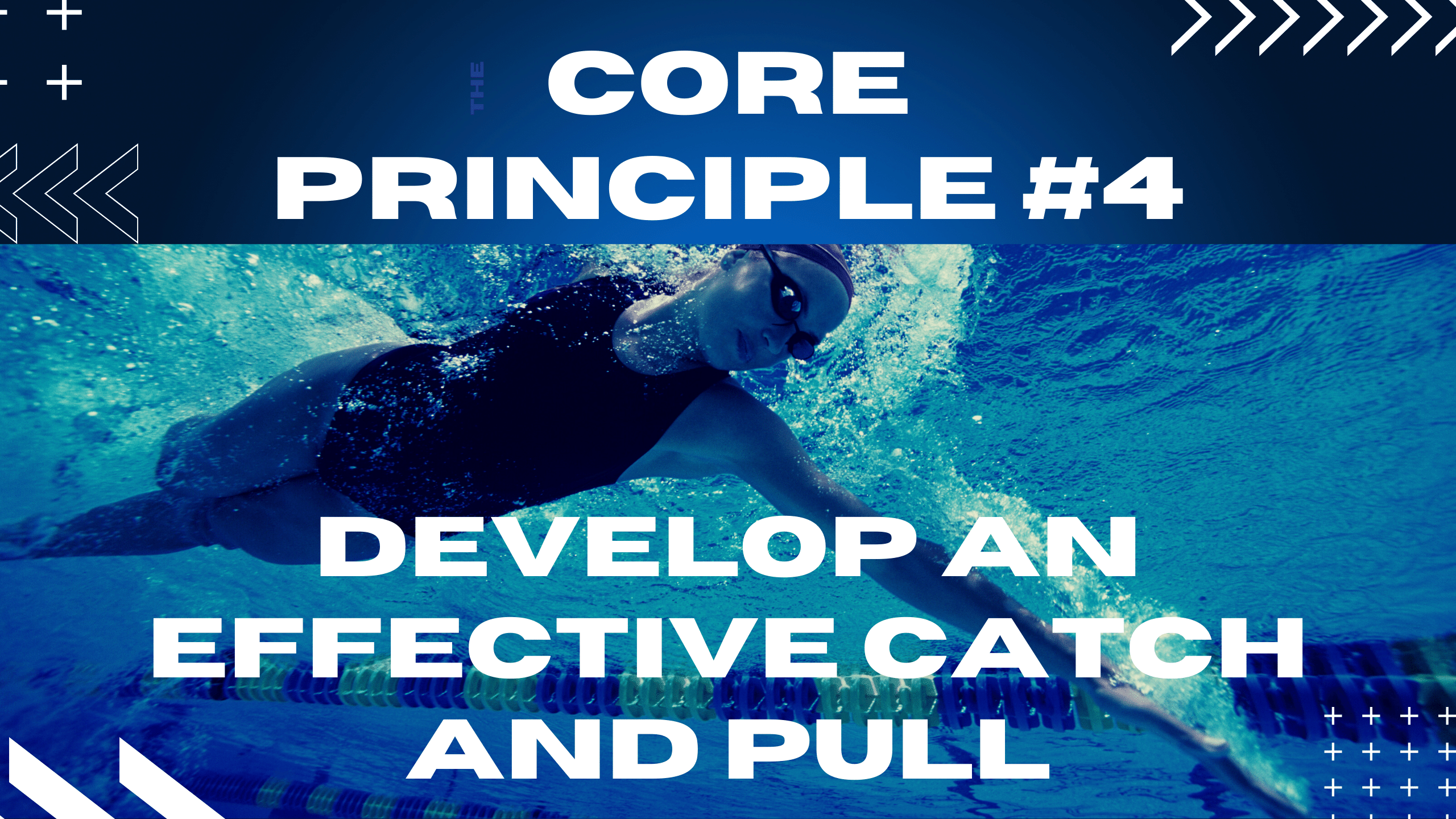
Welcome to the Effortless Swimming Podcast, the show that helps swimmers and triathletes love the water, become a better swimmer, and live a better life. Here’s your host, Brenton Ford. Welcome to the Effortless Swimming Podcast. We’ve talked about the five core principles of fast freestyle in previous episodes. And we’re now up to core principle number five, so the very final one. So core principle number one was breathe, deep, and relax. Core principle number two is find your balance. Core principle number three is rock, return, and align. And then core principle number four is develop an effective catch and pull. Now the last one is find your rhythm and timing. So to me, this is like the art or the dancing part of freestyle. It’s putting it all together in a way that suits you well. Because as you know, there’s so many different types of freestyle. No two swimmers generally look the same. There’s differences, particularly among all the elite swimmers, there’s so many differences
in sort of style and technique. But they’ve got all of these fundamentals that we’ve covered in the past four episodes. So finding your rhythm and timing. This is really about making sure everything comes together. And the first thing here that we generally want to try and do is your kick timing and coordinating your down kick and your catch on the same side. So one way that this often gets explained is that you want to kick down on your, say, left foot as your right hand enters the water. So the opposite sides of the body. Now that’s 100% correct. You want to kick down on your left foot while your right hand enters. So that can be one way to think of the kick timing. But another way to think of it, and I find this a little bit easier to tune into, is you want to try and coordinate the downward kick on your left side with the catch on your left side. Particularly for sprinting, look, you’re probably not going to be able to feel it.
But for more middle to long distance swimming, you’re going to be able to feel for it. Because sprinting is a little bit different. The ratings up, the kick is fast, you’re not going to be able to feel for it there. But for anything that’s kind of like a 200 or 400 meter event or longer, then you can kind of tune into this sort of timing. So when you get the downward kick and the catch happening at the same time on the same side, that can really get things to work together. Because one thing that we see with swimmers that are a little bit less experienced, a little bit more in the beginner end, is that often the kick is working independently of the arms. So things aren’t sort of timed very well. But how we can swim fast for very little effort is if we can coordinate the timing of things. So one of the ways to do it is to get the kick timing to happen. So what happens here is that when the downward kick happens on your leg, so this is when
the foot moves from up near the surface to down. So when that happens, that downward flick of the foot kind of sends this energy through the leg up to the hip and sort of up to your core. And it gives that little bit of stabilization for you then to feel as though you’ve got something to pull against. Because when you’re in the water, obviously it’s liquid, there’s nothing stable there. You’re not grounded. But it’s that downward motion of the kick that transfers that little bit of sort of energy, gives that stabilization through the hip and the core to then feel like you can sort of pull against it. And so that’s when you see someone who’s just like really in tune and they’ve got this nice rhythm happening. That’s one important factor to that. So there’s a couple of ways you can go about developing that. And one way I find to sort of do that is to just focus on one side only to begin with. So the way you might approach it is you might do, let’s say it’s like 1050s with
20 seconds rest in between each one. And all you’re focused on is just trying to get the downward kick and the catch to happen on let’s only your right side to begin with. And when you do get it, you’ll feel it. You’ll know when it’s happening together. So you’ll notice a big difference in it. And when you’re not quite there, you’ll probably feel a little bit disjointed or things just aren’t coordinated very well. So that’s the first thing is the kick timing that we want to get. Now, the other thing that we look for here or the other thing we want to start to develop is your ability to use different types of kick. So we talked about this in corporates one number two and we said we talked about a two-beat, a four-beat and a six-beat kick. So I think it’s really useful, more so for middle to long distance swimmers, to be able to change the type of kick that they’re doing. So a six-beat kick you’d consider to be like a constant kick or
a continuous kick where there’s not really much of a pause happening there. It’s just like a steady kick and that’s what I’d say probably most people tend to use, especially when they first start. And it’s a good thing to be able to do because when you want to really pick up the speed, a six-beat kick’s gonna allow you to do it. It can be a little bit more tiring than a two or a four-beat kick, but it’s definitely a good thing to have, especially when you’re trying to pick up the pace and for particularly open water swimmers or competitive pool swimmers. It’s what you’re going to need to have to be able to bring home the last 50 or the last 100 or 200 of your event is a six-beat kick. You’re probably gonna want to increase it to a six-beat kick if you weren’t using it because it does allow you to swim at a higher top end speed. So six-beat kick’s important. And the reason it’s called six-beat is because it’s basically three kicks
to one arm stroke. So with both arm strokes, so left, right, there’d be six kicks happening in total. So that’s the first one. Now the other two kicks, a two and a four-beat kick, can be really good for middle to long distance swimming, especially in the open water or especially if you’re wearing a wetsuit when you’re competing or when you’re swimming. Now the reason for that is a two and a four-beat kick, obviously you’re kicking less and the kick can be what uses a lot of energy for people, where the heart rate really can cause the heart rate to come up. So with an easy two or four-beat kick, then you can sort of conserve your energy a lot better than if you’re using a six-beat kick. So a two-beat kick is probably the easier one to start with and that’s where you do one kick to one arm stroke. And it’s particularly easy in a wetsuit because you’ve got that buoyancy of the wetsuit and most people don’t kick much at all when they do have a wetsuit on.
So it’s easy to sort of just get that feel for a two-beat kick and the way that you can sort of time it is like what we mentioned before. You can either think of it as when your left hand enters, you could kick with your right down with your right foot, or you could think of it as when your right foot kicks, you want to go through the catch on your right hand side. So just sort of doing it that way. And there’s going to be a pause there. It’s going to be like left kick and pause, right kick and a pause, left kick. So it’s not that continuous, like a six-beat. Now a four-beat kick is one that I find can really take some practice to get used to. But it’s something that I’m a big fan of, especially for most of the adults that I work with. And I’ve really tried to develop this with a lot of the summers that I coached inside the stroke analysis membership where they send in their videos because for the majority of them, they’re doing some sort of triathlon or open water racing.
And a lot of them are either using like a two-beat or a six-beat. But this four-beat kick, I find for most people, can allay to be a little bit, have a slightly faster speed than a two-beat does. But it uses less energy than a six-beat kick. So it’s something that I’ve tried to develop with a lot of swimmers and we’ve found it to be quite beneficial. So a four-beat kick is basically, it’s almost like a hybrid of a two and a six-beat. So the way that you might think of it, it’s one kick on one arm stroke and then three kicks on the other arm stroke. So the timing, the way I think of this, if I’m doing it myself, it’s a one, two, three, four. One, two, three, four. So there’s a little bit of a pause in the kick and that pause often comes in when we’re getting the breath. So for me, I would usually breathe on my left hand side. So I’ll have the one kick happen when I’m breathing to my left and my right hand’s out in front.
So I’m getting this kind of like, it feels like a bit of a glide. It’s kind of, it’s some right hand’s reaching forwards and I’m going one and then two, three, four. And then I’m back on my right hand out front, one, two, three, four. So the four-beat is a really good thing to try and develop, to give you another option there. Now, you’re not going to be typically, you’re not going to be fixed with using just a two-beat or just a four-beat or just a six-beat. It’s probably going to change. For me, when I’m training, it changes depending on what we’re doing. So if we’re doing like a descending set or a set like where we’re getting basically faster as we go through, let’s say it’s like a 10, 400 set. And we’re going the first four at like 60%, the next three of those at 70, then two at 80, and the last one at 90% or closer to max. Then I’m going to probably change the kick as I go. I’ll probably start with like a two or a four-beat kick
for those early ones. But then as I get towards the very last one, I’m going to be using, you probably like a combination of like a four-beat kick. And then I’m going to bring the six-beat kick for the last like a hundred, essentially. So it’s going to change depending on the speed and the effort that you’re doing. But it’s good to have those options there to give you a few more gears to use. And that stuff, it’s a little bit more advanced. So you might be listening to this and maybe you’re not quite there yet. You might want to work on those other couple of principles. But if you are there, it’s certainly something that can give you a lot more options when you’re swimming. Now the other part of this core principle is the Serapa effect and the hip drive. So the Serapa effect is kind of like this. The way I’d explain it is kind of like you’ve got this elastic band almost running from your rib cage on one side of your body,
diagonally through your core and it connects that with your pelvic girdle, kind of like your hips. And if you were to sort of look at it, it’s almost like this ribbon. So two bits connect to the hips or the pelvis and then it sort of comes up and it runs around your rib cage. So that’s this band of muscles that you use and they sort of work together. And so where you would often see this is like when someone’s pitching a baseball and they’ll really sort of, they’ll rotate their hips and their shoulders and they’ll load up this tension through that band of muscles. And then as they start to throw the ball, they’ll get this snap back effect and it’s those muscles shortening or contracting and they get a lot of power that’s derived from the hips. So that’s the Serapa effect and it’s in use in swimming as well. Now again, it’s one of those things that you can’t really, it’s very hard to see because it’s happening internally
but the way that you know it’s happening is when you see someone who’s got this beautiful sort of rhythm and timing to their stroke. So developing that Serapa effect is a little bit more advanced but it’s something that you can basically allow you to get a lot of power for very little effort compared to if you’re not getting it. Now the way that I would sort of think of this is am I getting it or not or can I feel for this Serapa effect? The way I picture it is it’s like when you’re reaching forwards and you’re on your side, you’re getting this lengthening through your, like your, almost like your hip flexor it feels like, through your core, up through your torso and kind of through your shoulder. It’s like this lengthening, like a rubber band expanding or getting stretched. And then as you go through the catch and the pull, you’ll feel this, you’ll feel it sort of contracting and those muscles will shorten and when you sort of time it well
and you don’t try and overpower it either, you just kind of let it find its rhythm. That’s when you feel that Serapa effect. So it’s this lengthening of your, of those muscles. Feels like a rubber band getting stretched and it’s got this tension built up and then it can release. So that’s what we’re going for. And there’s a couple of drills which I’ll talk about in a moment which can sort of help you with that but it is one of those things that’s a little bit more advanced and depending on sort of where you’re at, you may not wanna, you probably don’t need to think too much about that yet until you’re probably at around that 130 to 140 per 100 pace is probably when we’d start to consider that for most people. Now, the other one that we look at here and we touched on this in core principle number four is hand speed. So that’s slow to fast movements. So we talk a little bit about in core principle number four because it’s certainly a factor
but here we can start to consider it a little bit more. So that’s where when the hand enters and you’re reaching forwards, it’s gonna go through that part of the stroke a little bit slower than it will through the back. So it’s that gentle acceleration through the arm movement under the water that can help sort of get that timing right as well. The other thing that we can look at here is like a split tempo. So one way that you can increase your stroke rate
is to, it’s basically, your stroke rate is how long does it take you to complete a stroke or a stroke cycle? Now, one way that you can shorten that stroke cycle is to recover your arm over the top of the water a little bit faster. So while you will still like, you’ll still pull through the water a little bit quicker, we don’t wanna rush that part of the stroke too much because then you’re probably gonna feel like you’re spinning the wheels and you’re slipping a little bit. So what we can do instead to shorten that stroke cycle is to recover the arm over the top of the water a little bit faster. So let’s say for example, okay, your stroke rate is 60 strokes per minute, which would be one second for each arm stroke. So your left arm’s one, your right arm’s two, and so on. Now, if you were to shorten your stroke cycle, so let’s say it’s one second per stroke, let’s say you were able to come over the top of the water,
so one tenth per second quicker, that would mean that it’ll take you point nine of a second to do your left arm, point nine of a second to do your right arm. So you’ve effectively gone from, you’ve reduced your, or you’ve basically increased your stroke rate by what are we there, like 10%, so you’ve gone from like one second down to point nine. And all you’ve done is increase the speed at which your arm comes over the top of the water. Now you’re probably gonna find that your distance per stroke hasn’t decreased at all from that, maybe a little bit, but hardly at all. And so that’s one sort of factor that you’ve got to play with to then look at your stroke rate or your cadence.
The other thing with split tempo, there is that with a lot of swimmers and especially good distance swimmers, we see, and a good example of this is Katie Ledecky or Gregorio Paltrenieri is very good at this as well. You’ll see that they’re kind of faster on one side, like let’s say their left side, compared to their right side. So, and that develops this sort of, more of like a loping freestyle or galloping sort of freestyle. So that’s another thing that you may wanna consider developing in your stroke. So the way that I would teach it or picture it is it’s like on one side, you feel like you’re reaching for a little bit longer and you take a little bit more time on it. And then on the other side, so let’s say your right arm’s a longer one, your left one’s gonna sort of move through that a little bit quicker. It’s gonna start the catch a bit sooner and you’re not going to spend as much time in that reach phase of the stroke.
So it’s like, it’s almost imbalanced. And that’s not a bad thing. I’ve heard coaches say you should have an even stroke, like left side, right side’s exactly the same. But again, you just don’t see it at the elite level with all swimmers. With some, absolutely. Like if you look at Ariane Titmus, she’s a very even, very balanced swimmer and she breathes that way. But if you were to try and get Ledecky to do that, then it would really impact her stroke. She breathes to the one side only and she’s got that little bit more of a galloping stroke. So it just depends on what kind of swimmer you are, what sort of suits you best. So just that’s that individuality. That’s that dancing. It’s that arc part of the stroke and it’s about finding what works best for you. And so really good time to practice that stuff is in training, particularly in a set where you’re getting the chance to sort of push the pace a little bit. Now there’s a lot of drills that we’ve sort of got here
inside the membership to develop all this sort of stuff. Some that are quite unique. You might not have seen them before. One of my favorite ones for sort of developing this cross connection through the body and getting things to connect is fiddle-faddle drill. Now this is where you put one fin on. Let’s say it’s on your right foot and you’ll put a hand paddle on your left hand. So on opposite sides, you’ve got one paddle on, you’ve got one fin on. That can sort of help you feel this connection through the body or through the stroke. So I quite like fiddle-faddle drill. Another really simple one is freestyle with butterfly kicks or dolphin kicks. So you do one arm stroke with one dolphin kick and that really sort of gets you to feel for that hip drive and that connection through there. It kind of gets you to feel that Serapa effect a little bit. So there are two of the drills that sort of feature inside the training plan here and the membership.
And there’s a whole bunch of other ones as well that you can use and that are quite good. So I hope you enjoyed the five core principles of fast freestyle. The link here for the podcast, I’ll put a link where you can sort of have the summation of each of these principles and look at that for sort of reference there. And this is a good way to follow or a good structure to follow if you’re not sure where to start with your freestyle. Now the other thing that we released, I released this about three weeks ago, was the eight week faster freestyle program. And it follows the five core principles but it’s just got a really easy to follow structure to it. So week one, kind of work on that breathing and relaxation and it’s got a suggested warmup and then there’s three sessions to do to sort of help work on that part of the stroke. And then week two is the same thing but we progress through each parts of the stroke. So it’s what most of our members
are going through at the moment is this eight week faster freestyle course. So if you’d like to get that, it’s only available inside there for the swimming membership but it’s got all the drills and training plans there to develop your freestyle. And what we’re finding is that across that eight weeks you’re gonna find some extra speed, some extra time in each of those couple of weeks. And the thing that often happens is that people sometimes get overwhelmed. There’s so much to think about, there’s so much to focus on but with a sort of simple step by step process to follow, you don’t have to think too much about it. You can just keep it really simple. It’s really one thing a week. And then just as you go through that eight weeks probably you should buy the end of that. You’ll find yourself feeling pretty good and that speed will come up. I’ve got no doubt about that. So you can check out the eight week faster freestyle program
just inside the membership there if you’d like to. I’m also gonna put a 20% discount link to the membership if you are not a member. So I’ll put that coupon inside the show notes as well. So you can check that out wherever you listen to this. And yeah, I hope you enjoyed it. Again, just if this is useful to you and you know someone else who would enjoy it please share the podcast and I’d love it if you could leave a review on the iTunes store because it helps us get in front of more people. So thanks for listening. I’ll see you next week with another podcast episode. Thanks for listening to the Effortless Swimming Podcast. If you’d like us to help you become a faster, more efficient swimmer go to www.effortlesswimming.com.