








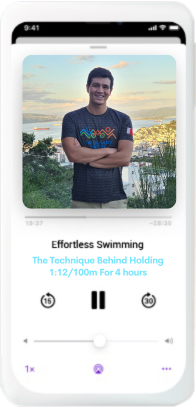
In this episode, we have a special guest, marathon swimmer Andy Donaldson, who is a three-time world record holder. Andy shares his insights on freestyle technique and how he is able to maintain an impressive pace of 1:12 per 100m for 4 hours. This episode focuses solely on technique, as we delve into Andy’s thought process and approach to his stroke. Tune in now!
00:00 Andy’s Background
2:31 Where is your head position?
2:58 How often are you breathing?
4:30 How do you use your kick?
5:23 What does your recovery look like?
8:09 What is the end of your stroke like?
9:07 What is your rotation like?
9:47 How did you develop your catch?
11:13 How much power are you putting into each stroke?
11:54 What do you do to increase your swim speed?
13:11 How do you like to train?
14:20 What pace are you aiming for?
14:49 What stroke rate are you aiming for?
Follow Andy on Instagram
Change your technique and swim a smoother, easier freestyle with the Effortless Swimming membership:
https://effortlessswimming.com/training-and-membership-plans/?el=blog
Do you want to work with me personally to improve your technique? Join my swim technique coaching here:
https://effortlessswimming.com/stroke-analysis-membership/?el=blog
Get 20% off wetsuits at Great Ocean Wetsuits with code ‘EFFORTLESS20’:
https://greatoceanwetsuits.com/
Get 15% off our 8-week Faster Freestyle course by using the code 8week15
https://effortlessswimming.com/8-week-faster-freestyle-course/
Related Content:
On A Mission To Complete The Oceans Seven in One Year with Andy Donaldson
Completing The Oceans 7 In One Year with Andy Donaldson
Watch the video on YouTube:
Transcript
Read the full transcript
Some of the drills that we were doing was single-arm freestyle, really just breaking it down, swimming with one arm in freestyle and allowing you to really focus on that hand entry, gliding forward, initiating the catch and starting your pull and then really maximizing. Getting a feel for the water because that traction is so important on the catch so that you can pull as much water as possible and gain that portion. Welcome to the Effortless Swimming Podcast to show that help swimmers and triathletes love the water, become a better swimmer and live a better life. Here’s your host, Brenton Ford. Hi and welcome to this week’s episode of the Effortless Swimming Podcast. My name is Brenton Ford and today I’ve got an episode that’s a little bit different than usual but it’s on the topic of freestyle technique and you’re going to hear it from one of the best. I caught up with Andy Donaldson who’s a three-time world record holder.
He completed the Ocean 7 in under 12 months which is swimming across seven of the world’s toughest channels and he also holds the world record for crossing the Cook Strait between the north and south islands of New Zealand. He did that in 4 hours and 33 minutes and averaged 1 minute 12 pace per 100. So incredibly quick. Now if you’ve been a podcast listener for a while you know that we’ve had Andy Donaldson on the podcast twice. Now this is a slightly different episode because we’re talking purely technique. I wanted to get it from the horse’s mouth about what he is thinking about in his stroke. So let’s jump into it. If you want to get some footage and see how he swims underwater and in the open water, we’ve got some great footage as well. So I teamed up with Sam Sheppard from Great Ocean Wet Suits. He did some really good drone footage of Andy swimming and I captured some underwater footage of him at the pool that I normally swim at.
So that’s on our YouTube page. If you want to check that out we posted a video last week with that footage. So go and check out that episode there too. And if you want to get all of the footage that I took with him and a full breakdown by me of his technique, I’ve posted all of that footage inside our Elite Swimmers section in the Effortless Swimming Membership. So I’ll put the link to join that below as well. If you do enjoy this episode there is two ways that would really help me out. That’s either showing this episode with a friend. If you know anyone who’s looking to get faster like this would be a good place for them to start, please pass on this episode to them. And if you are listening on Spotify or Apple iTunes, leaving a review helps us out more than you know. Thanks so much. Let’s jump into the episode. Where is your head position? With my head position I’d say it’s usually looking slightly forward tilted up
and when I’m turning to breathe, it almost follows the body rotation around turning my head to breathe but it’s not an over rotation. So I’d say the waterline is perhaps halfway across and I don’t want to be rotating any more than that because it’s putting straight on my neck. I’ll usually breathe every two. My preference is breathing to my left. I make sure that I do try balance it out and what I’ll try to do is in training I’ll breathe to the same side. So if I’ve gone down one length to breathing to say for example the dive pool I’ll make sure that I’m coming back and breathing to that direction as well. Just making sure there’s balances in my stroke. One of the reasons for breathing every two is just to get more oxygen into the body especially in the longer distances where you’re swimming in a aerobic zone and you need as much oxygen coming in to keep the body pumping. With posture I mean obviously in swimming we want to be as streamlined as possible.
You know if we think of ways to get faster we can put more water, get more propulsion or we can be more efficient in having a good posture. Good streamlined position helps with that efficiency. So one thing I remember learning when I was growing up was engaging your core and one of the tricks was imagine you’re pulling on a tight pair of jeans and you really haven’t as sucking as you zip up and get your jeans on and that’s to sort of subconsciously I think that’s what you want to be doing. Obviously not creating too much tension because that is using energy but in that position that’s nice, tall, good posture, engaging your core and you’re nice and rigid for when you’re pushing through the water. How do you use your kick? In the longer swims tend to kick less. Your thighs, your leg muscles are big muscles so they use up a lot of energy. So I’m using my kick less for propulsion and more for stability and the timing of the stroke, keeping the rhythm.
So I probably have a 2B kick in my longer swims, just means I kick twice per stroke and I’m not thinking about trying to create propulsion I’m not trying to drive forward using my legs. It’s more just feel for the water, keeping the body nice and balanced especially when you’re in the open water and you’re in conditions that might be thrown you around. Legs can certainly help with that stability and keeping you in a good position. What does your recovery look like? So with my recovery I’m wanting to get my arms back to the front as easy as possible. When you think of swimming that’s not where propulsion comes from the propulsion is everything under the water so if I can expend the least amount of energy to bring my hand from my hip back to the front then that’s really good and for me the most relaxed way is a nice high elbow and I’m just really letting the arm glide forward over the surface of the water
and comes with timing of the stroke so the other one’s going and cooling under the water and the opposite side of the body is coming across and in sync with that and placing your hand into the water we were talking about efficiency and I find that my nice high elbow allows me to place my hand into a position and get it into a position of catch where I can really anchor and initiate the pull section of the stroke. I find I can do that easier with a high elbow and find that position where I can really create traction I can find that easier with a nice clean hand entry. One of the reasons why we want a clean hand entry is because when those bubbles it’s harder to get that traction on the water you’re not pulling on clean water where you can create more propulsion if it’s disturbed and it’s got bubbles in it so clean entry as you set up for your catch and really get that traction to maximise your pull and catch and pull.
This podcast has brought you by Great Ocean Wet Suits an up-and-coming Australian performance wetsuit brand for triathletes and open water swimmers Wetsuits are designed and tested in Melbourne, Australia for fast, easy and enjoyable swimming for athletes of all levels they’re worn in and raced by Olympians, triathletes and open water swimmers from all over the world and I personally use Great Ocean Wet Suits even before they became a sponsor of the podcast I’ve personally found that the buoyancy, the freedom through the shoulders and the fit are the best that I’ve ever had in a wetsuit so I highly recommend them and you can currently get 20% off either the gold or silver wetsuit models using our own code effortless20 at checkout so enter the code effortless20 at checkout at greatoceanwetsuits.com and no matter where you are in the world if you’re in Australia, the US, Europe there’s free shipping worldwide so get yourself a great ocean wetsuit
I personally use the gold model of the wetsuit it just depends on what your goals are so greatoceanwetsuits.com, effortless20 at checkout I know you’ll like them what is the end of your strike like? after my hand entry I’m really trying to maximize the length in each stroke so I do glide quite a lot everyone’s different my stroke I really try to stretch out because I want to maximize the length of from the top of the stroke where I’m pulling all the way to where my hand gets to the hip that’s where my propulsion is coming from so I’m really gliding forward and it comes in conjunction with your body rotation so if we have our hands out here if I rotate, I’ve gained an extra whatever that is, 10cm that I can use to pull on each stroke and when it comes to marathon swimming and ultra marathon swimming and one stroke, small differences tiny margins in each stroke you do thousands of strokes and one of these marathon swims it all adds up
and makes a difference over time what about your rotation? my rotation, I’m a predominantly left hand reaver so I probably rotate more on my left because that’s where I breathe I don’t tend to rotate as well on this side personal preference, I think there’s maybe it is something I could do better but at the same time if it’s going to cost me more energy thinking about it then is it a change that I should make or not perhaps not, so I’m quite comfortable with having better rotation on this side when I breathe to my left because I’ll predominantly breathe left on race day and in a marathon swim how did you develop your catch? my catch and pull was something that I perhaps developed a bit later in life I actually wasn’t very good at pull growing up it was more when I got into distance swimming and distance freestyle that I was really forced to work on my catch, my pull and make it more efficient and then really get more out of each stroke
so some of the drills that we were doing was single arm freestyle really just breaking it down allowing you, swimming with one arm in freestyle and allowing you to really focus on that hand entry gliding forward initiating the catch and starting your pull and really maximising getting a feel for the water because that traction is so important on the catch so that you can pull as much water as possible and gain that propulsion so single arm freestyle was a good one and for those that are comfortable doing it and quite confident I think things like really doing a lot of pull and only work that certainly helped me to become quite efficient with your freestyle because your legs are sinking you really have to rate up and maximise each stroke in order to get that lift in the back and stop your hips from sinking How much power are you putting into each stroke? I would say in terms of pressure when we’re talking about catching through the pull
it’s increasing to about here and then slowly decreasing towards the back for me the way I think about it you’re getting most bang for buck or you’re getting most returns for your effort here and you’re recruiting and using stronger muscles here than you are at the back end of your underwater pull I’d say this would be at the peak and then easing off slightly again here as you come through the back and then bringing it forward through recovery What do you do to increase your swim speed? To increase speed there’s a couple of things that I’ll try to do to go through the gears creating more propulsion so that could be either by increasing your stroke rate more strokes per minute or really trying to create more power with each arm pull so I’ll probably emphasise more power per stroke great I feel more comfortable with that and I’ll just really try to tidy up and get more traction in my catch and really try to power through each stroke
swimming in a more efficient manner so we’re talking about efficiency being tighter and more streamlined so I’ll think about my body position in the water my hand entry making sure that it’s clean engaging my core and really trying to be quite tight and streamlined through the water and then if I really want to pick up the speeds and this will be mostly for short distances and sprints I’ll start to really bring in the legs and get that extra drive in propulsion through my kick How do you like to train? So if I’m training for a big marathon swim or a channel swim I’ll typically do a bit less then I suppose many people out there might do I’ll swim 30km in a week and really focus on working the right energy zones and working quality with good technique so for me I’m a big believer of if I want to swim at a certain pace I need to be training at a higher intensity so that I’m more comfortable up here I’ve expanded my zone of comfort
so that something down here is a little bit easier and more sustainable over a longer period of time if those longer swims are in places that are with rough conditions or I can expect it to be quite cold I’ll obviously make sure I acclimatize and do some practice in there but a lot of my training is done in the pool I’m more controlled and we can measure our training in those environments What pace do you aim for? For me the target pace I want to be holding is around 1,1200m a low heart rate so for me if I can get that to become a 2 pace so 140 beats per minute that would be something I’d look to sustain over a longer period of time and if I do happen to drop off on the day, on race day it’s still a pretty handy pace to be holding for those periods of time What strike are you aiming for? When I’m doing longer distance swims I try to have my team on my boat communicate key statistics to me so things like time time elapsed, distance covered
but a big one is stroke rate so my coach and I have been working really hard to hold around 60 strokes per minute we find that that’s a very efficient stroke rate and enables me to hold a good solid pace of around that 1,1200m speed Thanks for listening to the Effortless Swimming Podcast If you’d like us to help you become a faster more efficient swimmer go to www.effortlessswimming.com