








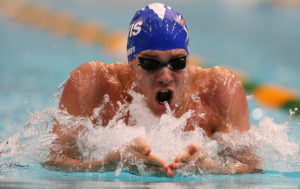
 In this episode of the Effortless Swimming Podcast we have former Australian swimmer turned coach, Sam Ashby. Sam made the Australian swim team in 2011 and competed at the World Championships. Today he coaches at MLC Aquatic in Melbourne. We explore the challenges of transitioning from racing to coaching, how your motivations change and why all athletes should take on a coaching role to develop their swimming.
00:50 – Sam’s Swimming Background
03:45 – Exploring Life Outside of Swimming
04:44 – On giving back…
09:45 – Guess who’s a big kid?
12:40 – “If I had the opportunity, I’d still be swimming now.”
18:28 – Why You Have To Swim Really Sloppy
19:25 – When the pain starts to overtake your brain…
26:44 – The Coach’s Role in Building Athlete’s Self-Confidence
30:32 – “I miss the camaraderie.”
32:22 – How Writing Can Help You Explore.
Transcript
Read the full transcript
Welcome to Effortless Swimming, the podcast for swimmers, triathletes and coaches. Join Australian swim coach, Brenton Ford, as he reveals the latest techniques and information to improve your swimming. Let’s dive right in. Welcome to the Effortless Swimming podcast. Today I’m here with one of my best mates, Sam Ashby, who has been on the Australian swim team. He’s now coaching an age group squad here in Melbourne. The reason I wanted to get Sam on the podcast today was to talk a bit about his experience as a butterfly I’ve been on the Australian team, but also making that transition from swimmer to coach. So Sam, welcome to the podcast. Thank you for having me. So Sam, just give those have seen a bit of a background on what you’ve achieved in swimming and I guess where it all started for you? Sure. So I started swimming. Mum had me in swimming lessons four or five, as most kids do when you learn to swim.
And then at seven or eight, I obviously had way too much energy. So she decided that I needed to burn some off. So she got me into sort of squad training. That was back in New Zealand when I was just turned 12. We moved to Wagga Wagga in New South Wales. So I spent a year there and then we moved down to Terralgan. And that’s where obviously you and I met and then I swim under your father. So I had some had quite a quite good success as an age group swimmer all the way through from when I was 13 all the way through to when I was 18. I was fortunate enough to win age group national medals. And I was also fortunate enough to make the Australian junior team twice for the junior Pampax, both in 2005 and then again in 2007. Then I sort of I was on a few tours with Australia, like the West Coast tour where we go over to the States and swim a few competitions in California. But I kind of had a lull for a few years where I was sort of in limbo just with my swimming, but also I think just as a person, I was kind of just Groundhog Day kind of thing.
And then I decided or got to a point where I had to make a decision. I decided to move to the Gold Coast to train under Glen Baker where we had a meeting and then the outcome of that meeting was I was going to focus all my attention on swimming butterfly rather than individual medley, which had been my forte in the past. So I moved up there in the middle of 2010. And then in 2011, I after being with Glen for maybe nine months, I made the world championship team for the hundred butterfly. So that was Jeff Ugel and myself. I was fortunate enough to make a semi-final there and it went to 52.1. And that was just a really good experience all around. Unfortunately, the following year, I didn’t have a good competition at the trials. I think I came fifth and yeah, missed out. So from there, I’d already sort of made the ultimatum that I was either going to make the Olympic team and continue swimming or I was going to finish up and explore life outside of swimming.
And so that’s what I ended up doing. And was that always a plan to take up coaching after you finished me? Or was that something that was a bit of an afterthought after you’d had some time out of it? I love the sport and I know a lot of swimmers come out of the sport a bit disengaged or disheartened, but that’s quite the opposite for me. I’ve always had a love for the sport and the opportunities it’s given me and how it’s shaped me as a person. And so I never had any intentions of never being around the pool deck again. In the back of my head, I always thought it would be nice to give back to the sport or nice to still stay in touch. Whether that be coaching full-time or just sort of helping out. And then an opportunity came up with another good friend of ours, Nick Valiartis, to coach the state squad at the club I’m at now, MLC Aquatic. And I kind of just progressed from there. And then to the point where I love doing it and I can’t see any reason why I’d stop.
I mean, I know when I started coaching it was I kind of fell into it a little bit. I never planned to get into coaching. A job came up at, when I was at university, a job came up at Melbourne University to coach twice a week there. And yeah, and I thought, well, that’s one thing I know how to do is swim. And I sort of knew a little bit about coaching. So I took it up and realized I really enjoyed it compared to a lot of the other stuff that I guess the other jobs that I had. And it’s great being able to teach others, share your knowledge and have that interaction with people who are looking to improve themselves. And I mean, it sounds like you sort of, I guess, maybe not fell into it, but it came about just by an opportunity came up and you thought you’d try it out. But now it’s something that you really enjoy. Yeah, for sure. Yeah, I always had dreams that I might become a carpenter because I kind of like doing physical stuff.
I think that just comes with the territory of being a swimmer. He always used to just grinding it out doing just that sort of physical labor. So yeah, definitely, definitely hadn’t come out of swimming going, oh, I’m definitely going to coach this is what I’m going to do. Yeah, it kind of just happened organically. And your personality, I think personalities suit different tasks. And right now, like my personality definitely gels with coaching athletes and helping them achieve what they want to achieve. And I think your coaching style is probably different to your old school swim coach where it’s sort of more in your face. It’s just yelling up to do more and more. Whereas I think, and I sort of said in AFL, so Aussie rules football, a lot of the top coaches these days are less about just barking orders. It’s more about engaging with each athlete individually, taking a different approach. With each athlete and being more on their level than having the sort of authoritarian role of a coach.
And I think that’s where it seems to be changing a lot these days is the longer relationships and the better relationships between coach and athlete. And now ones that where they’re almost on the same level and the coach is sort of helping the athlete learn more about themselves by asking better questions and having the athlete find out themselves instead of just telling them how it is. Yeah, yeah. Because you end up inevitably on pool deck having conversations with other coaches because there’s just, there ends up being time when you’re at a competition and there’s no athletes swimming. And one of the conversations I had with an exceptional young coach who I just have just, yeah, just some great chats with and just pick his brain as Pat Fisher. And I’m yet to read the book that he’s been talking about. So what you’re saying is that you be hard on your expectations and hard on your standards and you be soft with the people.
So from it and that’s sort of from a management aerial sort of point of view where like the standards that you have for your company, let’s say, they’re at a high level. But you don’t treat your people or treat the people that you work with like with that sort of authoritarian hard edge. You interact with them. You just essentially just being a person being a personable just being a personable person. And so and because, you know, I work, I don’t unlike you with working with the masters. I work with younger athletes, kids, but and I think it’s good because sometimes I’m a big kid. But there’s, yeah, you find that happy medium between connecting with the athletes, which is quite easy because it’s just you just naturally do it when you spend that much time with them and you actually enjoy doing it. But you don’t let your standards slip. And that’s the hard line where if you see something, you pull them up or you’ll say, no, that’s not good enough.
But then, you know, not to the point where you’re just screaming and yelling at them and they don’t listen to you. You know, they kind of lose that respect for you. Yeah, it’s fun finding that balance. And I’m still working on it always. I think most coaches always will keep working on it. Yeah. And that’s the great thing about, I mean, I guess whatever job you’re doing, if you’ve got that opportunity to grow and learn more, that’s the fun thing about it is just seeing, I guess, seeing what you’re good at, seeing what you’re maybe not so good at, but you’d like to improve and being able to develop in each of those areas. And it’s a long process. I mean, you don’t want to stop learning. So I’ve been coaching for the last 10 years now. And I mean, it took me at least sort of three or four years to get my head just around coaching and I guess the best way to do it. But even then, I’m just always changing and trying to find a better way to get more out of people.
Because, you know, at first, when I started, I didn’t want to step on anyone’s toes. I didn’t want to call them out on anything. And so I was no way near just, I guess, keeping people to those high expectations that you’re talking about. But now, you know, it’s okay to actually call people out on that sort of stuff because your job as the coach is to help them get the most out of themselves. And sometimes that’s what needs to happen. So it’s just an ongoing learning process. And it’s the same whether you’re an athlete as well. You’re learning about how far you can push your body. You’re learning how you race and developing your mental strength. And it’s just that long journey that I think if you can really dial into it, that’s what keeps someone in the sport for a long time. Is, you know, watching you, you know, stay in the sport until you were sort of early 20s. So 23, 24. You know, I think it seemed like the reason you stayed in the sport until that age,
whereas most people give up in their teenage years, is because you knew you could get more out of yourself. But you were continually looking to evolve and develop as a person. If I had the opportunity, I’d still be swimming now. Like, yeah, if you didn’t have to, if, you know, just general life was you’re able to focus and not have to worry about money or, you know, developing as a… developing your life outside of elite sport, I’d do a lot to get back there because it’s a great lifestyle and that pursuit of just refining something over and over and over and over again. It’s a really nice thing to do. And like, not many people get to have that opportunity. But I think coming back to being like, hard on your, or hard on the expectations with the athletes and how you go about doing that, I think that is in the, one of the essence and one of the most important things with the coaching is to get the most out of your athlete
without making them feel incompetent or belittling them. And at the same time, I think as athletes, if you’re really wanting to improve yourself, you want to hear it. You want to hear that that’s not good enough. Even if you think, I remember, I remember, I will always remember this one time when Rowan Taylor, my coach, when I was in Melbourne at Kerry Aquatic and then in Nutter Watting, there were a bunch of other young boys all my age and we were doing, we were training for 400 IM and I was on a Thursday morning and the Thursday morning was our hard set. And we ended up having to repeat the 400 IM max twice. So we ended up having to do three 400 IM max efforts. And whether or not we thought it was good enough was beside the point of, the point was that Rowan didn’t think it was good enough. But we also knew that he thought, that he completely cared about us as people but like getting the most out of us.
And so as annoyed, you know, as excuse my language, as pissed off as you’re going to get when you have to repeat a 400 IM max twice. You kind of respect that and you end up just being a bit athlete for that. And so if your coach is hard on you but you understand why they’re being hard on you and at the end of the day after this training session, they give you a pat on the back and say good job. I think that’s like really good coaching right there. Yeah. And I know when I was growing up and swimming and even in school, I wanted to live up to the expectations of my teachers and my coaches. Because I wanted to impress them. And I wanted to show them how hard I could be. And even like just your peer group. I mean, when I was, I think I was great two or three in school. They called me Speedy Gonzalez when it came to maths. I used to just try and do it as fast as I could. And I got that nickname for like a few weeks there.
And just, I didn’t want to not live up to that. So every time we had maths, I wanted to be as good as I could and just complete things quickly. Is that why you, is that why you did a Tournament of Butterfly on that Saturday morning session? Because you wanted to impress your dad? Pretty much, yeah. No, it was nine 200s, I’ll correct you. All right, it was the last session before September holidays. So we had two weeks off and it was nine 200s Butterfly. And I loved it. I absolutely love that set because after the first two, you kind of get into the rhythm and it’s a lot easier than what it sounds on paper once you get into it. And you know, by the end of it, you’re just going to, you’re going to feel so good that you did it. And then you can really enjoy your break now that you’ve done something that hard beforehand. So it’s, yeah, I just, I think setting challenges and making people stretch that just get out of their comfort zone a bit to be able to hit those goals that you set for them
is a good skill to have as a coach. And what about when you’re coaching your age group athletes? What sort of things do you have them think about when they’re training?
It will depend, like, maybe the theme of the session or where we are in the part of the season. So sometimes if they look, if they’re, let’s say, later in the week, maybe if we’re training on a Friday morning and they’re looking, you know, the athletes might look pretty tired or just a bit, you know, just tired really, end of the week. And sometimes I like just getting them in and having them not really think about anything. Just hop in, swim or don’t even swim. Just sort of float in the pool and don’t worry about technique or because I like, then there’s the other extreme where you want them really focusing in on their stroke counts and how the forward rotation that they’re getting or tightening up their hips so they’re not sort of slaying out. So it is that it just depends where in the season and what part of the session that they’re doing. But definitely giving them time to just not think and to not worry about technique or to be swim really sloppy
because when you stop worrying about, you know, where your hand placement is or how far you’re pushing back, you can kind of relax and actually get a nice feel for the water. At the moment, I’m getting like my guys will be focusing on stroke counts, just trying to be as efficient through the water as possible. I like to start off a session with a theme so I might be, all right, we’re going to focus on our underwaters. So, you know, practice some underwater kicking and then I’ll implement that into a turn. So we’re going to do 1050s where the key focus will be executing a really good push off from your turn and your underwater into breakout. The heart, I think that what I’m trying to do is and this is this is another challenge for all coaches is to under pressure maintain good stroke length or efficiency. So, you know, when the pain starts to hurt and it starts to overtake your brain and we can think about is how much you’re hurting and how hard it is to maintain your stroke
is to really maybe take back 10% of your effort into training hard and then put that 10% into maintaining good stroke length. And then over time, because the like the efficiency you maintain through stroke length, you’re going to enable with some faster. So that’s normally in a main set rather than like when we get in for warm ups. Yeah, that’s good. I like I was thinking about that. I was training last night with with the master squad I used to coach and I was just whatever reason I was thinking about I don’t know always think about coaching that sort of thing and and really I remember as a teenager one of the main themes that used to be part of the session was keeping technique under pressure under fatigue. And it doesn’t matter whether you’re doing triathlon or swimming is the ability to maintain your form towards the end of a race is what is going to allow you to finish fast because as soon as you lose that that form and that technique
that’s when it all starts to slip away. So as you said, even if you need to back off the effort five or 10%, you want to be able to hold your stroke together towards the end of a training session or towards the end of a race. So it takes some yeah, it takes a lot of discipline to be able to do it. But I think that’s a good thing to focus on. And one of the other things. So I had a triathlon coach grand trials on the one of the earlier podcasts. And one of the things he was speaking about was shutting on just not not tagging the pain that you might be feeling. So Gabby example of if you’re going for for a long run and you’re increasing effort as you went then you and it was hot as well. Then you might realize so that the first first response is OK, it feels hot. And then the second response that most people would have is like it’s hurting or I’m working hard. And so it hurts. But if you as long as you don’t tag it, as long as you just accept it,
you just say yes, the weather is hot. But you don’t make that connection between it’s hot and it’s painful. So don’t tag it. Then that’s the best way to just not think about it. So it just takes that you’ve got to make that habit. You’ve got to be able to train yourself to not make that connection. But looking back at I guess the best training sessions I’ve had or the best races, it’s when you don’t make that connection, you don’t put that label on it. It’s when you can make that you make the connection with why am I doing this. Like when you hit that and you’re completely dedicated and 100% behind why you’re doing what you’re doing, there’s almost nothing that you won’t do. And for me for sure, stopping a set is never an option. And it’s not an option from almost anybody, especially sports people. One of the another firmly cemented memory I have was one of the first, I think this is probably the first time that I ever really, no, actually second.
Second time that I got what you maybe consider broken or to breaking point. And that was on the Gold Coast with Glenn Baker. And he wrote up on the board 50-50s on a minute max effort. So then, you know, like my belly sort of just like gets a bit nervous when you see stuff like that. And so this was after a couple months of being on the Gold Coast and sort of starting to become a butterfly. And so my body and my mind wasn’t used to the intensity of all this butterfly training. So I assume that the 50-50s are going to be freestyle. And then Glenn told me it was going to be butterfly. Then my belly actually flipped and I got a bit dizzy. And yeah, that set was, I remember the first 10 I was holding 30s. Like not that fast at the time for me, but I hadn’t really had any butterfly conditioning. Then the next 10 blew out to 33s. Then the next 10 blew out to 36s. So brother, I still had 20 to go and I was almost heading 40s.
That’s my coaching stopwatch, just beeping.
And I was essentially just swimming up and down. My technique was absolutely shot. Everything was just, I was in the world of pain. And I just remember keep looking at the Glenn hoping that he’d stop me because you know, I was swimming like absolute rubbish. And he just didn’t stop me. And he just made me keep going, keep pushing. And I will admit that I had some tears in my goggles. And I’m definitely going to admit that I wanted to stop. I wanted him to stop me. I would admit that. But the fact that he didn’t and the fact that I finished the set has to be one of the most invaluable lessons that I’ve ever encountered. And I think once you hit, and I lost focus of why I was doing the 50-50s, I just all I could think about was how much I hurt and how much like I couldn’t keep going. But when you’re put in a position where you don’t have an opportunity to stop and your body’s breaking down and you actually finish it
and that feeling of achievement is something, like I said, just so invaluable. And you carry that through. And then the next time it’s not as bad and you get fitter and stronger and the next time is better and better and better until, instead of worrying about you maybe not finishing it, your mindset changes and you start thinking about, all right, how fast can I actually go now? And all right, like, I know I need to like, if I’m going to do a turn of butterfly, I know I want to be coming home in 30.31. So my goal is to not slip over at 200 speed. So you’re definitely going to hurt. And then I think if you hurt and you’re in a position where you don’t think you can keep going and you end up finishing it, you build that self-confidence, which, again, is another massive coaching, I wouldn’t say a tool, but as a coach, that’s half, half. I wouldn’t say that’s my job because I love doing what I’m doing, but I’m trying to build the athlete’s self-confidence
so they believe they can do stuff like that. Yeah. Because then, like I said before, when the big sets come in and it really does start to hurt, they believe they can do it. And once they believe they can do it, then they really start getting stuck into hard work. And I think as, especially as children, they haven’t been exposed to that sort of pain and that sort of pressure before. Yeah. That’s what I think sport and particularly swimming is great for kids is to develop that sense of that willpower and an ability to push through things when they get hurt. So if I had my time again, I’d definitely want to have gone through all of those years of swimming because I don’t think I’d be the person I am today or what I learned through such hard training, which, yeah, which is just invaluable. We’ve got to wrap it up now. We’re just driving back from a surf, which was a lot of fun. And one of the last things I want you to just speak about quickly
is what, I guess, what advice would you give to a young kid who is, I don’t know, let’s say they’re not enjoying their swimming or maybe they are, but what advice would you have for a young swimmer who is sort of questioning if it’s all worth it?
You’ve got to ask yourself why you’re doing it, you know. I think, and there’s plenty of different ways people are motivated to get out of bed at 4.30 in the morning to swim and whether that’s because, you know, like my motivation, my overall motivation was that I wanted to make the Olympics. So that was the big end goal. I didn’t achieve that goal, but as an adult and as someone who’s sort of reflected on his time in the sport, that didn’t really matter, that I didn’t make the Olympics. It would have been nice, but it didn’t matter. But find out why you want to wake up at 5 o’clock in the morning or 4.30 in the morning and then work around that. So if it’s the environment that’s affecting you, change your environment. If it’s your own mindset that’s affecting you, go talk to somebody. I think that actually talking to people and talking to people that you trust and if you don’t have someone that you do trust,
go find someone because I think we can talk. There’s a difference between just saying g’day and having a chat and then really talking about stuff. And I think as a young adult or young athlete, find people who are experienced or who you think may have… If you don’t know them, it doesn’t matter, just go up and say hi or send them an email and then talk to them and get their opinion. I toyed with the idea of coming back to swimming. I was coaching the kids and I absolutely loved it. And I’d see them train, especially when they do hard sets and we’d be running a hard set. And I’d see them working together and I just missed it. I missed that camaraderie you get through working together. And so what I did was… I want to get back into swimming and Adam Pine, who was a top Australian butterfly for many, many years, we’re right into his 30s. He was still making the national team in his 30s. As an older athlete, you’re working with your kids at the time.
I’m pretty incredible.
You know, managing your time or when you’re at your training session, just give everything you can to everything you do. It doesn’t matter if you’re going to do… You can’t do nine sessions. I couldn’t do nine sessions because I was coaching the kids, but I could do maybe six sessions. He goes, all right, well, you make those six sessions, the best six sessions that you can.
But I think finding out why you’re waking up early to go training and then talking to someone who you value their opinion or who you just would like to talk to and find out something that they might be able to offer you would be the two things that I think would be most important for a young athlete. That’s good. I think finding that reason why is number one. If you don’t know the main reason why you’re doing something, it’s very hard to keep going and push through when it does get tough. And the two best things I’ve found for that is number one is just grabbing a pen and paper and just writing. Whatever comes to your mind, just write it down. That’s what I like to do once a week is just… It kind of helps me explore the reason why I do… Whatever it might be, like training for an Iron Man or with effortless swimming. It helps me sort of uncover those deep reasons why. And then just speaking with people and just exploring things that way.
And I find the podcast is really good for that. I get a deep conversation, a long conversation, whereas in day-to-day life, whether it’s in the workplace or at training, sometimes you don’t get the time just to be able to do it. So even if it’s 15, 20 minutes, you can just really have that deep conversation with someone. And a lot of times it can sometimes be easier with people you know less as well because if they’re people that you do know really well, maybe it might not be as comfortable to talk about that stuff. So sometimes it is easier to open up to people you know even less once you get that conversation going. You’re less worried about what they might think because you don’t really know them. Yeah, yeah exactly. But like we were just talking before when we were driving down from the surf about how through conversation there’s been plenty of times where I’ve formulated ideas in my head whilst being in a conversation with somebody.
And I’m not obviously having done psychology or I’m not well educated in that but there has to be a sort of some sort of terminology or some you know some process that happens through conversation where you formulate new ideas or theories that end up being just super helpful. Yeah, yeah absolutely. So Sammy, thank you very much. Thanks for being on the podcast. I probably should have got you on at the very start. I mean you were in the first video that we did which was a mastering freestyle product. And yeah I hadn’t got you on the podcast until now after seven years later. Pretty much so. Just get me on when it’s pumping. So yeah, thanks again and definitely get you on again soon. Yeah we’ll just have a chat when we we’ll just put the microphone on and when we go down for surfs and just record the conversations we have. Yeah exactly that’s good fun. Thanks for joining us on the Effortless Swimming Podcast. To get transcriptions, bonus videos
and to be the first to hear about new episodes go to SwimmingPodcast.com