







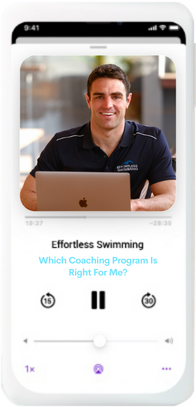
I want to have this episode to direct and help people determine what course will help them get better as a swimmer going forwards.
01:13 5-Day Catch Challenge
02:53 The Beginner Freestyle Course
04:25 8-Week Faster Freestyle Cours
8:15 Video Membership
09:08 Monthly Live Call(Inside the membership)
10:17 Stroke Analysis Membership
13:02 The Swim Camp
View our freestyle clinic schedule around Australia:
https://effortlessswimming.com/freestyle-stroke-correction-clinics/
Form Goggles:
http://formswim.com/effortless
Transcript
Read the full transcript
Welcome to the Effortless Swimming podcast to show that help swimmers and triathletes love the water, become a better swimmer and live a better life. Here’s your host, Brenton Ford.
Welcome to episode 265 of the Effortless Swimming podcast. In this episode, we’re looking at what coaching program is right for me. One of the questions I get asked least weekly, if not multiple times a week, is which course, which coaching product that you offer, which is the best one for me. So I want to have an episode that I can direct people to to help them determine what option will help them get better as a swimmer going forwards. And if you’re listening to this, you may not actually know some of the things that that we offer and we’re able to help with. So that’s why I want to cover them on this episode. Now, there’s a couple of courses that we currently have, all of these courses that I’m about to mention. They’re inside of our what we call the video membership. And the video membership is where we have all of our courses. We have workouts you can send a video in for our monthly call, which I’ll talk about in a moment.
But all these courses are included in any of our membership options. So if you’d like access to everything, that’s a place to go. But the first course coaching program I want to talk about is the five day catch challenge. And I’ve had more than 9000. I think people have been through that now. So it’s been a really popular program. It’s only $10. And that is a course for anyone who can swim 400 meters comfortably and they’re anywhere between one minute per 100 up to 2230 per 100. So if you can swim reasonably well, you can swim 400 meters, that is a good one just to get a tune up to your catch and pull and just work on holding more water and developing your catch that of all the things that is one that we’ve probably had the most results feedback from from people. And I think because it’s so simple, it’s one lesson a day, one or two, maybe three drills a day for some of the things there, but it’s a really simple thing to follow and it’s only five lessons.
So I’ve found that people have been able to improve their catch and get some ridiculous results with some of those things in that course, because a lot of times people don’t know what they need to be doing through the catch and the pool. And so they’re doing it wrong and it’s causing them to just slip through the water, not hold it very well. So when they do understand what they’re trying to do and they have a way to make those changes, then that can make a huge difference. And we’ve seen that with some some is taking 10, 15, 20 seconds off their 100 meter times in the course of a couple of days. Now that’s not you. That’s not normal, but we have had a lot of people who have done that. So that’s the five day catch challenge. And pretty much anyone who can swim, I’d recommend do that course, you’ll learn something and you will get better, at least in one aspect of your catch and pull by going through that course.
Now the next one is the beginner freestyle course. And this is designed for anyone who struggles to swim more than 100 meters without feeling out of breath. So if you can swim, say 700, 800 meters in a session, but you’re doing that in 25s or 50s, maybe hundreds, then this course is for you. So it’s designed to get you to swim your first 400 meters continuously without feeling like you’re you’re out of breath. And one of the athletes who we’ve had on this podcast, Marcus Meeks, is almost I think it’s the most popular episode this year, actually, he was a beginner swimmer who couldn’t swim things about 200 meters, couldn’t swim more than about 200 meters without tiring, without stopping. And then I started working with him and and he was persistent with his training and he eventually built up. And I think he did a 2000 or two and a half thousand yard swim continuous without stopping, could he kept going? Just that he’s like, all right, that’s
enough, I’ve proved that I can do it. So you can develop your swimming and get better with that beginner freestyle course. That is the best place for anyone who’s pretty much new to the sport or they’re stuck at that 100 200 meters maximum, the continuous swimming. So that’s the beginner freestyle course. Now, inside that course, inside the catch challenge and this other one I’m about to mention, if you’ve got any questions about your swimming, there’s a comment section where I’m there and I’ll answer your question. So I’m there to help you improve your swimming if you do have any questions along the way. Now, the third one is the eight week faster freestyle course. And this has been a good progression from anyone who’s done the five day catch challenge. Most of those people move on to the eight week faster freestyle course. And this is where we cover the other aspects of the stroke and go through those things that make a difference
and you should know when it comes to the different aspects. And we start with breathing because if you can’t breathe comfortably, you’re not going to be swimming far. You’re not going to be swimming well. So we start with the breathing and relaxation. And then we move through the other components of body position and body line, how you hold yourself in the water, your head position and where you breathe and then making sure your kicks effective and it’s not actually slowing you down. And then we move on to the rotation, recovery and then catch and pull. And then we put it all together with the right rhythm and timing. And then we look at stroke rate, making sure you’ve got the optimum stroke rate for whatever distance or event that you’re doing. So that one is spread out across eight weeks. You can do it even if you’re swimming in a squad. It’s ideal if you’re not swimming in a squad because you can take a bit longer with the drills and so on.
But even if you do swim in a squad, you can just incorporate some of their lessons from each week with a couple of drills as part of your warm up in your squad swimming. So it doesn’t matter whether you swim solo or with a squad. That eight week course is a great way to get the knowledge that you need on the technique and what’s important and progressively build up each of those things. And sometimes for people who go through courses like that, they think, oh, I’d love to do that. But I don’t know if I’ll stick with it. I don’t know if I’ll do it. The thing with that is when you join, you’ll get an email each week of what the focus is for that week and what we’re going to go through. So you get that prompt each week of this is what you should focus on when you’re at the pool. So even if you’re time poor and you haven’t got a lot of time to go through materials, the videos aren’t really long. I try to keep them as short
as possible and just have the relevant information that we need. So I want you to be able to do this stuff easily and actually do it rather than thinking you need to watch an hour of our video every week. That’s not the case at all. Most of them are between five to maximum 15 minutes for the videos. And then you’ve got the work out there. So you can do you can fit it into your week, even if you are a busy, busy person. So that’s eight week faster freestyle course. And most people tend to progress on to that after the five day catch challenge. This episode of the podcast is proudly brought to you by our sponsor, Form Goggles. They’re more than a pair of goggles meet the world’s most powerful swim platform. So yourself improve with Form Smart swim goggles, including a free one year membership when you purchase your goggles for only two hundred and twenty eight US dollars. Now they’ve currently changed up the offer where you can now
get the goggles and you have that one year membership included for free. And then if you’d like to continue with membership going forward, it’s only 15 US dollars a month where you get access to their workouts, training plans and their custom workout builder. But you’ll always have access to the real time data of the goggles. So you’ll never lose access to that. So if you’d like to swim without stopping to look at a pace clock or your watch and get live metrics right inside your goggles, including your time distance pace, they are right there in your goggles with form goggles. I’ve used these for over 12 months now and I’m a huge fan of these goggles and use them for a majority of my sessions and find them very helpful, especially for gauging my time, my effort and my pace. And I think it’s a very helpful tool for the majority of some is that I would normally work with to get your pair of form goggles and say 15 percent
off, use our link formswim.com forward slash effortless or use the coupon effortless at checkout. That will get you 15 percent off your pair of form goggles using our special link formswim.com forward slash effortless or use the coupon code effortless at checkout. Now the next thing is the video membership or our standard membership. This is where you’ve got all those courses. Plus we have a butterfly backstroke breast stroke course in there too. So if you’re wanting to develop those other strokes, we’ve got some nice gradual buildup drill progressions in there. Those courses are ones I recorded in the early days of effortless swimming, but the drills and the exercises are still just as relevant today as they were then. So I’ve got those courses in there as well. We’ve got our half and full distance Ironman training plans. They’re 12 week training plans, which you can download and follow. I’ve also got sort of maintenance, general
workouts in there. If you swim on your own, you can follow along with these workouts and build up your fitness, build up your strength. And that’s obviously an important component of getting better as a swimmer. It’s not just a technique. You need to be doing the right work and the right training session. So we’ve got that covered inside the membership there as well. And then the thing that seems to be most valuable for people is what we’ve added recently, which is our monthly live calls, Q&A calls, where any member can send in a video of them swimming and I’ll analyze it on that call. So we have people who send in their videos and I’ll say, all right, let’s focus on these one or two things. Here are some drills to go about it. And that’s what what’s the best thing to focus on and put your attention on. So I record those every month and they get recorded. They get posted inside the membership. And you can watch them back. You’ve got
the whole archive there from when we started doing it over the last couple of months there. And that’s where you really get a good idea of where most people are going wrong. You might identify some things in your own stroke where you’re like, okay, I’m probably doing that too. And then you’ve got a strategy on how you can make changes and improve on those things. So that’s our live monthly monthly call. There’s a few other things that we’ll be adding soon to that membership as well. But until they’re released, I won’t won’t mention them here just until they’re they’re ready to go and they’re ready to to launch. So that’s the video membership. Now the next level up from that, I guess, is our stroke analysis coaching. You get all those other things in the membership, but that’s where people will work with me one on one. And they’ll recall themselves swing post it in this private thread private chat. And then I’ll give them an analysis of their
stroke or pick out the one or two things and then give them a drill progression to do as part of their training part of their warm up. And then depending on the person, but they’ll either send a video the next week or two weeks later, and we’ll just continue that back and forth coaching over several months and just working on their technique and becoming a better swimmer. It doesn’t matter what your goals are, whether that is just wanting to be more efficient and look better when you swim or for a lot of people they’ve got triathlons that they’re doing, and they want to hit certain times with their races, then that’s probably the most of the people who I who I tend to work with. But that’s the stroke analysis coaching. I’ve only got a small group there. I don’t have capacity for a lot of people with that type of coaching. But I’ve worked with some people over multiple years doing that. And then we’ve had quite a few new people too, after we’ve had
some of our stroke analysis members on the podcast as guests as well. So that’s the stroke analysis coaching. Great if you have access to an underwater camera. Doesn’t have to be a GoPro, but an underwater camera, you can record footage every week or two. And then I’ll show you the angles to record. People post it to YouTube as an unlisted video. So it’s private. And then they send that to me through this private chat. And then I’ll provide them an analysis within a couple of days and go back and forth that way. And what amazed me when I first started doing that was initially I thought, I don’t know if I can actually help people remotely online, you know, can you actually make a difference by coaching someone when you’re not there physically in person. But sometimes the results even better than in person because when people see the analysis, they’re in their own home, they might be on the couch, they might be in the car waiting to go to the
pool. And so they’ve got the time to digest it. There’s no urgency or pressure to take this on board. They’re just there, they’re relaxed and they can take on the coaching. Then they go to the pool and they practice it in their own time. Again, there’s no pressure there. So they’re not too tense. They’re not trying to force things. They can do it on their own time. And I think it’s a combination of that and doing that back and forth over a long period of time where people can get really good results because of those couple of things. So it surprised me, first of all, when we started that several years ago, but now, you know, it’s just it’s standard. We know what to expect going going forward with this type of coaching. So that’s a stroke analysis coaching and links to all of these different courses and coaching programs will be in the show notes here for anyone who’s who’s interested. And then the final one is our camps. Now, we’ve got the Maldives
from camp next year. They’re fully booked. But if you would like to join the waitlist, you can add yourself there. I’m not sure how many we’ve got on the waitlist at the moment, but if we do get someone who’s sick or get a cancellation, we will contact people on the waitlist. So the Maldives camp. And then at the time of recording, I haven’t got this. We have got another camp in the works, but I haven’t got it finalised yet. So I won’t mention it just yet. You may have been emailed about it, depending on when you’re listening to this, but we have got another camp that we are planning for 2023, which will be on our website under the camps and clinic section. However, the camps are for anyone who’s a competent swimmer, you want to improve when you get some in-person coaching and you want to do it in an environment that is tropical, that’s that’s away from usual life and you want to work with myself and some other coaches in a more one-on-
one manner and do it over several days and have a good time doing it. So those swim camps are for people who are who are competent swimmers and who really love swimming and they love to learn and get better. And I become very good friends with the people who come along to our swimming camps because when you spend five, six days with people on an island with only a couple of hundred people and you’re seeing them several times a day, you get to know people really well. So I love those swimming camps. And that’s why we’re going to be adding another one hopefully for 2023. And yeah, and that’s that’s for anyone who is maybe listening to this podcast or watching YouTube videos for a while. They know what our coaching is about. They know what they they want with their swimming and they’d like to do some more in person stuff. So they tend to start fairly quickly when we do run them. And we’ve obviously got quite a limited amount
of spaces there. But that is a really good option for anyone who does want to take this stuff a little bit further. So thanks very much for listening to the podcast. I know many of you have been through some of the courses. Many of you are members already. But I’ll put those links in the show notes for anyone who wants to improve their swimming and has heard of an option that might be best suited to them. And I hope to see you inside. If you did hear about say the if you join the stroke analysis coaching you heard about on the podcast, let me know because it’s just good to know where you where you learned about it because I realize that we don’t talk that much about some of the things that we offer through the podcast here. So I just wanted to let you know what is available for anyone who’s wanting to improve their swimming. Thanks for listening. See you next week. Thanks for listening to the Effortless Swimming podcast. If you’d like us to
help you become a faster, more efficient swimmer, go to www.effortlesswimming.com.