







 Andre Obradovic has been our guest before where he talked about how you can adjust your sleeping routines and habits so you can perform better in the pool.
In this podcast, Andre and I discuss how he went from overweight white collar worker to lean athlete, by challenging his own beliefs about nutrition.
02:00 – Andre’s Journey to Weight Loss
03:00 – When Hunger Strikes
06:50 – The Food Diary Debunked
09:55 – 1 Minute Videos of What I’m Eating
15:05 – One of the guys lost 10 kilos!
19:05 – Why would we need chocolate drink?
19:34 – How To Create That Snowball of Feeling Better
20:09 – Eat this instead for breakfast.
21:19 – Have a salad for lunch.
27:01 – Shut up and take my money!
To learn more about Andre and his work, visit his website www.loseyourbelly.com.au
Transcript
Read the full transcript
Welcome to the Effortless Swimming Podcast to show that help swimmers and triathletes love the water, become a better swimmer, and live a better life. Here’s your host, Brenton Ford. Today’s guest is Andrei Bradovic, who we’ve had on the podcast before talking about sleep and how you can adjust your sleeping routines and habits so you get more sleep, deeper sleep and perform better in the pool. Today he’s talking about how to become a lean athlete. Because a number of years ago Andrei was training for marathons, running 70 kilometers a week, but still found himself overweight. So he questioned his beliefs about nutrition, made some changes to his diet after finding some different advice to what he was being given by a number of dietitians. And now he’s lost a lot of weight, much healthier, and he’s performing better, a lot better in triathlons, which is his main sport now. And Andrei came along to our Hell Week camp last year.
He gave a number of talks. One of those was about the nutritional changes or the diet changes that he went through and had really good results with. And we had a number of swimmers from that Hell Week camp lose a significant amount of weight in a number of weeks by taking that advice on board. So we talk a little bit about what he spoke about at Hell Week and some of the changes that he’s implemented into his diet. So he’s now performing better, he’s much leaner and kind of goes against the grain to what he was told five, six years ago when he was going to see some dietitians and nutritionists. Andrei, welcome to the podcast. G’day, Brenton. How are you? Very well. Thanks. We’ve, I mean, you’ve been on the podcast before talking about sleep. And there was probably one of the most useful podcasts that I’ve had where I’ve been able to implement some changes into my sleep routine. And today’s podcast is about weight loss and feeling better through changing what
you’re eating. And you’ve sort of been on this journey for the last couple of years. Can you tell the audience or those listening how you sort of came, came onto this, this topic and this journey that you’re on now? Yeah, sure, Brenton. Okay. So, so great. So I’ve been, I’ve been running marathons and half marathons for a couple of years. And I always had, I guess I had this belief that the more you trained, the more you worked out in the gym, the more you would have an opportunity to lose weight. And when you combine that extra training with a low fat diet, which is what I was on from a nutritionist to I was paying 200 bucks every time I went to see her. And she was wonderful. She’s a really nice person, but she had me on this calorie deficient nutrition approach, which means calories in calories out. So 90% of the world follows this model and I did. And I thought this is what would work is that if I exercise more calories
than I eat, I’m going to lose weight. And I did that for two to three years and it would work to some extent. But the problem was, and I’m sure many of your listeners would understand, I guarantee you is that I was always starving. So I’d be, I’d be eating low fat foods. I’d be eating six times a day. And that means when I say eating, I’m talking about any time you put any food in your mouth because that’s eating. It’s not just eight meals a day. It was like three main meals a day and I was having snacks in between. I was always starving. I was highly stressed because I was always my blood sugar, which I didn’t know at the time, but now I’ve had the insights to understand why this was happening. I was highly stressed about food, worrying about when was I going to have my next meal? When could I have that sandwich? When could I have that yogurt and muesli? And I wasn’t really losing any weight. I’d go from, well, at my worst stage, I got to 80 kilos, but I actually sort
of hovered around 74, 75 kilos most days, even though I was running 70 kilometers a week. So I wasn’t swimming 70 Ks. I wish I could swim 70 Ks a week, but I was running 70 Ks a week. And I was only ever able to get down to sort of just under 70 kilos just before a marathon. And then like presto the next week, I’ll be back up to 74 kilos in a week. So that’s sort of the problem I had. And I just got sick and tired of it. So I then decided that what I was doing wasn’t working for me. And I guess the key message out of this is if you’re doing something as an athlete, as a swimmer, or as a mom and a dad, as just a fun swimmer, whatever you’re doing, if you’re being told by experts that this is going to give you the results you need or you’ve done your own research and it’s not working, you’ve got to stand there at some stage and say, well, bloody hell, maybe these experts are wrong or maybe I’m different and I have to change what I’m doing.
So that’s sort of what led me up to this decision to change what I was doing, Brenton. Does that cover the background enough? Do you think? Yeah. Yeah. I think it’s it’s important to sort of share where you’re where you came from with this. And I mean, we’ve known each other for for quite a while now. And you came on the how we camp that we ran and you ran some some sessions with the group. And one of those was on on nutrition. And it’s I mean, it’s one of those things where it can be a very divisive subject and a touchy subject for for a lot of people. But I think it’s it’s worth
seeing what a seeing what other people’s beliefs about nutrition are and and maybe just considering why they’ve they’ve got those beliefs and what sort of causes me to bring this up is one of the things you spoke about a couple of months ago with me and and to the group at Helwick as well was that you eat twice a day. And I’m thinking, well, I don’t I don’t think I could do that. I’m like, I was eating five, six times a day and there’s no way I could possibly get through a day without feeling extreme hunger and and feeling like I’m whittling down to nothing if I ate that little. So can you talk a bit about the eating twice a day compared to six? Yeah, sure. OK, great, great point. So I guess I’ll start that by asking you and the listeners, if you ever go to a nutritionist or a dietitian or you ask to do a food diary, 90 percent of the time they’re already completed for us around this belief of breakfast, snack, lunch, snack, dinner, snack.
I guarantee you 90 percent of the time if you get given a food diary or you have some app that tracks your food, it’ll have those categories there. But that’s not how we’re meant to eat. So that straightaway builds this belief that we are supposed to eat six or eight times. Then we have all these personal trainers and I’m a qualified personal trainer and most of them are Muppets. They also tell their clients that they’ve got to eat every three hours. And and my thing is, well, if you’re not hungry, why are you eating? So so firstly, the way we change the way we eat in terms of not having to eat more than three times a day or two times a day is by burning fat as a fuel and reducing the blood sugar levels because every time we eat, our blood sugar goes up. And the thing that actually makes us hungry or sorry, every time we eat processed foods, carbs, carbs, whether they’re good carbs or OK, carbs and sugar and fruit,
our blood sugar rises. Now, the thing that makes us hungry and starving and wants us to make a seat is when that blood sugar drops below our normal homostasis level, which is like one or two one teaspoon of blood sugar in our blood. So what we want to understand is the reason we eat so often is firstly, we think we’re supposed to because it’s indoctrinated into us from when we’re a baby by people that think we have to eat every couple of hours. And then secondly, we get hungry. Now, the reason we get hungry is because we’re eating the wrong types of foods. So my my approach and this is approach that a lot of low carb, healthy fat people use around the world. This is a big movement. You know, we’re seeing a lot of triathletes and swimmers fueling like I do, which is what we call low carb, healthy fats is we only eat when we’re hungry. And the reason we can do that is because we’re reducing significantly amounts of sugar, processed foods, carbs,
and we’re stabilizing our blood sugar levels, which means we don’t get starving and we can go for 12 hours a day with only one meal in the morning and one in the evening. And it all depends what we’re eating that lets us sustain that throughout the day. Now, I’m training about 30 hours a week. So I actually now have moved to eating three times a day because I don’t actually want to lose weight. So I have to eat three times a day. Now, that makes that that probably seems a bit radical, that someone who trains 30 hours a week only eats three times a day. But that’s pretty much what I do now. But it’s all because I’ve taken a different approach to how I eat. And I’m never hungry. I’m balanced during the day of I’m pretty lean and my weight’s been the same for three years. It only varies about half a kilo and I never weigh any food. I never measure anything. I just intrinsically know how much I should be eating
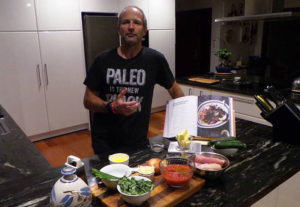
and when should I be eating because my body tells me. And what does that look like for you? What what does a what is a day look like for you in terms of what you’re eating? Yeah, great. OK, well, I’ll make sure I give you a YouTube link because I actually make a lot of videos, one minute videos of what I’m eating so people can actually see what it looks like and how amazing it is. So as an example, I’m in tape a week this week because I’m doing Geelong on Sunday. But last week when I was doing a pretty heavy training load, I most days I would get up at six and I would make an omelet and that would have leftover vegetables from the night before, which would be for me, as I said, I’m not trying to lose weight. So for me, it would be capsicum, zucchini, broccoli. These are leftover from the night before I would put them in a pan with some butter, a handful, you know, a handful, two handfuls of these pre-cooked vegetables, warm them up with butter.
In another pan, I’d have some bacon or some salmon or some leftover lamb or good, healthy protein meats, not chicken at breakfast. I prefer the fish or red meat or bacon cook that up. I then get two big handfuls of spinach. Put that in a pan with butter, the same pan as the vegetables that it all be melted down and ready to go. Then I just scrambled two eggs, two eggs in on top of the vegetables. Chuck the bacon on top, put a lid on top of the pan and within five minutes I had this amazing, massive breakfast meal that would be sustaining energy filling and just set you up for the day. I would then also have a magnesium drink. I have magnesium in water every morning.
I’d have a cup of tea with full cream, milk, no sugar. And and then I would probably I wouldn’t need to eat. I wouldn’t be hungry till probably two o’clock. So I’d go from six o’clock to two o’clock and during that time I might train for four hours and I’d come home and I wouldn’t actually eat, whereas most people are going for a protein shake or more carbs or more food. I just wouldn’t eat because I’m not hungry. Then at lunchtime I might have half a cos lettuce cut up and sort of have a quarter of that in a bowl with chopped up chorizo that’s been cooked or leftover lamb, leftover fish on top of that. With more vegetables. So a big heavy reliance on vegetables, salad and as much as possible, these be prepared or cut up the night before or the day before. And that makes my preparation easy. So that’d be about two o’clock. I’d continue drinking a lot of water during the day. And then evening meal would be once again
maybe not even any protein or meat, maybe just vegetables or it would be a small serve, 100 grams of beautiful, fatty scotch fillet steak, cooked rare on the barbecue with butter drizzled over the top with green beans, broccoli, cauliflower, some chili sauce and maybe maybe a glass of kombucha because I drink a lot of kombucha every day to help with gut health. So that would be a typical day’s food when I’m training heavy and, you know, I would never be hungry from that. And I would feel fantastic. I wouldn’t be bloated. And so that’s a typical day for me. And I’ve started to make some changes recently. So probably the last five weeks I’ve I’ve dropped around sort of three, three and a half kilos. I’ve gone from eighty five to around about eighty eighty two for the most part, just by kind of cutting back to two, maybe three meals a day for most days. Occasionally, I’ll be eating more if I’m tired and I’m trying to compensate.
But just trying to or just just cutting back that food. I’ve felt so much better and been able to think a lot clearer as well. And it’s it’s really helped with my training as well. And for me, I’m getting up in the morning. I’ll either train or or might be coaching, but I won’t eat until usually around about 10 o’clock because I’m not hungry until then. And and then I’ll either get through till maybe three o’clock or until till dinner time, maybe five or six o’clock. Yeah, depending on if I’ve trained in that sort of thing. And it’s it’s made a huge difference. And it’s just a it was mostly just a belief thing from what you mentioned, that how we can then when we’ve spoken every fortnight or so and just changed what I thought I had to be doing. And and now I’m just starting to listen to my body more. So when I’m not hungry, I usually don’t don’t eat. Sometimes it’s a boredom thing or it was a boredom thing
where I was wanted something to do or wanted a bit of a distraction or to procrastinate and I’d fill that with with food. But now I try and go for a walk or just do something else to to sort of occupy that that that time. And it’s it has made a huge difference with me. And I mean, we had some people come along to Hell Week and there’s there’s one person in particular and we won’t mention names, but he lost a lot of weight in the in the couple of weeks after Hell Week. Do you want to talk about his his results? Yeah, one of the guys like not many of the guys spoke to me and one on one is a lot of the girls did, but a lot of the guys didn’t. But one of the guys pinged me on Facebook and said, man, I’ve taken your stuff on board. I’ve dropped the carbs, dropped the processed foods. I feel amazing and I’ve lost 10. Like I converted what he told me in because it was in a dip. It was in pounds. He said it was 10 kilos and he was feeling amazing
and his swim times had improved. And I didn’t even know that this guy had taken on board what I said, because it’s quite it’s against what we’ve been taught. You know, swimming coaches will say you’ve got to have gels. You’ve got to have your porridge. You’ve got to have all these carbs. You know, most coaches, you want because you’re a smart coach and a top coach, right? But and so we believe that that’s right. And then all of a sudden, this guy that comes in, there’s not a big swimmer and a runner tells you to stop eating like that. So this guy must have gone away and really thought about it and tried it. And that’s that’s the thing he tried it and it’s worked for him and it’s had results. And it’s it’s really good that you can see people changing their life. Like 10 kilos is a lot of weight to move just by not smashing yourself more in the pool, but by just changing how you eat.
Yeah. And I mean, where do you where do you feel like the the adage of after a run or a swim or a bike ride? You like chocolate milk is a is a good recovery drink. I like something I hear nutritionists say all the time. But a chocolate milk, it’s got 50 grams of sugar in it. If you’re talking about like a big a big game or something like that. Where where is that sort of stuff come from? That stuff comes from corruption.
That stuff comes from the Dietitians Association of Australia, which is largely funded by big food companies. That’s how they get their funding to pay their CEO half a million dollars. This is all public information. You know, so dietitians have to give advice aligned with the National Food Guidelines, which are promoted and supported by the Dietitians Association. And if they don’t, they get barred and kicked out of the Dietitians Association so they can’t have a job, I mean, essentially. But if you want to take a step down, it’s because people, you know, companies and marketing like wider people drink go to a sports sugary drinks. Why do people drink all the sugary drinks from Endura? Why do people have all the gel bars? Everything associated with every racing event is about energy, foods and high sugar. And people just get bombarded with it. And they think that’s what they need to do. And milk’s just the same.
I did this 12 hour bike ride. It’s the peaks challenge up in the Gold Coast. And it was like 11 hours 40 on the bike, 280 Ks up some big hills. And this is the thing that astounds me. There are all these guys like younger than me who are much more overweight than me. And they were all sucking gels and eating sandwiches and struggling with this ride. And I had two avocados for the whole day after an omelette for breakfast. And I’ve never ridden more than three hours in my life. And these guys look like they ride bikes all the time because they have all the fancy gear on. And I did the ride and I wasn’t even screwed at the end. Whereas a lot of these guys are having lambing tins and chocolate slice. I mean, this is the food they brought out at all the stops. And a lady came up to me offering me this fudge and I said, why would I want to eat that? I’d get diabetes from that. And she just didn’t know what to say.
And all these big guys around me just looked at me like I was a Martian. But, you know, it’s totally opposite. Why would we need that food? So why do we need chocolate milk? We don’t. I’d be saying going have an avocado and and some seeds and some granola with some full fat Greek yogurt instead, if you need food.
And for someone who is listening to this and they think I wouldn’t mind to to try this. What would be one or two things that that someone could do today to start to get on that on that track and and and create that snowball of feeling better and and losing weight and and eating better? What’s what’s one or two changes to make straight away? Yeah, that’s a great question, Brent. And that way we can give people something they can start on. So I’d say if it’s in terms of practical, fast actions, they could take the first thing would be
with breakfast or the first meal of the day. What they want to do is whatever they’re doing, stop it and change it to this. So some bacon or some some nice meat that’s left over that’s already cooked because you don’t want to spend half an hour cooking meat in the morning. You know, 50, 60 grams of meat, whether it be salmon. If it’s chicken, that’s fine lamb or beef. Warm that up in a pan, a couple of handfuls of green vegetables. So beans, zucchinis, capsicum red or green, maybe some pumpkin if you got leftover roasted vegetables. And then two or three eggs and scramble them up or make an omelet or just fry the eggs and put them on top. It doesn’t matter what it looks like. The fact is it’ll taste amazing. No toast, no orange juice in the morning, just good, healthy vegetables, all cooked in butter and olive oil. And what I want you to do is make that breakfast, prepare it the night before if you’re rushed in the morning
and eat that breakfast first meal of the day and then see how you feel by lunchtime. And then if you’re not hungry, don’t have morning tea, just go without. And if you’re having that big breakfast, you shouldn’t be hungry till probably 12 or one o’clock. And then for lunch, don’t have a sandwich, don’t have rice, don’t have pasta, don’t have chips, have a salad with protein and eggs. There’s nothing wrong with eggs. This whole myth about cholesterol causing heart disease is bollocks, and that’s all on my website as well. So having a salad with meat, protein and vegetables for lunch and then don’t have a muffin for afternoon tea or fruit or light yogurt because that increases the sugar and it’ll just make you starving. And then for dinner, once again, get rid of pasta, potatoes, rice. Don’t eat any of that crap, right? And have more good, healthy meats, vegetables, salads with olive oil, nuts, seeds. Try that for two or three days.
Most people before they start with me, I say to them, do these things for a week. I guarantee you, you’ll lose a kilo, especially if you don’t drink alcohol, soft drink or, you know, orange juice. And they say, man, I’ve never felt like this before. I’m not starving. I’ve already lost half a kilo or a kilo. That’s that’s the first thing. The second thing you could do is observe. So keep a food diary and they can download one. I’ll give you a form they can download off the podcast. You keep a food diary for a week without changing anything. Just eat how you do normally, which is actually in most cases probably the wrong way to eat. And you know how your body feels. What it’s like going to the toilet, how your moods change. And you write down every single time you eat and everything you put in your mouth. And then you swap to this approach and you see how you change in terms of mindset, feeling how going to the toilet, you know,
you might not be constipated anymore. You might go to the toilet properly. You might train better. They’re the two things I think are important that people can take without spending any money by just thinking and observing what they’re doing. I love it. It’s one of the things that sticks in my mind is you’re talking. You run a spin class up near your place sort of north of north of Melbourne there. And you said a couple of the people who had done the spin class were coming up to you afterwards and I think they were talking about wondering about weight loss and like they’re doing all this training. But but the but the way it’s not coming off. And you said, let me guess what you are eating for breakfast and lunch. And and you guessed it, pretty much spot on. And and they will how do you how do you know that? And just said, well, you sort of mentioned mentioned all of that stuff. So like what let’s give that for an example,
like talking about one of the people who has come up after spin class wondering about how they can lose the weight as they’re doing all this training. Yeah, it’s OK. Yeah, well, there’s two. Firstly, there’s this lovely young girl and I’ve written this on a blog. So if you guys want to read the full story about both clients, they can this girl. I won’t say let’s say Gemma’s her name, right? First spin class, you know, first spin class ever that I had these people. I talk about nutrition. And one of the things I just said was, look, you know, hey, you know, if you’re a little bit overweight, really think about what you’re eating. I only eat two meals or two to three meals a day. I don’t eat snacks and I train 70 hours a week. And then one of them said, what the hell, what do you mean? You know, I’m always starving. And I and I said to the class, I said, OK, so if you’re having cereal or toast for breakfast or avocado, smash on toast because it’s trendy.
And then you’re having a muffin for morning tea or yogurt with fruit. I said the same thing as I did before, have an omelet, have this, this, this, this, don’t have toast, don’t have orange juice and try this for a couple of days and see how you feel. Well, the next week, this young girl comes up to me and basically goes, I’ve done that every morning and I haven’t been hungry to one o’clock. I’ve never and this girl’s like 22. She says, I’ve never been like that in my life. You’ve changed my life. I said, I haven’t I haven’t done nothing yet. I said, now this is what you need to do. So I just gave her some advice and then I think it was five weeks later, she came into class and it was hilarious. She’s talking to her friend. She goes, Andre, have a look at this. And it was a photo of a girl with her hands on her boobs and standing there in her knickers. Like, you know, you see on how people sometimes take photos
of themselves in the mirror. And there was one photo next to the other. And it was like, wow, what’s that? It was totally different. Like she’d lost, I don’t know. I think she said she’d lost like eight kilos in five weeks or something like that. And she says, I just did what you told me. Look at the difference. I never, ever thought I’d look like this. And I said, well, it’s more about looks. It’s how you feel and stuff. So that’s one example. And then she’s gone on to share that with about 300 of her girlfriends. And they all think she’s a legend. So that that’s fantastic. But one of them is a guy who came to my first spin class at another club and did the class and I’m walking at the top of the stairs. He’s walking up the stairs at the end. He goes, oh, mate, that was a great class. Gee, you’re lean. You must train heaps. And I knew where the conversation was going to go because he’s a little bit over weighs probably 105 kilos.
And he’s a bit taller than me. And and essentially I said, oh, well, yeah, I do. But it’s not about that. It’s all about the food. And he goes, what do you mean? And I said, well, how many times do you come to the gym a week? He goes, oh, six times and kills me and I’m tired and and I can’t lose this tummy. I said, all right, when you go home because this was six o’clock class finished at seven. I said, go home, have a omelet, no toast, no orange juice, no grog, no pasta, bread, blah, blah. You know, I said, do that for a couple of weeks or do that for a couple of days. And I said, what I want you to do is ring me this afternoon and tell me how it is. He rang me at four or five o’clock saying, I’ve never felt like this in my life after one day. So I said, do this for another three or four days and see what happens. While the following Monday he came to class. He said, right, I want to sign up to your program.
So he paid me whatever he paid me and he’s been doing it now for two months and he’s lost I think 12 kilos and he’s having to replace all these clothes. His whole family thinks he’s a legend. He stopped drinking alcohol because he was drinking a lot of alcohol. He’s only eating two times a day. Sometimes he’s only eating one time a day. He said it’s totally changed his life. So to be able to have the joy to teach people in group fitness and then have people change their lives like that, it’s just fantastic because he will never go back to what he used to do.
He’s now talking about getting abs.
And he’s an old guy like me, like he’s 50. I think he’s a 48 and I’m 52 and he’s talking about I want to look like you and I’m like, well, you can if you want it except for the ugly head, you know, it’s fantastic. Yeah, that’s awesome. And on the last podcast I did with a lady who’s a triathlete,
we were talking about why it is that people tend to like share their meals on Instagram or Facebook. And I think it comes from the feeling that you get when you do eat well. Like it’s, you know, you sort of make these healthy meals and you’re really proud of what you’ve made, but it’s more so the sort of the buzz that it gives you and how good you feel about yourself and how much energy you’ve got when you’re eating well. That’s why I think people love to share that sort of stuff. So it can really change your life just implementing a couple of these things into your daily routine and what you eat. And it’s helped me a lot as well. So for people who are listening to this and they want to find out more about what you do and how they can sort of start this journey to feeling better and losing weight, what’s the best place for them to find you? Look, I think the best thing to do would be to go to my YouTube channel or on Instagram
because that’s where the short, sharp one minute videos and photos of what I’m eating are. That’s sort of depending on how people want to operate or they could go to loseyourbelly.com.au which has some video content on there about the plans. But I think the more valuable approach would be go to my YouTube channel and you can see there’s probably 30 or 40 videos there listening to me talk, watch the videos, look at me cooking then contact me on loseyourbelly and we can talk about what you need to do. And I have plans that start from 250 bucks a month which basically involve time with me to explain this, to coach you, to help you through how you manage what you’re doing. And then we use this thing called the RealMill Revolution platform that I have access to where people track what they’re eating in terms of carbs. And I look at that every day and I contact people. And I’m coaching a couple of the swimmers from Hell Camp now and one of the people
is doing really well. She’s already dropped the weight she wanted to drop. She’s getting faster. She’s fat adapted within a couple of weeks and we’re working together every week. We just have a half hour call once a week at the end of the week. We check in, she asks me questions. It works really well that way. But I think YouTube is a great free resource that I’ve put there. People can look at a heap of stuff. They can get a lot of answers to questions from those videos and they can just try it themselves and if they get stuck, I can work with them on a program. But to me, this is more about helping your clients make the changes they can themselves for free. And if they want some additional help, lujabelly.com.au is probably a good place to go to. Fantastic. And I mean, this is even for people who aren’t in Australia. I mean, you can do stuff with people overseas as well. Yeah, in fact, I’ve only got probably two clients in Melbourne
the rest are either around Australia or overseas. I’ve got a cyclist in Texas. I’ve got triathlete in Singapore. I’ve got people in the UK. So the whole thing’s online and we do everything over Skype. And the main thing is me coaching them and supporting them and explaining and learning on the platform about why what they’ve been told is wrong so they can learn and understand why eating bread and grains is bad for us and how blood sugar works. And then I coach them over Skype with video and yeah, it works pretty well. Actually, I’ve got some good testimonials on my main website as well from clients. Excellent. And I’ll put all those links up in the show notes on effortlesswimming.com. So, Andre, thanks again for being on the podcast and what you teach and what you share with people. I’ve seen what a change that can make directly from people who have been to the Hell Week camp, things I’ve tried as well and I’ve implemented into my daily routine.
So keep doing what you’re doing and yeah, thanks for being on the podcast. Thanks, Brenton. Thanks everyone and I hope the listeners got a lot out of it. Thanks very much. Thanks for listening to the Effortless Swimming podcast. If you’d like us to help you become a faster, more efficient swimmer, go to www.effortlesswimming.com.