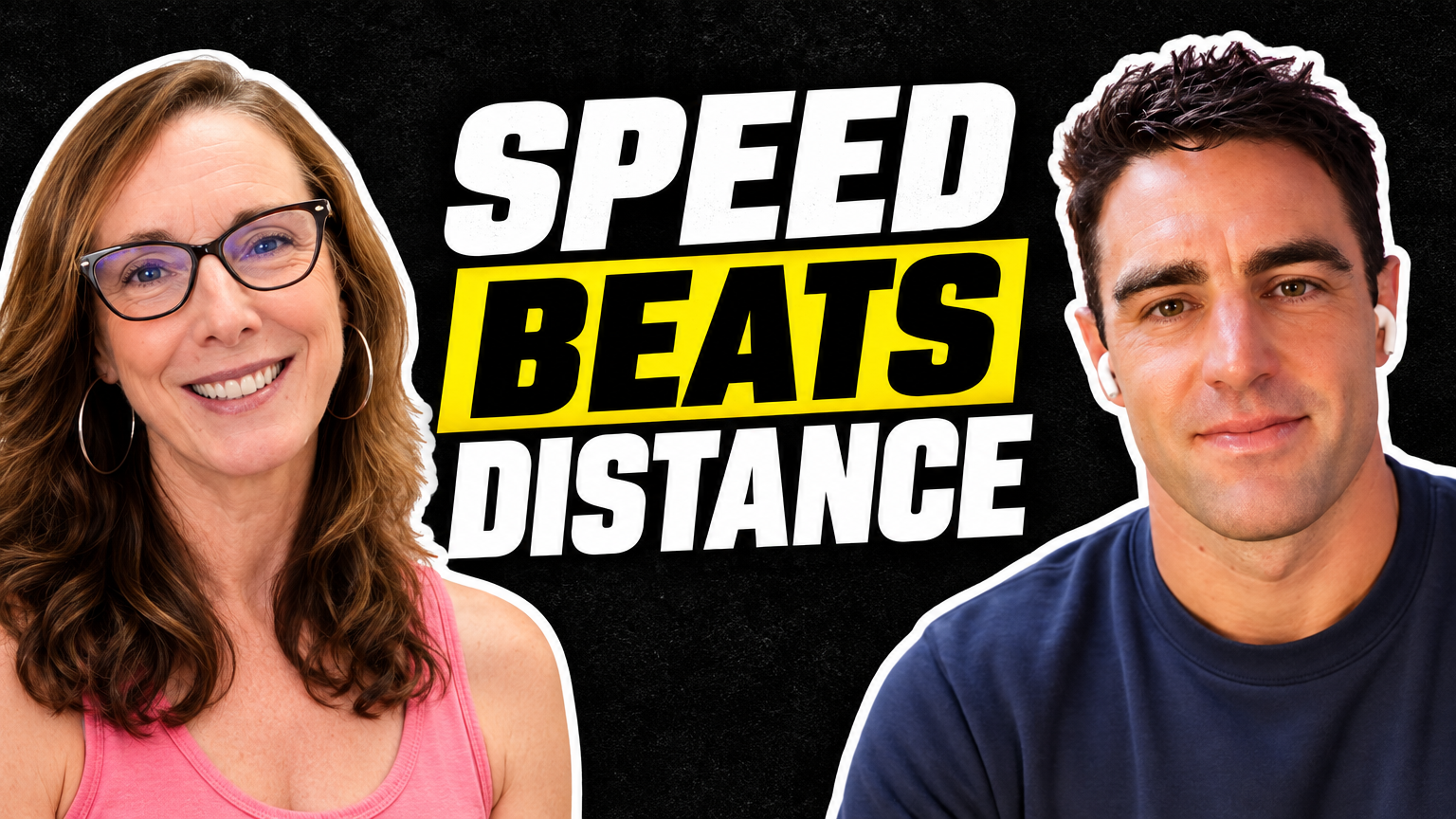









Race Pace Training is about swimming at or quicker than your racing speed. It’s often done in short intervals (eg 25m or 50m) with enough rest between intervals to recover and hit race speed on the next one. On this podcast Garrett McCaffrey, coach at the Phoenix Swim Club, joins me as we chat about how to best include this type of training in your workouts (and if it’s relevant to you!).
He’s just released a 12 week Race Pace Training program ideal for age group or Master’s swimmers and coaches.
We’re also joined by Chris Ritter, a strength and conditioning coach to Olympic swimmers and a guest on one of the most well-received podcasts we’ve done – listen to it here.

On this episode:
03:30 – What is race pace training?
09:05 – When a Swimming Technique Drops Off
09:20 – The Muscle Memory
10:11 – Finding a Way To Keep The Speed
13:19 – How do you deal with change?
17:28 – The Correlation of Age and Speed
18:00 – Why Race Pace Training Makes Physiological Sense
22:14 – Race Pace Training & Vegetables
28:13 – The Importance of Structure in Directing The Work
30:48 – The Race Pace Training 2.0
Talked about on this episode:
The 12-week Race Pace Training program
Transcript
Read the full transcript
Welcome to Effortless Swimming, the podcast for swimmers, triathletes and coaches. Join Australian swim coach, Brenton Ford, as he reveals the latest techniques and information to improve your swimming. Let’s dive right in. Welcome to the Effortless Swimming podcast. The topic of today’s podcast is race-paced training, and how you can use it as part of your weekly training routine to increase your swim speed and slow down less. And my two guests are Chris Ritter, who we’ve had on about 12 months ago. Chris and I spoke about strength training for swimmers, and it was probably one of the most well-received podcasts that we’ve done, that he gave a lot of useful exercises and tips for increasing your strength in order to swim faster. And he also had a lot of people visit his website to look at the strength progression exercises and routines that he recommended as part of the podcast. So that was an excellent one which you can go back and listen to.
My second guest is Garrett McAfrey, and he is a swim coach at the Phoenix Swim Club. And Chris has been developing his race-paced training method for the last couple of years. He’s added some things in, taken some things out, and really just found a way that’s worked best for him to help his athletes increase their swim speed by doing a lot more race type of efforts in training and backing off from the typical volume-based training. So we chat about that on the podcast, how you can use it, whether you’re an age group swimmer, a master swimmer, or a triathlete or open water swimmer. And like anything, it depends on what you’re training for and what your goals are as to what type of workouts you should be doing. And it’s not the be-all and end-all of training, but I think it’s a really important type of training to include for 99% of swimmers. We also discuss who we feel this is probably most relevant to.
And if you’d like to find out more about this race-paced training, Garrett and Chris have put together a 12-week training program, which progressively builds up, which you can find at effortlesswimming.com forward slash RPT. So if you feel like this is something that would help you increase your speed and slow down less, then you go to effortlesswimming.com forward slash RPT. And that will take you to Chris and Garrett’s website, where they’ve got that 12-week training program. All right, let’s get into it. Here’s Chris Ritter and Garrett McAfrey. Chris, Garrett, welcome to the podcast. Thanks for joining me. Thanks for having us, Brendan. Yeah, Brendan. Good to talk to you again. Chris, we’ve had you in the podcast probably 12 months ago. You were talking about strength training. That was probably one of the best responses I’ve had from a podcast. I had a lot of people email me back just saying how much they got out of it.
And I know a lot of people joined the program and submitted their email for a lot of the strength exercises that you offered. So looking forward to having you back on. Yeah, and hopefully those people that are listening are stronger 12 months later, right? That’s the key. Exactly. Yeah, it’s all good learning things. But if you don’t do anything with it, well, it’s really useless. But I mean, today we’re talking about race-pace training. And I think this is something that everyone can incorporate into their training in some way, especially if they’re short on time or they’re sort of stuck at a bit of a plateau. So maybe Gareth, can you give a bit of a background on what race-pace training is and who it’s best for? Yeah, I think there’s a lot of different people who throw the term around and a lot of different interpretations for exactly what it means. But for me, race-pace training is a focus in your training program
on the speed at which you’d like to compete. And so that kind of answers the second part of that question too, Brenton, because it’s definitely for swimmers who are interested in getting faster. I think it could be used for any type of race from open water, longer races, obviously all the way down to the shortest events in the pool, the 50s. So I feel like it’s still something that people are kind of starting to hear more and more. I think it’s something that a lot of coaches already incorporate into their training as phases or sets, a way that I’ve incorporated into my training. It is our focus throughout the entire season. And you sort of talk about in two stages where stage one is developing the speed itself and then the next stage is developing speed endurance. So can you talk a little bit about how you go about doing that? Sure. So we started doing some of the race-pace sets that a coach of mine
really brought from another coach here in the States, actually in Arizona, Charlie Cunningham, who’s now one of the assistants at Grand Canyon University and one of my coaches had trained under Charlie and Charlie had come up with these parametric sets. A couple of them are 50s on two minutes for back-end type 100 speed, 25s on one minute for front-end type 100 speed, 50s on anywhere between 50 or a minute for 200 pace and 100s on two minutes for back-end 200 pace. And we started to just build through those. And then one of the sets that Brent Russell, who is really the guy who put the science to this type of training, and he’s an Australian, but he now lives in San Diego, California, and he put a lot of his time and research into the science behind the type of training that I now use. And one of his main sets is 25s on anywhere between 30 or 40, a little bit of a tighter rest than what Charlie uses for his 25s on one.
And with Dr. Russell’s 25s, he started a type of set called Miss One, Sit One. So you either take a pace from your actual race, like what the middle two 25s in a short course race would be, and you try to hold that for anywhere between 12 to all the way up to 30. I think some coaches go even higher than that up to 40s in the 50s, pretty intense. But you go through that set and if you’re hitting the pace, let’s say it’s 13 seconds for a 25, say you hit a 13 second, then you do another one on the next interval. But say you go a 14 second instead of a 13 second, then instead of trying on the next interval, you rest for an interval. So it’s a Miss One, Sit One approach. And that way you are only spending time swimming at the speed that you want to race. And what I found is that that type of approach is really hard on the high school to college age kids that I coach. I don’t want to say it’s a generational thing,
but they look at that Missing One as failure and it starts to weigh on them psychologically. And it’s definitely a set that we do because I think they need to get used to dealing with failure and they need to understand why we’re making them Sit One out, but they sometimes do better when it’s just straight up fastest average. They end up spending more of those reps at or under the goal time than if we try resting for one and then trying again. So the idea behind it is just to be spending time using your practice time at a race applicable speed, whether that’s 50 speed, 100 speed, 200 speed, 500 speed, 1650 speed, whatever it would be, or 1500 speed, I guess for the Australian swimmers. It’s just making sure that you’re not just going back and forth and trying to track as many yards as you can. You’re trying to spend as much yards at race applicable speed as possible. And I’ve incorporated when I’m giving workouts to people
and try to incorporate a lot of that sort of thing where it’s about hitting that constant speed and not slowing down because in any race, whether it’s 100 free or 200 free or it’s the longer distance stuff with a half Ironman or a full Ironman distance event, it’s about being able to maintain, first of all, your speed and also maintain your technique. And that’s why I really like to cut down the distance of the reps of each set. So whether it’s 25s or 50s, often doing that instead of doing 200s or 400s, it allows the swimmer to get that rest to reset, recover, and then go again and hit that target speed that they’re looking for, but also maintain technique because you know as well as I do that when you’re coaching swimmers pretty regularly their technique can drop off towards the end of a 200 or a 400 in training. So if you give them that time to recover, they just get used to holding form from the start of a set all the way to the end.
Yeah, it’s the ideal of muscle memory. We’ve all heard that term and it’s a real thing. It actually takes place in the nervous system, but you want to train that body to be ready to go at that race pace so that that speed is automatic in the race. So kind of going back to your last question, because I don’t think I really got to answer it, Brendan. Sorry I got going on the development of how I came to the race pace stuff and I didn’t answer your phase question. So what I started to notice is that we hit a phase in the middle of the season where they started to get stale when we were just going those fast efforts one after another after another. And like you, you see their technique breakdown and they even had trouble hitting the speeds that they were going earlier in the season. So I had to try to figure out a way to keep that speed as we progressed through the season and build it. So I kind of, I started playing around with building some active recovery efforts in between.
So still not any garbage yardage. It was a little bit of either recovery for like a kick 25 or something easy and then a set up 25 like a distance per stroke or a drill 25 and then doing the fast one instead of just going fast one after fast one after fast one. But eventually phase two, you need to go fast one after fast one after fast one because that’s when the real adaptations take place that allow you to hold that speed. So, you know, that second phase is about slowing down less because you take those reps which in phase one of the program are protected by active recovery and some intervals that we kind of cushion a little bit more to protect the speed to allow them to go hopefully a faster speed than they’ve ever been before and really raise the bar on, you know, their base speed, so to speak. And then the second phase, you know, even though it’s much more difficult and even though some of the kids really get into that psychological struggle
it is important to be able to hit those paces for reps as many as you can and for as many in a row as you can. So that’s kind of how the, you know, we first protect the speed and the technique early in the season to really kind of hopefully raise the bar on how fast they can go and then in that second part try to get it so that they can maintain that speed and ideally slow down less than their races. I used to go to a master’s squad here in Australia and I was starting to see a big transition to this type of training in master’s athletes. One I think because of time is when people are working full-time, they have kids and it’s hard to squeeze in a really sort of long workout that might be 90 minutes. So sometimes if they’re training by themselves, I see people go to the pool. They might only swim for 45 minutes and maybe 30 to 45 minutes. So it’s a short set but they’re really getting that quality training done.
They’re hitting that high intensity and their times aren’t slower than those people who are doing the longest sessions. More often than not, they’re able to hit those faster speeds when they’re racing. So I think it’s really good in terms of time effectiveness or the effectiveness spent training. But I think it can also be difficult to manage from what I’ve, from my experience, it can be difficult to make that transition from, I guess, doing your old-school approach to training and then changing it to this sort of race-pace training. It can be quite a mindset shift but also quite a different thing for the athletes themselves to take on because they might not be hitting 5, 6K of recession if they’re used to that. They might only be hitting half that. And so they feel like they haven’t quite gotten the workout that they would have otherwise. But you’re going for results here, you’re going for that end speed.
How have you dealt with that change in going to race-pace training? It’s hard. And I’m assuming that a lot of your master swimmers are still swimming because at some point they had some success in the sport, right? Yeah. And so they had success doing it, most likely the high-volume endurance-focused approach. And so when you’ve had success, it’s really hard to look at this because it’s so different. It’s not easier. And I think that’s probably the biggest misconception that people have on their transitioning from a more traditional program into this type of training is that you’re doing less yardage, so it must be easier. Or you’ve got it so ingrained, you spent so long trying to tally up as many yards every week as you could that now you’re saying, okay, it’s not how many yards you can squeeze in, which I don’t know, like the interval determines how hard the practice is in a traditional program. The interval and the reps, and that’s kind of determining the hard.
Whereas in race-pace training, you decide how hard it’s going to be. If you’re at the end of a race-pace training session and you feel like it wasn’t much of a workout, well, then that’s your fault for not going faster. And I think that is a tough thing for people to transition into because it’s a different kind of work. It’s like a race where it’s as hard as you want to push it. I mean, there’s no interval on a race. None of our races are going to go more than six or seven minutes, even if it’s a 400. I guess for master swimmers, it might be a little bit more than that, but it’s definitely not going to go the hour that they spend in the water, and it’s not going to go for 5,000 meters like they are in the water. I mean, there’s no races in the pool that are that long. So the idea that we need to be going so far beyond what we’re racing at is, if you think about it, kind of crazy, but it’s something that we’ve done for so many years
and you’ve seen so many people have success with it, that it’s sometimes tough to let go of what they’ve experienced and what they know for something that I don’t understand how it couldn’t make more sense for them. So I think the transition is too hard. They’ve had success doing it a different way, and they’re so in tune to counting yards that they don’t understand that you can make a 25 or multiple 25s really hard. You can make a 50 really hard. You can definitely make 100s extremely hard. You want to try to hit 200 pace for 100. I’m saying take your best 200 time and try to hit half of that time for one 100 in practice and then try to do it for two. If you’re lucky enough to do it for one, if you’re good enough to do it for one, I should say not lucky, but then do it for two or three. You’re not going to be able to do it for 2,000 yards. You’re not going to be able to do 20 of those 100s. I don’t care if you’re doing them on three minutes.
You’re not going to be able to hit that speed, and if you are, then your 200 is not where it should be. So it’s a different kind of hard that I’m not sure our traditional programs have set our swimmers up to really understand how to work that kind of system. I think it’s so important as swimmers start to get older. So the Masters athletes, just to really do that short, sharp training, because to hit that high intensity, to hit that speed, it can be very rare in a lot of sessions, a lot of workouts these days. So I think that is really important. And the other thing as well is strength training. And Chris, I mean, I’m sure you’ll attest to this is as people start to age, once they start to get into their 30s, 40s, 50s, and you work with a lot of Masters swimmers, do you see a big correlation between someone’s ability to build strength or maintain their strength through doing the type of workouts we spoke about
in the podcast we recorded a couple of months ago. So a correlation between that and their ability to maintain their speed as they get older. Oh, yeah. And I think it plays off each other too, because a lot of the Masters swimmers that I work with in terms of doing their strength training, they’re getting more, I want to say almost drawn to the race-based training because it hits them on a lot of levels. They don’t have a lot of time to swim, right? They don’t want to be there for hours on end. They don’t want to be there any longer than they have to. They want to get in, get their workout and go on with their life, or if they’re retired having fun, they don’t want to be in the pool. And I think the race-based training, it makes sense on so many levels like physiology-wise. And that’s kind of my background, what I come from. And I always had a hard time meshing that with what the swimming world was doing.
So even though you got results going the more quote-unquote traditional route or the higher volume, not to say it didn’t work, but is that really the best way to do it? And I think Dave Saylor and the states started asking that question in the late 70s and 80s basically and it’s kind of, I think, the forefather of this race-based training movement of it. And I think it’s funny, it’s kind of been re-burnt a couple of times, but it’s really about, you want to practice swimming fast and slowing down less and Garrett kind of coined that phrase, I really like it. It’s just about going faster and practicing what you’re racing. And then if you couple that with strength training, you’re getting both the same physiological effects on both ends, whether you’re on land or in the water and you’re actually complimenting your training. Whereas if you’re going higher volume in the water all the time and then you do try to do some strength work,
at some point it’s kind of fighting against each other and you may not get as good results because they’re almost neutralizing each other a little bit. Whereas this way, you’re doing both things in terms of physiology-wise in the water and on land and they’re working together to get better. So I think it’s the best of both worlds really. Yeah, definitely. And I want to point out for the people listening, it really depends what you’re training for and what your goals are. I think there’s definitely still a place for longer, easier sessions whether it’s recovery swims or we give our triathletes a lot of pool boy paddles work and it might be longer distances, low heart rate, just to build strength and build their aerobic base in the water. But we also work in the race-pace training as well. So I find when you’re talking with someone and they might have heard something off YouTube or off a podcast like this, they take that as gospel
and they don’t then look at it how it might apply to them. So if someone’s maybe training for the English Channel, for example, and they listen to this and then they change their workouts from putting in a lot of case to build up the strength and endurance that they need to get through that. If they change from that to doing 25s, it might have some place but it’s not going to replace their training. So with anything that you learn or you hear, it’s about how it applies to you and then I think getting the advice from having that, you’re speaking to an expert on whether that applies to them or how it applies to them. So do you sort of feel the same way again in that it’s really about how does it apply to what you’re training for and what your goals are? I totally agree with that. I think that you have to keep in mind what your goal competition is and if your goal competition is to complete the English Channel,
then you need to be prepared to swim for that distance. And I still think that you could find ways if you want to improve your time on the English Channel, if you’re going after some kind of age group record or record in that, then there’s ways that you can kind of break that down into whether you’re doing 200s, 400s, maybe all the way up to 800s at that speed, you can kind of use the race pace training from time to time to try to incorporate within your workout. I mean, this is not a race pace, I don’t want to say exclusive. I’ve found that mixing in different parts of it, including aerobic progressions like you kind of talked about, we like to use paddles at different points, especially with some of my distance kids. I think that you’ve got to cater it to not only your competition but what you like and what you as a swimmer enjoy doing. And you can’t just always, I hate this example because Bob Bowman, Michael Phelps’s coach,
used this as his example of race pace training. It might be vegetables and it might be the very best thing for you but you can’t always eat vegetables. And I hate it and I love it because I think it could still be the focus but he’s right, of course he’s right, he’s a great coach but you can’t necessarily just take on an exclusive diet of one thing. So I think the program that I put together acknowledges that and there’s a kick progression built into it and there’s an aerobic progression built into it and there’s specialty sets when we break down into IAMers and sprinters and distance swimmers that has descend work in it. Some of the 200 and 100 progressions have descend work in it because I also worked with a swimmer Roland Schumann who did race pace exclusively for a stretch and he said he felt like the knife was getting worn dull. He was sharpening the knife so much that it almost dulled the knife and so this program kind of accommodates for that.
It protects the speed. Like I said, I found that with a lot of even my high school swimmers they got to a point where they weren’t getting faster and they weren’t even able to maintain their early season speed so that’s where this progression came in where we’re mixing a descend one to three, then a one fast one easy and then hit them all in a row to protect that speed because I still believe that the best thing even for somebody who is training for a longer race or an open water race, the best thing and the most valuable use of their time is to practice at the speed that they would like to compete at. I think physiologically that is the best way for them to be spending their time but as humans and not robots it’s not always that easy so building things into it to set them up for success when they do attempt to go their race pace efforts or their competition efforts I think is part of the art to the coaching
and part of what I’m sure you do as a master’s coach and what all coaches do is to get what they need to done in a way that their swimmers can do it and can do it well. Hey, Breton, if I could jump into, from my perspective I think the cool thing with Garrett because he came on the coaches’ corner where we were basically able to see his workouts for four weeks and I liked it how he was giving it his own spin. It wasn’t like, okay, instead of following high volume for example to the letter he wasn’t doing that for race-based training either but still allowing himself to be a coach and like he said, adapted in different ways and fit it to his style, his program, the athletes he’s coaching and so yeah, this is not the definitive program on race-based training by any means but I think it’s a really cool mix that he’s put together and I think it just really meshes with a lot of swimmers and coaches out there that are trying to think
okay, how do I implement this race-based training? It seems like this elusive thing out there or this super complicated thing Garrett’s done the work and he’s used other coaches’ resources and now he’s put it in the pot and it’s come out his own kind of mix and I just think it’s a really cool end solution here. Yeah, I think that’s the key isn’t it? You know, coaching is really an art you’ve got the basis of sort of science behind it but when you get all of those inputs it’s about creating your own output with them so taking the race-based training and it may not be to the letter of the law of how someone else has set it out but it’s about adapting it to your style of coaching and how you feel you can get the best results from your swimmers with it and I’ve found the same thing with my coaching now I’m coaching more triathletes than master swimmers but it’s about using my background as a competitive master’s coach
but also now coaching more triathletes so sort of using all of that and putting that into workouts and sessions that I feel will give them the best result for what they’re training for so really there’s no right or wrong but after coaching for years and years you come to understand what tends to get the best results for different kinds of swimmers and one thing that we say when we run clinics is that we’re not going to try and fit you into this one idea of how people should swim because a lot of times we get people who will come and they will have seen Sun Yang on YouTube and they’ve been trying to swim like him and they might be someone who’s five foot six they’ve got short limbs they don’t have much of a background in swimming and there’s no chance that they’re going to swim anything like Sun Yang and if they do it’s not going to be effective for them so it’s about finding what works for them and then sort of tailor in the feedback in that way
so it really is an art of coaching and we’ve got a number of coaches who work with us and we’ve all got very different styles but with the same I guess philosophy behind it so it’s a very individual thing and that’s what makes it interesting and exciting too you go to different programs, you go to different coaches and you might take away a couple of different things from each of them and then apply it and see what works best for you I feel like the artistic side of it is what drew me into it the creative side of it and doing sets and different types of workouts that engage the swimmers I found that as a fun challenge as a coach because I feel like I spent a lot of time as a swimmer zoning out and not engaged and I don’t think there’s many other sports where that’s what you’re supposed to do just get a song in your head and grind it out so I really enjoyed the creative side of it and the artistic side so to speak
but at a certain point you need some structure to be able to direct the work and I feel like the best thing that our sport has and the biggest draw for our sport is that we can show improvement we can show success it’s right there, the clock doesn’t lie and that battle with the clock lets you know if you’re becoming better at something and so I feel like I kind of took that creative side and I still have to give myself that outlet in certain sets and in certain places but I don’t want to get lost just trying to chase after, like you said the Sun Yang training and then the James Magnuson training and trying to just do all these different types of sets because then I just get lost with a big pile of nothing it’s like trying to cook with different recipes and all of a sudden you put all these different ingredients in and it just comes out to be yuck so there’s got to be some kind of structure there’s got to be some kind of progression
that keeps it moving towards the improvement because that’s why swimmers stay with our sport they need to improve and I think the structure that I’ve come up with and just through like you and every other coach have just done it through experience and it’s where it’s at right now and I can’t promise that in three years it’ll look the exact same because I’m sure I’ll be learning other things and be tweaking it all the time because that’s what any great coach would do but the structure allows for creativity but it also allows the swimmers to be able to see oh man, wow, yeah, I am getting better on my average for my 50s on two oh man, I made more 25s on 30 than I ever have before or I didn’t make as many as I have before but I made more in a row this week than I did last week and that kind of success just helps keep them moving in the middle of the season and being able to see that improvement in practice gives them confidence
when it comes to stepping behind the blocks and looking for improvement and that structure that you’re talking about I see it very much as like building a house you’ve got the base, the foundation you’ve got the walls but then everything else the colour of the paint, the windows, the styling that’s all sort of open for what you want to do so you’ve got the foundation there and the structure that stays but then you’re allowed to get that creative side out with the decoration and that sort of thing and you mentioned your program and your structure so can you talk a little bit about the race pace training 2.0 system that you’ve just released because I want to talk a bit about that and how you see it or who you see it working best for and just to get a bit of insight into how you’ve structured it So like I said we played around with just doing the straight up one rep after another if you’re making your pace you keep going
if you’re not making your pace then you rest one and then try to keep going and it worked well for a while but after a while they just kind of hit a plateau they got to the middle part of the season where it kind of it stalled out a little bit I wasn’t seeing them get faster the way that it was supposed to be based on the science so I built in some of that active recovery to help structure it so we’ve got three progressions a 100 pace progression a 200 pace progression and then an aerobic progression that we work through three different sets twice a week so let’s just dive into the 100 pace progression for example one day we’ll do a DPS distance per stroke so a set of 25s and we do them on 30 it’s yards just for your listener so it’s a little bit shorter than the meters that you guys would be doing short course but you’re looking for at least like a one to one and a half work to rest ratio one to two work to rest ratio isn’t a bad thing whatsoever
when in doubt give them a little bit more rest so that you’re setting them up for that success and that good technique but we build one where it’s a DPS so you just call it a smooth easy speed type effort then one fast and then a recovery effort to just kind of give them a chance to protect that speed so that’s what they would say let’s say if we’re doing our 100 pace on Mondays and Thursdays so on Monday you would see one of those sets it would start at 12 fast ones and build all the way up to 20 fast ones so the first time you see it it would be 36 25s where you go one DPS one fast one easy 12 times through then the next time you see it Thursday it would be one DPS one fast 12 times through for a total of 24 25s and then when you come back to it the following Monday it would just be 12 straight up on 30 fastest average then on Thursday when you come back to the progression then you would be going up to 13 so then it would be
39 I’m doing that math off the top of my head I hope I got it right but I’m pretty sure it would be 39 25s one DPS one fast one easy 13 times through and then the following Monday it would be one DPS one fast which is still quality work it’s a little bit of speed play they’re still working on their stroke they’re still counting their strokes for efficiency it is in no way garbage yardage but not having to go fast for each one of those reps adds for a little like active recovery so that they can go fast on those fast efforts and then the the following I think we were on a Thursday then it would be 13 straight up fastest average and once we get up to about 15 of those so that progression would just continue once you get up to about 15 of those then the fastest average becomes miss one sit one but the you know DPS fast easy version of that set stays the same and we build all the way up to 20 so all the way up to they’re doing
60 25s a 30 minute set and you’re sorry 90 sorry I was right 60 25s a 30 minute set you’re doing 20 of those fast so you’re doing 500 yards faster than your hundred pace throughout this 30 minute set and they’re going faster than their hundred pace on the 59th effort because that would be the last fast one I’m telling you they hold their speed or faster on these type of sets all the way through the set whereas normally you get to the end of a 30 minute set you’re you’re running on fumes but because of the active recovery they never really accumulate any lactic acid and they’re able to hit that speed over and over and over and over again in the neurological adaptation just becomes so much more effective so you know it just really protects that speed and then you know I’m talking to the kids I’m like alright you’ve done 60 25s you’ve done a 30 minute set now let’s just do 40 25s one DPS one fast and usually 99% of the time they’re at or faster than their
100 speed for all 20 of the fast ones again right and then you say okay so you have now in two different sets in the last week and a half done 20 reps faster than the speed that I’m even asking you to go here now I’m asking you to put together 20 in a row it’ll be over in 10 minutes it’s going to be intense but it’ll be over quickly and you’ve already proven to yourself that you’re able to hit that many reps but now you just have to put them back to back to back to back ways you’re said then done but at least it gives them you know some feel for what they’re about to try to do and you know by the time that they do that they only you know they build up to that and then by the time that they’re able to get close to 20 of those reps then we kind of go back down and we we set that average a little bit faster and then we try to just put those together and we kind of cut out those other two parts of the progression where there’s
deep instead of going DPS fast and easy we cut that part out and we just start going to fast one easy and then we start going three fast one easy and we alternate between that building and the miss one sit one fastest average and it’s very similar for the 200 pace except it’s 50s on 50 and then we also we mix in that aerobic set where you’re mixing in 50s 75s and 100s on a roughly three to one type work to rest ratio we do our 100s yards on 120 and we do the 50s on 40 and we alternate one day of that they’re just trying to make that interval and control their heart rate and then the other day that they do that that week they try to go after 500 or 400 type speed on those reps and so you know they’re they’re either doing 50s 75s or 100s it’s never look no week looks the exact same it’s not this in that way and those progressions just kind of keep it fresh and it keep evolving and then we also do parametric sets that are still built around their race
speed I think I talked about these from a coach that has done this for decades and just gone over just relentlessly Chris has had him on his podcast and Charlie has spent years putting together sets that he that he has proven to equate to back end speed or front end speed you know you can take these sets these parametric sets that he’s built and you can basically put their averages together and predict exactly not only what they’re gonna swim but how they’re gonna split it it’s kind of it’s kind of crazy how accurate it is and so we mix in those parametric sets that we build on throughout the entire year and you know we allow them to go between a primary 100 and a secondary 100 so they’re able to specialize and my group is you know I’ve got kids who are freshmen in high school all the way up through I work with Brea Larson who is was a 2012 US Olympian NC2A record holder and you know she works with this same group and they’re all able to specialize
they’re all doing the same sets but because it’s specialized for the individual just based on what pace they’re going it’s able to accommodate that wide range of ability and what I found is that they’re able to continuously improve you see improvement not only in practice but you see it in season and I think that’s another one of the perks of a race pace type program we’re not putting off success until the end of the season you know breaking you down to build you up for one good meet at the end of the season we’re you know at our highest volume of work we’re at speed the most so they’re able to go fast in season and we see a lot of improvement in season so that you don’t get necessarily the humongous drop at the end of the season but if you look at the drop over the entire season it’s been a progressive drop that if you look from start of the season to the end is that humongous drop it’s just done in a little bit at a time in each meet
that we do we never swim broken down where they’re not expecting to go at least close to their best time so
it’s something that has taken a few years to kind of put together and through trial and error figuring out what works best for the type of swimmer that we work with and really that type of swimmer is somebody who wants to get better they have to be invested it can’t be you know somebody who’s forced to be at practice it’s not for people who are just out there to stay fit and just you know practicing for fitness because you have to push yourself to a different level that most people who are just exercising aren’t willing to push themselves to it’s out there for people who want to get better and really want to get better and I think it’s effective as long as you bring that type of approach where you want to get better and you’re willing to put in the work and the pain and the struggle to get better this program can work for you I think it’s a lot more doable to push yourself if you’re training on your own so if you you get the race pace training
program and you’ve got the workouts there and if you’re just doing these by yourself without other swimmers or a coach it’s so much easier to push yourself for 25 metres at a time instead of doing 10-200s where you’re really trying to push each of those so that’s because I do a lot of training by myself and I find that if I just can’t really be bothered training but I know I’ve got to do it if I’ve got one of those days I’ll do something very similar to that where it’s 25s or 50 metres at most at effort and you usually feel pretty good at the end of it, you’re fatigued but because you’re hitting that pretty high speed you feel pretty good about yourself and it’s so much easier to do on your own you know you’ve got something out of it
yeah exactly it sounds a bit silly but it’s fun to go at that sort of speed as opposed to just 70% effort the whole way for the whole session, you really feel like you’ve got that benefit and especially if you haven’t done much intensity lately you’ll be pretty tired even after 825s at speed it’s just a different type of work out compared to the longest slower ones and for example we did a main set today myself and two friends and one of my friends he’s only back in the water for two weeks after a couple of weeks out and the main set was 800 metres and probably 300 metres of it was actually fast, maybe 400 yet he was absolutely spent at the end of it so you don’t need to do a lot to get a good work out the kids a lot of times the kids in my group are laying on the pool deck after a set and I know that that’s mission accomplished and I tell them all the time this is not the kind of work that if you just make the reps and make the intervals
that you’re going to get better that’s not how this works you can’t just go through the motions and I feel like you can kind of get by in a the traditional programs that I grew up swimming in that I feel like majority of people grew up swimming in you just kind of can get by you can sit at the back of the lane you can make the reps you don’t necessarily know if you’re getting better but when you’re going against the clock and everything is for a time and it’s intense you know if you got better that day or not and I think Chris talks a little bit about it too the physiological benefits are so much more effective when you’re at that high intensity it’s better for your heart it’s better for weight loss it’s better for everything so you know time wise you know getting that work into a shorter window is better plus you just finish and you know what work you got in whereas just kind of going through yards and and like you said it’s
75% you know you got your heart rate up it’s probably the equivalent of going out for a jog and it’s definitely beneficial it’s great for exercise you’re probably fitter because of it but you don’t know if you got faster and for those listening if you’d like to check out the race pace training system you can go to effortlesswimming.com and then RPT so RPT standing for race pace training I’ll also provide a link on the web page for this podcast so effortlesswimming.com forward slash RPT and I’ve had a look through some of the workouts on there and yeah really I really like the structure of them and they’re all about speed all about going fast and slowing down less so Garrett Chris thank you very much for joining me on the podcast and it was a long time between drinks Chris but I’m sure I’ll get you back on the podcast again a few months down the track so I appreciate your time. Yeah thanks Brent. Thanks for joining us on the effortless
swimming podcast to get transcriptions bonus videos and to be the first to hear about new episodes comingpodcast.com