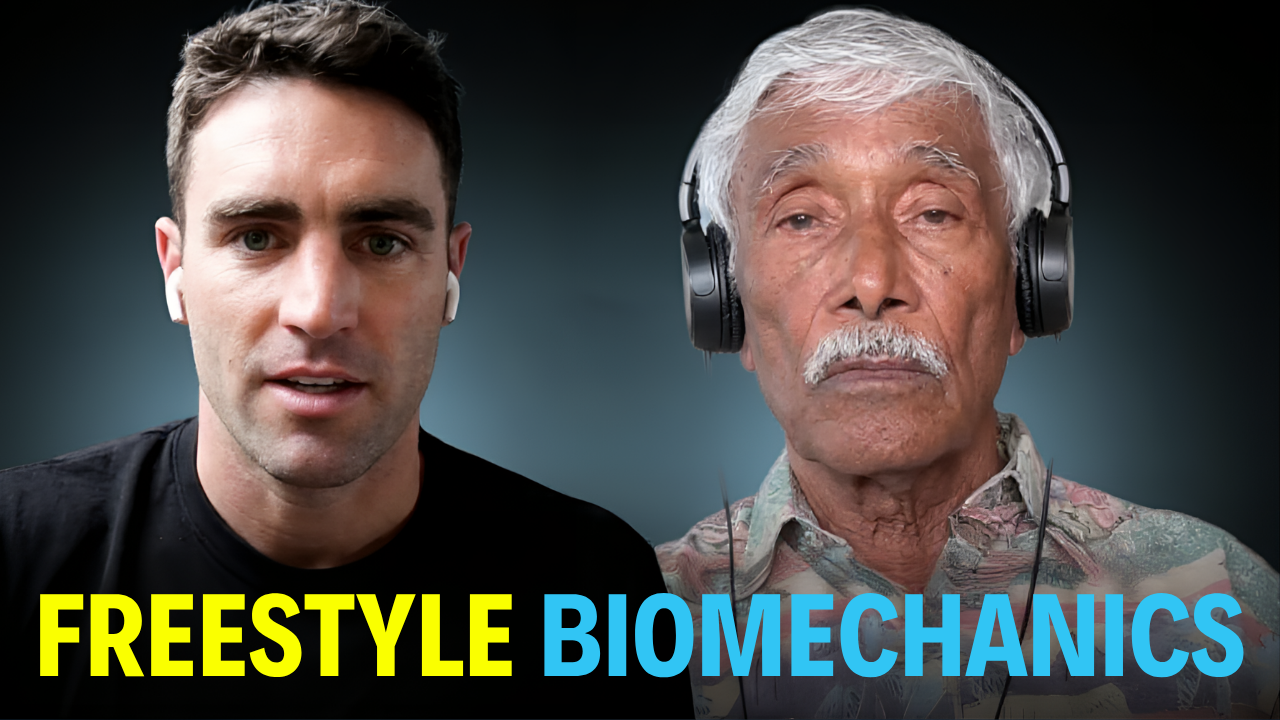








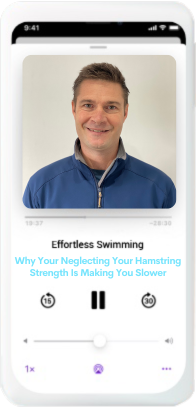
In this episode, we have Carl Reader, a functional movement coach with a background in exercise physiology and Pilates. We will discuss the connection between hamstring strength, mobility, and how it can improve swimming performance. Carl has extensive experience working with swimmers to improve their movement and strength training. Join us as we delve into his research and practices in today’s episode.
00:00 Introduction
00:59 Techniques and Tips from a Functional Movement Coach
01:59 The Role of Hamstrings in Maintaining Speed and Efficiency in Swimming
05:21 Exploring the Relationship Between Hamstrings and Calf Muscles
08:14 Factors Affecting Hamstring Strength
11:20 Strengthening Techniques for Better Posture and Muscle Activation
13:39 Squats: One of the Best Ways to Strengthen the Hamstring
17:43 Signs to Look Out for: Indicators of Hamstring Issues
21:08 Core Engagement in Squats: Finding Balance
More About Carl Reader:
website: https://carlreadercoaching.com/
email: [email protected]
Get the Functional Movement Course here
Change your technique and swim a smoother, easier freestyle with the Effortless Swimming membership:
https://effortlessswimming.com/training-and-membership-plans/?el=blog
Do you want to work with me personally to improve your technique? Join my swim technique coaching here:
https://effortlessswimming.com/stroke-analysis-membership/?el=blog
Get 20% off wetsuits at Great Ocean Wetsuits with code ‘EFFORTLESS20’:
https://greatoceanwetsuits.com/
Get 15% off our 8-week Faster Freestyle course by using the code 8week15
https://effortlessswimming.com/8-week-faster-freestyle-course/
Related Content:
Functional Movement For Swimmers With Carl Reader
Swimming (And Moving) Pain Free with Carl Reader
The One Exercise That Solves Most Aches And Pains with Carl Reader
Stop ‘Hauling’ Yourself Through The Water & Swim With Ease with Carl Reader
How To Strengthen And Stretch Your Hip Flexors For A Better Kick with Carl Reader
Watch the episode on YouTube:
Transcript
Read the full transcript
You’ll find that especially with swimmers, maybe with poor posture as well, is that they overuse their glutes and their back muscles to swim if the hamstrings are weak. So, you know, that then stops the whole flow of energy. When the hamstrings aren’t firing, you don’t get that support through the knee. So knee pain’s a big one. Lower back pain, definitely got to consider like weak hamstrings on the one side. Any sort of muscle imbalances where you’re told your one leg is longer than the other or your pelvis is out of alignment, that’s often a hamstring issue. Welcome to the Effortless Swimming Podcast to show that help swimmers and triathletes love the water, become a better swimmer and live a better life. Here’s your host, Brenton Ford. Welcome to the Effortless Swimming Podcast. Today, we have a return guest. We’ve got Carl Reader. Today, he’s here to talk about the relationship between hamstring strength and, I guess, mobility as well
and how that can actually improve your swimming. Carl, this is something that you’ve been looking into quite a bit recently. And just to give people who might be new to this podcast a bit of background, you’ve been on the podcast quite a bit. You’ve worked with a lot of the swimmers who are inside of our membership to help them move better and to be able to help them do their strength and conditioning a lot better as well. And so you’re kind of in the trenches with a lot of people on a regular basis and especially with the people that I work with as well. So I’d like to get you on to talk about the stuff that you’re researching, the stuff that you’re doing in your practice. So I’m looking forward to getting into today’s episode. Yeah, Brenton, thank you. Thanks for having me. And for those who don’t know me, as Brenton said, my name’s Carl Rita, functional movement coach, trained as an exercise physiologist. And my passion has always been about just
how understanding how the body works and good body mechanics and how we can avoid injuries and improve performance through just teaching people how to move better. And just really looking at also understanding the body as an electrical device. It’s something that we’ve spoken a lot before on the previous podcast and understanding how all the muscles are like the things she battery packs and how this flow of energy and electricity to the body works. So it’s been an exciting journey. It’s been wonderful working with the swimmers and again, just seeing them, just watching them get their progress through injuries and improve their sometimes their personal base. But overall just really just always like anything, just rinse and repeat and try to improve techniques and form. So tell me a bit about the research you’ve been doing into hamstrings and what relationship that has to swimming and how that can actually help people improve their swimming.
Yeah, so much attention given to the glutes and core which we know are very important. But I’ve just really just, with swimmers I’ve just been working a lot with strengthening their hamstrings and in a functional manner which we’ll get to later down the podcast. But just really just seeing how once we got the hamstrings really strong, how that really supported them in the water. And we talked about one of the things with hamstrings is that when you have weak hamstrings, you get this feeling that your legs keep dropping. And so that just simply by getting them functionally strong through hamstrings, how they said they’re able to just feel like you’re in a pool and we’ll touch that, we’ll break down all the different reasons why hamstrings are strong now. So I mean, the way that I kind of see it from a technique analysis perspective is we see people in the water and they might have a really great body position with the top half of their body, their hips, their torso
and their head might be quite high. But if they’ve either got tightness through the hip flexors and by the sounds of it, weakness through the hamstrings and sometimes the glutes, it makes it hard to keep the legs up in line with the rest of the body. And if you can’t hold yourself up in that position, then you’re going to be having to work quite hard to be able to maintain your speed. So how would you assess whether it’s weakness or tightness through the hamstrings or the glutes or hip flexors? Like where’s that relationship set? Yeah, that’s obviously what we do in the physical assessment, obviously we’re in the pool, but you’d see that as a coach, you would see them struggling with that, but then we would assess them and do some muscular assessments and see where there are, where does it break in that chain or that connection. And I think it’d be good to maybe start with the Y, like why hamstrings are so important
and a use of touch on hip flexors, but one of the causes, I mean, they’re all interrelated, but one of the causes of weak hamstrings are tight hip flexors as well. And you find that especially with swimmers, maybe with poor posture as well, is that they overuse their glutes and their back muscles to swim if the hamstrings are weak. So that then stops the whole flow of energy and that whole last week, we’ve discussed the Serape effect where the energy comes from the one side, the body crosses over to the top half, but so it’s a big problem. And the other one is weak core muscles that are specifically lower core muscles, which I’m finding and I work with the clients. And so a lot of my clients or your clients or your members are playing, so they’re doing some sort of core exercise, but they are on the one side of the body, that core is shut down. And what I mean by shut down, it’s just not getting enough contraction,
there’s not enough stimulus or signaling to that muscle. So it’s working maybe 70%. And that’s been quite a big breakthrough as well as you improve those lower core strength and the hamstrings straightaway also improve their connection. So it’s sort of a troubleshooting that we do online. And it’s not like with those lower core muscles, I think the way that people are not able to use them, it’s not like you need to be doing big, heavy weights. It’s like, it’s first of all, just getting that activation happening and getting those muscles to work properly in certain exercises and then building up and loading up from there, right? Like a lot of times people don’t have much strength or activation through there at all.
So there’s two sort of schools of thought and one is the idea that you’re hollowing and that’s drawing in the navel to spine. It’s very, it was made sort of famous in the Pilates time in the era of where there were ideas was to contract that deep corset muscle which is known as the chances of dominoes. So it’s referred to as hollowing, but it’s for me, I’m all going into the, like it’s a bracing that I’m looking for, you know, the bracing and again, you said it’s a nasty, it’s not a bracing like you’re gonna get points on the stomach, but there’s a bit of a stiffening and tensioning of the tonic muscles and the lower, lower, it’s actually not even the abdominals. If you look here, there’s abdominals coming down here. It’s more what we call the internal external obliques. So people are way more familiar with like strengthening their abs, but it’s actually getting into those internal external oblique deep down
and down in the pelvic inlet there. And the bracing is like, it’s just, when you tense the muscle, it actually expands, it doesn’t come inwards, you know what I mean? So if you contract biceps, you won’t see biceps getting depressed and sort of bulged out. And so the idea is that we want to actually not draw in too much and hold that tension inside as more bracing, a gentle stiffening is the word you want to like it. Gotcha. And with that, what about, what’s the relationship with calf muscles as well? It’s something that I remember you talking about previously. So. So when the hamstrings are weak or not connected, well, they’re never not connected, but we’re talking about like weak connection. And I think a bit of like a wifi signal like you have a weak connection, it’s that the calf then has to overwork and generate sort of power electricity force, which often causes a lot of cost strain, it restricts ankle mobility.
And as you know, as a swimmer, if you have nice and loose ankles, it’s a real aid and it helps a lot. So having good, that hamstring, and remember you’ve got the calf hamstring going into buttocks, then you’ve got lower, you’ve got the lower, you’ve got the back muscles going all the way through to the neck. So in that chain, if you’ve got a, like anything like a link, you remember the body’s just linked. So if there’s a break in the chain or in that link or in that connection, then often it’s the hamstrings and it really has a huge effect right through the whole body. Would it have any impact on how often someone gets cramps through the calves? And I’ve got no idea. I’m just curious about this because it’s such a common thing. I was training on Wednesday and we did a final 50, all out 50 max effort. And one of the guys pulled up at 25 meters because his calf was like a rock and he had to make his way back to the wall
and finally stretch it out. So I know it’s a really common one for a lot of people, especially triathletes. So is there any relationship there? There can be. I mean, it depends. It can be many, maybe no cramps can be caused by dehydration, mineral, like if there’s mineral loss there or like, you know, there’s quite a few things that can contribute to cramping, but it certainly can. If there’s a shutdown in the hamstring and it loses that connection, then costs are going to overwork and eventually cramps. So it’s a potential cause yet. So what are certain reasons that people might have poor hamstring strength and connection? Yeah, so we just touched on that. So weak corn is a big one. Tired hip flexors is another one. Poor posture is obviously very common. And then you go, which is also a result of poor hamstring strength again. You’ve got things like poor body mechanics. So just not moving through other day rides or maybe you’re exercising
and you’re not engaging the hamstrings enough. So those are the common ones that I see and there’s a lot of, I mean, people, the average person who’s doing exercise is aware that he could be strengthening hamstrings and we’ll get to that just now. But it’s just, the method they use to strengthen hamstrings, which is where we really wanna dive and just not into, that really does make a difference. And yeah, and then just, you know, too much good activation. I think if you, you know, if you Google best at exercises for lower body, you’re often here, like you’ve got to get the guts to buttocks strong or buttocks strong. It seems to be the key at the moment that everybody’s still focused on buttocks when they squat, you’re pushing through the heels, activate the buttocks, you are mainly activating buttocks. So it’s almost like it’s gone extreme now. So now everyone is like forgetting that there’s a hamstring and a clover cord
all working together. And so it’s interesting how we are, you know, it seems to be what the internet’s where the science is going. That’s when you tend to focus and then we’ve begun about the other, the other important muscles as well. It’s all about the booty, hey? No one comments on how good the hamstrings look. So yeah, I know a hundred percent of no one’s, no one’s really thinking like, are you like thinking about activating hamstring as you get up in a squat or anyway, but it’s not, it’s not so, yeah, it’s back to body when it, but for swimmers, it’s, it’s a really, it’s such a, you feel that different shade of weight and quite a few comments something from the members is I feel free and more power in my upper body because you’ve got, we talked about that if you were swimming with like slippers, how it’s make life so much easier. And that’s that deal. If you’re swimming and you feel like you’re supported from the hamstrings and you know you’re activated
and that’s, it’s doing its job.
Yeah, totally. And I, the comment that a lot of people make is that when they swim with a pool boy, they sit high in the water, things are really easy. When they take it off, they might be five or 10 seconds slower per hundred. Now, what I see there is that you’re holding your body in a way where you’re obviously sitting higher, but your legs are sitting in a better position as well. And I find that having that a good pool boy between your legs, it can actually sort of make you switch on that middle section of your body a bit to keep it in there. And it’s a little bit of that, yeah, that kind of engagement or activation that we want while we’re swimming, when you don’t have that in between your legs. So if you can have that same sort of sensational feeling, all that is going to help you sit better in the water. Well, the pool boy, the pool boys essentially take, is taking the role of the hamstrings. Does that make sense?
Like it’s compensating for that weakness there. So essentially, like if you, this is what it really seems to see here, if they’re good guys who are, if they do that work the hamstrings to get that improvement and get that feeling that they feel, wow, I really feel like my legs have been supported. So let’s get into some ways that people can start to get them working better and strengthen them and what sort of stuff you’re doing with these clients. So depending on the level of the other way, where they are in their journey, you know, if you’re an asteriathlete and it’s a lot easier, if you’re maybe someone who’s got poor posture and you’re not as big into exercises, but the simple things, there’s a few little simple techniques you can do. And one of them is simply like doing like a yoga stretch where you stand like wide apart with your feet and you soften the knees, bend your hips a bit and just bend down gently to touch the ground.
So not touching the ground with your hands and legs straight, but that sort of free sort of stretch, dynamic stretch, which I like, not holding the stretch. So you bend down and come back up and just doing like three or four of those, really just sort of activates and then proves that neural connection through then. The other one is, which is you can do with the, even before swimming, but even in the gym, which I do a lot of the members as well, is the thing called tapping, where you basically just, you just kind of like slapping, tapping the muscles over. You’re not hard, just, you can even just rub, but you’re just trying to draw, get attention and connection through those muscles and you’ll laugh, but if some people, they’ll be, when they tap their hamstrings, they’ll be like, oh, you want me to tap here? And I’m like, no, yeah. And then, so it’s just a gay body weight. It’s like, it’s amazing how many people
have to, they don’t know where their hamstrings are. So, yeah. So that, and then you can also, one that’s quite popular with physical therapists and the physios here in South Africa, is they make you do plantar dorsiflexion with the ankle. So just basic movements back and forth activates the hamstrings. I mean, it’s a weird sensation. Like you’ll do an exercise and you won’t feel it. And then you’ll do a couple of these little plantar flexion, dorsiflexion movements and suddenly you’ll feel the muscle actually activating. So you have to experience that for yourself. And then the other one is simply rotting your feet out. You find that people who are pronators who have got flat feet and are pronated, they struggle to get hamstring activation. If you get them to roll their feet out, my hands are your ankles in the video here. If you roll your ankles out to the side, supination, you get a much stronger activation through the hamstrings.
So those are the four. So those last two are from a standing position. And you can do those, those last two standing or sitting in the chair just rolling, rolling out. These you can do sitting or standing. Even ankle circles before you just swim even just that is the average person will do that just to mobilize ankle, not knowing that they’re actually are activating hamstrings as well. Gotcha. So that’s a, there are a couple of ways people can start to, to activate them, get that awareness around where they are and getting them working. What about ways to use them better? How do we, how do we strengthen them? How do we start to develop that?
This podcast has brought you by Great Ocean Wet Suits an up and coming Australian performance wetsuit brand for triathletes and open water swimmers. The wetsuits are designed and tested in Melbourne, Australia for fast, easy and enjoyable swimming for athletes of all levels. They’re worn in and raced by Olympians, triathletes and open water swimmers from all over the world. And I personally use Great Ocean Wetsuits even before they became a sponsor of the podcast. I’ve personally found that the buoyancy, the freedom through the shoulders and the fit are the best that I’ve ever had in a wetsuit. So I highly recommend them and you can currently get 20% off either the gold or silver wetsuit models using our own code effortless20 at checkout. So enter the code effortless20 at checkout at greatoceanwetsuits.com and no matter where you are in the world, if you’re in Australia, the US, Europe there’s free shipping worldwide.
So get yourself a great ocean wetsuit. I personally use the gold model of the wetsuit. It just depends on what your goals are. So greatoceanwetsuits.com, effortless20 at checkout. I know you’ll like them. Yeah, so, you know me, I’m a squat guru here on this, but squat squats are one of the best ways to strengthen hamstrings, but often which I’ve been finding with the swimmers is they’re not activated or they can’t actually feel their hamstrings. So we just take them back a bit and there’s a exercise that I really do is the seated stagger position where you get people sitting on a chair and you put the one leg about two to three inches in front. And then you ask them to stand up and very often they’ll wanna push through the heels to get the glutes, but what you wanna do is as you’re standing up you wanna push the hips through and gently pull the knee back and that activates the hamstrings straight away. They’ll often feel that
and then you’ll make them switch, they change legs, so they’ll change the other leg in front and then they’ll find them on one side like, oh, I can’t use my hamstring on that side or it’s getting my back and then you’ll go back and test that and that’s why the tests we see to see what are they actually using the hamstrings. But most people it’ll be like 98% glutes, like not much in the hamstrings. Some people have a lot of hamstrings, but not a lot of glutes so that it all depends on the person, but in the general you’ll see that they are mainly glutes and lower back comes in a lot, they’ll feel a lower back trying to compensate for weak hamstrings. So, and then you’re, yeah, sorry, jump in there. Oh, no, so now you continue on. I’ll ask this question at the end. Yeah, so once they got that, then the other thing is that your hamstrings, when people think about hamstrings, they think about bending their heel, picking their heel back into their buttocks,
you know what I mean? That is a typical, and that is a function of the hamstring, but that’s in what we call an open chain. So the foot’s not grounded on, planted on the ground, but it’s typical hamstring exercise you see would be lying on your stomach with the weights on your foot and your gym machines and then pulling your heel back towards your buttocks and so that will be concentrically working the hamstring and it does strengthen, but you must remember that again, that’s not something that you do in life functionally. You know what I mean? You’re very rarely lying on your side that it pulls something towards you and even when you walk in and riding it, yes, you’ve got that selection of the leg, but it’s not against 50, 60, 100 kilograms. It’s a very light, easy, but where you are loading it is in a squat position. So when you are bending down and then getting back up again, it’s the hamstrings that provide that sort of as you,
if you see the video here, as you squat down, the hamstrings are actually eccentrically loading, they’re actually getting longer and as you stand up, they’re concentrically shortening. So glutes, I mean, your squats, once you’re activated are a very powerful way to safely progress through into the squats here. Gotcha, and just thinking like for someone who’s listening to this, what would be a good indicator of someone who might want to consider looking at these exercises? Like what would a couple of signs be? And I know we’ve sort of talked about, we’ve talked tight hip flex and those sorts of things, but is there anything in sort of daily life that someone might experience that could be an indicator of take a look at this? Yep, knee pain. When the hamstrings aren’t firing, you don’t get that support through the knee. So knee pain is a big one. Lower back pain, definitely got to consider like a weak hamstrings on the one side.
Any sort of muscle imbalances where you’re told your one leg is longer than the other or your pelvis is out of alignment, that’s often a hamstring issue, then yeah, and you’re gonna find it’s interesting, but even shoulder pain, like because of the power, like once hamstrings and lower core get involved, like shoulders becomes three. So even links to shoulder pain. And again, that we talked about how you have that support in the water, your upper body can actually have energy and freedom to move if the hamstrings are dropping, that would have been dropping, I’m dropping like dropping ball pitch, they’re not strong, then that upper body has to really work hard and that can be the result of shoulder issues as well. So those are the big ones to watch out. And if you are doing squats or lunges and you just feel your knees and your quads and your buttocks and you don’t really feel hamstring involvement, then that’s a good time to stop
and just sort of go, hang on a minute, then you check what I’m doing here or maybe I need to cap or get connected. What I’m thinking of there, you mentioned shoulder could be shoulder issues. You know, it’s quite often like the process that I’ll need to go through with people, particularly those who are slower than about two minutes per 100, quite often they’ll be swimming, we talked about the low legs, okay? So that’s the first thing and that causes them to swim very flat because they can’t rotate properly and because things just aren’t connected and that can load up the shoulders a lot because they’re having to muscle their way through rather than it feeling like it’s effortless and it’s just flying well. So yeah, sometimes it’s just coming back to actually holding the body straight, making sure the right muscles are switched on and we’re holding that midsection of the body the right way and then we can rotate
and then we can actually move a lot freer through the catch in the pool and over the water. So yeah, it’s an interesting one that shoulder issues could be hamstring related. Related, yeah, and you make a great point. And that’s another function of hamstrings, hip internal accelerations as your pelvis is dropping and the legs are, these are my legs, moving in the water, that’s all hamstrings. Okay, obviously the buttocks is also involved with glutes but that’s all hamstrings. So it actually has many, many roles that the stabilizer, so when your one leg is kicking the hamstrings is holding the other leg isometrically contracting. So it’s actually pretty awesome how much functions these muscles are doing at microseconds. It’s all happening and that’s back to the electricity. It’s happening in milliseconds and it’s like the voltage has been shifting and the signaling is like you got to contract, you’ve got to eccentric, you’ve got to,
now you’ve got to pull, now you’re going to stabilize, now you’re going to internally rotate. So this is again why I reached out to you just saying these muscles, once we address, and again, you’re not saying don’t strengthen glutes, don’t strengthen lats, don’t strengthen your other muscles but this is an important part of the chain to really pay attention to. Terrific. Is there anything else you’d like to add or anything else people should be thinking about when it comes to use of the hamstrings, strengthening them and those sorts of things? So if you’re doing squats, again, back to squats but if you are doing squats is to really just make sure that you can feel the hamstrings and not dominating but activating in the squats and build that what we call baseline strength that you’ve got a solid foundation that you feel supported that you can move up and down easy if you’re not feeling it back and then you can start to load
so that loading could be in many ways there’s different variations of squats as you know but before you start doing heavy deadlifts and maybe like goblet squats or even like movements where you’re lifting up and that just make sure you’ve got that connection because that will provide a really strong base for you to move from and often we find with the squats people are really again, they’re trying to really get strong in the knees with the quad muscles and the glutes and which you do need for squatting obviously but it’s that the hamstrings and I’d also just quickly just pay attention to lower lower core like if you are doing core exercises just to kind of see if you have a check she put your hands on the lower if I was to draw like a cross here like blocks I’ve got like four blocks to feel like when you’re working even if you’re just lifting a leg up and down in the movement in the gym feel do I feel like this is contracting the same as that?
Is it balance or do I feel like an overwork and what I’ll tell for the final quickly for those is that you’ll often feel like your hip like so your quad muscle gets tired pretty quickly so if you’re ever doing any core exercise even the plant you’ll feel the quads jumping that’s the indication that you’re dropping voltage or you’re losing power in the core and so that’s just those are some sort of easy tip like your information that helps people. Fantastic, well Cal thanks so much for this I’ll link to the other episodes that we’ve done in the past for those that are listening to this because we’ve talked about the squat quite a bit I’ve also just talked about some common causes of injuries in those sorts of things as well so I’ll link to those episodes in the show notes and for anyone who’s listening to this and you’re wanting to get some professional help with these sorts of things Cal you work with a lot of our members
and just people who listen to the podcast online you’re based in South Africa but you work with a lot of them online so we’ll put the link to your website there if anyone wants to book in with the session with you and I appreciate you being on the podcast we’ll look down the track in another couple of months and seeing what else you’ve been looking into. Sounds great Bryn thanks for having me. Thanks for listening to the Effortless Swimming podcast if you’d like us to help you become a faster more efficient swimmer go to www.effortlesswimming.com