








01:45 Use Your Diaphragm
02:29 Breathing Exercises Out Of The Water
03:42 Box Breathing
04:04 Relax Your Chest And Upper Back
05:38 Having The Right Posture
06:52 Letting Go When You Exhale
The 5 Core Principle Of Fast Freestyle:
Join the 5 Day Catch Challenge:
Join the Effortless Swimming membership:
Effortless Swimming Freestyle Clinic
Transcript
Read the full transcript
Welcome to the Effortless Swimming Podcast to show that help swimmers and triathletes love the water, become a better swimmer and live a better life. Here’s your host, Brenton Ford.
Hello and welcome back to the podcast. In this week’s episode, I want to cover the five core principles of fast freestyle, because I realized that I hadn’t actually done a podcast or done a video on our five core principles. And this is like the foundation of how we teach technique. And this is really the structure that I like to follow when I’m either analyzing someone’s stroke or giving feedback. Because if you’ve got some sort of framework or structure to follow, it keeps things a whole lot more simple, and actually gives you a bit of a framework to follow to even for yourself to be able to look at what opportunities are there in your stroke to find some extra speed and make it easier. So of the five core principles, I’ll put a link to where you can find these on our website. It’ll give you a bit of a break down. And then for more details to go into more details and give you the drills and the ways to improve all
of these things. There’s a training for each of these modules inside of our membership. So if you remember, you’ll be able to see that inside. So the first principle, number one is breathe deep and relax. Everything really comes back to breathing. If not breathing, then nothing else is really going to matter. And we see it really with beginners where if they’re tense and they’re panicked, then they never really move well and they’re never never able to relax in the water. So if we can get our breathing right first and foremost, that’s really the foundation of them building upon a right being relaxed and comfortable in the water. So some of those things that we look to cover here, making sure that you use your diaphragm when you breathe and your diaphragm is this dome shaped muscle at the base of your ribs. And when you are using your diaphragm to breathe, you’re essentially getting more oxygen in with every breath. Whereas when someone’s panicked, they tend
to have this short shallow upper chest breathing. So they’re never quite breathing deep. Now when you’re swimming fast or you’re sprinting, look, you’re obviously not going to use your diaphragm as much, not going to be breathing as deeply. But just generally, we want to try and relax with our breathing, use our diaphragm. And sometimes that can feel as though you’re breathing into your belly instead of your upper chest. So I think a good way to approach this can really be doing some breathing exercises out of the water, even if you’re like at the desk, if you’re driving the car, just practicing breathing deep. And so one of the ways that I would often do this is by by closing my mouth, inhaling through my nose and taking five to 10 seconds to inhale. And I’m trying to expand my belly and let my ribs move outwards. So moving outwards to and that’s kind of an indication that you’re using your diaphragm when you’re breathing. So I’m trying to expand
that as I breathe, inhale through my nose for five to 10 seconds, and then slowly exhale for five to 10 seconds out. And so that’s a really good way just to practice that deeper breathing. And then when you get comfortable with that, it’s easier to take it into the water. Often I’ll sort of practice this on the way to the pool. So if I’m in the car, listen to a podcast or listen to music on my way to training, I will do 30 seconds to 60 seconds of just some breathing exercises, either like five seconds in five seconds out, or like box breathing, which can be like five seconds in, hold at the top for five seconds, exhale for five seconds, and then hold at the bottom for five seconds. So that’s box breathing. So some of those exercises can be a really good way just to kind of reset, lay to focus, and I find it’s it’s good to do pre training. The other thing you need to really do here to breathe well, is you’ve got to relax relax
your chest and your upper back. So let’s say that your upper traps are really tense and your shoulders are up near your ears. It makes it harder to breathe comfortably. So I’ve really got to relax through the torso and the upper part of the body to allow that breathing to happen a whole lot easier. And some of the members that I’ve worked with recently who are stroke analysis members and they’re sending in their videos, some of them we’ve noticed have been quite tight and tense through up through their shoulders and up through their upper back. And so what we’ve been working on with them is getting them to to relax that having their shoulders in the right position and just basically getting them to to relax that upper part of the body. And so we’ve done some done a couple of drills to help them do that. And like one basic drill you can do if you feel like maybe you’re hunched over and your shoulders are up near your ears, like
everything’s really tense. A good sort of basic drill you can do to get like your posture right is your side kick drill. We’ve got one arm in front, one arm by the side. And then have your shoulder near your cheek as your lead arm. So your shoulder near your cheek as you’re kicking on the side. Now what we tend to find that people are doing here is that instead of that they’ve got their shoulder almost like right near their ear up too high. And that’s when you find your upper traps are probably getting used. And it just leaves that poor posture. So that can be a good way to just kind of get this better posture happening. Now that the next sort of point there is making sure that we do have the right posture. And so you might have heard me describe this before. That’s like being tall and proud or having your chest forward. Or you might think of that as like a superhero sort of posture with this kind of posture. You are so much
stronger through the movements in swimming compared to if you are hunched over and rounded. So we want to number one make sure that we’re using our diaphragm to breathe. Number two, make sure that we’ve got the right posture when we’re when we’re swimming. So think of that tall and proud posture. Now sometimes when like we do this at clinics and people go from rounded posture to good posture. Sometimes they’re a little bit too upright, a little bit too tense with it. So like anything in swimming, we want to stay natural. We want to keep things really sort of normal. And so when you’re swimming, you don’t want to go into any positions that are sort of too much outside the range of your normal range of motion. And so if you’ve if you’re trying to do you have good posture, but you’re really like you’re really forcing it in your tense. That’s not how you’d be just generally. So keep that good posture, but keep it quite a normal
keep it quite normal compared to how you would would typically be. Now the other thing that we sort of want to get used to is letting go when we exhale. So what I mean by that is we don’t want to when you’re exhaling when you swing, you want to be able to breathe it out and just feel this instead of like it’s a really sort of calculated or really sort of drawn out breath. No, you want to basically just get rid of that air that you’ve got in your lungs as you’re exhaling. So it will be quite quick. And the reason that we want it to be fairly quick is because then you can return your face back into the water so that your head’s not off to the side for too long because if your head’s off to the side for too long, then it can make it a little bit hard to get a good catch with that arm that’s out in front. So let’s have a look at those points again. We’ve got number one, we want to use the diaphragm. So feel like you’re
breathing deep, using that your belly will kind of expand, your ribs will sort of come out a little bit to the side. So use your diaphragm to breathe relax your chest and upper back, keep a good posture, breathe into your belly and let it go when exhaling. And there’s a couple of exercises that we normally do in the water to help people get used to this. And we’ve got these inside of the membership training. But one of my favorite ones is sink down drill. So when you get into the pool, the way you can do sink down drill is take a breath in and then slowly exhale. And over that time that you’re exhaling, you’ll find that you’ll start to sink in the water. Now, maybe not straight away. You know, some people have got, they float in the water really well. So you might find that you’re right up near the surface. And it’s not until you’ve completely exhaled all of your air until when you start to finally sink back down into the
water. And the reason that we want to do that is if you can get comfortable just being in the water and relaxing and not sort of worrying about air, that relaxation will translate into your swimming. So after you’ve sort of sunk down, you might find yourself sitting on the bottom of the pool. Alright, then when you’re ready, come back up. Take another breath, slowly exhale, find yourself sinking down, relax, and then sit there for a little bit and come back up. Because with newer swimmers, we tend to find that they just, they don’t want to let go of that air or they don’t want to allow themselves the time to actually sink down because they’re kind of afraid of what’s going to happen or taking water in. So that can be a really useful drill to do even if you’re an experienced swimmer, that sort of exercise can help you just sort of get tuned into being in the water. So I quite like that drill. So that’s core principle
number one. It’s breathe deep and relax. And so inside of the membership there, we’ve got a warm up that you can follow. So I’ll run you through it now. So at the start of that warm up, we typically do 200 freestyle with fins on, we exhaling from the nose. We do six sink downs, 425s of side breathing drill. So this is a drill where you’ve got a kickboard in front, you’re breathing to the side and you’re trying to just keep half your head in, half the head out. And then after that, we do 650s of breath control, where you’d be breathing every third stroke for the first 25 and every fifth stroke for the second 25. So breath control drills can be really good for having, for helping you relax when you’re maybe short on air. Because if you can swim for say 50 meters, where you were doing breathing every seven, or let’s say it was every nine, right? That means that you’re swimming really efficiently because you’re not using a lot of energy or
effort to swim. And it means that you can get comfortable kind of holding your breath and being in control of your breath. So those breath control drills can be really good for for that. So a warm up like that can help you work on core principle number one, which is breathe deep and relax.
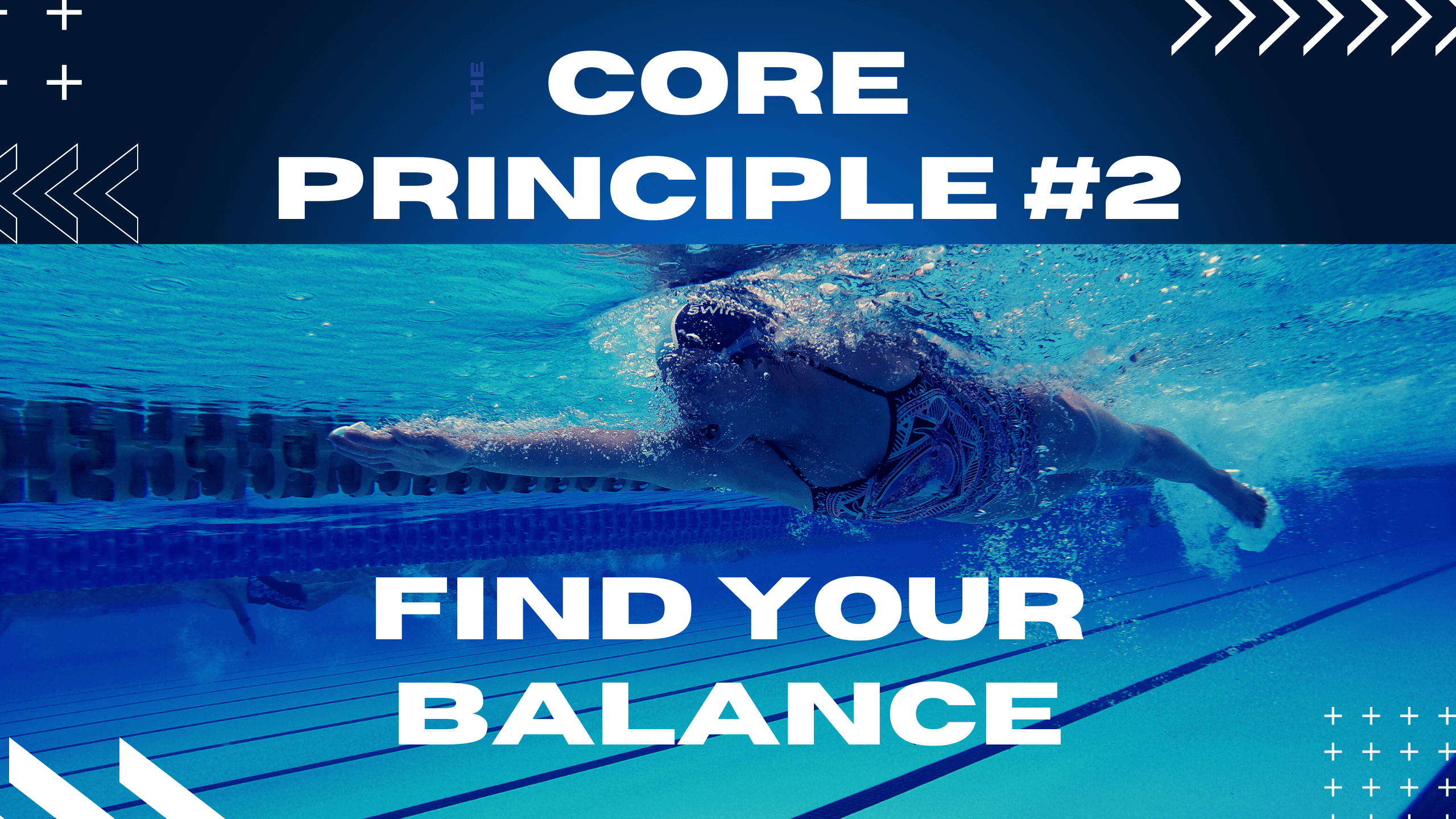
In the next episode, we’re going to look at core principle number two, which is find your balance. It’s all about body position, being able to make sure you’ve got your head, hips and heels at the surface and minimize or reduce drag, which is the most important thing that we’ve got to do in swimming. So tune in for the next episode of the podcast, which will cover core principle number two, find your balance. Hope you enjoyed this episode. See you next week. Thanks for listening to the effortless swimming podcast. If you’d like us to help you become a faster, more efficient swimmer, go to www.effortlesswimming.com.