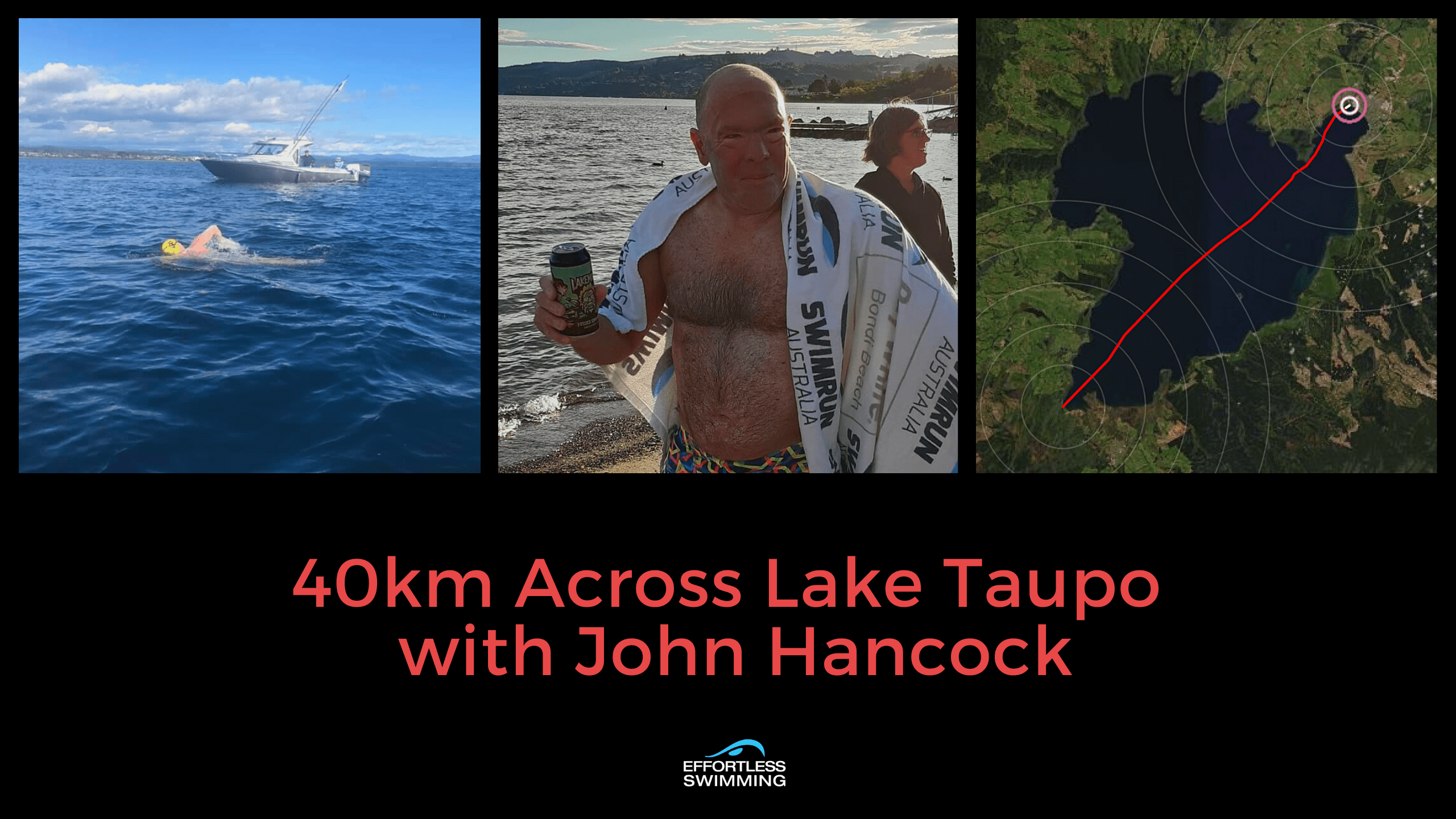








Rebecca Hollingsworth recently swam across the Cook Straight. In this episode, she talks about how her preparation,
training, and experience on that swim.
00:40 It’s Supposed to be 23km
2:23 Training While Waiting For Another Window
5:00 Doing A Tandem Swim
8:42 Not Slowing Down
9:28 Cold Adaptation
11:08 Fuelling
14:35 After The Swim (Mental Toll)
Become An ES Member To Improve Your Swimming
Transcript
Read the full transcript
I think it probably goes to show that like no two cook straight swims are the same. Welcome to the Effortless Swimming podcast to show that helps swimmers and triathletes love the water, become a better swimmer and live a better life. Here’s your host, Brenton Ford.
Welcome to episode 172 of the Effortless Swimming podcast. My guest today is Rebecca Hollingsworth, who’s joined me from New Zealand. And Rebecca has recently just had a successful crossing of the cook straight. So welcome and congratulations. Thank you. Great to be joining you. So this is a it’s a it’s a pretty big swim. It’s it’s I was reading your race or you’re right up on the on the swim. It’s a 23k swim, but took you 40 kilometers of swimming to get across it because of the tides. And can you give me a little bit of a background on on the challenges of the swim? Because you look at that and think 23k is okay, it’s a long distance. But how does it turn into 40k? And what’s that experience experience like?
I think it probably goes to show that like no two cook straight swims are the same. So there was a couple of swims on the Tuesday before we did our swim. And I think they did about 10 kilometers less swimming than I did.
But I think
you just the tides just do what they do. I don’t think we were expecting the tides to be that strong. But as soon as we hopped in, I think we covered about seven kilometers in that first hour and we went directly south. And then we sort of got stuck swimming on the spot for like an hour and a half before we moved north. So definitely not a straight line across that piece of water. Yeah, what do you think when you when you saw that you or you heard that you swam seven k’s in the first hour, were you thinking like this is great? Or like you knew that that was the tides doing doing that thing? Oh, it was it was quite fun. And it was awesome that we were sort of going that quickly. I think you feel it. Yeah, I think you do. Obviously, you don’t know that you’re going that fast. But when when Phil did tell us, and you know, I was like secretly hoping that it was kind of pushing us quite the way across the straight, but it was just going south really.
Yeah, yeah. And and what about the the lead up to the swim? So you were planning to do the swimming around, I think February, and you just didn’t quite get a get a window for it. So then you had to continue your training for for another month or a month and a half. And how did you go mentally just keeping that training going over the time where, you know, you just had to wait for another window? Yeah, so all my training, I sort of peaked around in mid January, like did a lot of mileage over the Christmas period. And we’re doing some really big weeks, then sort of 50 kish. And then sort of tapered for sort of white honey weekend, which in New Zealand sort of start of February, that was when our window was. And we’re all like super excited to do the swim. And it looked like there was going to be a day that we could do it. And then like the the afternoon evening before the forecast has changed and the forecast was for the sea to be getting rough in the
evening. So the swim was off. And I think Phil at the time just said, I just maintain the training, but don’t do anything crazy, like not don’t do big stuff. And so to start with us fine, I think I’ll sort of, you know, keeping it about probably about 30 k weeks. But then I sort of slowly like slackened off a bit. And it sort of ended up being quite an extended taper. But and I was also back working at that time. So, you know, it gets to be a bit of a chore, a little bit going, oh, I’ve got to keep my training going. But you know, not knowing when you’re going to swim.
Yeah, that’s that’s right. Like it’s not, it’s not like you’ve booked an Ironman or booked Rotteness channel or anything where you’ve got this set date. It’s like you’ve just got to keep it keep it ticking over. And especially with like 30 ks, you know, it’s quite a few hours a week in the pool. It’s and when you’re doing that kind of training, it’s more just for for distance than anything, isn’t it? So it’s like, it can be a sort of boring, pretty boring way to to training in many ways, where you just know you’ve got to do the distance.
I try to mix it up a little bit. So, you know, try to the pool stuff’s quite good for getting your speed. But I do like doing a good amount of training in the ocean, especially those big weeks that are getting some fun ocean swans in. But I suppose when I’m working, I’ve got quite a bit of my training happening in the pool. And so, you know, doing more stuff in the pool than in the ocean that can get a bit tedious. Yeah, you’ve got to you’ve got to do it. And I remember reading in your your write up that so you did a tandem swim, which is when someone you swim with someone else, and hopefully going at the same speed, so that you can, you know, you both get across together. And so you’ve got the one sort of support crew. And what was that? What was that sort of process like in terms of training, and wanting to be at the same speed as the the other swimmer, Karina, and and then as you were doing the swim itself.
Yeah, so I’ve I’ve previously done a tandem. So me and another friend did a tandem of Lake Topo. And that went really well. Like we’re most we’re pretty consistent through that swim. And so that gave me quite a lot of confidence to sort of give it a go with Karina. Because we don’t we’re all training together. So we sort of have a good idea of each other’s pace. I do remember though, quite early in the season, we, we did a swimmer fun. And it kind of sort of stuck stuck out for me that Karina swimming quite a bit faster. So I think she had sort of maintained a bigger mileage over over winter. And I was sort of probably a little bit late to the training game this time round. And so I think there’s not too much you can do about that. But I actually just get your training up. And then with those big training weeks, we we did a lot of swimming together. So a lot of our big swims, you know, we try to stick together. And I think that’s that’s
probably the best thing you can do to sort of try to swim consistently is actually do the training together. Yeah, definitely. That’s what I found swimming or training for right next was myself and a friend, Lysandra, we would do our big swims together in the Bay here in Melbourne. And it was just like we swim side by side the whole way. And it takes your mind off things so much more than if you’re doing it by yourself like it was it was easy doing 10, 12, 15 kilometer training swims as we were getting closer to it. Whereas like you just didn’t have to think about it. And then what about during the swim itself? So I know that, you know, halfway across a bit over that Karina started to slow down and she was getting cold and that sort of thing. Before that, was it easy? Was it? Do you feel like it was easier knowing that there was someone next to you swimming or you didn’t really think about it?
To be honest, it was quite different to any of our training swims, because obviously, when you’re swimming in the harbor, you don’t have the swell and the conditions that you’ve got in the cook straight. And so I think near the start of the swim, actually, we were, I think Karina sort of got our head of me a little bit at the start. And then with the swell, it was quite hard swimming next to each other. But I think we managed all right. And Phil could see both of us. I think we’re fine. And then I suppose as we sort of got into a ribbon a little bit, and it probably is as well sort of died down a little bit where we sort of better sort of swimming next to each other. And then like you said, sort of in the in the later part of the swim, she sort of started to drop her pace. And to start with, I just thought, oh yeah, I might just be getting faster or something. But yeah, as we sort of found out, that was a sort of startup
hypothermia, which was not not a good thing.
No, no, it’s how did you how did you go having to slow your pace? Did you start to get colder as a result? Or like what were you thinking mentally as well in terms of, or was it just like no, I’m swimming pretty, pretty quick here? So I think that the last thing that we wanted to do was for me to slow my pace. So I think Phil was quite conscious of that. And so what he got me doing was, so when Karina has slowed down quite a bit, he got me sort of swimming out from the IRB and back. So I was sort of doing this zigzag. I’m not sure for how long, probably at least in an hour, sort of doing this zigzag across Cook Street, while Karina was sort of trying to keep me to the IRB. She wasn’t doing a very good job of it at that point. But yeah. So I think if I slowed down, I would have, I would have got cold. So it’s kind of important when you’re doing a tandem that, you know, you’ve got, it does, you’ve got to think about those things, I suppose. Yeah. And
what about, did you have to do any sort of cold adaptation in your training? Or that was all in the Bay like you were swimming, no wetsuit and it was a similar temperature? Yeah, so I suppose an advantage doing Cook Street when you’re a local is that you’re sort of swimming in very similar water temperature. And both me and Karina swam through the winter, not doing long stuff, kind of just, we do, we do a squad on a Sunday morning at the Freiburg pool, which is sort of next to the beach. And then we’d sort of go out and do a short swim in the, in the harbour, sort of after our squad session. So we’re sort of regularly sort of getting in the sea over winter. And then that sort of makes it quite easy, sort of near the start of the season to start getting your mileage up in the sea and just being comfortable in the water. And Karina is actually better in the cold than me. So this kind of took me a bit by surprise that she got hypothermia.
But I think, you know, she’s written up a bit of a blog. And I think she sort of thinks it might be related to her fueling on that swim. Yeah. And that’s one of the things I can’t remember who I was speaking to about it. It might have been like a nutritionist type of diversity. And she works with a lot of channels and that sort of thing. And one of the things that she said that surprised me was that a lot of the times that when the body temperature drops, it’s a result of yeah, not enough fuel or not the right type of fuel. And so, yeah, I didn’t know that a couple of years ago before, before speaking to her. So it’s, yeah, it’s a big one. And what did you do fuel wise across the straight? How often were you fueling and what were you having? So we had our first feeds of after an hour. And then after that, it was every half an hour. And I feel like I’ve got a relatively good plan for my feeding because based on a couple of
my other big swim. So after sort of swimming, they tow poor. And I also did the scar series in Arizona in 2019. So I feel like I’ve practiced it a little bit. I have like a, I use like SIS, a sports drink. And I feel like that’s that’s sort of the base of my fueling, like most when you’re swimming, most of your fuel needs to come from your drink, I think. And then I think I was having gels roughly every every third feed. Less often than topo, because I think we overdid it in topo. I think me and me and Bri, we’re having gels every second. And it’s like after a while, we’re like, no, please, no more gels.
And then I think I just had a random collection of snacky things that I kind of just left it up to fill to sort of just give me some like snakes, like lollies. I think we had like the peanut butter sandwiches. I did. One thing I didn’t learn is that what works well in a lake doesn’t necessarily work well in the sea.
So like we had some snack balls, like you know, little foosball things. And they were just like too dry and solid out in the strait. Maybe because it wasn’t a hot day. So I hadn’t really softened. And also like in the lake, if you can kind of dunk your sandwiches in the lake and sort of eat them. You can’t really do that in the sea. So I was sort of trying to like, I think when I had my sandwich, I just used my sports drink to wash my sandwich down. And it was kind of like, yeah.
Yeah. Oh, that’s interesting. And so you feel like the, because your mouth would be so dry from the salt water anyway, that it was, that was part of the reason why those snack balls are a bit harder to get down as well. Maybe. Yeah. Yeah. Just the salt dynamics quite different, I think. And I, after this swim, I think after the lake swim, I felt like salty stuff. And after this swim, I just like, I demolished like nearly a container of lollies.
So I went sweet. Yeah, yeah, that’s that’s interesting. And I think you get to end of the swim as well. So I finished after 11 o’clock at night. So I was sort of swimming quite a lot in the dark. And I think Phil sort of made the call that it was probably better to keep me swimming than to stop me too often for feed. So I like barely fed in the last three hours. And so I was also very hungry when I got on the boat. So he’s the owner of lollies.
Okay, I don’t think anyone’s going to judge you for that. You’ve, you deserved at the end of a long swim like that. Jeez. And, and what about afterwards? So how long did it take you to, because I contacted you not too long after this swim, I think, and and you said like, I’d like to do the podcast. I’m just still sort of collecting my thoughts and yeah, just like winding down from the swim. So what was yeah, what happened? What was that like for you? A few days afterwards and a few weeks afterwards? Um, I feel like my so after Topor, I, I saw Topor’s in the middle of New Zealand, sort of 40 K freshwater swim. That was, I think my first big, big swim. And so I feel like the recovery after that swim was probably more about my body. I feel like it’s a lot more like took a more physical toll on me. So this time around, I feel it was probably less of a physical toll. I was actually feeling quite good after a few days. I sort of feeling a bit
recovered. But I think it took a bit of a mental toll. Like you kind of have to like your brain just tries to process everything that happens. And so you just like have to like re relive, I guess you’re the swim over and over again, like, you try to just process all when this happened and this happened and this happened. And also I think because the swim was so event full, like it was so unexpected, I wasn’t expecting to be out there for 12 hours. And what were you expecting? How long were you thinking or planning on? Oh, I think around eight hours. Right, that’s a lot longer. We’ve got a normal, I don’t think there is normal on the cook straight. But if we’ve got one of the friendlier days in the cook straight, I think it would have been more eight hours. So I think just lots happened in that swim. And so I think you, you know, your brain guy just needs to process it. And then you also find yourself like having to catch up on sleep and
and whatnot. But that was probably more the recovery for me. Just getting getting my head around it. Yeah, absolutely. And I mean, John John Hancock, who I had on the previous podcast, he kind of spoke about a similar thing. It’s like, yeah, physically, he was pretty good after his his lake swim. But it’s more the it’s more the mental side of things that you really have to be mindful of. Yeah, looking out for and especially when it is such a like such a big day and longer than what you had planned and
yeah, and sort of things not not going to plan as well as you would like in terms of conditions and all that sort of stuff like it’s, it can certainly be a lot to process. So what how you now a few weeks after the swim, because one of the things that John mentioned that he’d heard coaches and athletes talk about is the like the mental come down after a big, big event like that. And you’ve done quite a few big swims as well. Have you experienced that? Yeah, that sort of downward part of it and where you’re at at the moment with it?
And I think I’m pretty good on that side of things. I I’ve only really been doing
short little swims, but I’m going to go up and do go up to Auckland and do the Rangatoto swim this weekend is a bit of the end of season sort of sort of fun swim. I think it helps that I have other swims sort of in my sort of future. So this wasn’t like the be all end all, although my next swim is planning to be the English Channel. So I don’t actually know if I’ll ever get actually get overseas for that. But hopefully that next year. I think that it’s probably harder after topo because
I think so the topo swim was ended January and I had this idea that I would have chill out for a little bit and then just do some fun swims at the end of season, like sort of go up and do like the marathon swim in Auckland. But then COVID hit and then all of a sudden it’s like you can’t do any swimming. So we had quite a hard lockdown. It was like five weeks of no swimming.
And so I think it sort of went from I’ve done this really big swim to actually I’m not allowed to swim. Yeah, so I think that sort of hit me quite like more of a shock than what COVID might have been otherwise. So yeah, but I feel like I’ve done a few big swims now that I don’t think I have that big come down. But you never know. I’ve still got only three weeks from the swim now. Yeah. Oh, look, I hope you hope you don’t go through it. And it’s I mean one of the positive things about like you got to do the swim is that with Phil, who was the support over there and with all the boats and everything like it’s it’s a swim that’s just booked up for like it was like three years ahead or four years ahead or something like there’s so much demand to cook straight. Now that’s part of the Ocean Seven series that it’s like it’s almost impossible for the Kiwis to jump in and do it. And and that’s I guess one of the benefits of having
no no outside visitors in New Zealand at the moment is there was windows for Kiwis to do the lake swim and to do cook straight and so you managed to to secure it. And was there something that you were prior to COVID that you had thought about or planning?
I I kind of had it as my I’ll do it one day list.
So not that I have this. But you know, it was in the back of my mind that one day I’ll do the straight. I need I need to do the cook straight. So I get the freedom of the fairies. So that’s if you swim the cook straight, you don’t have to pay for the fairies over in South Ireland. Is that really a thing? Yeah, that’s a thing. That’s awesome. I had no idea. Most of the people who get it are international people who have been just amusing it.
Yeah. So I kind of knew that I wanted to do it one day. But you know, logistically, it’s I knew that, you know, Phil’s always busy. And if I did do it, I’d be on a season where I had to be a floater. So it’ll just like prepared to go at any time.
So I wasn’t in a big rush. So when COVID came about, it was probably more opportunistic. I know I had to delay. I was going to go to the do my English Channel in 2021, but I pushed that out a year. So by pushing that out, I decided to I’ve got to have another goal there. So cook straight was quite a good goal. And then sort of Karina was so Karina was on the support crew for the TOEFL swim that I did. And so she was kind of she got kind of motivated by being on a support crew. And I think she was, oh, yeah, I’m quite keen to cook straight it too. So we’re having those conversations. Oh, I wonder if Phil will take a tandem and cook straight. So we sort of tested it out. And yeah, he took us. But I’m not sure if you’ll take another tandem. So was that the first tandem across the the strike? I think there’s been others. But I think he’s just generally a bit reluctant because I think what our swim shows is even if you have quite a similar pace,
swimmers, you know, stuff can happen. Yeah. And then you’ve got Phil having to look out for two swimmers, not one. And I think it just sort of it’s a bit more of a handful for him. Yeah, yeah. And it’s like a big it’s a big responsibility with what with what can happen in the in the cold sea and and when people push themselves to the extremes of what they’re physically capable as well. So he’s he’s such a good person to have in your corner doing that sort of stuff. So there’s no one who no one else would trust more than Phil to look out for that stuff. And he says it how it is as well, which is which is great. And reading your write up to that he the way that you think he got your he motivated you a bit to maybe ramp up your training or ramp up your speed was he said something about being able to swim four kilometres an hour for for the cooks. Right. Can talk to me about like that off-handed comment that was probably strategic
on his part. Oh, yes. So we met up before Christmas. And I hear sort of, oh, yeah, this is how the swim’s going to go. You know, you’ve got to swim four K an hour and I was thinking to myself, oh, no, I’m not a four K an hour swim. But I think he’s got this a bit wrong. But it’s sort of, you know, laid out a good bit of a challenge for our training to go, OK, what is the speed? We’ve got to try it. And so I think I did. I did actually increase my pace, I think, and all that doing that that training and sort of, yeah, it’s good sort of motivator, I suppose. Yeah, yeah, that’s it. Oh, thanks. Thanks so much for jumping on the podcast and sharing sharing this. And I think we’ve probably had, I’m thinking in terms of guests, like maybe majority New Zealanders like yourself had a lot of New Zealand guests talking about these sorts of swims and it’s it’s just such a good swimming community over there. And and the fact that you’re
able to successfully swim across the Cook Strait is no small achievement because it’s such a like a twenty three K, but the there’s so much water moving through there. You get all the swells going through. It’s a it’s a pretty tumultuous piece of piece of water. And what I would like, what I love sort of seeing or looking at is when you look on a map and you can point I’ve swum from here to here like it’s a it’s a pretty cool achievement. And one of the ones that I did, which is a short swim, it’s not not necessarily a hard one, but there’s the Port Phillip Bay. There’s the entrance there to the Bay in Melbourne. And one of the swims that a friend of mine grant see the runs is called the Rip Swim. So it’s like a I think it’s maybe three K across across the heads there. And it’s like it’s one of the most dangerous like shipping stretches in the world in terms of ships. I don’t know having going off course and that sort of thing.
So I look at that on the map and go, that’s awesome. I swum from there to there across these two heads. But it pals in comparison to looking at the two islands in New Zealand going, I swum from there to there. So yeah, congratulations. It’s quite funny because with our route, we we ended up going as far north as these little islands called the brothers. And so most people don’t know about the brothers unless they know about the Cook Strait. And one of my work colleagues is often out in the Cook Strait. And when she found out that we went to the brothers, she sort of went home told her husband, they went to the brothers because apparently they’re quite notorious. Like she doesn’t even go there in a boat. Really? Oh my God. Now I can look on the map and go all the way up to those islands. Yeah, two, yeah, two for one. That’s I did see that island on the on the course map that you had. I wasn’t sure what they are or what they were.
But and you got there in what probably pretty short amount of time by the look of it with with the tide going there. But I mean, you probably look out to see and see the brothers and go, man, that’s a that’s a long way already to swim. And then you only have another 30 something case to go. That was that was probably three quarters in the brothers. So that was Oh, was it OK? Yeah, so, yes. So I was looking at the the other direction. Yeah, it was the northernmost part. So we kind of went south first and then the northernmost part of our route was the brothers and then it kind of got dark after that. Yeah, gotcha. I went to South. Karina hopped out then. Well, thanks again for being on the podcast and yeah, good luck for whatever the next adventure is for you. And thank you. Yeah, I’m sure people listen to this. There are thinking you’re probably crazy, but there are a lot of people who probably want to do something just as crazy.
So yeah, thanks again. And well done. So thank you. Lovely to talk to you. Thanks for listening to the Effortless Swimming Podcast. If you’d like us to help you become a faster, more efficient swimmer, go to www.effortlesswimming.com.